

This reference architecture provides a conceptual framework for deploying and operating customer-managed PostgreSQL databases on Google Distributed Cloud (GDC) air-gapped. This solution enables organizations to maintain critical database workloads by leveraging a highly available (HA), multi-zone cluster deployed on virtual machines.
The architecture focuses on a resilient 3-node configuration that ensures database availability even in the event of a single zone or infrastructure failure. It covers the full lifecycle from automated provisioning and networking to production-grade operations like high availability, backup, restore, and observability.
Features and capabilities
The solution provides several core functional components for database management:
- Automated high availability: Use Patroni and etcd to provide automatic leader election and failover, ensuring the database remains operational without manual intervention.
- Multi-zone resiliency: Distribute database nodes across three distinct availability zones to protect against localized hardware or infrastructure outages.
- Standardized automation: Provision the entire stack using Ansible-based playbooks with Autobase to ensure repeatable and consistent deployments.
- Connection pooling: Integrated PgBouncer service to manage high connection counts and stabilize resource consumption on the database nodes.
- Global load balancing: Use the platform-managed Global L4 Load Balancer to provide a single, stable virtual IP (VIP) that is accessible across all zones.
- Air-gapped readiness: Specialized workflows for packaging all required operating system dependencies and binaries for deployment in disconnected environments.
- Data protection: Leverage standard tools such as
pg_dumpandpg_basebackupalongside GDC storage snapshots to maintain a robust backup and recovery strategy.
Architecture
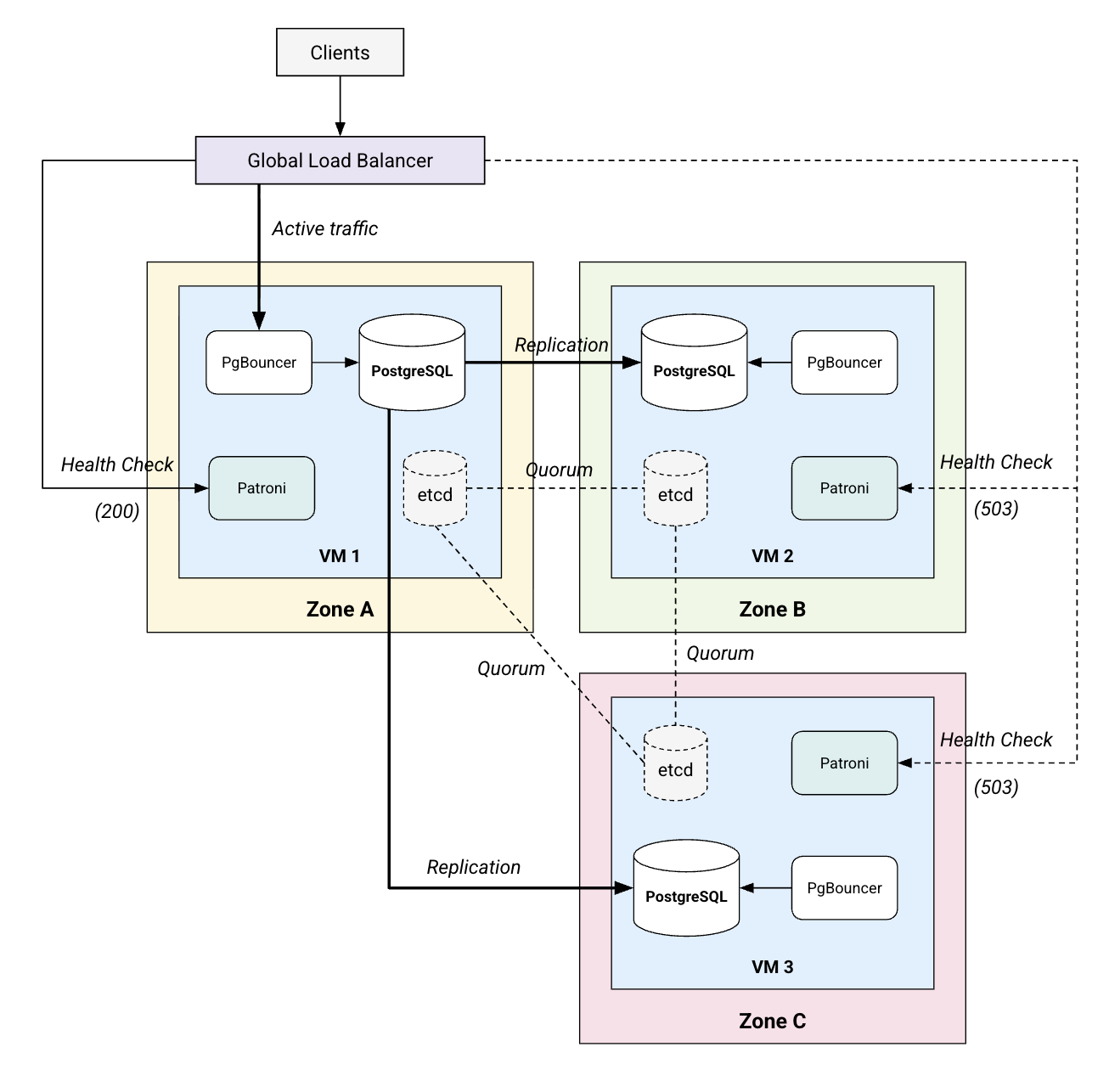
The architecture consists of a three VM environment distributed across three availability zones that run a colocated stack of services.
Architectural principles
- Majority-based consensus: Uses a quorum-based model where a majority of nodes (2 out of 3) must agree on the cluster state, preventing "split-brain" scenarios and ensuring data integrity.
- Separation of concerns: Each VM runs a colocated but distinct stack of services (database, HA manager, consensus, and pooler) to provide a self-contained and resilient node.
- Database-aware failover: Prioritizes database health metrics with Patroni's REST API to coordinate traffic redirection through the platform load balancer.
- Infrastructure as code: Relies on automated playbooks for all configuration tasks, reducing the risk of human error during deployment and scaling.
Concepts and technologies
This section details the functional components, their responsibilities, and how they communicate within the system.
Infrastructure and platform
- Virtual Machines (VMs): Dedicated compute instances distributed across zones to host the database stack.
- Global L4 Load Balancer: A platform-managed service providing a stable virtual IP (VIP) that routes traffic to the current cluster leader.
- Persistent storage: High-performance SSD-backed storage is required to meet the strict latency requirements for the consensus layer's write-ahead logs.
Services and logic
- PostgreSQL 17: The core relational database engine responsible for data persistence and query execution.
- Patroni: The high availability manager that monitors the local PostgreSQL process and coordinates leader elections using etcd.
- etcd: The distributed configuration store that provides the consensus layer and holds the authoritative state of the cluster.
- PgBouncer: A lightweight connection pooler that sits in front of PostgreSQL to handle incoming application connections efficiently.
Data flow and interfaces
- PgBouncer (Port 6432): The primary entry point for application database traffic.
- Patroni API (Port 8008): An HTTPS REST interface used by the load balancer to
perform health checks and identify the current leader using the
/primaryendpoint. - etcd (Port 2379): The communication channel for the consensus cluster to maintain state and perform elections.
Considerations
- Scalability and performance:
- Database nodes should be sized based on workload, with a minimum of 2 vCPUs and 8 GiB RAM. Production workloads typically start at 8 vCPUs and 32 GiB.
- Performance relies on low-latency storage; SSDs are required to ensure etcd can process data syncs in under 10ms.
- Synchronous replication: The overhead of synchronous replication depends directly on inter-zone network latency. To ensure optimal performance for zero-data-loss configurations, low inter-zone latency is required.
- Resource management and licensing:
- This solution relies on free, open-source database components.
- Autobase is used as the reference automation tool to streamline the installation and configuration of the HA stack. However, the architecture is not exclusively tied to Autobase, and the underlying open-source components can be managed using custom pipelines.
- For organizations requiring formal support for the automation package, third-party paid support is available.
- Connection pooling with PgBouncer is essential to prevent CPU and memory exhaustion caused by high user connection counts.
- Availability and reliability:
- High availability is achieved through a 3-node quorum. The failure of any single node or zone does not interrupt the service.
- Cluster stability: Maintaining a reliable quorum requires low network latency between nodes. Average round-trip times (RTT) should ideally be under 10ms to prevent election timeouts and cluster instability.
- Operational management:
- Routine tasks such as minor version patching and major upgrades remain the responsibility of the customer's operations team.
- Outputs from the VMs'
stdoutare automatically ingested into the GDC air-gapped monitoring platform. A guide will be published in the future on how to integrate more detailed monitoring for the individual components. - A robust backup strategy should be implemented using database-native tools and platform snapshots. Detailed guides for these procedures will be published separately.
Design decision
The architectural choices for this solution provide a resilient path for multi-zone deployments.
Virtual machines over Kubernetes
A VM-based approach was selected to provide multi-zone high availability. GDC doesn't support Kubernetes clusters that span multiple physical zones. Therefore, deploying dedicated VMs into separate zones is necessary to achieve a robust cross-zone architecture. This configuration can survive the total failure of a single infrastructure zone.
Platform-native global load balancing
The architecture leverages the GDC Global L4 Load Balancer instead of software-based proxies on the VMs. This approach provides several advantages:
- Global reach: Provides a stable virtual IP that is accessible across all zones.
- Platform managed: The VIP is managed independently by the platform's control plane.
- Simplified failover: Failover is managed through standard health-check probes rather than complex local software configurations.
- High availability: Removing reliance on local proxies ensures that the entry point for database traffic remains resilient.
Assumptions and limitations
Assumptions
- The environment has a local registry or mechanism to import packaged OS dependencies and binaries.
- Key-based SSH access is available to all target VMs for Ansible-based automation.
- The project has sufficient quota for multi-zone VM and Load Balancer provisioning.
Limitations
- Manual maintenance: Operating system patching and PostgreSQL version upgrades are manual tasks and are not automated by the solution.
- Storage sensitivity: The consensus layer (etcd) is highly sensitive to disk latency. Sustained high storage contention can impact the stability of the consensus layer.
- Network stability: The high availability manager relies on consistent, low-latency network connectivity between zones. Delays or network jitter can influence the timing of cluster coordination and role transitions.
Additional materials
- Reference automation code repository: Autobase Source Code on GitHub
- PostgreSQL database reference implementation