

This reference architecture provides a conceptual framework for deploying and operating highly available, customer-managed MySQL 8.4 databases on Google Distributed Cloud (GDC) air-gapped. It enables enterprise and early access customers to reliably maintain critical database workloads using a robust, multi-zone virtual machine (VM) setup.
Because GDC air-gapped lacks support for cross-zone Kubernetes stretch clusters, this architecture relies strictly on dedicated VMs deployed across three availability domains to ensure continuous operations and withstand a full zone failure without data loss.
Features and capabilities
- Multi-zone resiliency: A highly resilient 3-node configuration deployed across three distinct availability zones to protect against single infrastructure zone failures.
- Automated high availability and consensus: Uses Group Replication for Paxos-based consensus clustering, providing automatic failure detection, node agreement, and global data synchronization without split-brain scenarios.
- Intelligent traffic routing: Co-located MySQL Router instances manage connection routing. The router directs write operations (for example, port 6446) strictly to an active primary node and load-balances read operations (for example, port 6447) across synced replicas.
- Global load balancing: Integrates with the built-in GDC Global L4 Load Balancer to provide a single, stable Virtual IP (VIP) for client applications, abstracting the underlying node topology.
Architectural principles
- Quorum-based consensus: Prioritizes strict data consistency. Group Replication enforces a Paxos-based model requiring majority agreement, eliminating the risk of data loss or split-brain during network partitions.
- Separation of concerns: Decouples the database engine and consensus layer (Group Replication) from the client traffic routing layer (MySQL Router), while simplifying cluster lifecycle management using MySQL Shell.
- Infrastructure optimization: Specifically designed for air-gapped environments, utilizing robust VMs to bypass current Kubernetes networking limitations.
Architecture
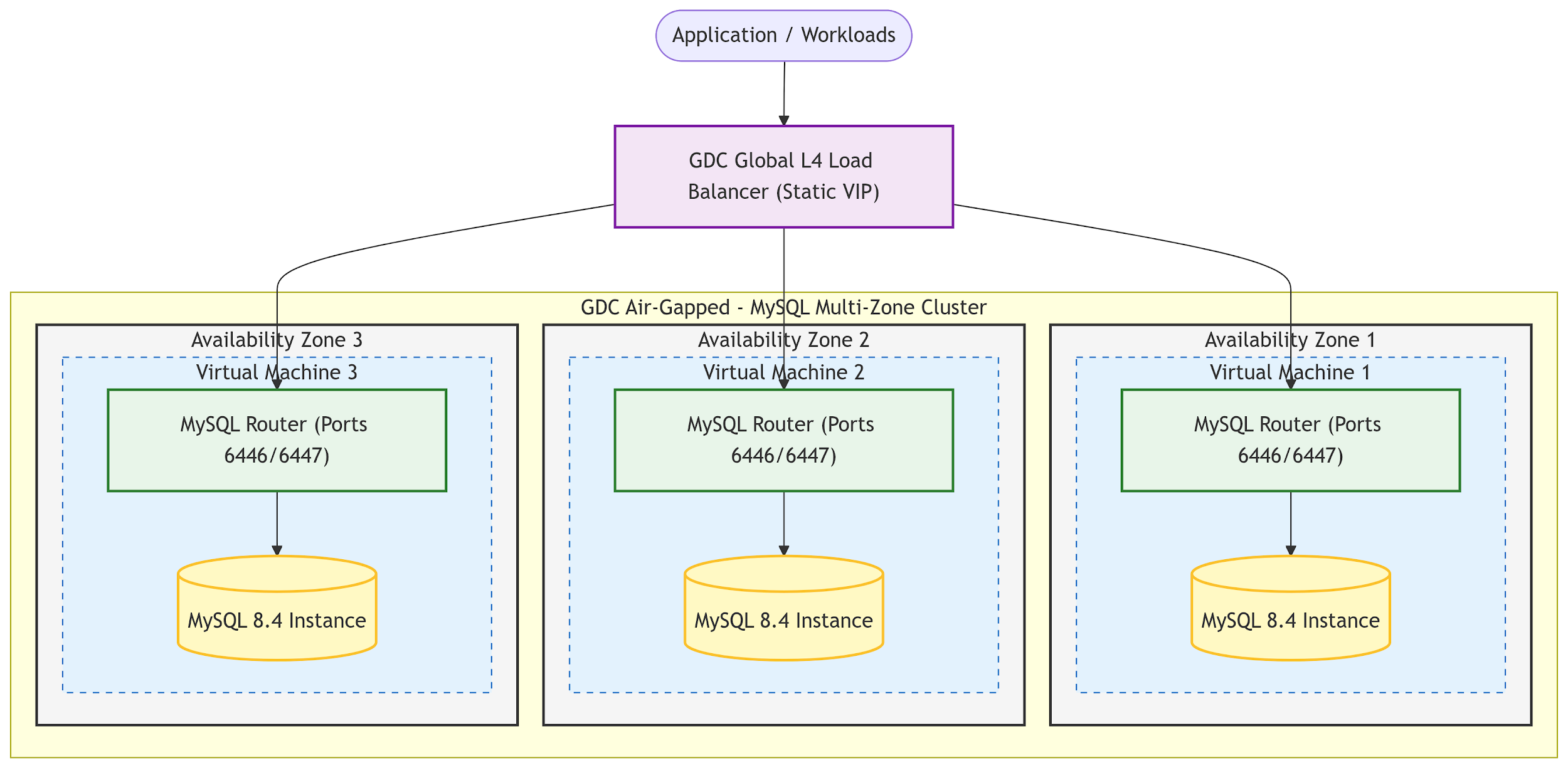
Concepts and technologies
This section details the functional components and their specific responsibilities within the multi-zone architecture.
Infrastructure and platform
- Virtual Machines (VMs): Three dedicated Compute instances, each deployed into a separate availability zone to form the failure domain boundaries.
- GDC Global L4 Load Balancer: A platform-managed networking construct that exposes a stable internal VIP, automatically evaluating MySQL Router health checks to redirect inbound traffic.
Services and logic
- MySQL 8.4: The core relational database engine.
- Group Replication / InnoDB Cluster: The built-in clustering framework responsible for multi-master replication and verifying node quorum using Paxos.
- MySQL Shell: The unified command-line interface used specifically to configure, provision, and administer the InnoDB cluster instances.
- MySQL Router: Acts as the traffic router on each VM. Configured dynamically to listen to the cluster metadata and forward traffic: active/backup for writes and round-robin for reads.
Data flow and interfaces
- Applications send database requests to the GDC Global L4 Load Balancer VIP.
- The Load Balancer proxies the connection to a healthy MySQL Router instance on one of the VMs.
- Based on the requested port, MySQL Router dynamically forwards traffic: Port 6446 strictly targets the active node for writes, while Port 6447 cycles reads across the cluster.
Considerations
- Performance vs. consistency trade-offs: Because Group Replication enforces consensus, transactions require acknowledgment from cluster peers. Performance directly correlates to the inter-zone network latency within the GDC environment.
- Resource management: Deploying MySQL Router directly on the database VMs optimizes hardware utilization but requires careful resource tuning to prevent connection pooling overhead from starving the core MySQL processes.
Design decision
- Virtual machines over Kubernetes: GDC air-gapped does not support Kubernetes clusters that span multiple physical zones. A VM-based approach was strictly chosen because deploying dedicated VMs across separate zones is the only viable method to achieve true multi-zone high availability and survive a total zone failure.
- InnoDB Cluster vs. Orchestrator and ProxySQL: A traditional primary/secondary architecture paired with ProxySQL and Orchestrator was evaluated as a feasible alternative. However, the built-in InnoDB Cluster (Group Replication + MySQL Router + MySQL Shell) was selected instead because it eliminates reliance on third-party routing overlays and drastically simplifies the operational complexity around failovers by keeping the consensus directly within MySQL.
- Platform built-in global load balancing: Leveraging the built-in GDC Global L4 Load Balancer ensures that the VIP is controlled by the GDC control plane, keeping the entry point resilient and simplifying cross-zone traffic delivery.
Assumptions and limitations
Assumptions
- Availability of infrastructure: Customers have sufficient project quota to provision dedicated, properly sized VMs and Global Load Balancers distributed evenly across three availability zones.
- Secure networking: Key-based access and proper ProjectNetworkPolicies (PNPs) are established to permit intra-cluster Group Replication synchronization and MySQL Router traffic.
Limitations
- Kubernetes unsupported: Customers strictly seeking containerized/Kubernetes-based solutions cannot achieve multi-zone HA until stretch clusters are fully supported by the platform.
- Manual upgrades required: Unlike managed services, this solution places the responsibility of routine OS-level patching and database minor version upgrades entirely on the customer.
- Network latency sensitivity: Replication demands a high-quality, stable network. Network jitter or latency spikes between the air-gapped zones will proportionally delay write operations across the MySQL cluster.
Additional materials
- Solution Reference Implementation (SRI): Solution Reference Implementation for Highly-Available, Multi-Zone MySQL 8 in GDC air-gapped