

Graph Query Language (GQL) supports all GoogleSQL DDL statements, including the following GQL-specific DDL statements:
Statement list
| Name | Summary |
|---|---|
CREATE PROPERTY GRAPH statement
|
Creates a property graph. |
DROP PROPERTY GRAPH statement
|
Deletes a property graph. |
CREATE PROPERTY GRAPH statement
Property graph definition
CREATE
  [ OR REPLACE ]
  PROPERTY GRAPH
  [ IF NOT EXISTS ]
  property_graph_name
  property_graph_content;

property_graph_content:
  node_tables
  [ edge_tables ]

node_tables:
  NODE TABLES element_list

edge_tables:
  EDGE TABLES element_list

element_list:
  (element[, ...])
Description
Creates a property graph.
Definitions
OR REPLACE: Replaces any property graph with the same name if it exists. If the property graph doesn't exist, creates the property graph. Can't appear withIF NOT EXISTS.IF NOT EXISTS: If any property graph exists with the same name, theCREATEstatement has no effect. Can't appear withOR REPLACE.property_graph_name: The name of the property graph. This name can be a path expression. This name must not conflict with the name of an existing table, view, or property graph.property_graph_content: Add the definitions for the nodes and edges in the property graph.node_tables: A collection of node definitions. A node definition defines a new type of node in the graph.The following example represents three node definitions:
Account,Customer, andGeoLocation.NODE TABLES ( Account, Customer LABEL Client PROPERTIES (cid, name), Location AS GeoLocation DEFAULT LABEL PROPERTIES ALL COLUMNS )edge_tables: A collection of edge definitions. An edge definition defines a new type of edge in the graph. An edge is directed and connects a source and a destination node.The following example represents two edge definitions:
OwnandTransfer.EDGE TABLES ( Own SOURCE KEY (cid) REFERENCES Customer (cid) DESTINATION KEY (aid) REFERENCES Account NO PROPERTIES, Transfer SOURCE KEY (from_id) REFERENCES Account (aid) DESTINATION KEY (to_id) REFERENCES Account (aid) LABEL Transfer NO PROPERTIES )element_list: A list of element (node or edge) definitions.element: Refer to Element definition for details.
Element definition
element:
  element_name
  [ AS element_alias ]
  element_keys
  [ { label_and_properties_list | element_properties } ]

element_keys:
  { node_element_key | edge_element_keys }

node_element_key:
  [ element_key ]

edge_element_keys:
  [ element_key ]
  source_key
  destination_key

element_key:
  KEY column_name_list

source_key:
  SOURCE KEY edge_column_name_list
  REFERENCES element_alias_reference [ node_column_name_list ]

destination_key:
  DESTINATION KEY edge_column_name_list
  REFERENCES element_alias_reference [ node_column_name_list ]

edge_column_name_list:
  column_name_list

node_column_name_list:
  column_name_list

column_name_list:
  (column_name[, ...])
Description
Adds an element definition to the property graph. For example:
Customer
  LABEL Client
    PROPERTIES (cid, name)
In a graph, labels and properties are uniquely identified by their names. Labels and properties with the same name can appear in multiple node or edge definitions. However, labels and properties with the same name must follow these rules:
- Properties with the same name must have the same value type.
- Labels with the same name must expose the same set of properties.
Definitions
element_name: The name of the input table or view from which elements are created. The following types of inputs are supported:- Standard tables
- External tables
- Managed BigLake Iceberg tables
- Iceberg REST catalog tables
- Views, including authorized views
- Non-incremental materialized views
You can't use incremental materialized views tables.
element_alias: An optional alias. You must use an alias if you use an input table for more than one element definition.element_keys: The key for a graph element. This uniquely identifies a graph element.By default, the element key is the primary key of the input table.
Element keys can be explicitly defined with the
KEYclause.
node_element_key: The element key for a node.KEY (item1_column, item2_column)edge_element_keys: The element key, source key, and destination key for an edge.KEY (item1_column, item2_column) SOURCE KEY (item1_column) REFERENCES item_node (item_node_column) DESTINATION KEY (item2_column) REFERENCES item_node (item_node_column)element_key: An optional key that identifies the node or edge element. Ifelement_keyisn't provided, then the primary key of the table is used.KEY (item1_column, item2_column)source_key: The key for the source node of the edge.SOURCE KEY (item1_column) REFERENCES item_node (item_node_column)destination_key: The key for the destination node of the edge.DESTINATION KEY (item2_column) REFERENCES item_node (item_node_column)column_name_list: One or more columns to assign to a key.In
column_name_list, column names must be unique.Reference column name lists:
node_column_name_list: One or more columns referenced from the node tables.edge_column_name_list: One or more columns referenced from the edge tables.
Referenced columns must exist in the corresponding node or edge table.
If
node_column_name_listdoesn't exist insource_keyordestination_key, then theelement_keysof the referenced node are used. In this case, the column order in theelement_keysmust match the column order in theedge_column_name_list.element_alias_reference: The alias of another element to reference.label_and_properties_list: The list of labels and properties to add to an element. For more information, see Label and properties list definition.
Label and properties list definition
label_and_properties_list:
  label_and_properties[...]

label_and_properties:
  element_label
  [ element_properties ]

element_label:
  {
    LABEL label_name |
    DEFAULT LABEL [ options_clause ]
  }

options_clause:
  OPTIONS (
    [ description = description_string ]
    [, synonyms = synonym_array ]
    [, extensions = extension_array ]
  )
Description
Adds a list of labels and properties to an element.
Definitions
label_and_properties: The label to add to the element and the properties exposed by that label. For example:LABEL Tourist PROPERTIES (home_city, home_country)When
label_and_propertiesisn't specified, the following is applied implicitly:DEFAULT LABEL PROPERTIES ARE ALL COLUMNSA property must be unique in
label_and_properties.element_label: Add a custom label or use the default label for the element.label_namemust be unique inelement.If you use
DEFAULT LABEL,label_nameis the same aselement_table_alias.element_properties: The properties associated with a label. A property can't be used more than once for a specific label. For more information, see Element properties definition.description_string: A string literal that describes the label to provide context and improve discoverability for natural language querying interfaces.synonym_array: An array of string literals that provides alternative names for the label to improve accuracy for natural language querying interfaces.extension_array: An array of string pairs (ARRAY<STRUCT<STRING, STRING>>) that represents additional metadata. You can use extensions to provide custom metadata, units, or formatting rules, such as[('currency', 'USD')]. This option provides context and improves discoverability for natural language querying interfaces.
Element properties definition
element_properties:
  {
    NO PROPERTIES |
    properties_are |
    derived_property_list
  }

properties_are:
  PROPERTIES [ ARE ] ALL COLUMNS [ EXCEPT column_name_list ]

column_name_list:
  (column_name[, ...])

derived_property_list:
  PROPERTIES (derived_property[, ...])

derived_property:
  { value_expression | measure_expression } [ AS property_name ] [ options_clause ]

options_clause:
  OPTIONS (
    [ description = description_string ]
    [, synonyms = synonym_array ]
    [, extensions = extension_array ]
  )
Description
Adds properties associated with a label.
Definitions
NO PROPERTIES: The element doesn't have properties.properties_are: Define which columns to include as element properties.If you don't include this definition, all columns are included by default, and the following definition is applied implicitly:
PROPERTIES ARE ALL COLUMNSIn the following examples, all columns in a table are included as element properties:
PROPERTIES ARE ALL COLUMNSPROPERTIES ALL COLUMNSIn the following example, all columns in a table except for
home_cityandhome_countryare included as element properties:PROPERTIES ARE ALL COLUMNS EXCEPT (home_city, home_country)column_name_list: A list of columns to exclude as element properties.Column names in the
EXCEPT column_name_listmust be unique.derived_property_list: A list of element property definitions.derived_property: An expression that defines a property and can optionally reference the input table columns.In the following example, the
idandnamecolumns are included as properties. Additionally, the result of thesalary + bonusexpression are included as theincomeproperty:PROPERTIES (id, name, salary + bonus AS income)A derived property includes:
value_expression: An expression that can be represented by simple constructs such as column references and functions. Subqueries are excluded.measure_expression: An expression wrapped in theMEASURE()keyword that defines an aggregate calculation or metric. A measure locks its aggregation to theKEYof the node or edge table on which the measure is defined to ensure that aggregations are performed at the correct level without overcounting. For example, ifamountis a property on theAccountnode, then you can define another property asMEASURE(SUM(amount)) AS total_account_amount. For more information about supported measure expression, read about the measure type.You can't use GQL to access a property that you defined using a measure. You can use the
GRAPH_EXPANDTVF to transform your graph into a relational table that lets you access the measure by calling it with theAGGfunction. For limitations on the types of graphs that you can use withGRAPH_EXPAND, read the input limitations. For more information, see Work with measures.AS property_name: Alias to assign to the value expression. This is optional unlessvalue_expressionis a function or the property is defined by a measure.
If
derived_propertyhas any column reference invalue_expression, that column reference must refer to a column of the underlying table.If
derived_propertydoesn't defineproperty_name,value_expressionmust be a column reference and the implicitproperty_nameis the column name.description_string: A string literal that describes the property to provide context and improve discoverability for natural language querying interfaces.synonym_array: An array of string literals that provides alternative names for the property to improve accuracy for natural language querying interfaces.extension_array: An array of string pairs (ARRAY<STRUCT<STRING, STRING>>) that represents additional metadata. You can use extensions to provide custom metadata, units, or formatting rules, such as[('currency', 'USD')]. This option provides context and improves discoverability for natural language querying interfaces.
FinGraph example
To create a property graph, you must first create tables that describe the
nodes and edges. Run the following statements to create and populate a dataset
called graph_db with tables that describe people, financial accounts that
they own, and transfers between accounts:
CREATE SCHEMA IF NOT EXISTS graph_db;

CREATE OR REPLACE TABLE graph_db.Person (
  id               INT64,
  name             STRING,
  birthday         TIMESTAMP,
  country          STRING,
  city             STRING,
  PRIMARY KEY (id) NOT ENFORCED
);

CREATE OR REPLACE TABLE graph_db.Account (
  id               INT64,
  create_time      TIMESTAMP,
  is_blocked       BOOL,
  nick_name        STRING,
  PRIMARY KEY (id) NOT ENFORCED
);

CREATE OR REPLACE TABLE graph_db.PersonOwnAccount (
  id               INT64 NOT NULL,
  account_id       INT64 NOT NULL,
  create_time      TIMESTAMP,
  PRIMARY KEY (id, account_id) NOT ENFORCED,
  FOREIGN KEY (id) REFERENCES graph_db.Person(id) NOT ENFORCED,
  FOREIGN KEY (account_id) REFERENCES graph_db.Account(id) NOT ENFORCED
);

CREATE OR REPLACE TABLE graph_db.AccountTransferAccount (
  id               INT64 NOT NULL,
  to_id            INT64 NOT NULL,
  amount           FLOAT64,
  create_time      TIMESTAMP NOT NULL,
  order_number     STRING,
  PRIMARY KEY (id, to_id, create_time) NOT ENFORCED,
  FOREIGN KEY (id) REFERENCES graph_db.Account(id) NOT ENFORCED,
  FOREIGN KEY (to_id) REFERENCES graph_db.Account(id) NOT ENFORCED
);
Next, run the following statements to insert data into each of the tables that you created:
INSERT INTO graph_db.Account
  (id, create_time, is_blocked, nick_name)
VALUES
  (7,"2020-01-10 06:22:20.222",false,"Vacation Fund"),
  (16,"2020-01-27 17:55:09.206",true,"Vacation Fund"),
  (20,"2020-02-18 05:44:20.655",false,"Rainy Day Fund");

INSERT INTO graph_db.Person
  (id, name, birthday, country, city)
VALUES
  (1,"Alex","1991-12-21 00:00:00","Australia","Adelaide"),
  (2,"Dana","1980-10-31 00:00:00","Czech_Republic","Moravia"),
  (3,"Lee","1986-12-07 00:00:00","India","Kollam");

INSERT INTO graph_db.AccountTransferAccount
  (id, to_id, amount, create_time, order_number)
VALUES
  (7,16,300,"2020-08-29 15:28:58.647","304330008004315"),
  (7,16,100,"2020-10-04 16:55:05.342","304120005529714"),
  (16,20,300,"2020-09-25 02:36:14.926","103650009791820"),
  (20,7,500,"2020-10-04 16:55:05.342","304120005529714"),
  (20,16,200,"2020-10-17 03:59:40.247","302290001255747");

INSERT INTO graph_db.PersonOwnAccount
  (id, account_id, create_time)
VALUES
  (1,7,"2020-01-10 06:22:20.222"),
  (2,20,"2020-01-27 17:55:09.206"),
  (3,16,"2020-02-18 05:44:20.655");
The following property graph, FinGraph, contains two node
definitions (Account and Person) and two edge definitions
(PersonOwnAccount and AccountTransferAccount).
CREATE OR REPLACE PROPERTY GRAPH graph_db.FinGraph
  NODE TABLES (
    graph_db.Account,
    graph_db.Person
  )
  EDGE TABLES (
    graph_db.PersonOwnAccount
      SOURCE KEY (id) REFERENCES Person (id)
      DESTINATION KEY (account_id) REFERENCES Account (id)
      LABEL Owns,
    graph_db.AccountTransferAccount
      SOURCE KEY (id) REFERENCES Account (id)
      DESTINATION KEY (to_id) REFERENCES Account (id)
      LABEL Transfers
  );
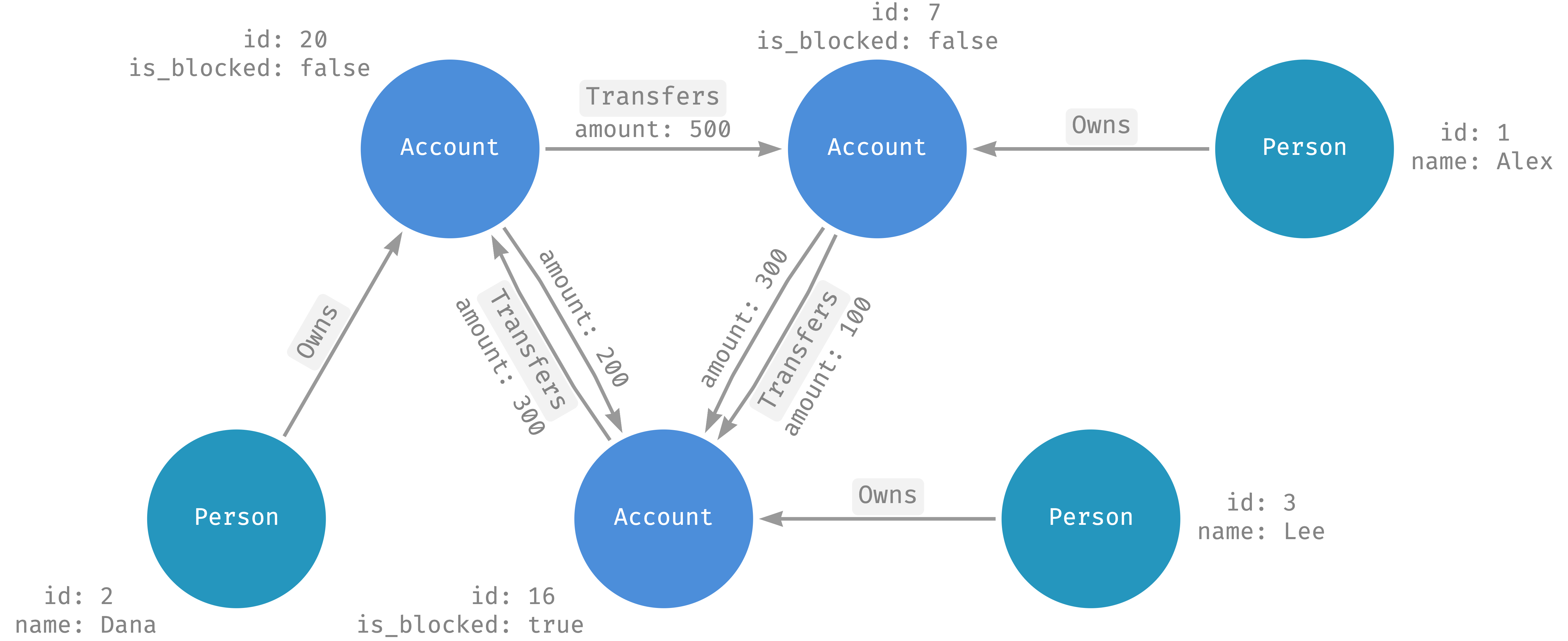
Once the property graph is created, you can use it in GQL queries. For
example, the following query matches all nodes labeled Person and then returns
the name values in the results.
GRAPH graph_db.FinGraph
MATCH (p:Person)
RETURN p.name

/*---------+
 | name    |
 +---------+
 | Alex    |
 | Dana    |
 | Lee     |
 +---------*/
DROP PROPERTY GRAPH statement
DROP PROPERTY GRAPH [ IF EXISTS ] property_graph_name;
Description
Deletes a property graph.
Definitions
IF EXISTS: If a property graph of the specified name doesn't exist, then the DROP statement has no effect and no error is generated.property_graph_name: The name of the property graph to drop.
Example
DROP PROPERTY GRAPH graph_db.FinGraph;