

Create and query a graph
This document shows you how to use BigQuery Graph to create a graph with financial information and run graph queries using the Graph Query Language (GQL).
Required roles
To get the permissions that
you need to work with graphs,
ask your administrator to grant you the
BigQuery Data Editor (roles/bigquery.dataEditor) IAM role on the dataset in which you create the node tables, edge tables, and graph.
For more information about granting roles, see Manage access to projects, folders, and organizations.
This predefined role contains the permissions required to work with graphs. To see the exact permissions that are required, expand the Required permissions section:
Required permissions
The following permissions are required to work with graphs:
-
Create a graph:
bigquery.propertyGraphs.create -
List graphs and their metadata:
bigquery.propertyGraphs.list -
Get the metadata and definition of a graph:
bigquery.propertyGraphs.get -
Update the metadata and definition of a graph:
bigquery.propertyGraphs.update -
Delete a graph:
bigquery.propertyGraphs.delete
You might also be able to get these permissions with custom roles or other predefined roles.
Create node and edge tables
Graphs are built from existing BigQuery tables and stored in
datasets.
To store the tables and graph that you create in the following examples,
create a dataset.
The following query creates a dataset called graph_db:
CREATE SCHEMA IF NOT EXISTS graph_db;
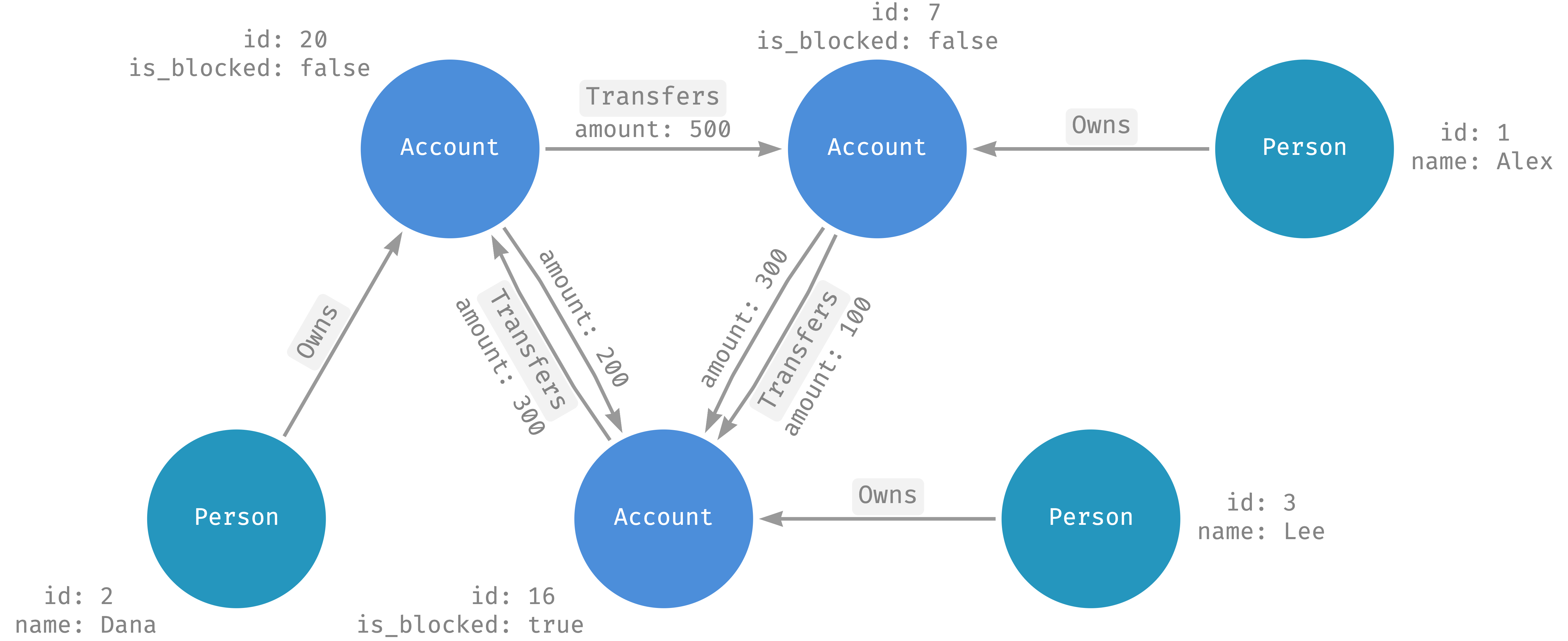
The following tables contain information about people and accounts, and the relationships between each of these entities:
Person: information about people.Account: information about bank accounts.PersonOwnAccount: information about who owns which accounts.AccountTransferAccount: information about transfers between accounts.
To create these tables, run the following
CREATE TABLE statements:
CREATE OR REPLACE TABLE graph_db.Person (
  id               INT64,
  name             STRING,
  birthday         TIMESTAMP,
  country          STRING,
  city             STRING,
  PRIMARY KEY (id) NOT ENFORCED
);

CREATE OR REPLACE TABLE graph_db.Account (
  id               INT64,
  create_time      TIMESTAMP,
  is_blocked       BOOL,
  nick_name        STRING,
  PRIMARY KEY (id) NOT ENFORCED
);

CREATE OR REPLACE TABLE graph_db.PersonOwnAccount (
  id               INT64 NOT NULL,
  account_id       INT64 NOT NULL,
  create_time      TIMESTAMP,
  PRIMARY KEY (id, account_id) NOT ENFORCED,
  FOREIGN KEY (id) REFERENCES graph_db.Person(id) NOT ENFORCED,
  FOREIGN KEY (account_id) REFERENCES graph_db.Account(id) NOT ENFORCED
);

CREATE OR REPLACE TABLE graph_db.AccountTransferAccount (
  id               INT64 NOT NULL,
  to_id            INT64 NOT NULL,
  amount           FLOAT64,
  create_time      TIMESTAMP NOT NULL,
  order_number     STRING,
  PRIMARY KEY (id, to_id, create_time) NOT ENFORCED,
  FOREIGN KEY (id) REFERENCES graph_db.Account(id) NOT ENFORCED,
  FOREIGN KEY (to_id) REFERENCES graph_db.Account(id) NOT ENFORCED
);
Create a graph
To create a graph, you can use the
CREATE PROPERTY GRAPH statement
or the visual graph modeler.
The following example uses the CREATE PROPERTY GRAPH statement to create a
graph called FinGraph in the graph_db dataset. The Account and Person
tables are the node tables. The AccountTransferAccount and PersonOwnAccount
tables are the edge tables, which represent relationships between the node tables.
CREATE OR REPLACE PROPERTY GRAPH graph_db.FinGraph
  NODE TABLES (
    graph_db.Account,
    graph_db.Person
  )
  EDGE TABLES (
    graph_db.PersonOwnAccount
      SOURCE KEY (id) REFERENCES Person (id)
      DESTINATION KEY (account_id) REFERENCES Account (id)
      LABEL Owns,
    graph_db.AccountTransferAccount
      SOURCE KEY (id) REFERENCES Account (id)
      DESTINATION KEY (to_id) REFERENCES Account (id)
      LABEL Transfers
  );
Insert data
To update the data in a graph, you update the data in your node and edge tables. When you create a graph, your data isn't moved or copied. Instead, a graph acts as a logical view of the data that exists in your node and edge tables. Your graph queries return results based on the data that exists in your node and edge tables at the time you run the query.
The following query inserts data into the tables that you created:
INSERT INTO graph_db.Account
  (id, create_time, is_blocked, nick_name)
VALUES
  (7,"2020-01-10 06:22:20.222",false,"Vacation Fund"),
  (16,"2020-01-27 17:55:09.206",true,"Vacation Fund"),
  (20,"2020-02-18 05:44:20.655",false,"Rainy Day Fund");

INSERT INTO graph_db.Person
  (id, name, birthday, country, city)
VALUES
  (1,"Alex","1991-12-21 00:00:00","Australia","Adelaide"),
  (2,"Dana","1980-10-31 00:00:00","Czech_Republic","Moravia"),
  (3,"Lee","1986-12-07 00:00:00","India","Kollam");

INSERT INTO graph_db.AccountTransferAccount
  (id, to_id, amount, create_time, order_number)
VALUES
  (7,16,300,"2020-08-29 15:28:58.647","304330008004315"),
  (7,16,100,"2020-10-04 16:55:05.342","304120005529714"),
  (16,20,300,"2020-09-25 02:36:14.926","103650009791820"),
  (20,7,500,"2020-10-04 16:55:05.342","304120005529714"),
  (20,16,200,"2020-10-17 03:59:40.247","302290001255747");

INSERT INTO graph_db.PersonOwnAccount
  (id, account_id, create_time)
VALUES
  (1,7,"2020-01-10 06:22:20.222"),
  (2,20,"2020-01-27 17:55:09.206"),
  (3,16,"2020-02-18 05:44:20.655");
Query a graph
To query a graph, you run queries that use the Graph Query Language.
The following query uses a
MATCH statement
to find information about who Dana transferred money to:
GRAPH graph_db.FinGraph
MATCH
  (person:Person {name: "Dana"})-[own:Owns]->
  (account:Account)-[transfer:Transfers]->(account2:Account)<-[own2:Owns]-(person2:Person)
RETURN
  person.name AS owner,
  transfer.amount AS amount,
  person2.name AS transferred_to
ORDER BY person2.name;
The results look similar to the following:
+-------+--------+----------------+
| owner | amount | transferred_to |
+-------+--------+----------------+
| Dana  | 500.0  | Alex           |
| Dana  | 200.0  | Lee            |
+-------+--------+----------------+
You can also use graphs as a data source in conversational analytics, which lets you ask natural language questions about your graphs. For example, you might ask "Who has Dana transferred money to and how much was transferred?"
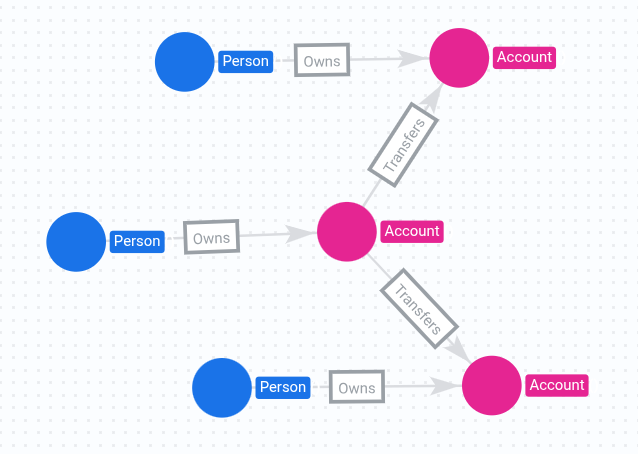
Visualize graph query results
You can
visualize your graph query results
in a notebook by using the %%bigquery --graph magic command followed by your
GQL query. The query must return graph elements in the JSON format. To visualize
the results of the query you ran in the previous section, run the following
query in a notebook code cell:
%%bigquery --graph
GRAPH graph_db.FinGraph
MATCH
  p = ((person:Person {name: "Dana"})-[own:Owns]->
  (account:Account)-[transfer:Transfers]->(acount2:Account)<-[own2:Owns]-(person2:Person))
RETURN
  TO_JSON(p) AS path;
Delete a graph
To delete a graph, use the DROP PROPERTY GRAPH statement. Deleting a graph has no effect
on the tables that were used to define the graph nodes and edges. The following
query deletes the FinGraph graph:
DROP PROPERTY GRAPH graph_db.FinGraph;
What's next
- See the introduction to BigQuery Graph.
- Learn more about graph schemas.
- Learn more about how to write graph queries.
- Learn more about the Graph Query Language (GQL).
- For a tutorial about fraud detection, see Fraud Detection with BigQuery Graph.
- For a tutorial about customer profiles, see Build customer 360 recommendations with BigQuery Graph.
- For a tutorial about supply chains, see Supply chain traceability with BigQuery Graph.