

Graph query overview
This document provides an overview of the graph query language (GQL) and how to
write graph queries for BigQuery Graph. You can run graph queries to
find patterns, traverse relationships, and gain insights from your property
graph. The examples in this document refer to a graph called FinGraph, which
shows the relationships between people, accounts they own, and transfers between
accounts. For information about the definition of the graph, see
FinGraph example.
Query structure
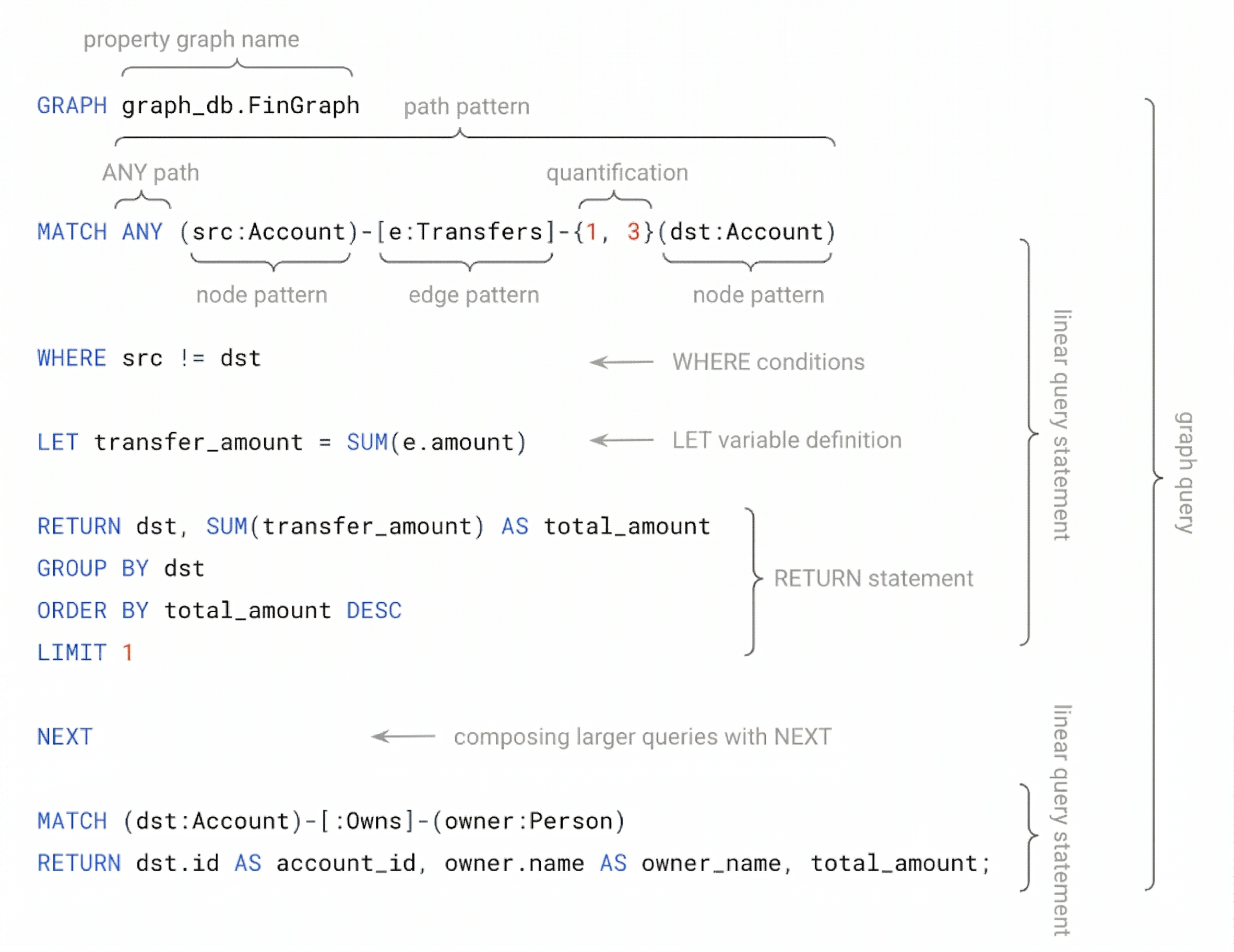
A graph query consists of the name of the graph, followed by one or more linear query statements. Each linear query contains one or more statements, which let you work with graph data to find pattern matches, define variables, filter and transform intermediate data, and return results. You run a graph query the same way that you run a SQL query in BigQuery.
Graph pattern matching
Graph pattern matching finds specific patterns within your graph. The most basic patterns are element patterns, such as node patterns that match nodes and edge patterns that match edges.
Node patterns
A node pattern matches nodes in your graph. This pattern contains matching parentheses, which might optionally include a graph pattern variable, a label expression, and property filters.
Find all nodes
The following query returns all nodes in the graph. The variable n, a graph
pattern variable, binds to the matching nodes. In this case, the node pattern
matches all nodes in the graph.
GRAPH graph_db.FinGraph
MATCH (n)
RETURN LABELS(n) AS label, n.id;
This query returns label and id:
label |
id |
|---|---|
Account |
7 |
Account |
16 |
Account |
20 |
Person |
1 |
Person |
2 |
Person |
3 |
Find all nodes with a specific label
The following query matches all nodes in the graph that have the Person
label.
The query returns the label and some properties of the matched nodes.
GRAPH graph_db.FinGraph
MATCH (p:Person)
RETURN LABELS(p) AS label, p.id, p.name;
This query returns the following properties of the matched nodes:
label |
id |
name |
|---|---|---|
Person |
1 |
Alex |
Person |
2 |
Dana |
Person |
3 |
Lee |
Find all nodes matching a label expression
You can create a
label expression
with one or more logical operators. For example, the following query matches all
nodes in the graph that have either the Person or Account label. The graph
pattern variable n exposes all
properties
from nodes with the Person or Account label.
GRAPH graph_db.FinGraph
MATCH (n:Person|Account)
RETURN LABELS(n) AS label, n.id, n.birthday, n.create_time;
Note the following in the results of this query:
- All nodes have the
idproperty. - Nodes matching the
Accountlabel have thecreate_timeproperty but don't have thebirthdayproperty. Thebirthdayproperty isNULLfor these nodes. - Nodes matching the
Personlabel have thebirthdayproperty but don't have thecreate_timeproperty. Thecreate_timeproperty isNULLfor these nodes.
label |
id |
birthday |
create_time |
|---|---|---|---|
Account |
7 |
NULL |
2020-01-10T14:22:20.222Z |
Account |
16 |
NULL |
2020-01-28T01:55:09.206Z |
Account |
20 |
NULL |
2020-02-18T13:44:20.655Z |
Person |
1 |
1991-12-21T08:00:00Z |
NULL |
Person |
2 |
1980-10-31T08:00:00Z |
NULL |
Person |
3 |
1986-12-07T08:00:00Z |
NULL |
Find all nodes matching the label expression and property filter
The following query matches all nodes in the graph that have the Person
label and the property id equal to 1:
GRAPH graph_db.FinGraph
MATCH (p:Person {id: 1})
RETURN LABELS(p) AS label, p.id, p.name, p.birthday;
The result is similar to the following:
label |
id |
name |
birthday |
|---|---|---|---|
Person |
1 |
Alex |
1991-12-21T08:00:00Z |
You can use the WHERE clause to form more complex filtering conditions on
labels and properties.
The following query uses the WHERE clause to filter on nodes for which
the property birthday is before 1990-01-10:
GRAPH graph_db.FinGraph
MATCH (p:Person WHERE p.birthday < '1990-01-10')
RETURN LABELS(p) AS label, p.name, p.birthday;
The result is similar to the following:
label |
name |
birthday |
|---|---|---|
Person |
Dana |
1980-10-31T08:00:00Z |
Person |
Lee |
1986-12-07T08:00:00Z |
Edge patterns
An edge pattern matches edges or relationships between nodes. Edge patterns are
enclosed in square brackets ([]) and include symbols such as -, ->, or
<- to indicate directions. An edge pattern might optionally include a graph
pattern variable to bind to matching edges.
Find all edges with matching labels
This query returns all edges in the graph with the Transfers label. The query
binds the graph pattern variable e to the matching edges.
GRAPH graph_db.FinGraph
MATCH -[e:Transfers]->
RETURN e.Id as src_account, e.order_number;
The result is similar to the following:
src_account |
order_number |
|---|---|
7 |
304330008004315 |
7 |
304120005529714 |
16 |
103650009791820 |
20 |
304120005529714 |
20 |
302290001255747 |
Find all edges matching the label expression and property filter
The edge pattern in the following query uses a label expression and a property
filter to find all edges labeled Transfers that match a specified
order number:
GRAPH graph_db.FinGraph
MATCH -[e:Transfers {order_number: "304120005529714"}]->
RETURN e.Id AS src_account, e.order_number;
The result is similar to the following:
src_account |
order_number |
|---|---|
7 |
304120005529714 |
20 |
304120005529714 |
Find all edges using any direction edge pattern
You can use the any direction edge pattern (-[]-) in a query to match edges
in either direction. The following query finds all transfers with a blocked
account:
GRAPH graph_db.FinGraph
MATCH (account:Account)-[transfer:Transfers]-(:Account {is_blocked:true})
RETURN transfer.order_number, transfer.amount;
The result is similar to the following:
order_number |
amount |
|---|---|
304330008004315 |
300 |
304120005529714 |
100 |
103650009791820 |
300 |
302290001255747 |
200 |
Path patterns
A path pattern is built from alternating node and edge patterns.
Find all paths from a specific node using a path pattern
The following query finds all transfers to an account initiated from an account
owned by Person with id equal to 2.
Each matched result represents a path from a Person node when id is equal to
2 through a connected Account node using an Owns edge,
into another Account node using a Transfers edge.
GRAPH graph_db.FinGraph
MATCH
  (p:Person {id: 2})-[:Owns]->(account:Account)-[t:Transfers]->
  (to_account:Account)
RETURN
  p.id AS sender_id, account.id AS from_id, to_account.id AS to_id;
The result is similar to the following:
sender_id |
from_id |
to_id |
|---|---|---|
2 |
20 |
7 |
2 |
20 |
16 |
Quantified path patterns
A quantified pattern repeats a pattern within a specified range.
Match a quantified edge pattern
To find paths of a variable length, you can apply a quantifier to an edge
pattern. The following query demonstrates this by finding destination accounts
that are one to three transfers away from a source Account with an id value
of 7.
The query applies the quantifier {1, 3} to the edge pattern
-[e:Transfers]->. This instructs the query to match paths that repeat the
Transfers edge pattern one, two, or three times. The WHERE clause is used to
exclude the source account from the results. The ARRAY_LENGTH function is used
to access the group variable e.
GRAPH graph_db.FinGraph
MATCH (src:Account {id: 7})-[e:Transfers]->{1, 3}(dst:Account)
WHERE src != dst
RETURN src.id AS src_account_id, ARRAY_LENGTH(e) AS path_length, dst.id AS dst_account_id;
The result is similar to the following:
src_account_id |
path_length |
dst_account_id |
|---|---|---|
7 |
1 |
16 |
7 |
1 |
16 |
7 |
3 |
16 |
7 |
3 |
16 |
7 |
2 |
20 |
7 |
2 |
20 |
Some rows in the results are repeated. This is because multiple paths that match the pattern can exist between the same source and destination nodes, and the query returns all of them.
Match a quantified path pattern
The following query finds paths between Account nodes with one to two
Transfers edges through intermediate accounts that are blocked.
The parenthesized path pattern is quantified, and its WHERE clause specifies
conditions for the repeated pattern.
GRAPH graph_db.FinGraph
MATCH
  (src:Account)
  ((a:Account)-[:Transfers]->(b:Account {is_blocked:true}) WHERE a != b){1,2}
    -[:Transfers]->(dst:Account)
RETURN src.id AS src_account_id, dst.id AS dst_account_id;
The result is similar to the following:
src_account_id |
dst_account_id |
|---|---|
7 |
20 |
7 |
20 |
20 |
20 |
Group variables
A graph pattern variable declared in a quantified pattern becomes a group variable when accessed outside that pattern. It then binds to an array of matched graph elements.
You can access a group variable as an array. Its graph elements are preserved in the order of their appearance along the matched paths. You can aggregate a group variable using horizontal aggregation.
Access group variable
In the following example, the variable e is accessed as follows:
- As a graph pattern variable bound to a single edge in the
WHEREclausee.amount > 100when it's within the quantified pattern. - As a group variable bound to an array of edge elements in
ARRAY_LENGTH(e)in theRETURNstatement when it's outside the quantified pattern. - As a group variable bound to an array of edge elements, which is aggregated
by
SUM(e.amount)outside the quantified pattern. This is an example of horizontal aggregation.
GRAPH graph_db.FinGraph
MATCH
  (src:Account {id: 7})-[e:Transfers WHERE e.amount > 100]->{0,2}
  (dst:Account)
WHERE src.id != dst.id
LET total_amount = SUM(e.amount)
RETURN
  src.id AS src_account_id, ARRAY_LENGTH(e) AS path_length,
  total_amount, dst.id AS dst_account_id;
The result is similar to the following:
src_account_id |
path_length |
total_amount |
dst_account_id |
|---|---|---|---|
7 |
1 |
300 |
16 |
7 |
2 |
600 |
20 |
Path search prefixes
To limit matched paths within groups that share source and destination nodes,
you can use the ANY, ANY SHORTEST, or ANY CHEAPEST path
search prefix.
You can only apply these prefixes before an entire path pattern, and you can't
apply them inside parentheses.
Match using ANY
The following query finds all reachable unique accounts that are one or two
Transfers away from a given Account node.
The ANY path search prefix ensures that the query returns only one path
between a unique pair of src and dst Account nodes. In the following
example, although you can reach the Account node with {id: 16} in two
different paths from the source Account node, the query returns only one path.
GRAPH graph_db.FinGraph
MATCH ANY (src:Account {id: 7})-[e:Transfers]->{1,2}(dst:Account)
LET ids_in_path = ARRAY_CONCAT(ARRAY_AGG(e.Id), [dst.Id])
RETURN src.id AS src_account_id, dst.id AS dst_account_id, ids_in_path;
The result is similar to the following:
src_account_id |
dst_account_id |
ids_in_path |
|---|---|---|
7 |
16 |
7,16 |
7 |
20 |
7,16,20 |
Match using ANY SHORTEST
The ANY SHORTEST path search prefix returns a single path for each pair of
source and destination nodes, selected from those with the minimum number of
edges.
For example, the following query finds one of the shortest paths between an
Account node with id value of 7 and an Account node with an id value
of 20. The query considers paths with one to three Transfers edges.
GRAPH graph_db.FinGraph
MATCH ANY SHORTEST (src:Account {id: 7})-[e:Transfers]->{1, 3}(dst:Account {id: 20})
RETURN src.id AS src_account_id, dst.id AS dst_account_id, ARRAY_LENGTH(e) AS path_length;
The result is similar to the following:
src_account_id |
dst_account_id |
path_length |
|---|---|---|
7 |
20 |
2 |
Match using ANY CHEAPEST
The ANY CHEAPEST path search prefix ensures that for each pair of source and
destination accounts, the query returns only one path with the minimum total
compute cost.
The following query finds a path with the minimum total compute cost between
Account nodes. This cost is based on the sum of the amount property of the
Transfers edges. The search considers paths with one to three Transfers
edges.
GRAPH graph_db.FinGraph
MATCH ANY CHEAPEST (src:Account)-[e:Transfers COST e.amount]->{1,3}(dst:Account)
LET total_cost = sum(e.amount)
RETURN src.id AS src_account_id, dst.id AS dst_account_id, total_cost;
The result is similar to the following:
src_account_id |
dst_account_id |
total_cost |
|---|---|---|
7 |
7 |
900 |
7 |
16 |
100 |
7 |
20 |
400 |
16 |
7 |
800 |
16 |
16 |
500 |
16 |
20 |
300 |
20 |
7 |
500 |
20 |
16 |
200 |
20 |
20 |
500 |
Graph patterns
A graph pattern consists of one or more path patterns,
separated by a comma (,).
Graph patterns can contain a WHERE clause, which lets you access all the graph
pattern variables in the path patterns to form filtering conditions. Each path
pattern produces a collection of paths.
Match using a graph pattern
The following query identifies intermediary accounts and their owners involved in transactions amounts exceeding 200, through which funds are transferred from a source account to a blocked account.
The following path patterns form the graph pattern:
- The first pattern finds paths where the transfer occurs from one account to a blocked account using an intermediate account.
- The second pattern finds paths from an account to its owning person.
The variable interm acts as a common link between the two path patterns, which
requires interm to reference the same element node in both path patterns. This
creates an equi-join operation based on the interm variable.
GRAPH graph_db.FinGraph
MATCH
  (src:Account)-[t1:Transfers]->(interm:Account)-[t2:Transfers]->(dst:Account),
  (interm)<-[:Owns]-(p:Person)
WHERE dst.is_blocked = TRUE AND t1.amount > 200 AND t2.amount > 200
RETURN
  src.id AS src_account_id, dst.id AS dst_account_id,
  interm.id AS interm_account_id, p.id AS owner_id;
The result is similar to the following:
src_account_id |
dst_account_id |
interm_account_id |
owner_id |
|---|---|---|---|
20 |
16 |
7 |
1 |
Linear query statements
You can chain multiple graph statements together to form a linear query statement. The statements are executed in the same order as they appear in the query.
Each statement takes the output from the previous statement as input. The input is empty for the first statement.
The output of the last statement is the final result.
For example, you can use linear query statements to find the maximum transfer to a blocked account. The following query finds the account and its owner with the largest outgoing transfer to a blocked account.
GRAPH graph_db.FinGraph
MATCH (src_account:Account)-[transfer:Transfers]->(dst_account:Account {is_blocked:true})
ORDER BY transfer.amount DESC
LIMIT 1
MATCH (src_account:Account)<-[owns:Owns]-(owner:Person)
RETURN src_account.id AS account_id, owner.name AS owner_name;
The following table illustrates this process by showing the intermediate results passed between each statement. For brevity, only some properties are shown.
| Statement | Intermediate result (abbreviated) | ||||||||||||
|---|---|---|---|---|---|---|---|---|---|---|---|---|---|
MATCH
  (src_account:Account)
    -[transfer:Transfers]->
  (dst_account:Account {is_blocked:true})
|
|
||||||||||||
ORDER BY transfer.amount DESC |
|
||||||||||||
LIMIT 1 |
|
||||||||||||
MATCH
  (src_account:Account)
    <-[owns:Owns]-
  (owner:Person)
|
|
||||||||||||
RETURN
  src_account.id AS account_id,
  owner.name AS owner_name
|
|
The result is similar to the following:
| account_id | owner_name |
|---|---|
7 |
Alex |
Return statement
The RETURN statement
specifies what to return from the matched patterns. It can access
graph pattern variables and include expressions and other clauses, such as
ORDER BY and GROUP BY.
BigQuery Graph doesn't support returning graph elements as query
results. To return the entire graph element, use the
TO_JSON function.
Return graph elements as JSON
GRAPH graph_db.FinGraph
MATCH (n:Account {id: 7})
-- Returning a graph element in the final results is NOT allowed. Instead, use
-- the TO_JSON function or explicitly return the graph element's properties.
RETURN TO_JSON(n) AS n;
The result is similar to the following:
| n |
|---|
{"identifier":"mUZpbkdyYXBoLkFjY291bnQAeJEO","kind":"node","labels":["Account"],"properties":{"create_time":"2020-01-10T14:22:20.222Z","id":7,"is_blocked":false,"nick_name":"Vacation
Fund"}} |
Compose larger queries with the NEXT keyword
You can chain multiple graph linear query statements using the NEXT keyword.
The first statement receives an empty input, and the output of each subsequent
statement becomes the input for the next.
The following example finds the owner of the account with the most incoming
transfers by chaining multiple graph linear statements. You can use the same
variable, for example, account, to refer to the same graph element across
multiple linear statements.
GRAPH graph_db.FinGraph
MATCH (:Account)-[:Transfers]->(account:Account)
RETURN account, COUNT(*) AS num_incoming_transfers
GROUP BY account
ORDER BY num_incoming_transfers DESC
LIMIT 1

NEXT

MATCH (account:Account)<-[:Owns]-(owner:Person)
RETURN account.id AS account_id, owner.name AS owner_name, num_incoming_transfers;
The result is similar to the following:
| account_id | owner_name | num_incoming_transfers |
|---|---|---|
16 |
Lee |
3 |
You can also combine linear query statements with set operators.
Functions and expressions
You can use all GoogleSQL functions (both aggregate and scalar functions), operators, and conditional expressions in graph queries. BigQuery Graph also supports GQL functions and GQL operators that can only be used in graph queries.
The following query includes a mix of GQL and SQL functions and operators within a graph query:
GRAPH graph_db.FinGraph
MATCH (person:Person)-[o:Owns]->(account:Account)
WHERE person IS SOURCE OF o
RETURN person, ARRAY_AGG(account.nick_name) AS accounts
GROUP BY person

NEXT

RETURN
  LABELS(person) AS labels,
  accounts,
  CONCAT(person.city, ", ", person.country) AS location,
  TO_JSON(person) AS person
LIMIT 1;
The result is similar to the following:
| labels | accounts | location | person |
|---|---|---|---|
Person |
["Vacation Fund"] |
Adelaide, Australia |
{"identifier":"mUZpbkdyYXBoLlBlcnNvbgB4kQI=","kind":"node","labels":["Person"],"properties":{"birthday":"1991-12-21T08:00:00Z","city":"Adelaide","country":"Australia","id":1,"name":"Alex"}} |
Subqueries
A subquery is a query that is nested in another query. The following rules apply to subqueries within graph queries:
- A subquery is enclosed within a pair of braces
{}. - A subquery starts with a
GRAPHclause to specify the graph in scope. The specified graph doesn't need to be the same as the one used in the outer query. - A graph pattern variable declared outside the subquery scope can't be declared again inside the subquery, but it can be referred to in expressions or functions inside the subquery.
Use a subquery to find the total number of transfers from each account
The following query illustrates the use of the VALUE subquery. The subquery is
enclosed in braces {} prefixed by the VALUE keyword. The query returns the total
number of transfers initiated from an account.
GRAPH graph_db.FinGraph
MATCH (p:Person)-[:Owns]->(account:Account)
RETURN p.name, account.id AS account_id, VALUE {
  GRAPH graph_db.FinGraph
  MATCH (a:Account)-[transfer:Transfers]->(:Account)
  WHERE a = account
  RETURN COUNT(transfer) AS num_transfers
} AS num_transfers;
The result is similar to the following:
| name | account_id | num_transfers |
|---|---|---|
Alex |
7 |
2 |
Dana |
20 |
2 |
Lee |
16 |
1 |
For a list of supported subquery expressions, see BigQuery Graph subqueries.
Query parameters
You can query BigQuery Graph with parameters. For more information, see the syntax and learn how to Run parameterized queries.
The following query matches Person nodes that have an id value that matches
a query parameter:
GRAPH graph_db.FinGraph
MATCH (person:Person {id: @id})
RETURN person.name;
Query graphs and tables together
You can combine graph queries and SQL queries by using the
GRAPH_TABLE operator.
The GRAPH_TABLE operator takes a linear graph query and returns its result in
a tabular form that can be integrated into a SQL query. This interoperability
lets you enrich graph query results with non-graph content and the other way
around.
For example, you can create a CreditReports table and insert a few credit
reports, as shown in the following example:
CREATE TABLE graph_db.CreditReports (
  person_id     INT64 NOT NULL,
  create_time   TIMESTAMP NOT NULL,
  score         INT64 NOT NULL,
  PRIMARY KEY (person_id, create_time) NOT ENFORCED
);
INSERT INTO graph_db.CreditReports (person_id, create_time, score)
VALUES
  (1,"2020-01-10 06:22:20.222", 700),
  (2,"2020-02-10 06:22:20.222", 800),
  (3,"2020-03-10 06:22:20.222", 750);
Next, you can identify specific persons through graph pattern matching in
GRAPH_TABLE and join the graph query results with the CreditReports table to
retrieve credit scores.
SELECT
  gt.person.id,
  credit.score AS latest_credit_score
FROM GRAPH_TABLE(
  graph_db.FinGraph
  MATCH (person:Person)-[:Owns]->(:Account)-[:Transfers]->(account:Account {is_blocked:true})
  RETURN DISTINCT person
) AS gt
JOIN graph_db.CreditReports AS credit
  ON gt.person.id = credit.person_id
ORDER BY credit.create_time;
The result is similar to the following:
| person_id | latest_credit_score |
|---|---|
1 |
700 |
2 |
800 |
What's next
- Learn how to create and query a graph.
- Learn more about how to design a graph schema.
- Learn how to visualize query results.