

BigQuery-Reservierungen überwachen
Als BigQuery-Administrator können Sie Reservierungen in Ihrem Projekt überwachen. Sehen Sie sich dazu die Nutzung von Projekt- und Reservierungs-Slots an und rufen Sie Ihre kapazitätsbasierte Abrechnung auf.
Nutzung von Projekt- und Reservierungs-Slots ansehen
Sie können die Nutzung von Projekt- und Reservierungs-Slots so aufrufen:
INFORMATION_SCHEMAAufrufe. Fragen Sie dieINFORMATION_SCHEMA.JOBS*-Ansichten ab, um Informationen zur Projekt- und Reservierungsnutzung abzurufen.Das Feld
reservation_idin denINFORMATION_SCHEMA.JOBS*-Ansichten enthält den Reservierungsnamen.Google Cloud console. Die Google Cloud Console enthält Diagramme zur Anzeige der Slot-Nutzung. Weitere Informationen finden Sie unter Diagramme zu administrativen Ressourcen verwenden.
Prüfprotokolle. Verwenden Sie Audit-Logs, um Messwerte zur Slot-Nutzung anzuzeigen.
Die Methode
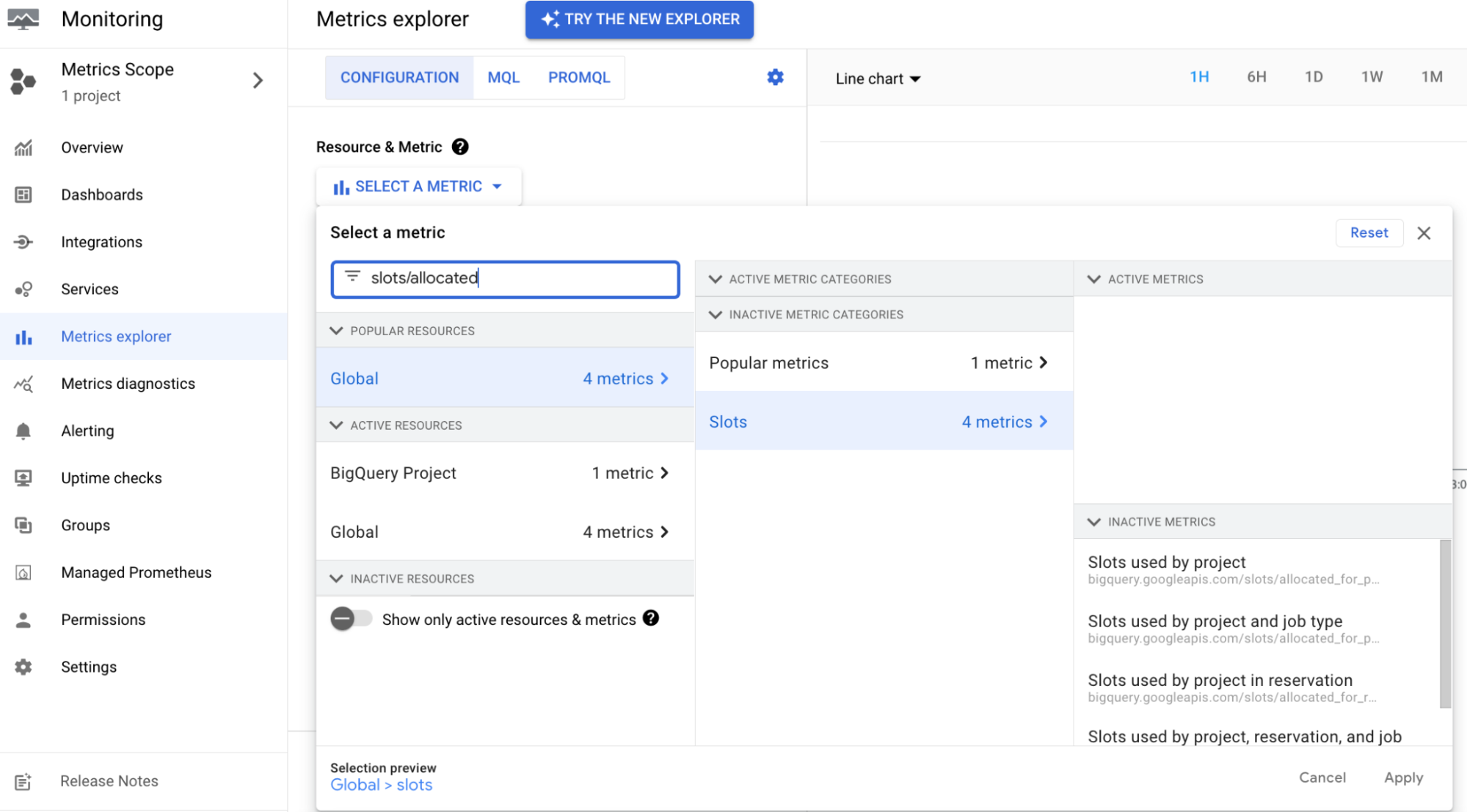
Jobs. Verwenden Sie die API-MethodeJobs, um Messwerte zur Slot-Nutzung für einen Job aufzurufen.Cloud Monitoring Mit Cloud Monitoring können Sie Dashboards erstellen, um Ihre zugewiesenen Slots zu überwachen. Mit einem Cloud Monitoring-Dashboard können Sie die Slot-Nutzung für jede Reservierung und für jeden Jobtyp in allen Projekten innerhalb der Reservierung ansehen. Weitere Informationen zu den für das Cloud Monitoring-Dashboard verfügbaren Messwerten finden Sie unter Für die Visualisierung verfügbare Messwerte.
Kapazitätsbasierte Abrechnung anzeigen
So rufen Sie Ihre kapazitätsbasierte Abrechnung in Echtzeit auf:
Rufen Sie in der Google Cloud Console die Seite Abrechnung auf.
Wählen Sie das Rechnungskonto aus, für das Sie die Rechnung aufrufen möchten.
Wechseln Sie zum Abschnitt Berichte und gehen Sie im Abschnitt Filter so vor:
- Wählen Sie in der Liste Dienste die Option BigQuery und alle zutreffenden Antworten aus.
- Wählen Sie in der Liste SKUs die Option Alle Artikelnummern aus.
Zuordnung der Reservierungskosten
Mit diesem Feature können Sie Reservierungsgebühren spezifischen Abfragenutzungen in den Projekten zuordnen, die die Reservierung verwendet haben. Dies ermöglicht eine präzisere Zuordnung der Nettokosten für jedes Projekt.
Alle BigQuery Reservations API-Kunden haben in ihren Cloud Billing-Daten eine Position Analysis Slots Attribution. Diese Position ist auf der Seite Abrechnung und im Cloud Billing-Export enthalten.
In dieser Position werden die pro Projekt verwendeten Slotstunden angezeigt. Es fallen keine Kosten an und die Gesamtsumme der Rechnung wird nicht beeinflusst.
Audit-Logs
Das Erstellen, Löschen und Aktualisieren von Ressourcen im Zusammenhang mit BigQuery-Reservierungen wird in den Auditlogs des Projektinhabers aufgezeichnet. Weitere Informationen finden Sie unter Audit-Log.
Autoscaling mit Informationsschema überwachen
Mit den folgenden SQL-Skripts können Sie die abgerechneten Slotsekunden für eine bestimmte Version prüfen. Sie müssen diese Skripts in demselben Projekt ausführen, in dem die Reservierungen erstellt wurden. Das erste Skript zeigt abgerechnete Slotsekunden, die von commitment_plan abgedeckt werden, während das zweite Skript abgerechnete Slotsekunden anzeigt, die nicht von einer Zusicherung abgedeckt sind.
Sie müssen nur den Wert von drei Variablen festlegen, um diese Skripts auszuführen:
start_timeend_timeedition_to_check
Diese Skripts unterliegen den folgenden Einschränkungen:
Gelöschte Reservierungen und Kapazitätszusicherungen werden am Ende der Datenaufbewahrungsdauer aus den Informationsschemaansichten entfernt. Geben Sie ein aktuelles Zeitfenster an, das keine gelöschten Reservierungen und Zusicherungen für korrekte Ergebnisse enthält.
Das Ergebnis der Skripts stimmt aufgrund kleiner Rundungsfehler möglicherweise nicht genau mit der Rechnung überein.
Das folgende Skript aggregiert Autoscaling-Slots nach Version.
Maximieren, um das Skript zum Berechnen von Autoscaling-Slotsekunden pro Edition aufzurufen.
SELECT
  edition,
  SUM(s.autoscale_current_slots) AS autoscale_slot_seconds
FROM
  `region-us.INFORMATION_SCHEMA.RESERVATIONS_TIMELINE` m
JOIN
  m.per_second_details s
WHERE
  period_start BETWEEN '2025-09-28'
  AND '2025-09-29'
GROUP BY
  edition
ORDER BY
  edition
Das folgende Skript aggregiert Autoscaling-Slots pro Reservierung.
Maximieren, um das Skript zum Berechnen von Autoscaling-Slotsekunden pro Reservierung aufzurufen.
select reservation_id, sum(s.autoscale_current_slots) as autoscale_slot_seconds
from `region-us.INFORMATION_SCHEMA.RESERVATIONS_TIMELINE` m
LEFT JOIN m.per_second_details s
WHERE period_start between '2025-09-28' and '2025-09-29'
group by reservation_id
order by reservation_id
Maximieren, um das Skript zum Berechnen von Slot-Sekunden aus Zusicherungen aufzurufen.
DECLARE start_time,end_time TIMESTAMP;

DECLARE
  edition_to_check STRING;

/* Google uses Pacific Time to calculate the billing period for all customers,
regardless of their time zone. Use the following format if you want to match the
billing report. Change the start_time and end_time values to match the desired
window. */

/* The following three variables (start_time, end_time, and edition_to_check)
are the only variables that you need to set in the script.

During daylight savings time, the start_time and end_time variables should
follow this format: 2024-02-20 00:00:00-08. */

SET start_time = "2023-07-20 00:00:00-07";
SET end_time = "2023-07-28 00:00:00-07";
SET edition_to_check = 'ENTERPRISE';

/* The following function returns the slot seconds for the time window between
two capacity changes. For example, if there are 100 slots between (2023-06-01
10:00:00, 2023-06-01 11:00:00), then during that window the total slot seconds
will be 100 * 3600.

This script calculates a specific window (based on the variables defined above),
which is why the following script includes script_start_timestamp_unix_millis
and script_end_timestamp_unix_millis. */

CREATE TEMP FUNCTION
GetSlotSecondsBetweenChanges(
  slots FLOAT64,
  range_begin_timestamp_unix_millis FLOAT64,
  range_end_timestamp_unix_millis FLOAT64,
  script_start_timestamp_unix_millis FLOAT64,
  script_end_timestamp_unix_millis FLOAT64)
RETURNS INT64
LANGUAGE js
AS r"""
    if (script_end_timestamp_unix_millis < range_begin_timestamp_unix_millis || script_start_timestamp_unix_millis > range_end_timestamp_unix_millis) {
      return 0;
    }
    var begin = Math.max(script_start_timestamp_unix_millis, range_begin_timestamp_unix_millis)
    var end = Math.min(script_end_timestamp_unix_millis, range_end_timestamp_unix_millis)
    return slots * Math.ceil((end - begin) / 1000.0)
""";

/*
Sample CAPACITY_COMMITMENT_CHANGES data (unrelated columns ignored):
+---------------------+------------------------+-----------------+--------+------------+--------+
|  change_timestamp   | capacity_commitment_id | commitment_plan | state  | slot_count | action |
+---------------------+------------------------+-----------------+--------+------------+--------+
| 2023-07-20 19:30:27 | 12954109101902401697   | ANNUAL          | ACTIVE |        100 | CREATE |
| 2023-07-27 22:29:21 | 11445583810276646822   | FLEX            | ACTIVE |        100 | CREATE |
| 2023-07-27 23:10:06 | 7341455530498381779    | MONTHLY         | ACTIVE |        100 | CREATE |
| 2023-07-27 23:11:06 | 7341455530498381779    | FLEX            | ACTIVE |        100 | UPDATE |

The last row indicates a special change from MONTHLY to FLEX, which happens
because of commercial migration.

*/

WITH
  /*
  Information containing which commitment might have plan
  updated (e.g. renewal or commercial migration). For example:
  +------------------------+------------------+--------------------+--------+------------+--------+-----------+----------------------------+
  |  change_timestamp   | capacity_commitment_id | commitment_plan | state  | slot_count | action | next_plan | next_plan_change_timestamp |
  +---------------------+------------------------+-----------------+--------+------------+--------+-----------+----------------------------+
  | 2023-07-20 19:30:27 | 12954109101902401697   | ANNUAL          | ACTIVE |        100 | CREATE | ANNUAL    |        2023-07-20 19:30:27 |
  | 2023-07-27 22:29:21 | 11445583810276646822   | FLEX            | ACTIVE |        100 | CREATE | FLEX      |        2023-07-27 22:29:21 |
  | 2023-07-27 23:10:06 | 7341455530498381779    | MONTHLY         | ACTIVE |        100 | CREATE | FLEX      |        2023-07-27 23:11:06 |
  | 2023-07-27 23:11:06 | 7341455530498381779    | FLEX            | ACTIVE |        100 | UPDATE | FLEX      |        2023-07-27 23:11:06 |
  */
  commitments_with_next_plan AS (
    SELECT
      *,
      IFNULL(
        LEAD(commitment_plan)
          OVER (
            PARTITION BY capacity_commitment_id ORDER BY change_timestamp ASC
          ),
        commitment_plan)
        next_plan,
      IFNULL(
        LEAD(change_timestamp)
          OVER (
            PARTITION BY capacity_commitment_id ORDER BY change_timestamp ASC
          ),
        change_timestamp)
        next_plan_change_timestamp
    FROM
      `region-us.INFORMATION_SCHEMA.CAPACITY_COMMITMENT_CHANGES_BY_PROJECT`
  ),

  /*
  Insert a 'DELETE' action for those with updated plans. The FLEX commitment
  '7341455530498381779' is has no 'CREATE' action, and is instead labeled as an
  'UPDATE' action.

  For example:
  +---------------------+------------------------+-----------------+--------+------------+--------+
  |  change_timestamp   | capacity_commitment_id | commitment_plan | state  | slot_count | action |
  +---------------------+------------------------+-----------------+--------+------------+--------+
  | 2023-07-20 19:30:27 | 12954109101902401697   | ANNUAL          | ACTIVE |        100 | CREATE |
  | 2023-07-27 22:29:21 | 11445583810276646822   | FLEX            | ACTIVE |        100 | CREATE |
  | 2023-07-27 23:10:06 | 7341455530498381779    | MONTHLY         | ACTIVE |        100 | CREATE |
  | 2023-07-27 23:11:06 | 7341455530498381779    | FLEX            | ACTIVE |        100 | UPDATE |
  | 2023-07-27 23:11:06 | 7341455530498381779    | MONTHLY         | ACTIVE |        100 | DELETE |
  */

  capacity_changes_with_additional_deleted_event_for_changed_plan AS (
    SELECT
      next_plan_change_timestamp AS change_timestamp,
      project_id,
      project_number,
      capacity_commitment_id,
      commitment_plan,
      state,
      slot_count,
      'DELETE' AS action,
      commitment_start_time,
      commitment_end_time,
      failure_status,
      renewal_plan,
      user_email,
      edition,
      is_flat_rate,
    FROM commitments_with_next_plan
    WHERE commitment_plan <> next_plan
    UNION ALL
    SELECT * FROM `region-us.INFORMATION_SCHEMA.CAPACITY_COMMITMENT_CHANGES_BY_PROJECT`
  ),

  /*
  The committed_slots change the history. For example:
  +---------------------+------------------------+------------------+-----------------+
  |  change_timestamp   | capacity_commitment_id | slot_count_delta | commitment_plan |
  +---------------------+------------------------+------------------+-----------------+
  | 2023-07-20 19:30:27 | 12954109101902401697   |              100 | ANNUAL          |
  | 2023-07-27 22:29:21 | 11445583810276646822   |              100 | FLEX            |
  | 2023-07-27 23:10:06 | 7341455530498381779    |              100 | MONTHLY         |
  | 2023-07-27 23:11:06 | 7341455530498381779    |             -100 | MONTHLY         |
  | 2023-07-27 23:11:06 | 7341455530498381779    |              100 | FLEX            |
  */

  capacity_commitment_slot_data AS (
    SELECT
      change_timestamp,
      capacity_commitment_id,
      CASE
        WHEN action = "CREATE" OR action = "UPDATE"
          THEN
            IFNULL(
              IF(
                LAG(action)
                  OVER (
                    PARTITION BY capacity_commitment_id ORDER BY change_timestamp ASC, action ASC
                  )
                  IN UNNEST(['CREATE', 'UPDATE']),
                slot_count - LAG(slot_count)
                  OVER (
                    PARTITION BY capacity_commitment_id ORDER BY change_timestamp ASC, action ASC
                  ),
                slot_count),
              slot_count)
        ELSE
          IF(
            LAG(action)
              OVER (PARTITION BY capacity_commitment_id ORDER BY change_timestamp ASC, action ASC)
              IN UNNEST(['CREATE', 'UPDATE']),
            -1 * slot_count,
            0)
        END
        AS slot_count_delta,
      commitment_plan
    FROM
      capacity_changes_with_additional_deleted_event_for_changed_plan
    WHERE
      state = "ACTIVE"
      AND edition = edition_to_check
      AND change_timestamp <= end_time
  ),

  /*
  The total_committed_slots history for each plan. For example:
  +---------------------+---------------+-----------------+
  |  change_timestamp   | capacity_slot | commitment_plan |
  +---------------------+---------------+-----------------+
  | 2023-07-20 19:30:27 |           100 | ANNUAL          |
  | 2023-07-27 22:29:21 |           100 | FLEX            |
  | 2023-07-27 23:10:06 |           100 | MONTHLY         |
  | 2023-07-27 23:11:06 |             0 | MONTHLY         |
  | 2023-07-27 23:11:06 |           200 | FLEX            |
  */

  running_capacity_commitment_slot_data AS (
    SELECT
      change_timestamp,
      SUM(slot_count_delta)
        OVER (
          PARTITION BY commitment_plan
          ORDER BY change_timestamp
          RANGE BETWEEN UNBOUNDED PRECEDING AND CURRENT ROW
        )
        AS capacity_slot,
      commitment_plan,
    FROM
      capacity_commitment_slot_data
  ),

  /*

  The slot_seconds between each changes, partitioned by each plan. For example:
  +---------------------+--------------+-----------------+
  |  change_timestamp   | slot_seconds | commitment_plan |
  +---------------------+--------------+-----------------+
  | 2023-07-20 19:30:27 |     64617300 | ANNUAL          |
  | 2023-07-27 22:29:21 |       250500 | FLEX            |
  | 2023-07-27 23:10:06 |         6000 | MONTHLY         |
  | 2023-07-27 23:11:06 |            0 | MONTHLY         |
  | 2023-07-27 23:11:06 |      5626800 | FLEX            |
  */

  slot_seconds_data AS (
    SELECT
      change_timestamp,
      GetSlotSecondsBetweenChanges(
        capacity_slot,
        UNIX_MILLIS(change_timestamp),
        UNIX_MILLIS(
          IFNULL(
            LEAD(change_timestamp)
              OVER (PARTITION BY commitment_plan ORDER BY change_timestamp ASC),
            CURRENT_TIMESTAMP())),
        UNIX_MILLIS(start_time),
        UNIX_MILLIS(end_time)) AS slot_seconds,
      commitment_plan,
    FROM
      running_capacity_commitment_slot_data
    WHERE
      change_timestamp <= end_time
  )

/*

The final result is similar to the following:
+-----------------+--------------------+
| commitment_plan | total_slot_seconds |
+-----------------+--------------------+
| ANNUAL          |           64617300 |
| MONTHLY         |               6000 |
| FLEX            |            5877300 |
*/

SELECT
  commitment_plan,
  SUM(slot_seconds) AS total_slot_seconds
FROM
  slot_seconds_data
GROUP BY
  commitment_plan
Das folgende Skript prüft die Slot-Nutzung, die nicht durch Zusicherungen für eine bestimmte Version abgedeckt ist. Diese Nutzung enthält zwei Arten von Slots: skalierte Slots und Baseline-Slots, die nicht durch Zusicherungen abgedeckt sind.
Maximieren, um das Skript zum Berechnen von Slotsekunden aufzurufen, die nicht durch Zusicherungen abgedeckt sind
/*
This script has several parts:
1. Calculate the baseline and scaled slots for reservations
2. Calculate the committed slots
3. Join the two results above to calculate the baseline not covered by committed
   slots
4. Aggregate the number
*/

-- variables
DECLARE start_time, end_time TIMESTAMP;

DECLARE
  edition_to_check STRING;

/* Google uses Pacific Time to calculate the billing period for all customers,
regardless of their time zone. Use the following format if you want to match the
billing report. Change the start_time and end_time values to match the desired
window. */

/* The following three variables (start_time, end_time, and edition_to_check)
are the only variables that you need to set in the script.

During daylight savings time, the start_time and end_time variables should
follow this format: 2024-02-20 00:00:00-08. */

SET start_time = "2023-07-20 00:00:00-07";
SET end_time = "2023-07-28 00:00:00-07";
SET edition_to_check = 'ENTERPRISE';

/*
The following function returns the slot seconds for the time window between
two capacity changes. For example, if there are 100 slots between (2023-06-01
10:00:00, 2023-06-01 11:00:00), then during that window the total slot seconds
will be 100 * 3600.

This script calculates a specific window (based on the variables defined above),
which is why the following script includes script_start_timestamp_unix_millis
and script_end_timestamp_unix_millis. */

CREATE TEMP FUNCTION GetSlotSecondsBetweenChanges(
  slots FLOAT64,
  range_begin_timestamp_unix_millis FLOAT64,
  range_end_timestamp_unix_millis FLOAT64,
  script_start_timestamp_unix_millis FLOAT64,
  script_end_timestamp_unix_millis FLOAT64)
RETURNS INT64
LANGUAGE js
AS r"""
    if (script_end_timestamp_unix_millis < range_begin_timestamp_unix_millis || script_start_timestamp_unix_millis > range_end_timestamp_unix_millis) {
      return 0;
    }
    var begin = Math.max(script_start_timestamp_unix_millis, range_begin_timestamp_unix_millis)
    var end = Math.min(script_end_timestamp_unix_millis, range_end_timestamp_unix_millis)
    return slots * Math.ceil((end - begin) / 1000.0)
""";
/*
Sample RESERVATION_CHANGES data (unrelated columns ignored):
+---------------------+------------------+--------+---------------+---------------+
|  change_timestamp   | reservation_name | action | slot_capacity | current_slots |
+---------------------+------------------+--------+---------------+---------------+
| 2023-07-27 22:24:15 | res1             | CREATE |           300 |             0 |
| 2023-07-27 22:25:21 | res1             | UPDATE |           300 |           180 |
| 2023-07-27 22:39:14 | res1             | UPDATE |           300 |           100 |
| 2023-07-27 22:40:20 | res2             | CREATE |           300 |             0 |
| 2023-07-27 22:54:18 | res2             | UPDATE |           300 |           120 |
| 2023-07-27 22:55:23 | res1             | UPDATE |           300 |             0 |

Sample CAPACITY_COMMITMENT_CHANGES data (unrelated columns ignored):
+---------------------+------------------------+-----------------+--------+------------+--------+
|  change_timestamp   | capacity_commitment_id | commitment_plan | state  | slot_count | action |
+---------------------+------------------------+-----------------+--------+------------+--------+
| 2023-07-20 19:30:27 | 12954109101902401697   | ANNUAL          | ACTIVE |        100 | CREATE |
| 2023-07-27 22:29:21 | 11445583810276646822   | FLEX            | ACTIVE |        100 | CREATE |
| 2023-07-27 23:10:06 | 7341455530498381779    | MONTHLY         | ACTIVE |        100 | CREATE |
*/

WITH
  /*
  The scaled_slots & baseline change history:
  +---------------------+------------------+------------------------------+---------------------+
  |  change_timestamp   | reservation_name | autoscale_current_slot_delta | baseline_slot_delta |
  +---------------------+------------------+------------------------------+---------------------+
  | 2023-07-27 22:24:15 | res1             |                            0 |                 300 |
  | 2023-07-27 22:25:21 | res1             |                          180 |                   0 |
  | 2023-07-27 22:39:14 | res1             |                          -80 |                   0 |
  | 2023-07-27 22:40:20 | res2             |                            0 |                 300 |
  | 2023-07-27 22:54:18 | res2             |                          120 |                   0 |
  | 2023-07-27 22:55:23 | res1             |                         -100 |                   0 |
  */
  reservation_slot_data AS (
    SELECT
      change_timestamp,
      reservation_name,
      CASE action
        WHEN "CREATE" THEN autoscale.current_slots
        WHEN "UPDATE"
          THEN
            IFNULL(
              autoscale.current_slots - LAG(autoscale.current_slots)
                OVER (
                  PARTITION BY project_id, reservation_name
                  ORDER BY change_timestamp ASC, action ASC
                ),
              IFNULL(
                autoscale.current_slots,
                IFNULL(
                  -1 * LAG(autoscale.current_slots)
                    OVER (
                      PARTITION BY project_id, reservation_name
                      ORDER BY change_timestamp ASC, action ASC
                    ),
                  0)))
        WHEN "DELETE"
          THEN
            IF(
              LAG(action)
                OVER (
                  PARTITION BY project_id, reservation_name
                  ORDER BY change_timestamp ASC, action ASC
                )
                IN UNNEST(['CREATE', 'UPDATE']),
              -1 * autoscale.current_slots,
              0)
        END
        AS autoscale_current_slot_delta,
      CASE action
        WHEN "CREATE" THEN slot_capacity
        WHEN "UPDATE"
          THEN
            IFNULL(
              slot_capacity - LAG(slot_capacity)
                OVER (
                  PARTITION BY project_id, reservation_name
                  ORDER BY change_timestamp ASC, action ASC
                ),
              IFNULL(
                slot_capacity,
                IFNULL(
                  -1 * LAG(slot_capacity)
                    OVER (
                      PARTITION BY project_id, reservation_name
                      ORDER BY change_timestamp ASC, action ASC
                    ),
                  0)))
        WHEN "DELETE"
          THEN
            IF(
              LAG(action)
                OVER (
                  PARTITION BY project_id, reservation_name
                  ORDER BY change_timestamp ASC, action ASC
                )
                IN UNNEST(['CREATE', 'UPDATE']),
              -1 * slot_capacity,
              0)
        END
        AS baseline_slot_delta,
    FROM
      `region-us.INFORMATION_SCHEMA.RESERVATION_CHANGES`
    WHERE
      edition = edition_to_check
      AND change_timestamp <= end_time
  ),

  -- Convert the above to running total
  /*
  +---------------------+-------------------------+----------------+
  |  change_timestamp   | autoscale_current_slots | baseline_slots |
  +---------------------+-------------------------+----------------+
  | 2023-07-27 22:24:15 |                       0 |            300 |
  | 2023-07-27 22:25:21 |                     180 |            300 |
  | 2023-07-27 22:39:14 |                     100 |            300 |
  | 2023-07-27 22:40:20 |                     100 |            600 |
  | 2023-07-27 22:54:18 |                     220 |            600 |
  | 2023-07-27 22:55:23 |                     120 |            600 |
  */
  running_reservation_slot_data AS (
    SELECT
      change_timestamp,
      SUM(autoscale_current_slot_delta)
        OVER (ORDER BY change_timestamp RANGE BETWEEN UNBOUNDED PRECEDING AND CURRENT ROW)
        AS autoscale_current_slots,
      SUM(baseline_slot_delta)
        OVER (ORDER BY change_timestamp RANGE BETWEEN UNBOUNDED PRECEDING AND CURRENT ROW)
        AS baseline_slots,
    FROM
      reservation_slot_data
  ),

  /*
  The committed_slots change history. For example:
  +---------------------+------------------------+------------------+
  |  change_timestamp   | capacity_commitment_id | slot_count_delta |
  +---------------------+------------------------+------------------+
  | 2023-07-20 19:30:27 | 12954109101902401697   |              100 |
  | 2023-07-27 22:29:21 | 11445583810276646822   |              100 |
  | 2023-07-27 23:10:06 | 7341455530498381779    |              100 |
  */
  capacity_commitment_slot_data AS (
    SELECT
      change_timestamp,
      capacity_commitment_id,
      CASE
        WHEN action = "CREATE" OR action = "UPDATE"
          THEN
            IFNULL(
              IF(
                LAG(action)
                  OVER (
                    PARTITION BY capacity_commitment_id ORDER BY change_timestamp ASC, action ASC
                  )
                  IN UNNEST(['CREATE', 'UPDATE']),
                slot_count - LAG(slot_count)
                  OVER (
                    PARTITION BY capacity_commitment_id ORDER BY change_timestamp ASC, action ASC
                  ),
                slot_count),
              slot_count)
        ELSE
          IF(
            LAG(action)
              OVER (PARTITION BY capacity_commitment_id ORDER BY change_timestamp ASC, action ASC)
              IN UNNEST(['CREATE', 'UPDATE']),
            -1 * slot_count,
            0)
        END
        AS slot_count_delta
    FROM
      `region-us.INFORMATION_SCHEMA.CAPACITY_COMMITMENT_CHANGES_BY_PROJECT`
    WHERE
      state = "ACTIVE"
      AND edition = edition_to_check
      AND change_timestamp <= end_time
  ),

  /*
  The total_committed_slots history. For example:
  +---------------------+---------------+
  |  change_timestamp   | capacity_slot |
  +---------------------+---------------+
  | 2023-07-20 19:30:27 |           100 |
  | 2023-07-27 22:29:21 |           200 |
  | 2023-07-27 23:10:06 |           300 |
  */
  running_capacity_commitment_slot_data AS (
    SELECT
      change_timestamp,
      SUM(slot_count_delta)
        OVER (ORDER BY change_timestamp RANGE BETWEEN UNBOUNDED PRECEDING AND CURRENT ROW)
        AS capacity_slot
    FROM
      capacity_commitment_slot_data
  ),

  /* Add next_change_timestamp to the above data,
   which will be used when joining with reservation data. For example:
  +---------------------+-----------------------+---------------+
  |  change_timestamp   | next_change_timestamp | capacity_slot |
  +---------------------+-----------------------+---------------+
  | 2023-07-20 19:30:27 |   2023-07-27 22:29:21 |           100 |
  | 2023-07-27 22:29:21 |   2023-07-27 23:10:06 |           200 |
  | 2023-07-27 23:10:06 |   2023-07-31 00:14:37 |           300 |
  */
  running_capacity_commitment_slot_data_with_next_change AS (
    SELECT
      change_timestamp,
      IFNULL(LEAD(change_timestamp) OVER (ORDER BY change_timestamp ASC), CURRENT_TIMESTAMP())
        AS next_change_timestamp,
      capacity_slot
    FROM
      running_capacity_commitment_slot_data
  ),

  /*
  Whenever we have a change in reservations or commitments,
  the scaled_slots_and_baseline_not_covered_by_commitments will be changed.
  Hence we get a collection of all the change_timestamp from both tables.
  +---------------------+
  |  change_timestamp   |
  +---------------------+
  | 2023-07-20 19:30:27 |
  | 2023-07-27 22:24:15 |
  | 2023-07-27 22:25:21 |
  | 2023-07-27 22:29:21 |
  | 2023-07-27 22:39:14 |
  | 2023-07-27 22:40:20 |
  | 2023-07-27 22:54:18 |
  | 2023-07-27 22:55:23 |
  | 2023-07-27 23:10:06 |
  */
  merged_timestamp AS (
    SELECT
      change_timestamp
    FROM
      running_reservation_slot_data
    UNION DISTINCT
    SELECT
      change_timestamp
    FROM
      running_capacity_commitment_slot_data
  ),

  /*
  Change running reservation-slots and make sure we have one row when commitment changes.
  +---------------------+-------------------------+----------------+
  |  change_timestamp   | autoscale_current_slots | baseline_slots |
  +---------------------+-------------------------+----------------+
  | 2023-07-20 19:30:27 |                       0 |              0 |
  | 2023-07-27 22:24:15 |                       0 |            300 |
  | 2023-07-27 22:25:21 |                     180 |            300 |
  | 2023-07-27 22:29:21 |                     180 |            300 |
  | 2023-07-27 22:39:14 |                     100 |            300 |
  | 2023-07-27 22:40:20 |                     100 |            600 |
  | 2023-07-27 22:54:18 |                     220 |            600 |
  | 2023-07-27 22:55:23 |                     120 |            600 |
  | 2023-07-27 23:10:06 |                     120 |            600 |
  */
  running_reservation_slot_data_with_merged_timestamp AS (
    SELECT
      change_timestamp,
      IFNULL(
        autoscale_current_slots,
        IFNULL(
          LAST_VALUE(autoscale_current_slots IGNORE NULLS) OVER (ORDER BY change_timestamp ASC), 0))
        AS autoscale_current_slots,
      IFNULL(
        baseline_slots,
        IFNULL(LAST_VALUE(baseline_slots IGNORE NULLS) OVER (ORDER BY change_timestamp ASC), 0))
        AS baseline_slots
    FROM
      running_reservation_slot_data
    RIGHT JOIN
      merged_timestamp
      USING (change_timestamp)
  ),

  /*
  Join the above, so that we will know the number for baseline not covered by commitments.
  +---------------------+-----------------------+-------------------------+------------------------------------+
  |  change_timestamp   | next_change_timestamp | autoscale_current_slots | baseline_not_covered_by_commitment |
  +---------------------+-----------------------+-------------------------+------------------------------------+
  | 2023-07-20 19:30:27 |   2023-07-27 22:24:15 |                       0 |                                  0 |
  | 2023-07-27 22:24:15 |   2023-07-27 22:25:21 |                       0 |                                200 |
  | 2023-07-27 22:25:21 |   2023-07-27 22:29:21 |                     180 |                                200 |
  | 2023-07-27 22:29:21 |   2023-07-27 22:39:14 |                     180 |                                100 |
  | 2023-07-27 22:39:14 |   2023-07-27 22:40:20 |                     100 |                                100 |
  | 2023-07-27 22:40:20 |   2023-07-27 22:54:18 |                     100 |                                400 |
  | 2023-07-27 22:54:18 |   2023-07-27 22:55:23 |                     220 |                                400 |
  | 2023-07-27 22:55:23 |   2023-07-27 23:10:06 |                     120 |                                400 |
  | 2023-07-27 23:10:06 |   2023-07-31 00:16:07 |                     120 |                                300 |
  */
  scaled_slots_and_baseline_not_covered_by_commitments AS (
    SELECT
      r.change_timestamp,
      IFNULL(LEAD(r.change_timestamp) OVER (ORDER BY r.change_timestamp ASC), CURRENT_TIMESTAMP())
        AS next_change_timestamp,
      r.autoscale_current_slots,
      IF(
        r.baseline_slots - IFNULL(c.capacity_slot, 0) > 0,
        r.baseline_slots - IFNULL(c.capacity_slot, 0),
        0) AS baseline_not_covered_by_commitment
    FROM
      running_reservation_slot_data_with_merged_timestamp r
    LEFT JOIN
      running_capacity_commitment_slot_data_with_next_change c
      ON
        r.change_timestamp >= c.change_timestamp
        AND r.change_timestamp < c.next_change_timestamp
  ),

  /*
  The slot_seconds between each changes. For example:
  +---------------------+--------------------+
  |  change_timestamp   | slot_seconds |
  +---------------------+--------------+
  | 2023-07-20 19:30:27 |            0 |
  | 2023-07-27 22:24:15 |        13400 |
  | 2023-07-27 22:25:21 |        91580 |
  | 2023-07-27 22:29:21 |       166320 |
  | 2023-07-27 22:39:14 |        13200 |
  | 2023-07-27 22:40:20 |       419500 |
  | 2023-07-27 22:54:18 |        40920 |
  | 2023-07-27 22:55:23 |       459160 |
  | 2023-07-27 23:10:06 |     11841480 |
  */
  slot_seconds_data AS (
    SELECT
      change_timestamp,
      GetSlotSecondsBetweenChanges(
        autoscale_current_slots + baseline_not_covered_by_commitment,
        UNIX_MILLIS(change_timestamp),
        UNIX_MILLIS(next_change_timestamp),
        UNIX_MILLIS(start_time),
        UNIX_MILLIS(end_time)) AS slot_seconds
    FROM
      scaled_slots_and_baseline_not_covered_by_commitments
    WHERE
      change_timestamp <= end_time AND next_change_timestamp > start_time
  )

/*
Final result for this example:
+--------------------+
| total_slot_seconds |
+--------------------+
|           13045560 |
*/
SELECT
  SUM(slot_seconds) AS total_slot_seconds
FROM
  slot_seconds_data
Nächste Schritte
- Weitere Informationen zu Kapazitätszusicherungsplänen.
- Weitere Informationen zur Verwendung von Admin-Ressourcendiagrammen
- Informationen zu BigQuery-Preisen