

The Manage Workflows admin page is where Looker admins can manage the Conversational Analytics agentic workflows that were created by any user across the instance. The admin page is accessible from the Alerts & Schedules section of the Admin panel. The Manage Workflows admin page lists information about all active and inactive workflows.
Users can view information about the workflows that they have created, or for which they are listed as a recipient, on the Manage Workflows user page, which is available from their user profile menu.
Workflow information
The Manage Workflows admin page provides the following information about all workflows on the Looker instance:
| Column | Definition |
|---|---|
| Workflow Name | The title of the workflow, which is set by the agent when the workflow is initiated. The agent generates a default workflow title that's based on the content of the conversation. Click the workflow name to open the Details page for that workflow. |
| Owner | The name of the user who created the workflow. |
| Avg Run Time | The duration of the workflow query in seconds. |
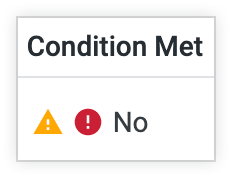
| Condition Met | A Yes or No that indicates whether the workflow conditions were met when the workflow query was last run. A -- symbol is displayed if the workflow query has not yet run or if the workflow query ran but it couldn't be determined whether the workflow conditions were met. This column displays warning icons or error icons that are related to any warnings or errors that surface when the workflow query is run or the workflow notification is delivered. Hold your pointer over the warning or error icon to see the associated error message, if applicable.A warning icon with a stale workflow warning indicates that the data on the dashboard tile did not change between the two most recent workflow queries. Read more about this message in the Alert error and warning messages section on this page. |
| Frequency | The frequency at which the workflow is run to check whether conditions have been met or exceeded. |
| Status | This column indicates whether the workflow is active or disabled. A workflow is marked as Disabled when a user disables their own workflow from the Manage Workflows user page or when a Looker admin disables the workflow. Disabling the workflow will pause notifications for any workflow recipients. |
| Activity | A link that directs you to the workflow's Activity page. |
| Options menu | A menu from which you can take additional actions on the workflow. See more in the Workflow management options section on this page. |
Manage workflows for the Looker instance
Workflow management may involve the following tasks:
- Managing workflow status
- Viewing workflow metadata on the Details page
- Monitoring workflow activity on the Activity page
- Modifying workflow conditions and thresholds
Inline with each workflow is an Options menu with these selections:
- View Workflow
- Edit Workflow
- Disable Workflow (if the workflow is active)
- Enable Workflow (if the workflow is disabled)
Click View Workflow to open the Details page.
Click Edit Workflow to open and modify the workflow's settings. Click Save Workflow to save your changes or Cancel to close the editing window without saving.
Manage the status of a workflow
Although you cannot permanently delete a workflow, you can control whether the workflow is active. When a workflow has a Status of Active, the workflow query continues to run according to the frequency that is specified in the workflow in order to check whether its conditions have been met. If conditions have been met, workflow recipients will be notified according to the notification method that's specified in the workflow. When a workflow has a Status of Disabled, no workflow query will run and no notifications will be sent. A disabled workflow's Details page shows no results in the workflow visualization.
A workflow owner or Looker admin may need to disable a workflow manually under some circumstances, which may include the following:
- Temporarily pausing workflow notifications to re-configure workflow conditions
- Troubleshooting error messages or warnings
- Resolving notification delivery failures
To disable a workflow, follow these steps:
- On the Manage Workflows admin page, find the workflow that needs to be disabled.
- Select the workflow's Options menu.
- Select Disable Workflow.
You can re-enable the workflow at any time by following these steps and selecting Enable Workflow.
View workflow details
The Details page is a dialog that shows a summary of workflow information that can be viewed by the workflow owner and any of the workflow's recipients. It shows the following information:
- Context about what conditions trigger the workflow or what it means for the workflow to be triggered.
- A visualization of the workflow query results.
- The More menu on the workflow visualization, which has an option to Explore from here. Select this option to open an Explore that is pre-set with the workflow query.
- The Test Now button, which runs an instant workflow query.
From the Manage Workflows admin page, Looker admins can view can view the Details page for any workflow on the instance in one of these ways:
- Select the workflow's Options menu, and then select View Workflow.
- Click the name of the workflow.
On the Details page, Looker admins can perform the following tasks:
- Select the text field to add context about the workflow.
- Select the More menu, and then select the Explore from here option to open an Explore that is pre-set with the workflow query.
- Select Test Now to run a workflow query instantly, without having to wait for the workflow's specified frequency. If the workflow's conditions are met, a notification will be sent to its owner and any additional recipients.
Click Done to close the Details page.
Monitor workflow activity
Looker runs a workflow query at its specified frequency to check whether its conditions have been met. The results of these checks become the workflow's history, which is viewable on the Activity page.
The table on the Activity page includes the following information about each workflow query job:
| Heading | Definition | Possible values |
|---|---|---|
| Ran At | The timestamp of when the workflow query was initiated | Any timestamp in the format DD/MM HH:MM05/30 18:25 |
| Run Time | How long the workflow query took to run | Any duration in the format 0.81s |
| Fresh | A Boolean that indicates whether the workflow query checked data that had changed between the two most recent workflow queries |
|
| Source | The origin of the data from which the workflow query checked for the threshold value that was indicated in the workflow conditions |
|
| Source Time | The timestamp of the database row from which the workflow query checked for the threshold value | Any timestamp in the format DD/MM HH:MMExample: 05/25 16:01 |
| Condition Met | A Boolean that indicates whether or not the workflow conditions were met |
|
| Trigger | The threshold value that would trigger the workflow if met or exceeded | Any numerical value |
| Observed | The observed value that met or exceeded the workflow conditions and triggered the workflow | Any numerical value |
| Status | The status of the workflow query |
|
On the Activity page, Looker admins can perform the following tasks:
- View the frequency with which the workflow query checks its conditions.
- View the workflow history.
- Use the Test Now button to run an instant workflow query — if the workflow is triggered, a notification will be sent to its owner and any additional recipients.
Click Done to close the Activity page.
Modify workflow conditions
A workflow owner or Looker admin may need to modify the workflow configuration manually under some circumstances, which may include the following:
- Enabling or disabling Gemini powered key driver analysis, which appears in the notification
- Adjusting the metric thresholds and conditions that trigger the workflow as organization needs evolve
- Updating notification destinations
- Updating the workflow frequency to align better with caching policies
To modify the settings of a workflow, following these steps:
- From the Manage Workflows page, select the Options menu for the workflow that you would like to modify.
- Select Edit Workflow, which opens the workflow editing dialog.
- Make your changes to the workflow's settings.
- Select Save Alert to save your changes.
Effect of deleting agents, conversations, Explores, or dashboards on workflows
Deleting a data agent or a conversation affects the associated workflow in the following ways:
- If a user deletes the conversation with the agent that generates the workflow, that workflow remains active. Any workflow notification recipients will continue to receive notifications when the workflow conditions are met.
- If a user deletes the agent that generates the workflow, that workflow remains active. Any workflow notification recipients will continue to receive notifications when the workflow conditions are met.
- If a user deletes the Explore or dashboard that contains the data that the workflow is monitoring, that workflow remains active. Any workflow notification recipients will continue to receive notifications when the workflow conditions are met.
Workflow error and warning messages
The Manage Workflows admin page displays any errors or warnings that are surfaced when the workflow is run or the workflow notification is delivered. Error messages, if applicable, appear when you hold your pointer over the warning icon or error icon in the Condition Met column.
Notification delivery failed with existing configuration
For workflows that are set up to deliver notifications to the Slack or the Looker mobile app, the error message Notification delivery failed with existing configuration appears when the workflow determines that the workflow conditions have been met but the notification couldn't be delivered. This failure may occur if something about the Slack configuration has changed since the workflow was created — for example, if the Slack workspace that the workflow was delivering to was disconnected from the Looker instance or if the Slack channel that the workflow was delivering to was deleted, or if Looker cannot connect to the integrations.
Warning: Querying fresh data
A warning icon in the Condition Met column indicates that the data upon which the workflow is based did not change between the two most recent workflow queries. Hold your pointer over this icon to display the message Stale Alert Warning.
There are a few possible explanations for why the data did not change between queries. If this warning persists, talk to your Looker developer to verify that the caching policies that are defined for the agent's Explores are aligned with the workflow frequency setting.
Related resources
- Conversational analytics overview
- Manage your agentic workflows
- Use agentic workflows to monitor changes in your data