

Supervisa reservas de BigQuery
Como administrador de BigQuery, puedes supervisar las reservas de tu proyecto consultando el uso de ranuras de reserva y de proyecto y visualizando tu factura basada en la capacidad.
Visualiza el uso de proyectos y ranuras de reserva
Puedes ver el uso de ranuras de reserva y de proyecto de las siguientes maneras:
Vistas de
INFORMATION_SCHEMA. Para recuperar la información de uso del proyecto y la reserva, consulta las vistas deINFORMATION_SCHEMA.JOBS*.El campo
reservation_iden las vistas deINFORMATION_SCHEMA.JOBS*contiene el nombre de la reserva.Google Cloud console. La consola Google Cloud incluye gráficos que muestran el uso de las ranuras. Para obtener más información, consulta Usa gráficos de recursos administrativos.
Registros de auditoría. Usa los registros de auditoría para ver las métricas sobre el uso de las ranuras.
El método
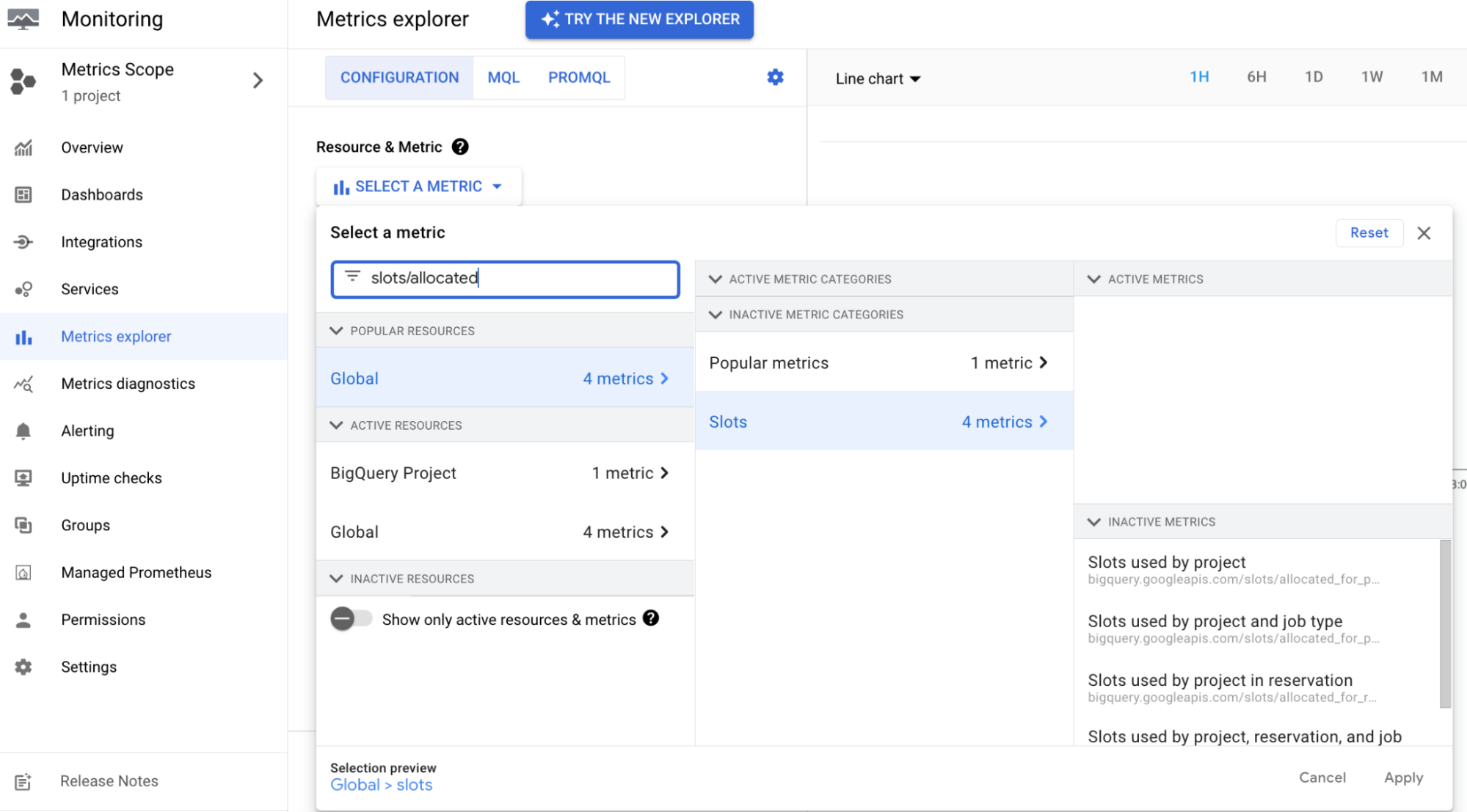
Jobs. Usa el método de la APIJobspara ver las métricas sobre el uso de las ranuras de un trabajo.Cloud Monitoring. Puedes usar Cloud Monitoring para crear paneles y supervisar tus ranuras asignadas. Con un panel de Cloud Monitoring, puedes ver el uso de ranuras para cada reserva y para cada tipo de trabajo en todos los proyectos de la reserva. Para obtener más información sobre las métricas disponibles en el panel de Cloud Monitoring, consulta Métricas disponibles para la visualización.
Visualiza tu factura basada en la capacidad
Para ver tu factura basada en la capacidad en tiempo real, sigue estos pasos:
En la consola de Google Cloud , ve a la página Facturación.
Selecciona el proyecto de la cuenta de facturación cuya factura deseas ver.
Navega a la sección Informes y, luego, en la sección Filtros, haz lo siguiente:
- En la lista Servicios, selecciona BigQuery y todas las opciones que correspondan.
- Selecciona Todos los SKU de la lista SKU.
Atribución del costo de la reserva
Esta función te permite atribuir las tarifas de reserva al uso específico de la consulta en todos los proyectos que usaron la reserva. Esta función genera costos netos más precisos para cada proyecto.
Todos los clientes de la API de BigQuery Reservations tienen una línea de pedido de “Análisis de atribución de ranuras” en sus datos de la Facturación de Cloud. Este concepto se incluye en la página Facturación y en la exportación de la Facturación de Cloud.
En esta línea de pedido, se muestran las horas de ranura utilizadas por proyecto. No genera costos y no afecta los totales de tu factura.
Registros de auditoría
La creación, eliminación y actualización de los recursos relacionados con las reservas de BigQuery se registran en los registros de auditoría del propietario del proyecto. Para obtener más información, consulta Registro de auditoría.
Supervisa el ajuste de escala automático con el esquema de información
Puedes usar las siguientes secuencias de comandos de SQL para verificar los segundos de ranura facturados para una edición en particular. Debes ejecutar estos secuencias de comandos en el mismo proyecto en el que se crearon las reservas. El primer código muestra los segundos de espacios facturados cubiertos por commitment_plan, mientras que el segundo muestra los segundos de espacios facturados que no están cubiertos por un compromiso.
Solo necesitas establecer el valor de tres variables para ejecutar estos secuencias de comandos:
start_timeend_timeedition_to_check
Estas secuencias de comandos están sujetas a las siguientes advertencias:
Las reservas y los compromisos de capacidad borrados se quitan de las vistas del esquema de información al final del período de retención de datos. Especifica un período reciente que no contenga reservas ni compromisos borrados para obtener resultados correctos.
Es posible que el resultado de las secuencias de comandos no coincida exactamente con la factura debido a pequeños errores de redondeo.
La siguiente secuencia de comandos agrega las ranuras de ajuste de escala automático por edición.
Expande para ver la secuencia de comandos para calcular los segundos de ranura de ajuste de escala automático por edición.
SELECT
  edition,
  SUM(s.autoscale_current_slots) AS autoscale_slot_seconds
FROM
  `region-us.INFORMATION_SCHEMA.RESERVATIONS_TIMELINE` m
JOIN
  m.per_second_details s
WHERE
  period_start BETWEEN '2025-09-28'
  AND '2025-09-29'
GROUP BY
  edition
ORDER BY
  edition
La siguiente secuencia de comandos agrega las ranuras de ajuste de escala automático por reserva.
Expande para ver la secuencia de comandos para calcular los segundos de ranura de ajuste de escala automático por reserva.
select reservation_id, sum(s.autoscale_current_slots) as autoscale_slot_seconds
from `region-us.INFORMATION_SCHEMA.RESERVATIONS_TIMELINE` m
LEFT JOIN m.per_second_details s
WHERE period_start between '2025-09-28' and '2025-09-29'
group by reservation_id
order by reservation_id
Expande para ver la secuencia de comandos para calcular los segundos de ranura a partir de los compromisos.
DECLARE start_time,end_time TIMESTAMP;

DECLARE
  edition_to_check STRING;

/* Google uses Pacific Time to calculate the billing period for all customers,
regardless of their time zone. Use the following format if you want to match the
billing report. Change the start_time and end_time values to match the desired
window. */

/* The following three variables (start_time, end_time, and edition_to_check)
are the only variables that you need to set in the script.

During daylight savings time, the start_time and end_time variables should
follow this format: 2024-02-20 00:00:00-08. */

SET start_time = "2023-07-20 00:00:00-07";
SET end_time = "2023-07-28 00:00:00-07";
SET edition_to_check = 'ENTERPRISE';

/* The following function returns the slot seconds for the time window between
two capacity changes. For example, if there are 100 slots between (2023-06-01
10:00:00, 2023-06-01 11:00:00), then during that window the total slot seconds
will be 100 * 3600.

This script calculates a specific window (based on the variables defined above),
which is why the following script includes script_start_timestamp_unix_millis
and script_end_timestamp_unix_millis. */

CREATE TEMP FUNCTION
GetSlotSecondsBetweenChanges(
  slots FLOAT64,
  range_begin_timestamp_unix_millis FLOAT64,
  range_end_timestamp_unix_millis FLOAT64,
  script_start_timestamp_unix_millis FLOAT64,
  script_end_timestamp_unix_millis FLOAT64)
RETURNS INT64
LANGUAGE js
AS r"""
    if (script_end_timestamp_unix_millis < range_begin_timestamp_unix_millis || script_start_timestamp_unix_millis > range_end_timestamp_unix_millis) {
      return 0;
    }
    var begin = Math.max(script_start_timestamp_unix_millis, range_begin_timestamp_unix_millis)
    var end = Math.min(script_end_timestamp_unix_millis, range_end_timestamp_unix_millis)
    return slots * Math.ceil((end - begin) / 1000.0)
""";

/*
Sample CAPACITY_COMMITMENT_CHANGES data (unrelated columns ignored):
+---------------------+------------------------+-----------------+--------+------------+--------+
|  change_timestamp   | capacity_commitment_id | commitment_plan | state  | slot_count | action |
+---------------------+------------------------+-----------------+--------+------------+--------+
| 2023-07-20 19:30:27 | 12954109101902401697   | ANNUAL          | ACTIVE |        100 | CREATE |
| 2023-07-27 22:29:21 | 11445583810276646822   | FLEX            | ACTIVE |        100 | CREATE |
| 2023-07-27 23:10:06 | 7341455530498381779    | MONTHLY         | ACTIVE |        100 | CREATE |
| 2023-07-27 23:11:06 | 7341455530498381779    | FLEX            | ACTIVE |        100 | UPDATE |

The last row indicates a special change from MONTHLY to FLEX, which happens
because of commercial migration.

*/

WITH
  /*
  Information containing which commitment might have plan
  updated (e.g. renewal or commercial migration). For example:
  +------------------------+------------------+--------------------+--------+------------+--------+-----------+----------------------------+
  |  change_timestamp   | capacity_commitment_id | commitment_plan | state  | slot_count | action | next_plan | next_plan_change_timestamp |
  +---------------------+------------------------+-----------------+--------+------------+--------+-----------+----------------------------+
  | 2023-07-20 19:30:27 | 12954109101902401697   | ANNUAL          | ACTIVE |        100 | CREATE | ANNUAL    |        2023-07-20 19:30:27 |
  | 2023-07-27 22:29:21 | 11445583810276646822   | FLEX            | ACTIVE |        100 | CREATE | FLEX      |        2023-07-27 22:29:21 |
  | 2023-07-27 23:10:06 | 7341455530498381779    | MONTHLY         | ACTIVE |        100 | CREATE | FLEX      |        2023-07-27 23:11:06 |
  | 2023-07-27 23:11:06 | 7341455530498381779    | FLEX            | ACTIVE |        100 | UPDATE | FLEX      |        2023-07-27 23:11:06 |
  */
  commitments_with_next_plan AS (
    SELECT
      *,
      IFNULL(
        LEAD(commitment_plan)
          OVER (
            PARTITION BY capacity_commitment_id ORDER BY change_timestamp ASC
          ),
        commitment_plan)
        next_plan,
      IFNULL(
        LEAD(change_timestamp)
          OVER (
            PARTITION BY capacity_commitment_id ORDER BY change_timestamp ASC
          ),
        change_timestamp)
        next_plan_change_timestamp
    FROM
      `region-us.INFORMATION_SCHEMA.CAPACITY_COMMITMENT_CHANGES_BY_PROJECT`
  ),

  /*
  Insert a 'DELETE' action for those with updated plans. The FLEX commitment
  '7341455530498381779' is has no 'CREATE' action, and is instead labeled as an
  'UPDATE' action.

  For example:
  +---------------------+------------------------+-----------------+--------+------------+--------+
  |  change_timestamp   | capacity_commitment_id | commitment_plan | state  | slot_count | action |
  +---------------------+------------------------+-----------------+--------+------------+--------+
  | 2023-07-20 19:30:27 | 12954109101902401697   | ANNUAL          | ACTIVE |        100 | CREATE |
  | 2023-07-27 22:29:21 | 11445583810276646822   | FLEX            | ACTIVE |        100 | CREATE |
  | 2023-07-27 23:10:06 | 7341455530498381779    | MONTHLY         | ACTIVE |        100 | CREATE |
  | 2023-07-27 23:11:06 | 7341455530498381779    | FLEX            | ACTIVE |        100 | UPDATE |
  | 2023-07-27 23:11:06 | 7341455530498381779    | MONTHLY         | ACTIVE |        100 | DELETE |
  */

  capacity_changes_with_additional_deleted_event_for_changed_plan AS (
    SELECT
      next_plan_change_timestamp AS change_timestamp,
      project_id,
      project_number,
      capacity_commitment_id,
      commitment_plan,
      state,
      slot_count,
      'DELETE' AS action,
      commitment_start_time,
      commitment_end_time,
      failure_status,
      renewal_plan,
      user_email,
      edition,
      is_flat_rate,
    FROM commitments_with_next_plan
    WHERE commitment_plan <> next_plan
    UNION ALL
    SELECT * FROM `region-us.INFORMATION_SCHEMA.CAPACITY_COMMITMENT_CHANGES_BY_PROJECT`
  ),

  /*
  The committed_slots change the history. For example:
  +---------------------+------------------------+------------------+-----------------+
  |  change_timestamp   | capacity_commitment_id | slot_count_delta | commitment_plan |
  +---------------------+------------------------+------------------+-----------------+
  | 2023-07-20 19:30:27 | 12954109101902401697   |              100 | ANNUAL          |
  | 2023-07-27 22:29:21 | 11445583810276646822   |              100 | FLEX            |
  | 2023-07-27 23:10:06 | 7341455530498381779    |              100 | MONTHLY         |
  | 2023-07-27 23:11:06 | 7341455530498381779    |             -100 | MONTHLY         |
  | 2023-07-27 23:11:06 | 7341455530498381779    |              100 | FLEX            |
  */

  capacity_commitment_slot_data AS (
    SELECT
      change_timestamp,
      capacity_commitment_id,
      CASE
        WHEN action = "CREATE" OR action = "UPDATE"
          THEN
            IFNULL(
              IF(
                LAG(action)
                  OVER (
                    PARTITION BY capacity_commitment_id ORDER BY change_timestamp ASC, action ASC
                  )
                  IN UNNEST(['CREATE', 'UPDATE']),
                slot_count - LAG(slot_count)
                  OVER (
                    PARTITION BY capacity_commitment_id ORDER BY change_timestamp ASC, action ASC
                  ),
                slot_count),
              slot_count)
        ELSE
          IF(
            LAG(action)
              OVER (PARTITION BY capacity_commitment_id ORDER BY change_timestamp ASC, action ASC)
              IN UNNEST(['CREATE', 'UPDATE']),
            -1 * slot_count,
            0)
        END
        AS slot_count_delta,
      commitment_plan
    FROM
      capacity_changes_with_additional_deleted_event_for_changed_plan
    WHERE
      state = "ACTIVE"
      AND edition = edition_to_check
      AND change_timestamp <= end_time
  ),

  /*
  The total_committed_slots history for each plan. For example:
  +---------------------+---------------+-----------------+
  |  change_timestamp   | capacity_slot | commitment_plan |
  +---------------------+---------------+-----------------+
  | 2023-07-20 19:30:27 |           100 | ANNUAL          |
  | 2023-07-27 22:29:21 |           100 | FLEX            |
  | 2023-07-27 23:10:06 |           100 | MONTHLY         |
  | 2023-07-27 23:11:06 |             0 | MONTHLY         |
  | 2023-07-27 23:11:06 |           200 | FLEX            |
  */

  running_capacity_commitment_slot_data AS (
    SELECT
      change_timestamp,
      SUM(slot_count_delta)
        OVER (
          PARTITION BY commitment_plan
          ORDER BY change_timestamp
          RANGE BETWEEN UNBOUNDED PRECEDING AND CURRENT ROW
        )
        AS capacity_slot,
      commitment_plan,
    FROM
      capacity_commitment_slot_data
  ),

  /*

  The slot_seconds between each changes, partitioned by each plan. For example:
  +---------------------+--------------+-----------------+
  |  change_timestamp   | slot_seconds | commitment_plan |
  +---------------------+--------------+-----------------+
  | 2023-07-20 19:30:27 |     64617300 | ANNUAL          |
  | 2023-07-27 22:29:21 |       250500 | FLEX            |
  | 2023-07-27 23:10:06 |         6000 | MONTHLY         |
  | 2023-07-27 23:11:06 |            0 | MONTHLY         |
  | 2023-07-27 23:11:06 |      5626800 | FLEX            |
  */

  slot_seconds_data AS (
    SELECT
      change_timestamp,
      GetSlotSecondsBetweenChanges(
        capacity_slot,
        UNIX_MILLIS(change_timestamp),
        UNIX_MILLIS(
          IFNULL(
            LEAD(change_timestamp)
              OVER (PARTITION BY commitment_plan ORDER BY change_timestamp ASC),
            CURRENT_TIMESTAMP())),
        UNIX_MILLIS(start_time),
        UNIX_MILLIS(end_time)) AS slot_seconds,
      commitment_plan,
    FROM
      running_capacity_commitment_slot_data
    WHERE
      change_timestamp <= end_time
  )

/*

The final result is similar to the following:
+-----------------+--------------------+
| commitment_plan | total_slot_seconds |
+-----------------+--------------------+
| ANNUAL          |           64617300 |
| MONTHLY         |               6000 |
| FLEX            |            5877300 |
*/

SELECT
  commitment_plan,
  SUM(slot_seconds) AS total_slot_seconds
FROM
  slot_seconds_data
GROUP BY
  commitment_plan
La siguiente secuencia de comandos verifica el uso de ranuras que no cubren los compromisos para una edición en particular. Este uso contiene dos tipos de ranuras: ranuras escaladas y ranuras del modelo de referencia no cubiertas por compromisos.
Expande para ver la secuencia de comandos para calcular los segundos de espacios publicitarios no cubiertos por compromisos
/*
This script has several parts:
1. Calculate the baseline and scaled slots for reservations
2. Calculate the committed slots
3. Join the two results above to calculate the baseline not covered by committed
   slots
4. Aggregate the number
*/

-- variables
DECLARE start_time, end_time TIMESTAMP;

DECLARE
  edition_to_check STRING;

/* Google uses Pacific Time to calculate the billing period for all customers,
regardless of their time zone. Use the following format if you want to match the
billing report. Change the start_time and end_time values to match the desired
window. */

/* The following three variables (start_time, end_time, and edition_to_check)
are the only variables that you need to set in the script.

During daylight savings time, the start_time and end_time variables should
follow this format: 2024-02-20 00:00:00-08. */

SET start_time = "2023-07-20 00:00:00-07";
SET end_time = "2023-07-28 00:00:00-07";
SET edition_to_check = 'ENTERPRISE';

/*
The following function returns the slot seconds for the time window between
two capacity changes. For example, if there are 100 slots between (2023-06-01
10:00:00, 2023-06-01 11:00:00), then during that window the total slot seconds
will be 100 * 3600.

This script calculates a specific window (based on the variables defined above),
which is why the following script includes script_start_timestamp_unix_millis
and script_end_timestamp_unix_millis. */

CREATE TEMP FUNCTION GetSlotSecondsBetweenChanges(
  slots FLOAT64,
  range_begin_timestamp_unix_millis FLOAT64,
  range_end_timestamp_unix_millis FLOAT64,
  script_start_timestamp_unix_millis FLOAT64,
  script_end_timestamp_unix_millis FLOAT64)
RETURNS INT64
LANGUAGE js
AS r"""
    if (script_end_timestamp_unix_millis < range_begin_timestamp_unix_millis || script_start_timestamp_unix_millis > range_end_timestamp_unix_millis) {
      return 0;
    }
    var begin = Math.max(script_start_timestamp_unix_millis, range_begin_timestamp_unix_millis)
    var end = Math.min(script_end_timestamp_unix_millis, range_end_timestamp_unix_millis)
    return slots * Math.ceil((end - begin) / 1000.0)
""";
/*
Sample RESERVATION_CHANGES data (unrelated columns ignored):
+---------------------+------------------+--------+---------------+---------------+
|  change_timestamp   | reservation_name | action | slot_capacity | current_slots |
+---------------------+------------------+--------+---------------+---------------+
| 2023-07-27 22:24:15 | res1             | CREATE |           300 |             0 |
| 2023-07-27 22:25:21 | res1             | UPDATE |           300 |           180 |
| 2023-07-27 22:39:14 | res1             | UPDATE |           300 |           100 |
| 2023-07-27 22:40:20 | res2             | CREATE |           300 |             0 |
| 2023-07-27 22:54:18 | res2             | UPDATE |           300 |           120 |
| 2023-07-27 22:55:23 | res1             | UPDATE |           300 |             0 |

Sample CAPACITY_COMMITMENT_CHANGES data (unrelated columns ignored):
+---------------------+------------------------+-----------------+--------+------------+--------+
|  change_timestamp   | capacity_commitment_id | commitment_plan | state  | slot_count | action |
+---------------------+------------------------+-----------------+--------+------------+--------+
| 2023-07-20 19:30:27 | 12954109101902401697   | ANNUAL          | ACTIVE |        100 | CREATE |
| 2023-07-27 22:29:21 | 11445583810276646822   | FLEX            | ACTIVE |        100 | CREATE |
| 2023-07-27 23:10:06 | 7341455530498381779    | MONTHLY         | ACTIVE |        100 | CREATE |
*/

WITH
  /*
  The scaled_slots & baseline change history:
  +---------------------+------------------+------------------------------+---------------------+
  |  change_timestamp   | reservation_name | autoscale_current_slot_delta | baseline_slot_delta |
  +---------------------+------------------+------------------------------+---------------------+
  | 2023-07-27 22:24:15 | res1             |                            0 |                 300 |
  | 2023-07-27 22:25:21 | res1             |                          180 |                   0 |
  | 2023-07-27 22:39:14 | res1             |                          -80 |                   0 |
  | 2023-07-27 22:40:20 | res2             |                            0 |                 300 |
  | 2023-07-27 22:54:18 | res2             |                          120 |                   0 |
  | 2023-07-27 22:55:23 | res1             |                         -100 |                   0 |
  */
  reservation_slot_data AS (
    SELECT
      change_timestamp,
      reservation_name,
      CASE action
        WHEN "CREATE" THEN autoscale.current_slots
        WHEN "UPDATE"
          THEN
            IFNULL(
              autoscale.current_slots - LAG(autoscale.current_slots)
                OVER (
                  PARTITION BY project_id, reservation_name
                  ORDER BY change_timestamp ASC, action ASC
                ),
              IFNULL(
                autoscale.current_slots,
                IFNULL(
                  -1 * LAG(autoscale.current_slots)
                    OVER (
                      PARTITION BY project_id, reservation_name
                      ORDER BY change_timestamp ASC, action ASC
                    ),
                  0)))
        WHEN "DELETE"
          THEN
            IF(
              LAG(action)
                OVER (
                  PARTITION BY project_id, reservation_name
                  ORDER BY change_timestamp ASC, action ASC
                )
                IN UNNEST(['CREATE', 'UPDATE']),
              -1 * autoscale.current_slots,
              0)
        END
        AS autoscale_current_slot_delta,
      CASE action
        WHEN "CREATE" THEN slot_capacity
        WHEN "UPDATE"
          THEN
            IFNULL(
              slot_capacity - LAG(slot_capacity)
                OVER (
                  PARTITION BY project_id, reservation_name
                  ORDER BY change_timestamp ASC, action ASC
                ),
              IFNULL(
                slot_capacity,
                IFNULL(
                  -1 * LAG(slot_capacity)
                    OVER (
                      PARTITION BY project_id, reservation_name
                      ORDER BY change_timestamp ASC, action ASC
                    ),
                  0)))
        WHEN "DELETE"
          THEN
            IF(
              LAG(action)
                OVER (
                  PARTITION BY project_id, reservation_name
                  ORDER BY change_timestamp ASC, action ASC
                )
                IN UNNEST(['CREATE', 'UPDATE']),
              -1 * slot_capacity,
              0)
        END
        AS baseline_slot_delta,
    FROM
      `region-us.INFORMATION_SCHEMA.RESERVATION_CHANGES`
    WHERE
      edition = edition_to_check
      AND change_timestamp <= end_time
  ),

  -- Convert the above to running total
  /*
  +---------------------+-------------------------+----------------+
  |  change_timestamp   | autoscale_current_slots | baseline_slots |
  +---------------------+-------------------------+----------------+
  | 2023-07-27 22:24:15 |                       0 |            300 |
  | 2023-07-27 22:25:21 |                     180 |            300 |
  | 2023-07-27 22:39:14 |                     100 |            300 |
  | 2023-07-27 22:40:20 |                     100 |            600 |
  | 2023-07-27 22:54:18 |                     220 |            600 |
  | 2023-07-27 22:55:23 |                     120 |            600 |
  */
  running_reservation_slot_data AS (
    SELECT
      change_timestamp,
      SUM(autoscale_current_slot_delta)
        OVER (ORDER BY change_timestamp RANGE BETWEEN UNBOUNDED PRECEDING AND CURRENT ROW)
        AS autoscale_current_slots,
      SUM(baseline_slot_delta)
        OVER (ORDER BY change_timestamp RANGE BETWEEN UNBOUNDED PRECEDING AND CURRENT ROW)
        AS baseline_slots,
    FROM
      reservation_slot_data
  ),

  /*
  The committed_slots change history. For example:
  +---------------------+------------------------+------------------+
  |  change_timestamp   | capacity_commitment_id | slot_count_delta |
  +---------------------+------------------------+------------------+
  | 2023-07-20 19:30:27 | 12954109101902401697   |              100 |
  | 2023-07-27 22:29:21 | 11445583810276646822   |              100 |
  | 2023-07-27 23:10:06 | 7341455530498381779    |              100 |
  */
  capacity_commitment_slot_data AS (
    SELECT
      change_timestamp,
      capacity_commitment_id,
      CASE
        WHEN action = "CREATE" OR action = "UPDATE"
          THEN
            IFNULL(
              IF(
                LAG(action)
                  OVER (
                    PARTITION BY capacity_commitment_id ORDER BY change_timestamp ASC, action ASC
                  )
                  IN UNNEST(['CREATE', 'UPDATE']),
                slot_count - LAG(slot_count)
                  OVER (
                    PARTITION BY capacity_commitment_id ORDER BY change_timestamp ASC, action ASC
                  ),
                slot_count),
              slot_count)
        ELSE
          IF(
            LAG(action)
              OVER (PARTITION BY capacity_commitment_id ORDER BY change_timestamp ASC, action ASC)
              IN UNNEST(['CREATE', 'UPDATE']),
            -1 * slot_count,
            0)
        END
        AS slot_count_delta
    FROM
      `region-us.INFORMATION_SCHEMA.CAPACITY_COMMITMENT_CHANGES_BY_PROJECT`
    WHERE
      state = "ACTIVE"
      AND edition = edition_to_check
      AND change_timestamp <= end_time
  ),

  /*
  The total_committed_slots history. For example:
  +---------------------+---------------+
  |  change_timestamp   | capacity_slot |
  +---------------------+---------------+
  | 2023-07-20 19:30:27 |           100 |
  | 2023-07-27 22:29:21 |           200 |
  | 2023-07-27 23:10:06 |           300 |
  */
  running_capacity_commitment_slot_data AS (
    SELECT
      change_timestamp,
      SUM(slot_count_delta)
        OVER (ORDER BY change_timestamp RANGE BETWEEN UNBOUNDED PRECEDING AND CURRENT ROW)
        AS capacity_slot
    FROM
      capacity_commitment_slot_data
  ),

  /* Add next_change_timestamp to the above data,
   which will be used when joining with reservation data. For example:
  +---------------------+-----------------------+---------------+
  |  change_timestamp   | next_change_timestamp | capacity_slot |
  +---------------------+-----------------------+---------------+
  | 2023-07-20 19:30:27 |   2023-07-27 22:29:21 |           100 |
  | 2023-07-27 22:29:21 |   2023-07-27 23:10:06 |           200 |
  | 2023-07-27 23:10:06 |   2023-07-31 00:14:37 |           300 |
  */
  running_capacity_commitment_slot_data_with_next_change AS (
    SELECT
      change_timestamp,
      IFNULL(LEAD(change_timestamp) OVER (ORDER BY change_timestamp ASC), CURRENT_TIMESTAMP())
        AS next_change_timestamp,
      capacity_slot
    FROM
      running_capacity_commitment_slot_data
  ),

  /*
  Whenever we have a change in reservations or commitments,
  the scaled_slots_and_baseline_not_covered_by_commitments will be changed.
  Hence we get a collection of all the change_timestamp from both tables.
  +---------------------+
  |  change_timestamp   |
  +---------------------+
  | 2023-07-20 19:30:27 |
  | 2023-07-27 22:24:15 |
  | 2023-07-27 22:25:21 |
  | 2023-07-27 22:29:21 |
  | 2023-07-27 22:39:14 |
  | 2023-07-27 22:40:20 |
  | 2023-07-27 22:54:18 |
  | 2023-07-27 22:55:23 |
  | 2023-07-27 23:10:06 |
  */
  merged_timestamp AS (
    SELECT
      change_timestamp
    FROM
      running_reservation_slot_data
    UNION DISTINCT
    SELECT
      change_timestamp
    FROM
      running_capacity_commitment_slot_data
  ),

  /*
  Change running reservation-slots and make sure we have one row when commitment changes.
  +---------------------+-------------------------+----------------+
  |  change_timestamp   | autoscale_current_slots | baseline_slots |
  +---------------------+-------------------------+----------------+
  | 2023-07-20 19:30:27 |                       0 |              0 |
  | 2023-07-27 22:24:15 |                       0 |            300 |
  | 2023-07-27 22:25:21 |                     180 |            300 |
  | 2023-07-27 22:29:21 |                     180 |            300 |
  | 2023-07-27 22:39:14 |                     100 |            300 |
  | 2023-07-27 22:40:20 |                     100 |            600 |
  | 2023-07-27 22:54:18 |                     220 |            600 |
  | 2023-07-27 22:55:23 |                     120 |            600 |
  | 2023-07-27 23:10:06 |                     120 |            600 |
  */
  running_reservation_slot_data_with_merged_timestamp AS (
    SELECT
      change_timestamp,
      IFNULL(
        autoscale_current_slots,
        IFNULL(
          LAST_VALUE(autoscale_current_slots IGNORE NULLS) OVER (ORDER BY change_timestamp ASC), 0))
        AS autoscale_current_slots,
      IFNULL(
        baseline_slots,
        IFNULL(LAST_VALUE(baseline_slots IGNORE NULLS) OVER (ORDER BY change_timestamp ASC), 0))
        AS baseline_slots
    FROM
      running_reservation_slot_data
    RIGHT JOIN
      merged_timestamp
      USING (change_timestamp)
  ),

  /*
  Join the above, so that we will know the number for baseline not covered by commitments.
  +---------------------+-----------------------+-------------------------+------------------------------------+
  |  change_timestamp   | next_change_timestamp | autoscale_current_slots | baseline_not_covered_by_commitment |
  +---------------------+-----------------------+-------------------------+------------------------------------+
  | 2023-07-20 19:30:27 |   2023-07-27 22:24:15 |                       0 |                                  0 |
  | 2023-07-27 22:24:15 |   2023-07-27 22:25:21 |                       0 |                                200 |
  | 2023-07-27 22:25:21 |   2023-07-27 22:29:21 |                     180 |                                200 |
  | 2023-07-27 22:29:21 |   2023-07-27 22:39:14 |                     180 |                                100 |
  | 2023-07-27 22:39:14 |   2023-07-27 22:40:20 |                     100 |                                100 |
  | 2023-07-27 22:40:20 |   2023-07-27 22:54:18 |                     100 |                                400 |
  | 2023-07-27 22:54:18 |   2023-07-27 22:55:23 |                     220 |                                400 |
  | 2023-07-27 22:55:23 |   2023-07-27 23:10:06 |                     120 |                                400 |
  | 2023-07-27 23:10:06 |   2023-07-31 00:16:07 |                     120 |                                300 |
  */
  scaled_slots_and_baseline_not_covered_by_commitments AS (
    SELECT
      r.change_timestamp,
      IFNULL(LEAD(r.change_timestamp) OVER (ORDER BY r.change_timestamp ASC), CURRENT_TIMESTAMP())
        AS next_change_timestamp,
      r.autoscale_current_slots,
      IF(
        r.baseline_slots - IFNULL(c.capacity_slot, 0) > 0,
        r.baseline_slots - IFNULL(c.capacity_slot, 0),
        0) AS baseline_not_covered_by_commitment
    FROM
      running_reservation_slot_data_with_merged_timestamp r
    LEFT JOIN
      running_capacity_commitment_slot_data_with_next_change c
      ON
        r.change_timestamp >= c.change_timestamp
        AND r.change_timestamp < c.next_change_timestamp
  ),

  /*
  The slot_seconds between each changes. For example:
  +---------------------+--------------------+
  |  change_timestamp   | slot_seconds |
  +---------------------+--------------+
  | 2023-07-20 19:30:27 |            0 |
  | 2023-07-27 22:24:15 |        13400 |
  | 2023-07-27 22:25:21 |        91580 |
  | 2023-07-27 22:29:21 |       166320 |
  | 2023-07-27 22:39:14 |        13200 |
  | 2023-07-27 22:40:20 |       419500 |
  | 2023-07-27 22:54:18 |        40920 |
  | 2023-07-27 22:55:23 |       459160 |
  | 2023-07-27 23:10:06 |     11841480 |
  */
  slot_seconds_data AS (
    SELECT
      change_timestamp,
      GetSlotSecondsBetweenChanges(
        autoscale_current_slots + baseline_not_covered_by_commitment,
        UNIX_MILLIS(change_timestamp),
        UNIX_MILLIS(next_change_timestamp),
        UNIX_MILLIS(start_time),
        UNIX_MILLIS(end_time)) AS slot_seconds
    FROM
      scaled_slots_and_baseline_not_covered_by_commitments
    WHERE
      change_timestamp <= end_time AND next_change_timestamp > start_time
  )

/*
Final result for this example:
+--------------------+
| total_slot_seconds |
+--------------------+
|           13045560 |
*/
SELECT
  SUM(slot_seconds) AS total_slot_seconds
FROM
  slot_seconds_data
¿Qué sigue?
- Obtén más información sobre los planes de compromiso de capacidad.
- Aprende a usar gráficos de recursos administrativos.
- Obtén más información sobre los precios de BigQuery.