

This document provides a reference architecture to help you design and deploy a multi-tenant agentic AI system on Google Cloud. As your organization scales generative AI deployments, different business units require specialized AI agents that access unique tools, follow specific operational rules, and process sensitive data. Business units might develop fragmented application silos within an organization, which can cause high operational overhead, severe governance gaps, and a risk of data exposure. This architecture shows you how to build a centralized system that lets you empower decentralized teams with autonomous AI capabilities while you maintain unified security and compliance.
The intended audience for this document includes architects, developers, and administrators who build and manage enterprise-grade, multi-agent systems in the cloud. The document assumes that you have a foundational understanding of AI, ML, and LLM concepts, and of agentic AI.
The deployment section of this document provides an implementation strategy to help you build and deploy a multi-tenant agentic AI system.
Architecture
The following diagram shows an architecture for a multi-tenant agentic AI system that follows a hub-and-spoke model. A hub-and-spoke model is a network design where a central environment, which is known as a hub, connects to multiple isolated environments, which are known as spokes.
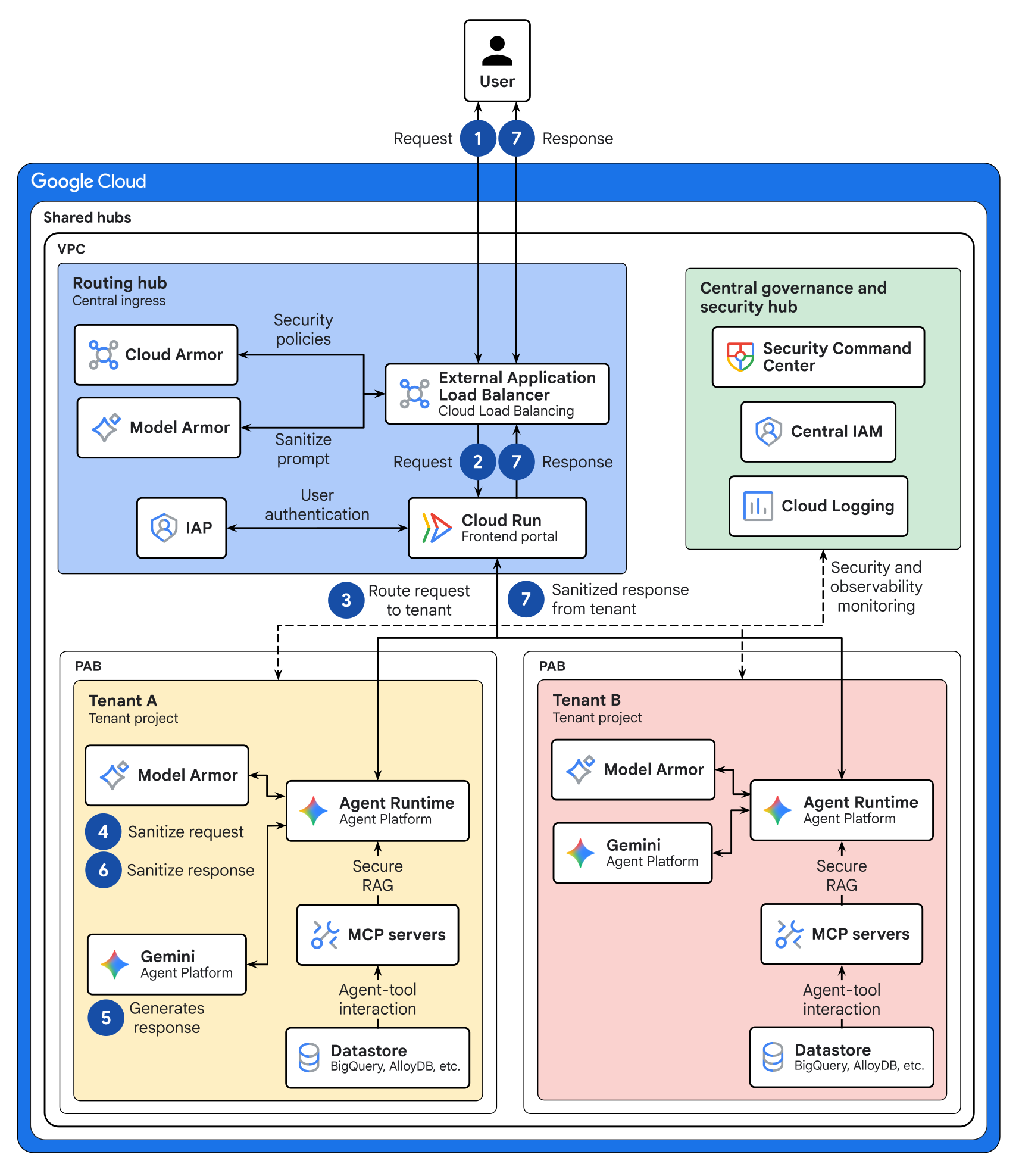
The architecture consists of the following components:
| Component | Description |
|---|---|
| VPC Service Controls | The architecture uses VPC Service Controls to configure a service perimeter at the organization level. This service perimeter provides a strict security boundary and it helps prevent data exfiltration. |
| Routing hub |
The routing hub acts as the central ingress point for the architecture and it includes the following components:
|
| Central governance and security hub |
The central governance and security hub is a dedicated Google Cloud project that provides centralized Identity and Access Management (IAM), logging, monitoring, and security for the entire platform. This hub includes the following components:
|
| Tenant projects |
Each tenant project is a dedicated Google Cloud project for each business unit. Individual tenant projects are isolated environments that include the following components:
|
Agentic flow
The example multi-tenant system in the preceding architecture has the following flow:
- A user's request is routed through an external Application Load Balancer. Within the routing hub,
these checks are completed to help ensure that only authenticated and safe
traffic reaches the frontend portal:
- Cloud Armor applies security policies to absorb any initial Layer 4 network protocol-based distributed denial-of-service (DDoS) attacks. Cloud Armor inspects the request and filters malicious traffic, such as SQL injection (SQLi), cross-site scripting (XSS), and known bot signatures.
- Model Armor intercepts the payload to detect and reject prompt injection attacks or malicious intent.
- If any of these layers detect a threat or unauthorized access, then the load balancer drops the request at the network edge.
- If the security layers detect no threat and they validate the user's access, then the load balancer routes the traffic to the backend service.
- If the request passes all checks, the load balancer routes the request to the
frontend platform, which performs the following actions:
- Extracts the user's identity, such as the user's business unit or tenant ID.
- Uses IAP to verify the user's corporate identity and device health.
- Uses a dynamically maintained registry to identify the correct target tenant.
- The frontend portal routes the request to the tenant. To help ensure that the agent can't access other tenant projects or unauthorized Google Cloud services, Agent Runtime uses a PAB Policy to limit the resources that the agent can access.
- Model Armor uses Sensitive Data Protection to inspect and dynamically mask any personally identifiable information (PII) or restricted content. Model Armor performs an additional check for malicious prompt injections from the request to help ensure that the agent only processes safe data.
Gemini performs the following tasks to generate a response:
- Performs an initial reasoning pass to understand the user's intent.
- If Gemini determines that it lacks specific facts, then it
generates a plan to call the tenant's specific data tools:
- To verify whether a user has permission to access the data resources, the agent verifies the user's identity and IAM role bindings.
- To retrieve context, the agent executes a tool call through the MCP server to the tenant datastore.
- The agent creates a grounded response by combining its internal logic with the newly retrieved, tenant-specific facts.
If Gemini doesn't need additional facts, then it generates a response and sends the response to Model Armor.
Model Armor inspects and dynamically masks any PII or restricted content and sends the sanitized response to the tenant agent. This final inspection helps to ensure that no sensitive data leaks in the output.
The response is routed back to the user, from the tenant agent through the frontend platform and then through the load balancer.
Products used
This reference architecture uses the following Google Cloud and open-source products and tools, chosen for their serverless nature, scalability, and security features:
- VPC Service Controls: A managed networking functionality that minimizes data exfiltration risks for your Google Cloud resources.
- Cloud Load Balancing: A portfolio of high performance, scalable, global and regional load balancers.
- Google Cloud Armor: A network security service that offers web application firewall (WAF) rules and helps to protect against DDoS and application attacks.
- Model Armor: A service that provides protection for your generative and agentic AI resources against prompt injection, sensitive data leaks, and harmful content.
- Identity-Aware Proxy (IAP): A service that enables a zero-trust access model for your applications and virtual machines.
- Identity and Access Management (IAM): A system that lets you create and manage permissions for Google Cloud resources.
- Cloud Run: A serverless compute platform that lets you run containers directly on top of Google's scalable infrastructure.
- Gemini Enterprise Agent Platform: A comprehensive platform that lets you build, scale, govern, and optimize enterprise‑grade AI agents.
- Gemini: A family of multimodal AI models developed by Google.
- Model Context Protocol (MCP): An open-source standard for connecting AI applications to external systems.
- Cloud Logging: A real-time log management system with storage, search, analysis, and alerting.
Use case
Multi-tenant agentic AI systems are suitable for enterprise organizations that want to scale generative AI deployments beyond a single application. To identify use cases that this architecture is suitable for, analyze your business processes and identify different teams that require their own specialized AI agents that access unique tools and sensitive data. This approach helps you empower decentralized teams with autonomous AI capabilities while you maintain unified security and corporate compliance.
The following is an example use case for a multi-tenant agentic AI system.
Enterprise-wide customer service
You can adapt this reference architecture to provide AI-powered customer service across distinct business divisions. For example, to support an electronics division and a home goods division, you deploy an electronics agent and a home goods agent as two separate agents in separate tenant projects. These specialized AI agents act as intelligent assistants that handle division-specific support inquiries by accessing unique technical specifications, warranties, or return policies. This automation lets human support teams focus on more complex customer escalations.
For this use case, the architecture provides the following benefits:
- Strict data isolation: The multi-tenant design helps ensure that the support knowledge for each division is strictly isolated. PAB Policy provides guardrails that help ensure that an agent identity in one tenant can't access data in another tenant.
- Specialized agent knowledge: Because each agent resides in an isolated tenant project, the agent only retrieves context from its division-specific datastore. This targeted retrieval helps improve accuracy and helps prevent the agent from confusing the policies of different business units.
- Reduced cross-domain risk: The architecture helps to eliminate the risk of data exposure between business units. Even if an agent identity is compromised, the agent can't access unauthorized Google Cloud resources.
This architecture is ideal for large retail organizations and enterprises that manage multiple distinct brands or business units and that require strict data sovereignty.
Design alternatives
This section presents alternative design approaches that you can consider for your multi-tenant agentic AI deployment in Google Cloud.
Private access deployment
In the architecture that this document describes, users access the multi-tenant agentic AI system over the public internet through a centrally exposed external Application Load Balancer. If your organization requires a system that remains inaccessible from the public internet, then you can adapt the architecture to use one of the following private access strategies.
Block traffic with edge security policies
To allow traffic only from your organization's verified corporate IP addresses, you can configure Cloud Armor security policies to deny any other traffic. This high-priority security rule blocks all of the unauthorized requests at the network edge. For an additional layer of security, you can use IAP to require a valid corporate identity session and you can configure IAM permissions for all users.
This approach lets you take advantage of Cloud Armor edge security policies to offload DDoS mitigation and WAF filtering, such as SQLi and XSS, and it provides a zero-trust experience. However, the frontend IP address of the external Application Load Balancer remains public and it might not meet the compliance requirements of some organizations.
Route traffic through an internal Application Load Balancer
The architecture in this document uses an external Application Load Balancer, which provides robust Cloud Armor policies, more advanced security features, and lower operational complexity compared to internal load balancers. However, the use of an external load balancer means that traffic traverses the public internet.
To keep traffic entirely within the private Google network, you can use an internal Application Load Balancer. The use of an internal Application Load Balancer supports IAP for identity verification. A global external Application Load Balancer evaluates IAP policies at the edge layer. By contrast, an internal Application Load Balancer evaluates policies at the internal network layer. Because traffic never traverses the public internet, the use of an internal Application Load Balancer helps you to meet strict data sovereignty and zero-public IP address requirements.
To maintain low latency and comply with regional data residency requirements, deploy a regional internal Application Load Balancer in each primary region. With a regional internal Application Load Balancer, you route traffic from on-premises environments over Cloud Interconnect or over Cloud VPN directly to the internal IP address of the load balancer. A regional internal Application Load Balancer supports regional Cloud Armor for internal WAF protection. However, compared to an external Application Load Balancer, regional internal Application Load Balancers support a limited set of Cloud Armor security policies, lack advanced security features, and increase operational complexity.
To further minimize latency and to help ensure high availability to meet your disaster recovery requirements, you can deploy a cross-region internal Application Load Balancer. With a cross-region internal Application Load Balancer, you use Cloud DNS with geolocation routing policies to resolve the internal URL of the application to the cross-region internal Application Load Balancer in the Google Cloud region that's closest to the user. However, a cross-regional configuration doesn't support any Cloud Armor integration.
Compute infrastructure
To prioritize a serverless-first approach that provides easier management and lower operational overhead, the architecture in this document uses Cloud Run for its compute infrastructure. You can also run containerized applications on GKE clusters. Google Kubernetes Engine (GKE) is a container orchestration engine that automates the deployment, scaling, and management of containerized applications. GKE fully supports both internal and external Application Load Balancers. For information about how to choose a compute service for your workloads on Google Cloud, see Hosting Applications on Google Cloud.
Local and shared MCP servers
To enable the components of your agentic system to interact, you need to establish clear communication protocols. MCP is an open protocol that provides a standardized interface for agents to access and use necessary tools, data, and other services.
To connect your tenant agents to your datastore, consider your application requirements to choose from the following MCP server deployment options. When you choose between local and shared MCP deployments, consider the trade-offs between data isolation and operational efficiency.
Local MCP server: A local MCP server, or a tenant-specific MCP server, is an MCP server that you deploy within each tenant project and that provides agents access to datastores and tools that are specific to that business unit.
The following are key features and considerations for local MCP servers:
- Network: A project-level VPC Service Controls perimeter and PAB Policy provide inherent security and isolation, which helps to ensure no cross-tenant access.
- Management: Individual developer and operations teams manage tenant projects independently. This isolation provides autonomy for each business unit.
- Security: The fixed IAM boundaries of the tenant project help minimize lateral risk surfaces and they don't require complex identity mappings.
Local MCP servers offer maximum isolation and they can handle highly sensitive or regulated data access. However, if you deploy multiple local MCP servers, then you increase your operational load. We recommend local MCP servers for applications that require restrictive access to datastores that might contain sensitive information.
Shared MCP server: A shared MCP server, or a global MCP server, is an MCP server that you deploy in a shared services project. Shared MCP servers provide access to tools and systems that are common across multiple tenants.
The following are key features and considerations for shared MCP servers:
- Network: To help ensure that traffic doesn't traverse the public internet, shared MCP servers require private connectivity, such as Private Service Connect or VPC Network Peering.
- Management: A centralized operations team manages the implementation for the entire system. This consolidated management optimizes operational efficiency and removes the requirement to duplicate local implementations across multiple tenants.
- Security: You securely propagate the end-user identity from the agent in the tenant project to the shared MCP server. To help ensure that users can only access or modify data that they're permitted to, the shared MCP server uses the propagated user identity to enforce fine-grained access control on the backend system.
Shared MCP servers centralize management for common tools, which reduces duplication and optimizes operational efficiency. Although shared MCP servers reduce management overhead, they require robust identity propagation and authorization logic to maintain secure access. We recommend shared MCP servers for interactions with common corporate systems and tools, such as expense reporting tools, human resources (HR) systems, corporate-wide knowledge bases, or attendance managers.
In this architecture, you use MCP servers to standardize the connection between your tenant agents and your datastores. Depending on your workload requirements, you might use other types of agent tools to connect your agents with specific external APIs and systems. For more information about agent tool interactions, see Agent tools.
Design considerations
The following sections describe design factors, best practices, and recommendations to consider when you use this reference architecture to develop a topology that meets your specific requirements for security, reliability, cost, and performance. The guidance in this section isn't exhaustive. Depending on your workload's requirements and the products and features that you use, there might be additional design factors and trade-offs that you should consider.
Security, privacy, and compliance
This section describes design considerations and recommendations to design a topology in Google Cloud that meets your workload's security, privacy, and compliance requirements.
Security considerations for agents
AI agents introduce certain unique and critical security risks that conventional, deterministic security practices might not be able to mitigate adequately. Google recommends an approach for secure AI agents that combines the strengths of deterministic security controls with dynamic, reasoning-based defenses. This approach is grounded in three core principles: human oversight, carefully defined agent autonomy, and observability. The following are specific recommendations that are aligned with these core principles:
- Human oversight: An agentic AI system might sometimes fail or might not perform as expected. For example, the model might generate inaccurate content or an agent might select inappropriate tools. In business-critical agentic AI systems, incorporate a human-in-the-loop flow to let human supervisors monitor, override, and pause agents. For example, human users can review the output of agents, approve or reject the outputs, and provide further guidance to correct errors or to make strategic decisions. This approach combines the efficiency of agentic AI systems with the critical thinking and domain expertise of human users.
- Agent identity and least-privilege access:
- Provide each agent a workload-bound, SPIFFE-based identity by using Agent Identity. You can use Agent Identity when you deploy agents to Agent Runtime or to Cloud Run.
- Configure per-agent permissions by using IAM access policies and Agent Platform access control with IAM. Grant each agent only the permissions that it needs to perform its tasks and to communicate with tools and with other agents. To further isolate each agent and limit the potential impact of a security breach, bind a PAB Policy to the agent identity.
- When agents need to authenticate to external tools or to third-party APIs, use the Agent Identity auth manager. With this approach, you can centrally control OAuth tokens and API keys instead of having to embed credentials within agent code or prompts.
Ingress and egress traffic governance: Route agent traffic through Agent Gateway to enforce runtime security policies at both the ingress and egress boundaries. For information about the runtime platforms that support Agent Gateway, see Supported agent runtimes.
- Client-to-Agent (ingress): Deploy Agent Gateway in front of your agent runtime. The gateway helps to authenticate callers and inspect inbound prompts in real time by using Model Armor.
Agent-to-Anywhere (egress):
- Route outbound agent-to-agent (A2A) and agent-to-tool (MCP) requests through Agent Gateway in egress mode.
- Enforce default-deny access policies by using IAM access policies and IAP.
- Verify that target agents and tools are registered in Agent Registry.
- Inspect outbound tool invocations and responses with Model Armor to help prevent data exfiltration, indirect prompt injection, and tool misuse.
Monitoring: Monitor agent behavior by using comprehensive tracing capabilities that give you visibility into every action that an agent takes, including its reasoning process, tool selection, and execution paths. For more information, see Logging an agent in Agent Runtime and Logging in ADK.
For more information about securing AI agents, see Safety and Security for AI Agents.
Virtual Private Cloud (VPC) security considerations
In this architecture, you deploy each tenant in a dedicated Google Cloud project. To create a strict security boundary, combine tenant project-level isolation with PAB Policy and VPC Service Controls at the organization level.
IAM security considerations
To implement the principle of least privilege, use a persona-based access model. For example, you can define custom IAM roles to help ensure that a developer who builds an agent in one tenant can't access data in another tenant.
Cloud Armor security considerations
Cloud Armor provides security and WAF protection to defend the frontend portal against DDoS attacks and web vulnerabilities. A global external Application Load Balancer supports the full suite of advanced edge features, such as bot management and Google Cloud Armor Adaptive Protection.
If you deploy a regional internal Application Load Balancer, then Cloud Armor operates with a restricted set of standard WAF policies. The restricted set of policies are tailored for internal network boundaries and it includes policies like SQLi and XSS protection. For more information, see Integrating Cloud Armor with other Google products.
Agent Platform security considerations
To help ensure that your Agent Platform configurations and usage meet your security requirements, consider the following recommendations:
- Shared responsibility: Security is a shared responsibility. Agent Platform secures the underlying infrastructure and provides tools and security controls to help you protect your data, code, and models. You are responsible for properly configuring your services, managing access controls, and securing your applications. For more information, see Agent Platform shared responsibility.
- Security controls: Agent Platform supports Google Cloud security controls that you can use to meet your requirements for data residency, customer-managed encryption keys (CMEK), network security using VPC Service Controls, and Access Transparency. For more information, see the following documentation:
- Safety: AI models might produce harmful responses, sometimes in response
to malicious prompts.
- To enhance safety and mitigate potential misuse of the agentic AI system, you can configure content filters to act as barriers to harmful inputs and responses. For more information, see Safety and content filters.
- To inspect and sanitize inference requests, agent prompts, tool calls, and responses for threats like prompt injection and harmful content, you can use Model Armor for direct model API calls and for requests that are routed through Agent Gateway. Model Armor helps you prevent malicious input, verify content safety, protect sensitive data, maintain compliance, and enforce safety and security policies consistently.
- Model access: You can set up organization policies to limit the type and versions of AI models that can be used in a Google Cloud project. For more information, see Control access to Model Garden models.
- Data protection: To discover and de-identify sensitive data in the prompts and responses and in log data, use the Cloud Data Loss Prevention API. For more information, see this video: Protecting sensitive data in AI apps.
Shared model endpoints: To help prevent abuse and ensure fair usage for shared model endpoints, implement one of the following strategies:
Tenant-level rate limiting: Enforce quotas in the frontend portal for each tenant before requests reach the shared endpoint. Enforce the quotas by doing the following:
- Extract the tenant identity from the IAP context.
- Track usage against predefined limits for each tenant by using an external store like Memorystore for Redis.
- Reject requests from tenants that exceed their limits.
API Gateway: To enforce per-tenant quotas by using API keys and usage plans, implement API Gateway before the shared endpoint.
MCP security considerations
To help ensure that your MCP implementation meets your security requirements, consider the following recommendations:
- Tool registration and discovery: Register MCP servers and tools in Agent Registry so that agents only connect to inventoried, administrator-approved MCP endpoints.
- Access control and traffic inspection: Route agent-to-MCP traffic through Agent Gateway in Agent-to-Anywhere (egress) mode and protect MCP servers (such as MCP servers hosted on Cloud Run) by using IAP and IAM access policies. Configure Model Armor or semantic governance policies on Agent Gateway to inspect MCP tool inputs and outputs for sensitive data exposure and indirect prompt injection.
- General MCP security: When you configure your agents to use MCP, ensure that access to external data and tools is authorized, implement privacy controls like encryption, apply filters to protect sensitive data, and monitor agent interactions. For more information, see MCP and security.
Cloud Run security considerations
To enhance the security posture of the frontend portal, prioritize server-side rendering (SSR) over client-side rendering (CSR). Compared to CSR, SSR offers these benefits:
- Executes application logic and manages secrets within a controlled Google Cloud environment.
- Reduces the client-side attack surface and helps prevent sensitive data leaks to the user's untrusted browser.
- Limits data exposure by sending only the necessary HTML to the client.
- Provides centralized output encoding to defend against cross-site scripting (XSS) attacks.
Security Command Center security considerations
To monitor for threats and enforce security policies such as multi-factor authentication (MFA) and data encryption, use the tools in Security Command Center.
More security recommendations
- Google Cloud Well-Architected Framework AI and ML perspective: Security
- Google's Approach for Secure AI Agents: An Introduction
Reliability
This section describes design considerations and recommendations to build and operate reliable infrastructure for your deployment in Google Cloud.
Cloud Load Balancing reliability considerations
A global external Application Load Balancer provides a single Anycast IP address that automatically routes user traffic to the closest geographical Google edge. This configuration reduces latency through edge Secure Sockets Layer (SSL) termination. It also helps ensure high availability if a region experiences an outage because it intelligently reroutes traffic to healthy regional backends.
Tenant reliability considerations
To tolerate or handle agent-level failures, deploy agents in isolated tenant projects. This isolation helps to ensure that operational issues or security incidents stay within a single business unit and don't affect other resources or business units.
Agent Platform reliability considerations
If the number of requests to the model exceeds the allocated capacity, then the model returns error code 429. For workloads that are business critical and that require consistently high throughput, you can reserve throughput by using Provisioned Throughput.
Agent Runtime reliability considerations
To help ensure that your Agent Runtime configurations and usage meet your reliability requirements, consider the following recommendations:
- Serverless scalability: Agents that are deployed on Agent Runtime scale independently based on demand. A sudden spike in usage in one tenant doesn't exhaust the compute resources or affect the availability of an agent in another tenant project.
- Error handling: To handle transient errors like error code 429 rate limits, the agent orchestration logic uses exponential backoff. If a context deadline is exceeded, then the agent performs a graceful shutdown and it reports partial progress back to the user. For example, a context deadline can be exceeded due to slow tool calls, third-party API latency, processing massive datasets, or compute-intensive processing.
For reliability principles and recommendations that are specific to AI and ML workloads, see AI and ML perspective: Reliability in the Well-Architected Framework.
Operational efficiency
This section describes the factors to consider when you use this reference architecture to design a Google Cloud topology that you can operate efficiently.
Google Cloud Observability considerations
Logging and Cloud Monitoring let you monitor the health and performance of the entire platform. You can set up alerts to proactively detect and troubleshoot issues without allowing access to sensitive data.
Operational efficiency considerations for all of the products in the architecture
Using Agent Platform within a standardized tenant architecture pattern lets you establish a consistent baseline when you onboard new tenants. To reduce operational burden, automate the deployment process by using Infrastructure as Code (IaC) tools like Terraform. For Terraform code that you can use to build and deploy a multi-tenant agentic AI system, see the Deployment section of this document.
For operational excellence principles and recommendations that are specific to AI and ML workloads, see AI and ML perspective: Operational excellence in the Well-Architected Framework.
Cost optimization
This section provides guidance to optimize the cost of setting up and operating a Google Cloud topology that you build by using this reference architecture.
Agent Platform cost considerations
To help ensure that your Agent Platform configurations and usage meet your cost requirements, consider the following recommendations:
- Token consumption: To manage costs and prevent your AI model from
exceeding context windows, use the following strategies to manage context for
the AI model:
- Context summarization: Instead of saving an entire session conversation as context, use an AI model to summarize older conversation and less critical information.
- Prune outputs: Identify and remove less relevant or verbose parts of tool outputs or retrieved context. For example, if you only need the column names from your data, you can remove excessive metadata from a database schema fetch. This strategy requires custom logic that uses heuristics, filtering, or a small language model (SLM) to extract the most important information.
- Maximum token limit: To help prevent infinite loops and to help control costs, enforce a session maximum token limit.
Model endpoints: To manage API quotas and resource utilization, you can deploy Agent Platform endpoints in either a dedicated configuration or a shared configuration:
- Dedicated endpoints: When you deploy endpoints within each tenant project, you provide inherent quota isolation. Each tenant's usage counts against its own project quotas, which prevents inter-tenant impact. Compared to shared endpoints, dedicated endpoints offer simpler quota management. However, dedicated endpoints prevent you from taking advantage of the potential cost savings of a shared endpoint.
- Shared endpoints: To optimize costs, you can host a shared endpoint in the central governance and security hub. Because all of the tenants share the same pool of quotas, to help prevent malicious attacks, you must implement mitigation strategies such as tenant-level rate limiting or quota enforcement with API Gateway. Compared to dedicated endpoints, shared endpoints are more cost-effective. However, shared endpoints require additional engineering effort and they can introduce latency and management overhead.
For information about costs on Agent Platform, see Cost of building and deploying AI models in Agent Platform.
Cloud Run cost considerations
Instrumentation lets you monitor performance, troubleshoot issues, and track resource usage for each tenant. To identify the tenant for each request, extract the user identity from the context that IAP provides. For information about how to instrument your application, see Choose an instrumentation approach.
Model Armor cost considerations
To enforce strict governance and a zero-trust posture, this architecture deploys Model Armor at two layers: in the routing hub and within each tenant project. Although this two-layered approach helps to ensure data sovereignty, it increases latency and operational costs. To reduce costs and system complexity, filter all of the prompts and responses by deploying Model Armor exclusively in the routing hub.
Cost considerations for all of the products in the architecture
To help ensure that your architecture meets your cost requirements, consider the following general recommendations:
- Shared infrastructure: Shared core infrastructure components, such as the frontend portal, the central governance and security hub, and Agent Platform, can reduce costs compared to when you build a separate, custom stack for each agent.
Platform overhead: To distribute the shared costs of the central governance and security hub, use an allocation model that fits your tracking capabilities and usage patterns. We recommend that you use one of the following cost allocation models:
- Even split allocation: An even split model allocates shared costs equally across all of the tenants. Use this model when the platform is a baseline utility or when the overhead of granular tracking outweighs the cost benefits.
- Proportional allocation: A proportional model, or chargeback process, allocates shared costs based on the proportion of direct costs that each tenant incurs. Use this model when tenant consumption varies drastically and you have robust telemetry, such as Resource Manager labels and log parsing, to attribute costs accurately.
- Fixed allocation: A fixed, or tiered, model allocates shared costs based on business-defined coefficients. Use this model when tenants require different service-level agreements (SLAs). A fixed model allocation lets you charge fixed rates for premium dedicated capabilities versus standard shared capabilities.
For more information about how to allocate shared services costs, see Cloud FinOps: Shared services cost allocation.
Centralized cost management: To accurately track the total cost of ownership (TCO) of your agentic AI system and attribute costs to individual business units, use labels and Cloud Billing export data. For more information about how to use labels for cost awareness, see Foster a culture of cost awareness.
To estimate the cost of your Google Cloud resources, use the Google Cloud Pricing Calculator.
For cost optimization principles and recommendations that are specific to AI and ML workloads, see AI and ML perspective: Cost optimization in the Well-Architected Framework.
Deployment
To deploy this reference architecture, use the multi-tenant agentic AI Terraform example that's available in GitHub.
What's next
- Learn more about how to build an agent with ADK and Agents CLI in Agent Platform.
- Learn how to use the Agent Platform remote MCP server.
- Learn about best practices for enabling VPC Service Controls.
- Learn how to manage deployed agents on Agent Runtime.
- Learn about best practices for scaling and high traffic.
- To implement just-in-time elevation strategies, explore how to use Privileged Access Manager.
- For an overview of architectural principles and recommendations that are specific to AI and ML workloads in Google Cloud, see the AI and ML perspective in the Well-Architected Framework.
- For more reference architectures, diagrams, and best practices, explore the Cloud Architecture Center.
Contributors
Authors:
- Shivank Awasthi | Field Solutions Architect
- Utkarsh Bhardwaj | Technical Solutions Consultant, Agentic AI, Apps, Cloud Platforms, and Infrastructure
Other contributors:
- Adrian Corona | Manager, Global Services Delivery, Security
- Agnieszka Kołkiewicz | GSD AI Manager
- Anmol Sachdeva | Ads Solutions Engineer, Global Business
- Ashish Agarwal | EMEA North lead, Global Services Delivery
- Ashmita Kapoor | JAPAC GenAI FSA, and Applied AI CE Manager
- Ashutosh Gupta | Director, Global Service Delivery
- Aspen Sherrill | Cloud Security Architect
- Chinmay Deshpande | Cloud Migration Consultant, Infrastructure
- Gaurav Taneja | EMEA South Infra, Data, AI, and GDC Delivery Lead
- Ishmeet Mehta | NorthAm Platform Specialist, Apps CE
- Joanna Nowek | AI Transformation Consultant
- Kumar Dhanagopal | Cross-Product Solution Developer
- Mark Schlagenhauf | Technical Writer, Networking
- Matthias Ziener | Manager, Global Service Delivery
- Olu Akinrolabu | Security Cloud Consultant
- Paweł Tokarski | EMEA South Infra, Data, AI, and GDC Delivery Lead
- Paweł Glica | Core EMEA Practise Lead
- Prabha Arya | Strategic Cloud Engineer
- Samantha He | Technical Writer
- Suchit Puri | Global AI Practice Lead
- Thomas Cliett | Director of delta AI
- Valentín Huerta | AI Engineer