

המודל והכלי Gemini 2.5 Computer Use מאפשרים לאפליקציות שלכם ליצור אינטראקציה עם משימות בדפדפן ולבצע אותן באופן אוטומטי. באמצעות צילומי מסך, מודל השימוש במחשב יכול להסיק מידע על מסך המחשב ולבצע פעולות על ידי יצירת פעולות ספציפיות בממשק המשתמש, כמו קליקים בעכבר וקלט מהמקלדת. בדומה לבקשה להפעלת פונקציה, צריך לכתוב את קוד האפליקציה בצד הלקוח כדי לקבל את בקשת הפעלת הפונקציה של הכלי והמודל לשימוש במחשב, ולבצע את הפעולות המתאימות.
באמצעות המודל והכלי לשימוש במחשב, אתם יכולים ליצור סוכנים שיכולים:
- להפוך לאוטומטיות משימות חוזרות של הזנת נתונים או מילוי טפסים באתרים.
- לגלוש באתרים כדי לאסוף מידע.
- עזרה למשתמשים על ידי ביצוע רצפים של פעולות באפליקציות אינטרנט.
הנושאים במדריך:
- איך פועלים המודל והכלי לשימוש במחשב
- איך מפעילים את המודל ואת הכלי לשימוש במחשב
- איך שולחים בקשות, מקבלים תשובות ויוצרים לולאות של סוכנים
- אילו פעולות במחשב נתמכות
- תמיכה בנושאי בטיחות ואבטחה
- תצוגה מקדימה של המחירים
המדריך הזה מבוסס על ההנחה שאתם משתמשים ב-Gen AI SDK ל-Python ומכירים את Playwright API.
במהלך תקופת התצוגה המקדימה, אין תמיכה במודל ובכלי Computer Use בשפות אחרות של SDK או במסוף Google Cloud .
בנוסף, אתם יכולים לראות את יישום ההפניה של המודל והכלי לשימוש במחשב ב-GitHub.
איך פועלים המודל והכלי לשימוש במחשב
במקום ליצור תשובות טקסטואליות, המודל והכלי לשימוש במחשב קובעים מתי לבצע פעולות ספציפיות בממשק המשתמש, כמו קליקים בעכבר, ומחזירים את הפרמטרים הנדרשים לביצוע הפעולות האלה. צריך לכתוב את קוד האפליקציה בצד הלקוח כדי לקבל את המודל ואת הכלי function_call של Computer Use ולבצע את הפעולות המתאימות.
האינטראקציות עם המודל והכלים במחשב פועלות בתהליך של לולאה מבוססת-סוכן:
שליחת בקשה למודל
- מוסיפים את המודל והכלי Computer Use (שימוש במחשב) לבקשת ה-API, ואם רוצים, גם כלים נוספים.
- הנחיית המודל והכלי לשימוש במחשב באמצעות הבקשה של המשתמש וצילום מסך שמייצג את המצב הנוכחי של ממשק המשתמש הגרפי.
קבלת התשובה של המודל
- המודל מנתח את בקשת המשתמש ואת צילום המסך, ומפיק תגובה שכוללת הצעה ל
function_callשמייצגת פעולה בממשק המשתמש (לדוגמה, 'לחיצה על הקואורדינטות (x,y)' או 'הקלדת הטקסט'). רשימה של כל הפעולות שאפשר להשתמש בהן עם המודל מופיעה במאמר בנושא פעולות נתמכות. - תגובת ה-API עשויה לכלול גם
safety_responseממערכת בטיחות פנימית שבדקה את הפעולה המוצעת של המודל. התג הזהsafety_responseמסווג את הפעולה כ:- רגילה או מותרת: הפעולה נחשבת בטוחה. יכול להיות גם שלא יופיע
safety_response. - נדרש אישור: המודל עומד לבצע פעולה שעשויה להיות מסוכנת (לדוגמה, לחיצה על באנר של אישור קובצי Cookie).
- רגילה או מותרת: הפעולה נחשבת בטוחה. יכול להיות גם שלא יופיע
- המודל מנתח את בקשת המשתמש ואת צילום המסך, ומפיק תגובה שכוללת הצעה ל
ביצוע הפעולה שהתקבלה
- הקוד בצד הלקוח מקבל את
function_callואת כלsafety_responseהנלווים. - אם הערך של
safety_responseהוא regular או allowed (או אם לא מופיעsafety_response), קוד בצד הלקוח יכול להריץ אתfunction_callשצוין בסביבת היעד (למשל, דפדפן אינטרנט). - אם ב-
safety_responseמצוין שנדרש אישור, האפליקציה צריכה לבקש מהמשתמש אישור לפני הפעלתfunction_call. אם המשתמש מאשר, ממשיכים להפעלת הפעולה. אם המשתמש מסרב, לא מבצעים את הפעולה.
- הקוד בצד הלקוח מקבל את
תיעוד מצב הסביבה החדש
- אם הפעולה בוצעה, הלקוח מצלם צילום מסך חדש של ממשק המשתמש ושל כתובת ה-URL הנוכחית כדי לשלוח אותם בחזרה למודל ולכלי Computer Use כחלק מ-
function_response. - אם פעולה נחסמה על ידי מערכת הבטיחות או שהמשתמש דחה את האישור שלה, יכול להיות שהאפליקציה תשלח למודל סוג אחר של משוב או תסיים את האינטראקציה.
- אם הפעולה בוצעה, הלקוח מצלם צילום מסך חדש של ממשק המשתמש ושל כתובת ה-URL הנוכחית כדי לשלוח אותם בחזרה למודל ולכלי Computer Use כחלק מ-
בקשה חדשה נשלחת למודל עם המצב המעודכן. התהליך חוזר על עצמו משלב 2, כשהמודל והכלי לשימוש במחשב משתמשים בצילום המסך החדש (אם הוא סופק) וביעד המתמשך כדי להציע את הפעולה הבאה. הלולאה נמשכת עד שהמשימה מסתיימת, מתרחשת שגיאה או שהתהליך מסתיים (לדוגמה, אם התגובה נחסמת על ידי מסנני בטיחות או החלטת משתמש).
התרשים הבא ממחיש איך פועלים המודל והכלי לשימוש במחשב:
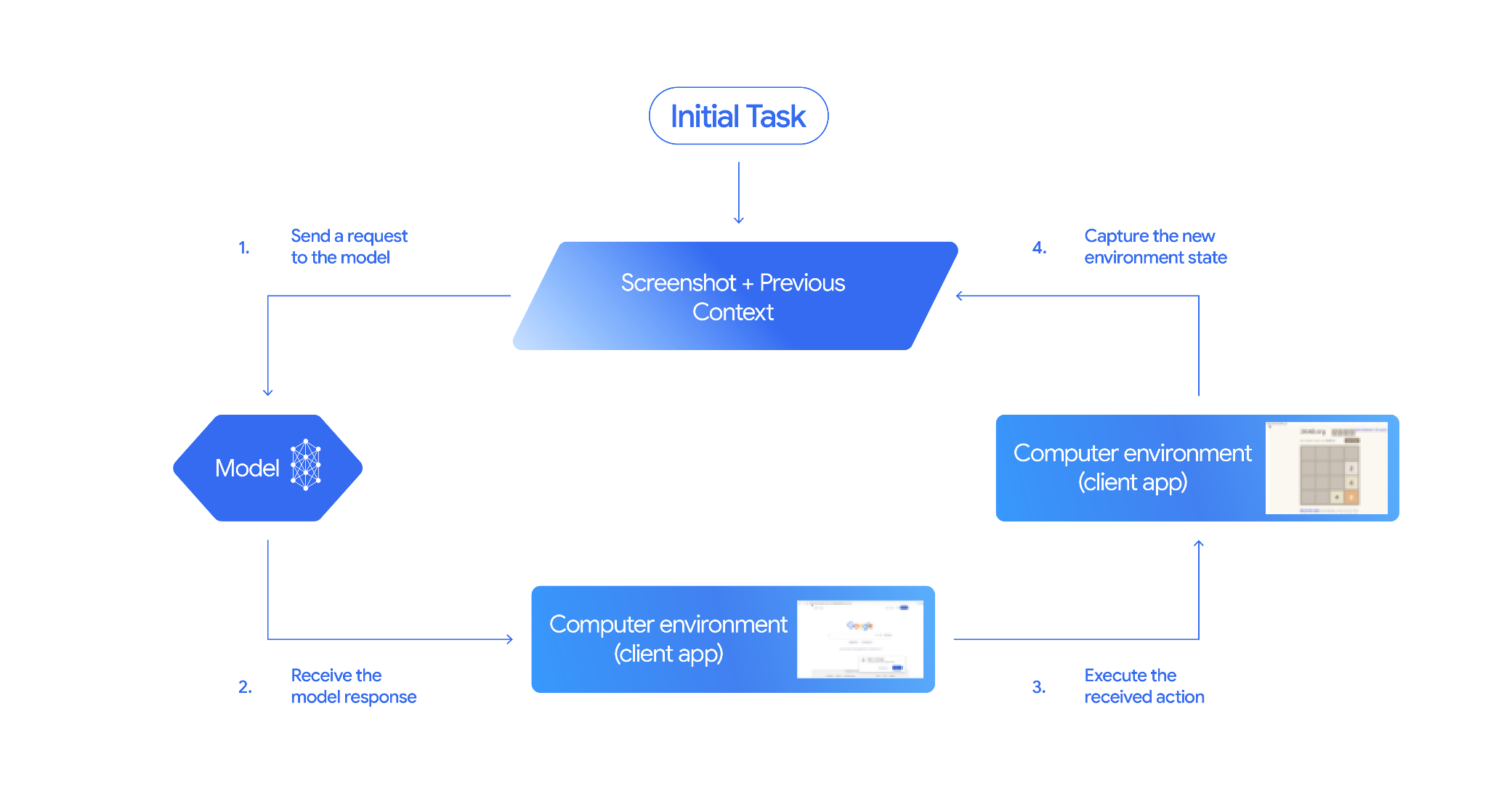
הפעלת המודל והכלי לשימוש במחשב
כדי להפעיל את המודל והכלי לשימוש במחשב, משתמשים ב-gemini-2.5-computer-use-preview-10-2025 בתור המודל, ומוסיפים את המודל והכלי לשימוש במחשב לרשימת הכלים המופעלים:
Python
from google import genai
from google.genai import types
from google.genai.types import Content, Part, FunctionResponse

client = genai.Client()

# Add Computer Use model and tool to the list of tools
generate_content_config = genai.types.GenerateContentConfig(
    tools=[
        types.Tool(
            computer_use=types.ComputerUse(
                environment=types.Environment.ENVIRONMENT_BROWSER,
                )
              ),
            ]
          )

# Example request using the Computer Use model and tool
contents = [
    Content(
        role="user",
        parts=[
            Part(text="Go to google.com and search for 'weather in New York'"),
          ],
        )
      ]

response = client.models.generate_content(
    model="gemini-2.5-computer-use-preview-10-2025",
    contents=contents,
    config=generate_content_config,
  )
שליחת בקשה
אחרי שמגדירים את המודל ואת הכלי לשימוש במחשב, שולחים למודל הנחיה שכוללת את המטרה של המשתמש וצילום מסך ראשוני של ממשק המשתמש הגרפי.
אפשר גם להוסיף את הפרטים הבאים:
- פעולות שמוחרגות: אם יש פעולות מתוך רשימת הפעולות הנתמכות בממשק המשתמש שאתם לא רוצים שהמודל יבצע, מציינים את הפעולות האלה ב-
excluded_predefined_functions. - פונקציות בהגדרת המשתמש: בנוסף למודל ולכלי לשימוש במחשב, יכול להיות שתרצו לכלול פונקציות מותאמות אישית בהגדרת המשתמש.
בדוגמת קוד לדוגמה הבאה מפעילים את המודל ואת הכלי 'שימוש במחשב' ושולחים את הבקשה למודל:
Python
from google import genai
from google.genai import types
from google.genai.types import Content, Part

client = genai.Client()

# Specify predefined functions to exclude (optional)
excluded_functions = ["drag_and_drop"]

# Configuration for the Computer Use model and tool with browser environment
generate_content_config = genai.types.GenerateContentConfig(
    tools=[
        # 1. Computer Use model and tool with browser environment
        types.Tool(
            computer_use=types.ComputerUse(
                environment=types.Environment.ENVIRONMENT_BROWSER,
                # Optional: Exclude specific predefined functions
                excluded_predefined_functions=excluded_functions
                )
              ),
        # 2. Optional: Custom user-defined functions (need to defined above)
        # types.Tool(
           # function_declarations=custom_functions
           #   )
    ],
)

# Create the content with user message
contents: list[Content] = [
    Content(
        role="user",
        parts=[
            Part(text="Search for highly rated smart fridges with touchscreen, 2 doors, around 25 cu ft, priced below 4000 dollars on Google Shopping. Create a bulleted list of the 3 cheapest options in the format of name, description, price in an easy-to-read layout."),
            # Optional: include a screenshot of the initial state
            # Part.from_bytes(
                 # data=screenshot_image_bytes,
                 # mime_type='image/png',
            # ),
        ],
    )
]

# Generate content with the configured settings
response = client.models.generate_content(
    model='gemini-2.5-computer-use-preview-10-2025',
    contents=contents,
    config=generate_content_config,
)

# Print the response output
print(response.text)
אפשר גם לכלול פונקציות מותאמות אישית בהגדרת המשתמש כדי להרחיב את הפונקציונליות של המודל. במאמר שימוש במודל ובכלי לשימוש במחשב לתרחישי שימוש בנייד מוסבר איך להגדיר שימוש במחשב לתרחישי שימוש בנייד על ידי הוספת פעולות כמו open_app, long_press_at ו-go_home, והחרגת פעולות שספציפיות לדפדפן.
קבלת תשובות
המודל מגיב עם FunctionCalls אחד או יותר אם הוא קובע שצריך לבצע פעולות בממשק המשתמש או להשתמש בפונקציות שהוגדרו על ידי המשתמש כדי להשלים את המשימה. קוד האפליקציה צריך לנתח את הפעולות האלה, להריץ אותן ולאסוף את התוצאות. המודל והכלי Computer Use תומכים בקריאה מקבילית לפונקציות, כלומר המודל יכול להחזיר כמה פעולות עצמאיות בתור אחד.
{
  "content": {
    "parts": [
      {
        "text": "I will type the search query into the search bar. The search bar is in the center of the page."
      },
      {
        "function_call": {
          "name": "type_text_at",
          "args": {
            "x": 371,
            "y": 470,
            "text": "highly rated smart fridges with touchscreen, 2 doors, around 25 cu ft, priced below 4000 dollars on Google Shopping",
            "press_enter": true
          }
        }
      }
    ]
  }
}
בהתאם לפעולה, יכול להיות שבתגובת ה-API יוחזר גם safety_response:
{
  "content": {
    "parts": [
      {
        "text": "I have evaluated step 2. It seems Google detected unusual traffic and is asking me to verify I'm not a robot. I need to click the 'I'm not a robot' checkbox located near the top left (y=98, x=95)."
      },
      {
        "function_call": {
          "name": "click_at",
          "args": {
            "x": 60,
            "y": 100,
            "safety_decision": {
              "explanation": "I have encountered a CAPTCHA challenge that requires interaction. I need you to complete the challenge by clicking the 'I'm not a robot' checkbox and any subsequent verification steps.",
              "decision": "require_confirmation"
            }
          }
        }
      }
    ]
  }
}
ביצוע פעולות שהתקבלו
אחרי שמקבלים תשובה, המודל צריך לבצע את הפעולות שקיבל.
הקוד הבא מחלץ קריאות לפונקציות מתשובה של Gemini, ממיר קואורדינטות מטווח של 0-1000 לפיקסלים בפועל, מבצע פעולות בדפדפן באמצעות Playwright ומחזיר את סטטוס ההצלחה או הכישלון של כל פעולה:
import time
from typing import Any, List, Tuple


def normalize_x(x: int, screen_width: int) -> int:
    """Convert normalized x coordinate (0-1000) to actual pixel coordinate."""
    return int(x / 1000 * screen_width)


def normalize_y(y: int, screen_height: int) -> int:
    """Convert normalized y coordinate (0-1000) to actual pixel coordinate."""
    return int(y / 1000 * screen_height)


def execute_function_calls(response, page, screen_width: int, screen_height: int) -> List[Tuple[str, Any]]:
    """
    Extract and execute function calls from Gemini response.

    Args:
        response: Gemini API response object
        page: Playwright page object
        screen_width: Screen width in pixels
        screen_height: Screen height in pixels

    Returns:
        List of tuples: [(function_name, result), ...]
    """
    # Extract function calls and thoughts from the model's response
    candidate = response.candidates[0]
    function_calls = []
    thoughts = []

    for part in candidate.content.parts:
        if hasattr(part, 'function_call') and part.function_call:
            function_calls.append(part.function_call)
        elif hasattr(part, 'text') and part.text:
            thoughts.append(part.text)

    if thoughts:
        print(f"Model Reasoning: {' '.join(thoughts)}")

    # Execute each function call
    results = []
    for function_call in function_calls:
        result = None

        try:
            if function_call.name == "open_web_browser":
                print("Executing open_web_browser")
                # Browser is already open via Playwright, so this is a no-op
                result = "success"

            elif function_call.name == "click_at":
                actual_x = normalize_x(function_call.args["x"], screen_width)
                actual_y = normalize_y(function_call.args["y"], screen_height)

                print(f"Executing click_at: ({actual_x}, {actual_y})")
                page.mouse.click(actual_x, actual_y)
                result = "success"

            elif function_call.name == "type_text_at":
                actual_x = normalize_x(function_call.args["x"], screen_width)
                actual_y = normalize_y(function_call.args["y"], screen_height)
                text = function_call.args["text"]
                press_enter = function_call.args.get("press_enter", False)
                clear_before_typing = function_call.args.get("clear_before_typing", True)

                print(f"Executing type_text_at: ({actual_x}, {actual_y}) text='{text}'")

                # Click at the specified location
                page.mouse.click(actual_x, actual_y)
                time.sleep(0.1)

                # Clear existing text if requested
                if clear_before_typing:
                    page.keyboard.press("Control+A")
                    page.keyboard.press("Backspace")

                # Type the text
                page.keyboard.type(text)

                # Press enter if requested
                if press_enter:
                    page.keyboard.press("Enter")

                result = "success"

            else:
                # For any functions not parsed above
                print(f"Unrecognized function: {function_call.name}")
                result = "unknown_function"

        except Exception as e:
            print(f"Error executing {function_call.name}: {e}")
            result = f"error: {str(e)}"

        results.append((function_call.name, result))

    return results
אם הערך שמוחזר safety_decision הוא require_confirmation, צריך לבקש מהמשתמש לאשר לפני שממשיכים בביצוע הפעולה. בהתאם לתנאים ולהגבלות, אסור לך לעקוף בקשות לאישור אנושי.
הקוד הבא מוסיף לוגיקה של בטיחות לקוד הקודם:
import termcolor


def get_safety_confirmation(safety_decision):
    """Prompt user for confirmation when safety check is triggered."""
    termcolor.cprint("Safety service requires explicit confirmation!", color="red")
    print(safety_decision["explanation"])

    decision = ""
    while decision.lower() not in ("y", "n", "ye", "yes", "no"):
        decision = input("Do you wish to proceed? [Y]es/[N]o\n")

    if decision.lower() in ("n", "no"):
        return "TERMINATE"
    return "CONTINUE"


def execute_function_calls(response, page, screen_width: int, screen_height: int):
    # ... Extract function calls from response ...

    for function_call in function_calls:
        extra_fr_fields = {}

        # Check for safety decision
        if 'safety_decision' in function_call.args:
            decision = get_safety_confirmation(function_call.args['safety_decision'])
            if decision == "TERMINATE":
                print("Terminating agent loop")
                break
            extra_fr_fields["safety_acknowledgement"] = "true"

        # ... Execute function call and append to results ...
תיעוד המצב החדש
אחרי שמבצעים את הפעולות, שולחים את התוצאה של הפעלת הפונקציה בחזרה למודל, כדי שהוא יוכל להשתמש במידע הזה כדי ליצור את הפעולה הבאה. אם בוצעו כמה פעולות (קריאות מקבילות), צריך לשלוח FunctionResponse לכל אחת מהן בתור הבא של המשתמש. בפונקציות שהוגדרו על ידי המשתמש, FunctionResponse צריך להכיל את ערך ההחזרה של הפונקציה שהופעלה.
function_response_parts = []

for name, result in results:
    # Take screenshot after each action
    screenshot = page.screenshot()
    current_url = page.url

    function_response_parts.append(
        FunctionResponse(
            name=name,
            response={"url": current_url},  # Include safety acknowledgement
            parts=[
                types.FunctionResponsePart(
                    inline_data=types.FunctionResponseBlob(
                       mime_type="image/png", data=screenshot
                    )
                )
            ]
        )
    )

# Create the user feedback content with all responses
user_feedback_content = Content(
    role="user",
    parts=function_response_parts
)

# Append this feedback to the 'contents' history list for the next API call
contents.append(user_feedback_content)
יצירת לופ של סוכן
משלבים את השלבים הקודמים בלולאה כדי לאפשר אינטראקציות מרובות שלבים. הלולאה צריכה לטפל בקריאות מקבילות לפונקציות. חשוב לזכור לנהל את היסטוריית השיחות (מערך התוכן) בצורה נכונה על ידי הוספה של תשובות המודל ותשובות הפונקציה.
Python
from google import genai
from google.genai.types import Content, Part
from playwright.sync_api import sync_playwright


def has_function_calls(response):
    """Check if response contains any function calls."""
    candidate = response.candidates[0]
    return any(hasattr(part, 'function_call') and part.function_call
               for part in candidate.content.parts)


def main():
    client = genai.Client()

    # ... (config setup from "Send a request to model" section) ...

    with sync_playwright() as p:
        browser = p.chromium.launch(headless=False)
        page = browser.new_page()
        page.goto("https://www.google.com")

        screen_width, screen_height = 1920, 1080

        # ... (initial contents setup from "Send a request to model" section) ...

        # Agent loop: iterate until model provides final answer
        for iteration in range(10):
            print(f"\nIteration {iteration + 1}\n")

            # 1. Send request to model (see "Send a request to model" section)
            response = client.models.generate_content(
                model='gemini-2.5-computer-use-preview-10-2025',
                contents=contents,
                config=generate_content_config,
            )

            contents.append(response.candidates[0].content)

            # 2. Check if done - no function calls means final answer
            if not has_function_calls(response):
                print(f"FINAL RESPONSE:\n{response.text}")
                break

            # 3. Execute actions (see "Execute the received actions" section)
            results = execute_function_calls(response, page, screen_width, screen_height)
            time.sleep(1)

            # 4. Capture state and create feedback (see "Capture the New State" section)
            contents.append(create_feedback(results, page))

        input("\nPress Enter to close browser...")
        browser.close()


if __name__ == "__main__":
    main()
מודל וכלים לשימוש במחשב בתרחישים לנייד
בדוגמה הבאה מוסבר איך להגדיר פונקציות בהתאמה אישית (כמו open_app, long_press_at ו-go_home), לשלב אותן עם כלי השימוש במחשב המובנה של Gemini ולהחריג פונקציות ספציפיות לדפדפן שלא צריך. רישום הפונקציות המותאמות אישית מאפשר למודל להפעיל אותן בצורה חכמה לצד פעולות רגילות בממשק המשתמש, כדי להשלים משימות בסביבות שאינן דפדפן.
from typing import Optional, Dict, Any

from google import genai
from google.genai import types
from google.genai.types import Content, Part


client = genai.Client()

def open_app(app_name: str, intent: Optional[str] = None) -> Dict[str, Any]:
    """Opens an app by name.

    Args:
        app_name: Name of the app to open (any string).
        intent: Optional deep-link or action to pass when launching, if the app supports it.

    Returns:
        JSON payload acknowledging the request (app name and optional intent).
    """
    return {"status": "requested_open", "app_name": app_name, "intent": intent}


def long_press_at(x: int, y: int, duration_ms: int = 500) -> Dict[str, int]:
    """Long-press at a specific screen coordinate.

    Args:
        x: X coordinate (absolute), scaled to the device screen width (pixels).
        y: Y coordinate (absolute), scaled to the device screen height (pixels).
        duration_ms: Press duration in milliseconds. Defaults to 500.

    Returns:
        Object with the coordinates pressed and the duration used.
    """
    return {"x": x, "y": y, "duration_ms": duration_ms}


def go_home() -> Dict[str, str]:
    """Navigates to the device home screen.

    Returns:
        A small acknowledgment payload.
    """
    return {"status": "home_requested"}


#  Build function declarations
CUSTOM_FUNCTION_DECLARATIONS = [
    types.FunctionDeclaration.from_callable(client=client, callable=open_app),
    types.FunctionDeclaration.from_callable(client=client, callable=long_press_at),
    types.FunctionDeclaration.from_callable(client=client, callable=go_home),
]

# Exclude browser functions

EXCLUDED_PREDEFINED_FUNCTIONS = [
    "open_web_browser",
    "search",
    "navigate",
    "hover_at",
    "scroll_document",
    "go_forward",
    "key_combination",
    "drag_and_drop",
]

# Utility function to construct a GenerateContentConfig

def make_generate_content_config() -> genai.types.GenerateContentConfig:
    """Return a fixed GenerateContentConfig with Computer Use + custom functions."""
    return genai.types.GenerateContentConfig(
        tools=[
            types.Tool(
                computer_use=types.ComputerUse(
                    environment=types.Environment.ENVIRONMENT_BROWSER,
                    excluded_predefined_functions=EXCLUDED_PREDEFINED_FUNCTIONS,
                )
            ),
            types.Tool(function_declarations=CUSTOM_FUNCTION_DECLARATIONS),
        ]
    )


# Create the content with user message
contents: list[Content] = [
    Content(
        role="user",
        parts=[
            # text instruction
            Part(text="Open Chrome, then long-press at 200,400."),
            # optional screenshot attachment
            Part.from_bytes(
                data=screenshot_image_bytes,
                mime_type="image/png",
            ),
        ],
    )
]

# Build your fixed config (from helper)
config = make_generate_content_config()

# Generate content with the configured settings
response = client.models.generate_content(
        model="gemini-2.5-computer-use-preview-10-2025",
        contents=contents,
        config=generate_content_config,
    )

    print(response)
פעולות נתמכות
המודל והכלי Computer Use מאפשרים למודל לבקש את הפעולות הבאות באמצעות FunctionCall. בקוד בצד הלקוח צריך להטמיע את לוגיקת הביצוע של הפעולות האלה. אפשר לראות דוגמאות בהטמעה לדוגמה.
| שם הפקודה | תיאור | ארגומנטים (בבקשה להפעלת פונקציה) | בקשה להפעלת פונקציה לדוגמה |
|---|---|---|---|
| open_web_browser | הפעולה הזו תפתח את דפדפן האינטרנט. | ללא | {"name": "open_web_browser", "args": {}} |
| wait_5_seconds | הפסקת הביצוע למשך 5 שניות כדי לאפשר לתוכן דינמי להיטען או לאנימציות להסתיים. | ללא | {"name": "wait_5_seconds", "args": {}} |
| go_back | מעבר לדף הקודם בהיסטוריה של הדפדפן. | ללא | {"name": "go_back", "args": {}} |
| go_forward | מעבר לדף הבא בהיסטוריה של הדפדפן. | ללא | {"name": "go_forward", "args": {}} |
| search | ניווט לדף הבית של מנוע החיפוש שמוגדר כברירת מחדל (לדוגמה, Google). שימושי להתחלת משימת חיפוש חדשה. | ללא | {"name": "search", "args": {}} |
| navigate | הדפדפן עובר ישירות לכתובת ה-URL שצוינה. | url: str |
{"name": "navigate", "args": {"url": "https://www.wikipedia.org"}} |
| click_at | קליקים בנקודה ספציפית בדף האינטרנט. הערכים של x ו-y מבוססים על רשת של 1,000x1,000 ומוגדרים בהתאם לממדי המסך. | y: int (0-999), x: int (0-999) |
{"name": "click_at", "args": {"y": 300, "x": 500}} |
| hover_at | מציב את הסמן בנקודה ספציפית בדף האינטרנט. הערכים x ו-y מבוססים על רשת של 1000x1000. | y: int (0-999) x: int (0-999) |
{"name": "hover_at", "args": {"y": 150, "x": 250}} |
| type_text_at | מזין טקסט בקואורדינטה ספציפית. כברירת מחדל, הפקודה מוחקת קודם את השדה ומקישה על Enter אחרי ההקלדה, אבל אפשר להשבית את הפעולות האלה. הערכים x ו-y מבוססים על רשת של 1000x1000. | y: int (0-999), x: int (0-999), text: str, press_enter: bool (אופציונלי, ברירת המחדל היא True), clear_before_typing: bool (אופציונלי, ברירת המחדל היא True) |
{"name": "type_text_at", "args": {"y": 250, "x": 400, "text": "search query", "press_enter": false}} |
| key_combination | מקישים על מקשים או על שילובים של מקשים במקלדת, כמו Control+C או Enter. האפשרות הזו שימושית להפעלת פעולות (כמו שליחת טופס באמצעות Enter) או פעולות בלוח העריכה. | keys: str (לדוגמה, 'enter', 'control+c'. רשימה מלאה של המפתחות המותרים מופיעה במאמר בנושא הפניה ל-API) |
{"name": "key_combination", "args": {"keys": "Control+A"}} |
| scroll_document | גלילה של כל דף האינטרנט למעלה, למטה, שמאלה או ימינה. | direction: str ("up", "down", "left", or "right") |
{"name": "scroll_document", "args": {"direction": "down"}} |
| scroll_at | מגללים רכיב או אזור ספציפיים בנקודה (x, y) בכיוון שצוין, במידה מסוימת. הקואורדינטות והגודל (ברירת מחדל 800) מבוססים על רשת של 1,000x1,000. | y: int (0-999), x: int (0-999), direction: str ("up", "down", "left", "right"), magnitude: int (0-999, Optional, default 800) |
{"name": "scroll_at", "args": {"y": 500, "x": 500, "direction": "down", "magnitude": 400}} |
| drag_and_drop | גורר רכיב מקואורדינטת התחלה (x, y) ומשחרר אותו בקואורדינטת יעד (destination_x, destination_y). כל הקואורדינטות מבוססות על רשת בגודל 1,000x1,000. | y: int (0-999), x: int (0-999), destination_y: int (0-999), destination_x: int (0-999) |
{"name": "drag_and_drop", "args": {"y": 100, "x": 100, "destination_y": 500, "destination_x": 500}} |
בטיחות ואבטחה
בקטע הזה מתוארים אמצעי ההגנה שמוטמעים במודל ובכלי לשימוש במחשב כדי לשפר את השליטה של המשתמשים ואת הבטיחות. בנוסף, מפורטות בו שיטות מומלצות לצמצום סיכונים חדשים פוטנציאליים שהכלי עלול להציג.
אישור החלטה בנושא בטיחות
בהתאם לפעולה, התשובה מהמודל והכלי לשימוש במחשב עשויה לכלול safety_decision ממערכת בטיחות פנימית. ההחלטה הזו מאמתת את הפעולה שהכלי מציע לביצוע כדי לשמור על הבטיחות.
{
  "content": {
    "parts": [
      {
        "text": "I have evaluated step 2. It seems Google detected unusual traffic and is asking me to verify I'm not a robot. I need to click the 'I'm not a robot' checkbox located near the top left (y=98, x=95)."
      },
      {
        "function_call": {
          "name": "click_at",
          "args": {
            "x": 60,
            "y": 100,
            "safety_decision": {
              "explanation": "I have encountered a CAPTCHA challenge that requires interaction. I need you to complete the challenge by clicking the 'I'm not a robot' checkbox and any subsequent verification steps.",
              "decision": "require_confirmation"
            }
          }
        }
      }
    ]
  }
}
אם הערך של safety_decision הוא require_confirmation, חובה לבקש מהמשתמש לאשר לפני שממשיכים בביצוע הפעולה.
בדוגמת הקוד הבאה, המשתמש מתבקש לאשר לפני ביצוע הפעולה. אם המשתמש לא מאשר את הפעולה, הלולאה מסתיימת. אם המשתמש מאשר את הפעולה, היא מבוצעת והשדה safety_acknowledgement מסומן כ-True.
import termcolor

def get_safety_confirmation(safety_decision):
    """Prompt user for confirmation when safety check is triggered."""
    termcolor.cprint("Safety service requires explicit confirmation!", color="red")
    print(safety_decision["explanation"])

    decision = ""
    while decision.lower() not in ("y", "n", "ye", "yes", "no"):
        decision = input("Do you wish to proceed? [Y]es/[N]o\n")

    if decision.lower() in ("n", "no"):
        return "TERMINATE"
    return "CONTINUE"

def execute_function_calls(response, page, screen_width: int, screen_height: int):

    # ... Extract function calls from response ...

    for function_call in function_calls:
        extra_fr_fields = {}

        # Check for safety decision
        if 'safety_decision' in function_call.args:
            decision = get_safety_confirmation(function_call.args['safety_decision'])
            if decision == "TERMINATE":
                print("Terminating agent loop")
                break
            extra_fr_fields["safety_acknowledgement"] = "true" # Safety acknowledgement

        # ... Execute function call and append to results ...
אם המשתמש מאשר, צריך לכלול את אישור הבטיחות בקובץ FunctionResponse.
function_response_parts.append(
    FunctionResponse(
        name=name,
        response={"url": current_url,
                  **extra_fr_fields},  # Include safety acknowledgement
        parts=[
            types.FunctionResponsePart(
                inline_data=types.FunctionResponseBlob(
                    mime_type="image/png", data=screenshot
                )
             )
           ]
         )
       )
שיטות מומלצות לשמירה על האבטחה
המודל והכלי לשימוש במחשב הם כלי חדשני, והם מציגים סיכונים חדשים שמפתחים צריכים להיות מודעים להם:
- תוכן לא מהימן ותרמיות: כדי להשיג את המטרה של המשתמש, המודל עשוי להסתמך על מקורות מידע לא מהימנים ועל הוראות מהמסך. לדוגמה, אם המטרה של המשתמש היא לרכוש טלפון Pixel והמודל נתקל בתרמית 'קבלת Pixel בחינם אם תשלים סקר', יש סיכוי שהמודל ישלים את הסקר.
- פעולות לא מכוונות מדי פעם: המודל עלול לפרש לא נכון את המטרה של המשתמש או את התוכן של דף האינטרנט, ולבצע פעולות שגויות כמו לחיצה על הלחצן הלא נכון או מילוי הטופס הלא נכון. זה עלול לגרום לכשלים במשימות או לגניבת נתונים.
- הפרות מדיניות: יכול להיות שהיכולות של ה-API יופנו, בכוונה או שלא בכוונה, לפעילויות שמפירות את המדיניות של Google (המדיניות בנושא שימוש אסור ב-AI גנרטיבי והתנאים וההגבלות הנוספים למתן שירות של Gemini API). האיסור הזה כולל פעולות שעלולות לשבש את השלמות של מערכת, לפגוע באבטחה, לעקוף אמצעי אבטחה כמו CAPTCHA, לשלוט במכשירים רפואיים וכו'.
כדי לטפל בסיכונים האלה, אפשר ליישם את אמצעי הבטיחות והשיטות המומלצות הבאים:
- Human-in-the-Loop (HITL):
- הטמעת אישור משתמש: אם תגובת הבטיחות מציינת require_confirmation, צריך להטמיע אישור משתמש לפני ההפעלה.
- הוספת הוראות בטיחות בהתאמה אישית: בנוסף לבדיקות האישור המובנות של המשתמשים, המפתחים יכולים להוסיף הוראות מערכת בהתאמה אישית כדי לאכוף את מדיניות הבטיחות שלהם. ההוראות יכולות לחסום פעולות מסוימות של המודל או לדרוש אישור מהמשתמש לפני שהמודל מבצע פעולות מסוימות עם סיכון גבוה שאי אפשר לבטל. הנה דוגמה להוראה מותאמת אישית למערכת הבטיחות שאפשר לכלול כשמנהלים אינטראקציה עם המודל.
אפשר ללחוץ כאן כדי לראות דוגמה ליצירת קישור
## **RULE 1: Seek User Confirmation (USER_CONFIRMATION)**

This is your first and most important check. If the next required action falls
into any of the following categories, you MUST stop immediately, and seek the
user's explicit permission.

**Procedure for Seeking Confirmation:**  * **For Consequential Actions:**
Perform all preparatory steps (e.g., navigating, filling out forms, typing a
message). You will ask for confirmation **AFTER** all necessary information is
entered on the screen, but **BEFORE** you perform the final, irreversible action
(e.g., before clicking "Send", "Submit", "Confirm Purchase", "Share").  * **For
Prohibited Actions:** If the action is strictly forbidden (e.g., accepting legal
terms, solving a CAPTCHA), you must first inform the user about the required
action and ask for their confirmation to proceed.

**USER_CONFIRMATION Categories:**

*   **Consent and Agreements:** You are FORBIDDEN from accepting, selecting, or
    agreeing to any of the following on the user's behalf. You must ask th e
    user to confirm before performing these actions.
    *   Terms of Service
    *   Privacy Policies
    *   Cookie consent banners
    *   End User License Agreements (EULAs)
    *   Any other legally significant contracts or agreements.
*   **Robot Detection:** You MUST NEVER attempt to solve or bypass the
    following. You must ask the user to confirm before performing these actions.
*   CAPTCHAs (of any kind)
    *   Any other anti-robot or human-verification mechanisms, even if you are
        capable.
*   **Financial Transactions:**
    *   Completing any purchase.
    *   Managing or moving money (e.g., transfers, payments).
    *   Purchasing regulated goods or participating in gambling.
*   **Sending Communications:**
    *   Sending emails.
    *   Sending messages on any platform (e.g., social media, chat apps).
    *   Posting content on social media or forums.
*   **Accessing or Modifying Sensitive Information:**
    *   Health, financial, or government records (e.g., medical history, tax
        forms, passport status).
    *   Revealing or modifying sensitive personal identifiers (e.g., SSN, bank
        account number, credit card number).
*   **User Data Management:**
    *   Accessing, downloading, or saving files from the web.
    *   Sharing or sending files/data to any third party.
    *   Transferring user data between systems.
*   **Browser Data Usage:**
    *   Accessing or managing Chrome browsing history, bookmarks, autofill data,
        or saved passwords.
*   **Security and Identity:**
    *   Logging into any user account.
    *   Any action that involves misrepresentation or impersonation (e.g.,
        creating a fan account, posting as someone else).
*   **Insurmountable Obstacles:** If you are technically unable to interact with
    a user interface element or are stuck in a loop you cannot resolve, ask the
    user to take over.
---

## **RULE 2: Default Behavior (ACTUATE)**

If an action does **NOT** fall under the conditions for `USER_CONFIRMATION`,
your default behavior is to **Actuate**.

**Actuation Means:**  You MUST proactively perform all necessary steps to move
the user's request forward. Continue to actuate until you either complete the
non-consequential task or encounter a condition defined in Rule 1.

*   **Example 1:** If asked to send money, you will navigate to the payment
    portal, enter the recipient's details, and enter the amount. You will then
    **STOP** as per Rule 1 and ask for confirmation before clicking the final
    "Send" button.
*   **Example 2:** If asked to post a message, you will navigate to the site,
    open the post composition window, and write the full message. You will then
    **STOP** as per Rule 1 and ask for confirmation before clicking the final
    "Post" button.

    After the user has confirmed, remember to get the user's latest screen
    before continuing to perform actions.

# Final Response Guidelines:
Write final response to the user in these cases:
- User confirmation
- When the task is complete or you have enough information to respond to the user
- סביבת ביצוע מאובטחת: מריצים את הסוכן בסביבה מאובטחת עם ארגז חול כדי להגביל את ההשפעה הפוטנציאלית שלו (לדוגמה, מכונה וירטואלית (VM) עם ארגז חול, קונטיינר (כמו Docker) או פרופיל דפדפן ייעודי עם הרשאות מוגבלות).
- ניקוי קלט: ניקוי של כל הטקסט שנוצר על ידי משתמשים בהנחיות, כדי לצמצם את הסיכון להוראות לא מכוונות או להחדרת הנחיות. זו שכבת אבטחה מועילה, אבל היא לא תחליף לסביבת הרצה מאובטחת.
- רשימות היתרים ורשימות החסימה: כדאי להטמיע מנגנוני סינון כדי לשלוט במקומות שבהם המודל יכול לנווט ובפעולות שהוא יכול לבצע. רשימת חסימה של אתרים אסורים היא נקודת התחלה טובה, אבל רשימת היתרים מגבילה יותר ומספקת אבטחה גבוהה יותר.
- יכולת מעקב ורישום ביומן: שמירה של יומנים מפורטים לצורך ניפוי באגים, ביקורת ותגובה לתקריות. הלקוח צריך לתעד הנחיות, צילומי מסך, פעולות שהמודל מציע (
function_call), תשובות שקשורות לבטיחות וכל הפעולות שהלקוח מבצע בסופו של דבר.
תמחור
התמחור של מודל Computer Use והכלי זהה לתמחור של Gemini 2.5 Pro, והם משתמשים באותם מק"טים. כדי לפצל את העלויות של מודל השימוש במחשב ושל כלי, משתמשים בתוויות מטא-נתונים מותאמות אישית. מידע נוסף על שימוש בתוויות מטא-נתונים מותאמות אישית לצורך מעקב אחר עלויות זמין במאמר תוויות מטא-נתונים מותאמות אישית.