

This document provides a high-level architecture for an application that uses AI to generate solutions for support questions from customers.
The intended audience for this document includes architects, developers, and administrators who build and manage generative AI applications in the cloud. The document assumes that you have a foundational understanding of generative AI.
The Deployment section of this document provides code samples for AI-assisted customer support use cases.
Architecture
The following diagram shows an architecture for an AI-assisted support desk application in Google Cloud. The application receives questions from customers, retrieves relevant resources from a knowledge base, and then it generates solutions for the questions. The architecture is an implementation of the retrieval-augmented generation (RAG) approach.
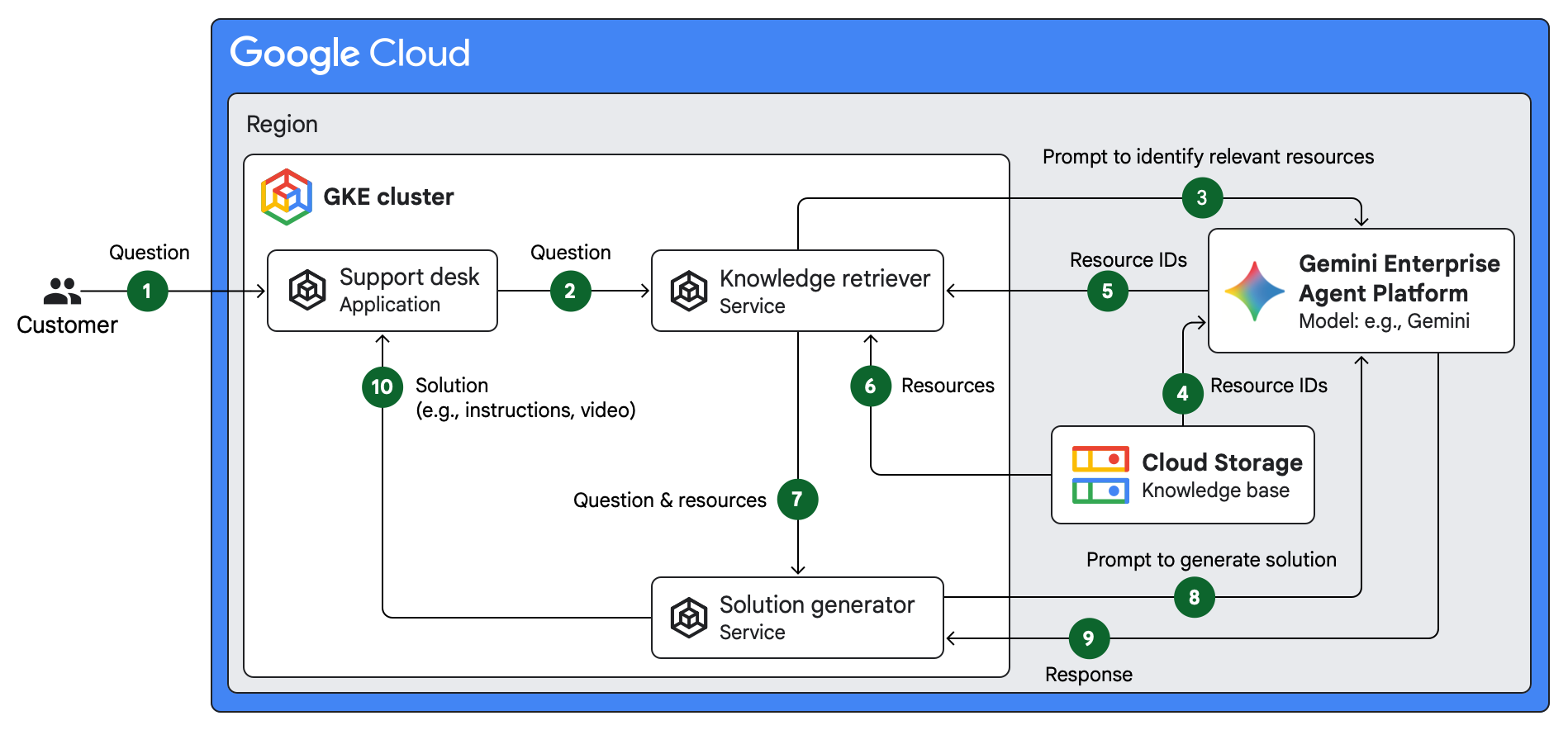
The application in this architecture consists of containerized services that are deployed in a Google Kubernetes Engine (GKE) cluster. The architecture shows the following flow:
- A customer submits a question to the support desk application.
- The support desk application passes the customer's question to the knowledge retriever service.
- The knowledge retriever service constructs and sends a prompt to Gemini API to retrieve resources that are relevant to the customer's question.
- Gemini identifies relevant resources from a support knowledge base that's stored in Cloud Storage.
- Gemini returns the IDs of the relevant resources to the knowledge retriever service.
- The knowledge retriever service retrieves the relevant resources from Cloud Storage.
- The knowledge retriever service sends the customer's question and relevant resources to the solution generator service.
- The solution generator service sends the resources to Gemini API, with a prompt to generate a detailed solution for the customer's question.
- Gemini generates a solution, such as step-by-step instructions or a video walkthrough.
- The solution generator service provides the solution to the customer through the support desk application.
Products used
This example architecture uses the following Google Cloud products:
- Google Kubernetes Engine (GKE): A Kubernetes service that you can use to deploy and operate containerized applications at scale using Google's infrastructure.
- Gemini Enterprise Agent Platform: A comprehensive platform that lets you build, scale, govern, and optimize enterprise‑grade AI agents.
- Cloud Storage: A low-cost, no-limit object store for diverse data types. Data can be accessed from within and outside Google Cloud, and it's replicated across locations for redundancy.
Deployment
To experiment with AI-assisted customer support applications in Google Cloud, use the following code samples:
- Build a customer support application that uses generative AI.
- Sample prompt for AI-assisted customer service use cases.
What's next
- Build a customer support agent using Gemini.
- Build AI agents for customer support use cases by using playbooks, flows, and data stores in Dialogflow CX.
- Explore more generative AI architecture guides.
- For an overview of architectural principles and recommendations that are specific to AI and ML workloads in Google Cloud, see the AI and ML perspective in the Well-Architected Framework.
- For more reference architectures, diagrams, and best practices, explore the Cloud Architecture Center.
Contributors
Author: Kumar Dhanagopal | Cross-Product Solution Developer
Other contributors:
- Amina Mansour | Head of Cloud Platform Evaluations Team
- Megan O'Keefe | Developer Advocate
- Samantha He | Technical Writer
- Shir Meir Lador | Developer Relations Engineering Manager