

This page describes how to create a data store and connect LumApps to Gemini Enterprise.
Before you begin
Before setting up your LumApps connection, ensure you have the following in place:
Grant the Discovery Engine Editor role (
roles/discoveryengine.editor). This role is required for the user to create the data store. To grant this role, do the following:- In the Google Cloud console, go to the IAM page.
- Locate the user account and click edit Edit.
- Grant the
Discovery Engine Editorrole to the user. For more information, see IAM roles and permissions.
Contact LumApps Support at
support@lumapps.comand request the activation of the MCP feature flag on your LumApps platform. If the MCP feature flag is not activated, connection attempts fail with the following error:MCP Server is not activated for your organization. Please contact your administrator.Generate credentials for your OAuth client. For more information, see LumApps configuration.
Create LumApps data store
To create a LumApps data store, perform the following steps:
In the Google Cloud console, go to the Gemini Enterprise page.
Select or create a Google Cloud project.
In the navigation menu, click Data stores.
Click Create data store.
In the Source section, search for LumApps, and click Select.
In the Data section:
In the Authentication settings section, enter the following authentication details:
- LumApps Instance URL: The base URL of your LumApps customer
instance (for example,
https://customer.app.lumapps.com). - Organization ID: Your LumApps organization ID (for example,
5769928858664960). - Client ID: The OAuth client ID of your application.
- Client secret: The OAuth client secret of your application.
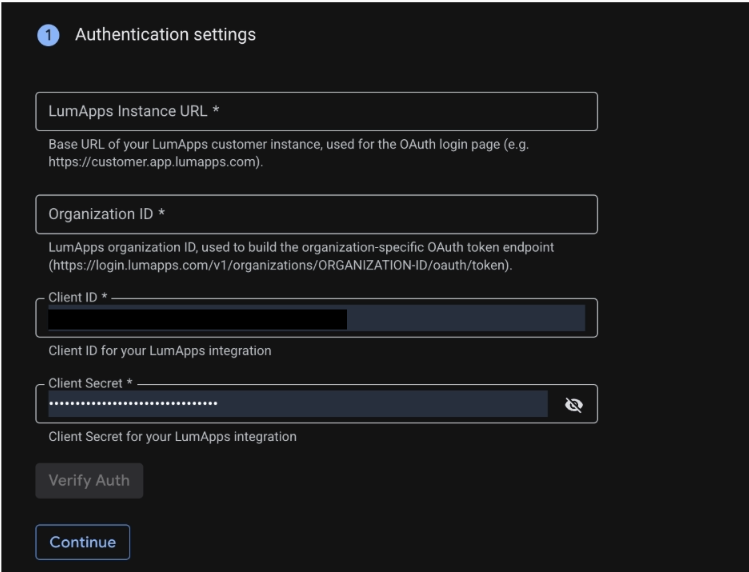
For more information about credentials, see LumApps configuration.
- LumApps Instance URL: The base URL of your LumApps customer
instance (for example,
Click Continue.
In the Entities to search section, select the entities that you want Gemini Enterprise to search. For LumApps, this includes Content.
Click Continue.
In the Configuration section:
- From the Multi-region list, select the location for your data connector.
- In the Your data connector name field, enter a name for your connector.
- If you selected
usoreuas the location, configure the Encryption settings:- Optional: If you haven't configured single-region keys, click Go to settings page to do so. For more information, see Register a single-region key for third-party connectors.
- Select Google-managed encryption key or Cloud KMS key.
- If you selected Cloud KMS key:
- In the Key management type list, select the appropriate type.
- In the Cloud KMS key list, select the key.
Click Continue.
In the Billing section, select General pricing or Configurable pricing. For more information, see Verify the billing status of your projects and Licenses.
Click Create. Gemini Enterprise creates your data store and displays your data stores on the Data Stores page.
On the Data Stores page, click your data store name to see the status. After the data store state changes from Creating to Active, the LumApps connector is ready to be used.
After creating the data store, connect the data store you just created to an existing app or create a new app and connect it to the new app, and authorize Gemini Enterprise to access LumApps before executing any queries. To know more, see What's next.
Data handling and query execution
This section describes how Gemini Enterprise manages your query and the privacy implications of using the federated data store.
Query execution
After you authorize LumApps and send a search query to Gemini Enterprise:
- Gemini Enterprise sends your search query directly to the LumApps API.
- Gemini Enterprise blends the results with those from other connected data sources and displays a comprehensive search result.
Data handling
When using third-party federated search, the following data handling rules apply:
- Your query string is sent to the third-party search backend (LumApps API).
- These third parties may associate queries with your identity.
- If multiple federated search data sources are enabled, the query might be sent to all of them.
- After the data reaches the third-party system, it is governed by that system's terms of service and privacy policies.
What's next
To provide a user interface for querying your LumApps data, create an app and connect it to the LumApps data store.
To preview how your search results appear after your app is set up, see Get search results.
To enable alerts for the data store, see Configure alerts for third-party data stores.