הערכה של מודלים של סיווג ורגרסיה מבית AutoML

בדף הזה מוסבר איך להעריך את מודלי הסיווג והרגרסיה של AutoML.

‫Vertex AI מספק מדדים להערכת מודלים שיעזרו לכם לקבוע את הביצועים של המודלים, כמו מדדי דיוק וזיכרון. ‫Vertex AI מחשב מדדי הערכה באמצעות קבוצת נתונים לבדיקה.

לפני שמתחילים

לפני שמעריכים את המודל, מאמנים את המודל.

איך משתמשים במדדי הערכת מודלים

מדדי הערכת המודל מספקים מדידות כמותיות של הביצועים של המודל בקבוצת נתונים לבדיקה. הפרשנות והשימוש במדדים האלה תלויים בצורך העסקי ובבעיה שהמודל אומן לפתור. לדוגמה, יכול להיות שסף הסיבולת שלכם לתוצאות חיוביות מוטעות יהיה נמוך יותר מאשר לתוצאות שליליות מוטעות, או להיפך. השאלות האלה משפיעות על המדדים שבהם מתמקדים.

קבלת מדדי הערכה

אתם יכולים לקבל קבוצה מצטברת של מדדי הערכה עבור המודל שלכם, ובחלק מהיעדים, מדדי הערכה עבור סיווג או תווית מסוימים. מדדי הערכה של סיווג או תווית מסוימים נקראים גם פלח הערכה. בקטע הבא מוסבר איך לקבל מדדים מצטברים של הערכה ופרוסות של הערכה באמצעות המסוף Google Cloud או API.

מסוף Google Cloud

  1. במסוף Google Cloud , בקטע Vertex AI, עוברים לדף Models.

    כניסה לדף Models

  2. בתפריט הנפתח אזור, בוחרים את האזור שבו נמצא המודל.

  3. ברשימת המודלים, לוחצים על המודל הרצוי כדי לפתוח את הכרטיסייה Evaluate (הערכה) של המודל.

    בכרטיסייה הערכה אפשר לראות את מדדי ההערכה המצטברים של המודל, כמו דיוק ממוצע והחזרה.

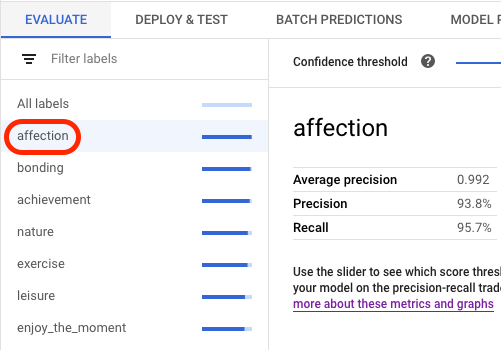
    אם ליעד של המודל יש פלחים להערכה, במסוף תוצג רשימה של תוויות. אפשר ללחוץ על תווית כדי לראות את מדדי ההערכה של התווית הזו, כמו שמוצג בדוגמה הבאה:

    בחירת תוויות במסוף

API

בקשות API לקבלת מדדי הערכה זהות לכל סוג נתונים ולכל יעד, אבל הפלט שונה. בדוגמאות הבאות מוצגת אותה בקשה אבל תשובות שונות.

קבלת מדדים נצברים של הערכת מודל

מדדי ההערכה המצטברים של המודל מספקים מידע על המודל כמכלול. כדי לראות מידע על פלח מסוים, אפשר להציג את הפלחים של הערכת המודל.

כדי לראות מדדים משוקללים של הערכת מודל, משתמשים בשיטה projects.locations.models.evaluations.get.

בוחרים את הכרטיסייה שלמטה שמתאימה ליעד שלכם:

סיווג

‫Vertex AI מחזיר מערך של מדדי מהימנות. בכל רכיב מוצגים מדדי הערכה עם ערך confidenceThreshold שונה (החל מ-0 ועד 1). כשמציגים ערכי סף שונים, אפשר לראות איך ערך הסף משפיע על מדדים אחרים כמו דיוק וזיכרון.

בוחרים כרטיסייה שמתאימה לשפה או לסביבה שלכם:

REST

לפני שמשתמשים בנתוני הבקשה, צריך להחליף את הנתונים הבאים:

  • LOCATION: האזור שבו המודל מאוחסן.
  • PROJECT: מזהה הפרויקט.
  • MODEL_ID: המזהה של משאב המודל.
  • PROJECT_NUMBER: מספר הפרויקט שנוצר באופן אוטומטי.
  • EVALUATION_ID: המזהה של הערכת המודל (מופיע בתגובה).

ה-method של ה-HTTP וכתובת ה-URL:

GET https://LOCATION-aiplatform.googleapis.com/v1/projects/PROJECT/locations/LOCATION/models/MODEL_ID/evaluations

כדי לשלוח את הבקשה אתם צריכים לבחור אחת מהאפשרויות הבאות:

curl

מריצים את הפקודה הבאה:

curl -X GET \
-H "Authorization: Bearer $(gcloud auth print-access-token)" \
"https://LOCATION-aiplatform.googleapis.com/v1/projects/PROJECT/locations/LOCATION/models/MODEL_ID/evaluations"

PowerShell

מריצים את הפקודה הבאה:

$cred = gcloud auth print-access-token
$headers = @{ "Authorization" = "Bearer $cred" }

Invoke-WebRequest `
-Method GET `
-Headers $headers `
-Uri "https://LOCATION-aiplatform.googleapis.com/v1/projects/PROJECT/locations/LOCATION/models/MODEL_ID/evaluations" | Select-Object -Expand Content

אתם אמורים לקבל תגובת JSON שדומה לזו:

Java

לפני שמנסים את הדוגמה הזו, צריך לפעול לפי Javaהוראות ההגדרה במאמר Vertex AI quickstart using client libraries. מידע נוסף מופיע במאמרי העזרה של Vertex AI Java API.

כדי לבצע אימות ב-Vertex AI, צריך להגדיר את Application Default Credentials. מידע נוסף זמין במאמר הגדרת אימות לסביבת פיתוח מקומית.


import com.google.cloud.aiplatform.v1.ModelEvaluation;
import com.google.cloud.aiplatform.v1.ModelEvaluationName;
import com.google.cloud.aiplatform.v1.ModelServiceClient;
import com.google.cloud.aiplatform.v1.ModelServiceSettings;
import java.io.IOException;

public class GetModelEvaluationTabularClassificationSample {

  public static void main(String[] args) throws IOException {
    // TODO(developer): Replace these variables before running the sample.
    // To obtain evaluationId run the code block below after setting modelServiceSettings.
    //
    // try (ModelServiceClient modelServiceClient = ModelServiceClient.create(modelServiceSettings))
    // {
    //   String location = "us-central1";
    //   ModelName modelFullId = ModelName.of(project, location, modelId);
    //   ListModelEvaluationsRequest modelEvaluationsrequest =
    //   ListModelEvaluationsRequest.newBuilder().setParent(modelFullId.toString()).build();
    //   for (ModelEvaluation modelEvaluation :
    //     modelServiceClient.listModelEvaluations(modelEvaluationsrequest).iterateAll()) {
    //       System.out.format("Model Evaluation Name: %s%n", modelEvaluation.getName());
    //   }
    // }
    String project = "YOUR_PROJECT_ID";
    String modelId = "YOUR_MODEL_ID";
    String evaluationId = "YOUR_EVALUATION_ID";
    getModelEvaluationTabularClassification(project, modelId, evaluationId);
  }

  static void getModelEvaluationTabularClassification(
      String project, String modelId, String evaluationId) throws IOException {
    ModelServiceSettings modelServiceSettings =
        ModelServiceSettings.newBuilder()
            .setEndpoint("us-central1-aiplatform.googleapis.com:443")
            .build();

    // Initialize client that will be used to send requests. This client only needs to be created
    // once, and can be reused for multiple requests. After completing all of your requests, call
    // the "close" method on the client to safely clean up any remaining background resources.
    try (ModelServiceClient modelServiceClient = ModelServiceClient.create(modelServiceSettings)) {
      String location = "us-central1";
      ModelEvaluationName modelEvaluationName =
          ModelEvaluationName.of(project, location, modelId, evaluationId);
      ModelEvaluation modelEvaluation = modelServiceClient.getModelEvaluation(modelEvaluationName);

      System.out.println("Get Model Evaluation Tabular Classification Response");
      System.out.format("\tName: %s\n", modelEvaluation.getName());
      System.out.format("\tMetrics Schema Uri: %s\n", modelEvaluation.getMetricsSchemaUri());
      System.out.format("\tMetrics: %s\n", modelEvaluation.getMetrics());
      System.out.format("\tCreate Time: %s\n", modelEvaluation.getCreateTime());
      System.out.format("\tSlice Dimensions: %s\n", modelEvaluation.getSliceDimensionsList());
    }
  }
}

Node.js

לפני שמנסים את הדוגמה הזו, צריך לפעול לפי Node.jsהוראות ההגדרה במאמר Vertex AI quickstart using client libraries. מידע נוסף מופיע במאמרי העזרה של Vertex AI Node.js API.

כדי לבצע אימות ב-Vertex AI, צריך להגדיר את Application Default Credentials. מידע נוסף זמין במאמר הגדרת אימות לסביבת פיתוח מקומית.

/**
 * TODO(developer): Uncomment these variables before running the sample
 * (not necessary if passing values as arguments). To obtain evaluationId,
 * instantiate the client and run the following the commands.
 */
// const parentName = `projects/${project}/locations/${location}/models/${modelId}`;
// const evalRequest = {
//   parent: parentName
// };
// const [evalResponse] = await modelServiceClient.listModelEvaluations(evalRequest);
// console.log(evalResponse);

// const modelId = 'YOUR_MODEL_ID';
// const evaluationId = 'YOUR_EVALUATION_ID';
// const project = 'YOUR_PROJECT_ID';
// const location = 'YOUR_PROJECT_LOCATION';

// Imports the Google Cloud Model Service Client library
const {ModelServiceClient} = require('@google-cloud/aiplatform');

// Specifies the location of the api endpoint
const clientOptions = {
  apiEndpoint: 'us-central1-aiplatform.googleapis.com',
};

// Instantiates a client
const modelServiceClient = new ModelServiceClient(clientOptions);

async function getModelEvaluationTabularClassification() {
  // Configure the parent resources
  const name = `projects/${project}/locations/${location}/models/${modelId}/evaluations/${evaluationId}`;
  const request = {
    name,
  };

  // Get model evaluation request
  const [response] = await modelServiceClient.getModelEvaluation(request);

  console.log('Get model evaluation tabular classification response');
  console.log(`\tName : ${response.name}`);
  console.log(`\tMetrics schema uri : ${response.metricsSchemaUri}`);
  console.log(`\tMetrics : ${JSON.stringify(response.metrics)}`);
  console.log(`\tCreate time : ${JSON.stringify(response.createTime)}`);
  console.log(`\tSlice dimensions : ${response.sliceDimensions}`);

  const modelExplanation = response.modelExplanation;
  console.log('\tModel explanation');
  if (!modelExplanation) {
    console.log('\t\t{}');
  } else {
    const meanAttributions = modelExplanation.meanAttributions;
    if (!meanAttributions) {
      console.log('\t\t\t []');
    } else {
      for (const meanAttribution of meanAttributions) {
        console.log('\t\tMean attribution');
        console.log(
          `\t\t\tBaseline output value : \
            ${meanAttribution.baselineOutputValue}`
        );
        console.log(
          `\t\t\tInstance output value : \
            ${meanAttribution.instanceOutputValue}`
        );
        console.log(
          `\t\t\tFeature attributions : \
            ${JSON.stringify(meanAttribution.featureAttributions)}`
        );
        console.log(`\t\t\tOutput index : ${meanAttribution.outputIndex}`);
        console.log(
          `\t\t\tOutput display name : \
            ${meanAttribution.outputDisplayName}`
        );
        console.log(
          `\t\t\tApproximation error : \
            ${meanAttribution.approximationError}`
        );
      }
    }
  }
}
getModelEvaluationTabularClassification();

Python

במאמר התקנת Vertex AI SDK ל-Python מוסבר איך להתקין או לעדכן את Vertex AI SDK ל-Python. מידע נוסף מופיע ב מאמרי העזרה של Python API.

from google.cloud import aiplatform


def get_model_evaluation_tabular_classification_sample(
    project: str,
    model_id: str,
    evaluation_id: str,
    location: str = "us-central1",
    api_endpoint: str = "us-central1-aiplatform.googleapis.com",
):
    """
    To obtain evaluation_id run the following commands where LOCATION
    is the region where the model is stored, PROJECT is the project ID,
    and MODEL_ID is the ID of your model.

    model_client = aiplatform.gapic.ModelServiceClient(
        client_options={
            'api_endpoint':'LOCATION-aiplatform.googleapis.com'
            }
        )
    evaluations = model_client.list_model_evaluations(parent='projects/PROJECT/locations/LOCATION/models/MODEL_ID')
    print("evaluations:", evaluations)
    """
    # The AI Platform services require regional API endpoints.
    client_options = {"api_endpoint": api_endpoint}
    # Initialize client that will be used to create and send requests.
    # This client only needs to be created once, and can be reused for multiple requests.
    client = aiplatform.gapic.ModelServiceClient(client_options=client_options)
    name = client.model_evaluation_path(
        project=project, location=location, model=model_id, evaluation=evaluation_id
    )
    response = client.get_model_evaluation(name=name)
    print("response:", response)

רגרסיה

בוחרים כרטיסייה שמתאימה לשפה או לסביבה שלכם:

REST

לפני שמשתמשים בנתוני הבקשה, צריך להחליף את הנתונים הבאים:

  • LOCATION: האזור שבו המודל מאוחסן.
  • PROJECT: .
  • MODEL_ID: המזהה של משאב המודל.
  • PROJECT_NUMBER: מספר הפרויקט שנוצר באופן אוטומטי.
  • EVALUATION_ID: המזהה של הערכת המודל (מופיע בתגובה).

ה-method של ה-HTTP וכתובת ה-URL:

GET https://LOCATION-aiplatform.googleapis.com/v1/projects/PROJECT/locations/LOCATION/models/MODEL_ID/evaluations

כדי לשלוח את הבקשה אתם צריכים לבחור אחת מהאפשרויות הבאות:

curl

מריצים את הפקודה הבאה:

curl -X GET \
-H "Authorization: Bearer $(gcloud auth print-access-token)" \
"https://LOCATION-aiplatform.googleapis.com/v1/projects/PROJECT/locations/LOCATION/models/MODEL_ID/evaluations"

PowerShell

מריצים את הפקודה הבאה:

$cred = gcloud auth print-access-token
$headers = @{ "Authorization" = "Bearer $cred" }

Invoke-WebRequest `
-Method GET `
-Headers $headers `
-Uri "https://LOCATION-aiplatform.googleapis.com/v1/projects/PROJECT/locations/LOCATION/models/MODEL_ID/evaluations" | Select-Object -Expand Content

אתם אמורים לקבל תגובת JSON שדומה לזו:

Java

לפני שמנסים את הדוגמה הזו, צריך לפעול לפי Javaהוראות ההגדרה במאמר Vertex AI quickstart using client libraries. מידע נוסף מופיע במאמרי העזרה של Vertex AI Java API.

כדי לבצע אימות ב-Vertex AI, צריך להגדיר את Application Default Credentials. מידע נוסף זמין במאמר הגדרת אימות לסביבת פיתוח מקומית.


import com.google.cloud.aiplatform.v1.ModelEvaluation;
import com.google.cloud.aiplatform.v1.ModelEvaluationName;
import com.google.cloud.aiplatform.v1.ModelServiceClient;
import com.google.cloud.aiplatform.v1.ModelServiceSettings;
import java.io.IOException;

public class GetModelEvaluationTabularRegressionSample {

  public static void main(String[] args) throws IOException {
    // TODO(developer): Replace these variables before running the sample.
    // To obtain evaluationId run the code block below after setting modelServiceSettings.
    //
    // try (ModelServiceClient modelServiceClient = ModelServiceClient.create(modelServiceSettings))
    // {
    //   String location = "us-central1";
    //   ModelName modelFullId = ModelName.of(project, location, modelId);
    //   ListModelEvaluationsRequest modelEvaluationsrequest =
    //   ListModelEvaluationsRequest.newBuilder().setParent(modelFullId.toString()).build();
    //   for (ModelEvaluation modelEvaluation :
    //     modelServiceClient.listModelEvaluations(modelEvaluationsrequest).iterateAll()) {
    //       System.out.format("Model Evaluation Name: %s%n", modelEvaluation.getName());
    //   }
    // }
    String project = "YOUR_PROJECT_ID";
    String modelId = "YOUR_MODEL_ID";
    String evaluationId = "YOUR_EVALUATION_ID";
    getModelEvaluationTabularRegression(project, modelId, evaluationId);
  }

  static void getModelEvaluationTabularRegression(
      String project, String modelId, String evaluationId) throws IOException {
    ModelServiceSettings modelServiceSettings =
        ModelServiceSettings.newBuilder()
            .setEndpoint("us-central1-aiplatform.googleapis.com:443")
            .build();

    // Initialize client that will be used to send requests. This client only needs to be created
    // once, and can be reused for multiple requests. After completing all of your requests, call
    // the "close" method on the client to safely clean up any remaining background resources.
    try (ModelServiceClient modelServiceClient = ModelServiceClient.create(modelServiceSettings)) {
      String location = "us-central1";
      ModelEvaluationName modelEvaluationName =
          ModelEvaluationName.of(project, location, modelId, evaluationId);
      ModelEvaluation modelEvaluation = modelServiceClient.getModelEvaluation(modelEvaluationName);

      System.out.println("Get Model Evaluation Tabular Regression Response");
      System.out.format("\tName: %s\n", modelEvaluation.getName());
      System.out.format("\tMetrics Schema Uri: %s\n", modelEvaluation.getMetricsSchemaUri());
      System.out.format("\tMetrics: %s\n", modelEvaluation.getMetrics());
      System.out.format("\tCreate Time: %s\n", modelEvaluation.getCreateTime());
      System.out.format("\tSlice Dimensions: %s\n", modelEvaluation.getSliceDimensionsList());
    }
  }
}

Node.js

לפני שמנסים את הדוגמה הזו, צריך לפעול לפי Node.jsהוראות ההגדרה במאמר Vertex AI quickstart using client libraries. מידע נוסף מופיע במאמרי העזרה של Vertex AI Node.js API.

כדי לבצע אימות ב-Vertex AI, צריך להגדיר את Application Default Credentials. מידע נוסף זמין במאמר הגדרת אימות לסביבת פיתוח מקומית.

/**
 * TODO(developer): Uncomment these variables before running the sample
 * (not necessary if passing values as arguments). To obtain evaluationId,
 * instantiate the client and run the following the commands.
 */
// const parentName = `projects/${project}/locations/${location}/models/${modelId}`;
// const evalRequest = {
//   parent: parentName
// };
// const [evalResponse] = await modelServiceClient.listModelEvaluations(evalRequest);
// console.log(evalResponse);

// const modelId = 'YOUR_MODEL_ID';
// const evaluationId = 'YOUR_EVALUATION_ID';
// const project = 'YOUR_PROJECT_ID';
// const location = 'YOUR_PROJECT_LOCATION';

// Imports the Google Cloud Model Service Client library
const {ModelServiceClient} = require('@google-cloud/aiplatform');

// Specifies the location of the api endpoint
const clientOptions = {
  apiEndpoint: 'us-central1-aiplatform.googleapis.com',
};

// Instantiates a client
const modelServiceClient = new ModelServiceClient(clientOptions);

async function getModelEvaluationTabularRegression() {
  // Configure the parent resources
  const name = `projects/${project}/locations/${location}/models/${modelId}/evaluations/${evaluationId}`;
  const request = {
    name,
  };

  // Get model evaluation request
  const [response] = await modelServiceClient.getModelEvaluation(request);

  console.log('Get model evaluation tabular regression response');
  console.log(`\tName : ${response.name}`);
  console.log(`\tMetrics schema uri : ${response.metricsSchemaUri}`);
  console.log(`\tMetrics : ${JSON.stringify(response.metrics)}`);
  console.log(`\tCreate time : ${JSON.stringify(response.createTime)}`);
  console.log(`\tSlice dimensions : ${response.sliceDimensions}`);

  const modelExplanation = response.modelExplanation;
  console.log('\tModel explanation');
  if (!modelExplanation) {
    console.log('\t\t{}');
  } else {
    const meanAttributions = modelExplanation.meanAttributions;
    if (!meanAttributions) {
      console.log('\t\t\t []');
    } else {
      for (const meanAttribution of meanAttributions) {
        console.log('\t\tMean attribution');
        console.log(
          `\t\t\tBaseline output value : \
            ${meanAttribution.baselineOutputValue}`
        );
        console.log(
          `\t\t\tInstance output value : \
            ${meanAttribution.instanceOutputValue}`
        );
        console.log(
          `\t\t\tFeature attributions : \
            ${JSON.stringify(meanAttribution.featureAttributions)}`
        );
        console.log(`\t\t\tOutput index : ${meanAttribution.outputIndex}`);
        console.log(
          `\t\t\tOutput display name : \
            ${meanAttribution.outputDisplayName}`
        );
        console.log(
          `\t\t\tApproximation error : \
            ${meanAttribution.approximationError}`
        );
      }
    }
  }
}
getModelEvaluationTabularRegression();

Python

במאמר התקנת Vertex AI SDK ל-Python מוסבר איך להתקין או לעדכן את Vertex AI SDK ל-Python. מידע נוסף מופיע ב מאמרי העזרה של Python API.

from google.cloud import aiplatform


def get_model_evaluation_tabular_regression_sample(
    project: str,
    model_id: str,
    evaluation_id: str,
    location: str = "us-central1",
    api_endpoint: str = "us-central1-aiplatform.googleapis.com",
):
    """
    To obtain evaluation_id run the following commands where LOCATION
    is the region where the model is stored, PROJECT is the project ID,
    and MODEL_ID is the ID of your model.

    model_client = aiplatform.gapic.ModelServiceClient(
        client_options={
            'api_endpoint':'LOCATION-aiplatform.googleapis.com'
            }
        )
    evaluations = model_client.list_model_evaluations(parent='projects/PROJECT/locations/LOCATION/models/MODEL_ID')
    print("evaluations:", evaluations)
    """
    # The AI Platform services require regional API endpoints.
    client_options = {"api_endpoint": api_endpoint}
    # Initialize client that will be used to create and send requests.
    # This client only needs to be created once, and can be reused for multiple requests.
    client = aiplatform.gapic.ModelServiceClient(client_options=client_options)
    name = client.model_evaluation_path(
        project=project, location=location, model=model_id, evaluation=evaluation_id
    )
    response = client.get_model_evaluation(name=name)
    print("response:", response)

הצגת רשימה של כל פרוסות ההערכה (מודלים של סיווג בלבד)

השיטה projects.locations.models.evaluations.slices.list מציגה את כל פרוסות ההערכה של המודל. צריך את מזהה ההערכה של המודל, שאפשר לקבל כשמציגים את מדדי ההערכה המצטברים.

אפשר להשתמש בפרוסות של הערכת המודל כדי לקבוע את הביצועים של המודל לגבי תווית ספציפית. בשדה value מצוינת התווית שאליה מתייחסים המדדים.

‫Vertex AI מחזיר מערך של מדדי מהימנות. בכל רכיב מוצגים מדדי הערכה עם ערך confidenceThreshold שונה (החל מ-0 ועד 1). כשמציגים ערכי סף שונים, אפשר לראות איך ערך הסף משפיע על מדדים אחרים כמו דיוק וזיכרון.

REST

לפני שמשתמשים בנתוני הבקשה, צריך להחליף את הנתונים הבאים:

  • LOCATION: האזור שבו נמצא המודל. לדוגמה: us-central1.
  • PROJECT: .
  • MODEL_ID: מזהה המודל.
  • EVALUATION_ID: המזהה של הערכת המודל שמכילה את פרוסות ההערכה שרוצים להציג.

ה-method של ה-HTTP וכתובת ה-URL:

GET https://LOCATION-aiplatform.googleapis.com/v1/projects/PROJECT/locations/LOCATION/models/MODEL_ID/evaluations/EVALUATION_ID/slices

כדי לשלוח את הבקשה אתם צריכים לבחור אחת מהאפשרויות הבאות:

curl

מריצים את הפקודה הבאה:

curl -X GET \
-H "Authorization: Bearer $(gcloud auth print-access-token)" \
"https://LOCATION-aiplatform.googleapis.com/v1/projects/PROJECT/locations/LOCATION/models/MODEL_ID/evaluations/EVALUATION_ID/slices"

PowerShell

מריצים את הפקודה הבאה:

$cred = gcloud auth print-access-token
$headers = @{ "Authorization" = "Bearer $cred" }

Invoke-WebRequest `
-Method GET `
-Headers $headers `
-Uri "https://LOCATION-aiplatform.googleapis.com/v1/projects/PROJECT/locations/LOCATION/models/MODEL_ID/evaluations/EVALUATION_ID/slices" | Select-Object -Expand Content

אתם אמורים לקבל תגובת JSON שדומה לזו:

Java

לפני שמנסים את הדוגמה הזו, צריך לפעול לפי Javaהוראות ההגדרה במאמר Vertex AI quickstart using client libraries. מידע נוסף מופיע במאמרי העזרה של Vertex AI Java API.

כדי לבצע אימות ב-Vertex AI, צריך להגדיר את Application Default Credentials. מידע נוסף זמין במאמר הגדרת אימות לסביבת פיתוח מקומית.


import com.google.cloud.aiplatform.v1.ModelEvaluationName;
import com.google.cloud.aiplatform.v1.ModelEvaluationSlice;
import com.google.cloud.aiplatform.v1.ModelEvaluationSlice.Slice;
import com.google.cloud.aiplatform.v1.ModelServiceClient;
import com.google.cloud.aiplatform.v1.ModelServiceSettings;
import java.io.IOException;

public class ListModelEvaluationSliceSample {

  public static void main(String[] args) throws IOException {
    // TODO(developer): Replace these variables before running the sample.
    // To obtain evaluationId run the code block below after setting modelServiceSettings.
    //
    // try (ModelServiceClient modelServiceClient = ModelServiceClient.create(modelServiceSettings))
    // {
    //   String location = "us-central1";
    //   ModelName modelFullId = ModelName.of(project, location, modelId);
    //   ListModelEvaluationsRequest modelEvaluationsrequest =
    //   ListModelEvaluationsRequest.newBuilder().setParent(modelFullId.toString()).build();
    //   for (ModelEvaluation modelEvaluation :
    //     modelServiceClient.listModelEvaluations(modelEvaluationsrequest).iterateAll()) {
    //       System.out.format("Model Evaluation Name: %s%n", modelEvaluation.getName());
    //   }
    // }
    String project = "YOUR_PROJECT_ID";
    String modelId = "YOUR_MODEL_ID";
    String evaluationId = "YOUR_EVALUATION_ID";
    listModelEvaluationSliceSample(project, modelId, evaluationId);
  }

  static void listModelEvaluationSliceSample(String project, String modelId, String evaluationId)
      throws IOException {
    ModelServiceSettings modelServiceSettings =
        ModelServiceSettings.newBuilder()
            .setEndpoint("us-central1-aiplatform.googleapis.com:443")
            .build();

    // Initialize client that will be used to send requests. This client only needs to be created
    // once, and can be reused for multiple requests. After completing all of your requests, call
    // the "close" method on the client to safely clean up any remaining background resources.
    try (ModelServiceClient modelServiceClient = ModelServiceClient.create(modelServiceSettings)) {
      String location = "us-central1";
      ModelEvaluationName modelEvaluationName =
          ModelEvaluationName.of(project, location, modelId, evaluationId);

      for (ModelEvaluationSlice modelEvaluationSlice :
          modelServiceClient.listModelEvaluationSlices(modelEvaluationName).iterateAll()) {
        System.out.format("Model Evaluation Slice Name: %s\n", modelEvaluationSlice.getName());
        System.out.format("Metrics Schema Uri: %s\n", modelEvaluationSlice.getMetricsSchemaUri());
        System.out.format("Metrics: %s\n", modelEvaluationSlice.getMetrics());
        System.out.format("Create Time: %s\n", modelEvaluationSlice.getCreateTime());

        Slice slice = modelEvaluationSlice.getSlice();
        System.out.format("Slice Dimensions: %s\n", slice.getDimension());
        System.out.format("Slice Value: %s\n\n", slice.getValue());
      }
    }
  }
}

Node.js

לפני שמנסים את הדוגמה הזו, צריך לפעול לפי Node.jsהוראות ההגדרה במאמר Vertex AI quickstart using client libraries. מידע נוסף מופיע במאמרי העזרה של Vertex AI Node.js API.

כדי לבצע אימות ב-Vertex AI, צריך להגדיר את Application Default Credentials. מידע נוסף זמין במאמר הגדרת אימות לסביבת פיתוח מקומית.

/**
 * TODO(developer): Uncomment these variables before running the sample
 * (not necessary if passing values as arguments). To obtain evaluationId,
 * instantiate the client and run the following the commands.
 */
// const parentName = `projects/${project}/locations/${location}/models/${modelId}`;
// const evalRequest = {
//   parent: parentName
// };
// const [evalResponse] = await modelServiceClient.listModelEvaluations(evalRequest);
// console.log(evalResponse);

// const modelId = 'YOUR_MODEL_ID';
// const evaluationId = 'YOUR_EVALUATION_ID';
// const project = 'YOUR_PROJECT_ID';
// const location = 'YOUR_PROJECT_LOCATION';

// Imports the Google Cloud Model Service Client library
const {ModelServiceClient} = require('@google-cloud/aiplatform');

// Specifies the location of the api endpoint
const clientOptions = {
  apiEndpoint: 'us-central1-aiplatform.googleapis.com',
};

// Instantiates a client
const modelServiceClient = new ModelServiceClient(clientOptions);

async function listModelEvaluationSlices() {
  // Configure the parent resources
  const parent = `projects/${project}/locations/${location}/models/${modelId}/evaluations/${evaluationId}`;
  const request = {
    parent,
  };

  // Get and print out a list of all the evaluation slices for this resource
  const [response] =
    await modelServiceClient.listModelEvaluationSlices(request);
  console.log('List model evaluation response', response);
  console.log(response);
}
listModelEvaluationSlices();

Python

במאמר התקנת Vertex AI SDK ל-Python מוסבר איך להתקין או לעדכן את Vertex AI SDK ל-Python. מידע נוסף מופיע ב מאמרי העזרה של Python API.

from google.cloud import aiplatform


def list_model_evaluation_slices_sample(
    project: str,
    model_id: str,
    evaluation_id: str,
    location: str = "us-central1",
    api_endpoint: str = "us-central1-aiplatform.googleapis.com",
):
    """
    To obtain evaluation_id run the following commands where LOCATION
    is the region where the model is stored, PROJECT is the project ID,
    and MODEL_ID is the ID of your model.

    model_client = aiplatform.gapic.ModelServiceClient(
        client_options={
            'api_endpoint':'LOCATION-aiplatform.googleapis.com'
            }
        )
    evaluations = model_client.list_model_evaluations(parent='projects/PROJECT/locations/LOCATION/models/MODEL_ID')
    print("evaluations:", evaluations)
    """
    # The AI Platform services require regional API endpoints.
    client_options = {"api_endpoint": api_endpoint}
    # Initialize client that will be used to create and send requests.
    # This client only needs to be created once, and can be reused for multiple requests.
    client = aiplatform.gapic.ModelServiceClient(client_options=client_options)
    parent = client.model_evaluation_path(
        project=project, location=location, model=model_id, evaluation=evaluation_id
    )
    response = client.list_model_evaluation_slices(parent=parent)
    for model_evaluation_slice in response:
        print("model_evaluation_slice:", model_evaluation_slice)

קבלת מדדים לפלח אחד

כדי לראות את מדדי ההערכה של פרוסה אחת, משתמשים בשיטה projects.locations.models.evaluations.slices.get. צריך להזין את מזהה הפלח, שמופיע כשמציגים את כל הפלחים. הדוגמה הבאה רלוונטית לכל סוגי הנתונים ולכל היעדים.

REST

לפני שמשתמשים בנתוני הבקשה, צריך להחליף את הנתונים הבאים:

  • LOCATION: האזור שבו נמצא המודל. לדוגמה, us-central1.
  • PROJECT: .
  • MODEL_ID: מזהה המודל.
  • EVALUATION_ID: המזהה של הערכת המודל שמכילה את פרוסת ההערכה שרוצים לאחזר.
  • SLICE_ID: המזהה של פרוסת הערכה שרוצים לקבל.
  • PROJECT_NUMBER: מספר הפרויקט שנוצר באופן אוטומטי.
  • EVALUATION_METRIC_SCHEMA_FILE_NAME: השם של קובץ סכימה שמגדיר את מדדי ההערכה שיוחזרו, כמו classification_metrics_1.0.0.

ה-method של ה-HTTP וכתובת ה-URL:

GET https://LOCATION-aiplatform.googleapis.com/v1/projects/PROJECT/locations/LOCATION/models/MODEL_ID/evaluations/EVALUATION_ID/slices/SLICE_ID

כדי לשלוח את הבקשה אתם צריכים לבחור אחת מהאפשרויות הבאות:

curl

מריצים את הפקודה הבאה:

curl -X GET \
-H "Authorization: Bearer $(gcloud auth print-access-token)" \
"https://LOCATION-aiplatform.googleapis.com/v1/projects/PROJECT/locations/LOCATION/models/MODEL_ID/evaluations/EVALUATION_ID/slices/SLICE_ID"

PowerShell

מריצים את הפקודה הבאה:

$cred = gcloud auth print-access-token
$headers = @{ "Authorization" = "Bearer $cred" }

Invoke-WebRequest `
-Method GET `
-Headers $headers `
-Uri "https://LOCATION-aiplatform.googleapis.com/v1/projects/PROJECT/locations/LOCATION/models/MODEL_ID/evaluations/EVALUATION_ID/slices/SLICE_ID" | Select-Object -Expand Content

אתם אמורים לקבל תגובת JSON שדומה לזו:

Java

לפני שמנסים את הדוגמה הזו, צריך לפעול לפי Javaהוראות ההגדרה במאמר Vertex AI quickstart using client libraries. מידע נוסף מופיע במאמרי העזרה של Vertex AI Java API.

כדי לבצע אימות ב-Vertex AI, צריך להגדיר את Application Default Credentials. מידע נוסף זמין במאמר הגדרת אימות לסביבת פיתוח מקומית.


import com.google.cloud.aiplatform.v1.ModelEvaluationSlice;
import com.google.cloud.aiplatform.v1.ModelEvaluationSlice.Slice;
import com.google.cloud.aiplatform.v1.ModelEvaluationSliceName;
import com.google.cloud.aiplatform.v1.ModelServiceClient;
import com.google.cloud.aiplatform.v1.ModelServiceSettings;
import java.io.IOException;

public class GetModelEvaluationSliceSample {

  public static void main(String[] args) throws IOException {
    // TODO(developer): Replace these variables before running the sample.
    // To obtain evaluationId run the code block below after setting modelServiceSettings.
    //
    // try (ModelServiceClient modelServiceClient = ModelServiceClient.create(modelServiceSettings))
    // {
    //   String location = "us-central1";
    //   ModelName modelFullId = ModelName.of(project, location, modelId);
    //   ListModelEvaluationsRequest modelEvaluationsrequest =
    //   ListModelEvaluationsRequest.newBuilder().setParent(modelFullId.toString()).build();
    //   for (ModelEvaluation modelEvaluation :
    //     modelServiceClient.listModelEvaluations(modelEvaluationsrequest).iterateAll()) {
    //       System.out.format("Model Evaluation Name: %s%n", modelEvaluation.getName());
    //   }
    // }
    String project = "YOUR_PROJECT_ID";
    String modelId = "YOUR_MODEL_ID";
    String evaluationId = "YOUR_EVALUATION_ID";
    String sliceId = "YOUR_SLICE_ID";
    getModelEvaluationSliceSample(project, modelId, evaluationId, sliceId);
  }

  static void getModelEvaluationSliceSample(
      String project, String modelId, String evaluationId, String sliceId) throws IOException {
    ModelServiceSettings modelServiceSettings =
        ModelServiceSettings.newBuilder()
            .setEndpoint("us-central1-aiplatform.googleapis.com:443")
            .build();

    // Initialize client that will be used to send requests. This client only needs to be created
    // once, and can be reused for multiple requests. After completing all of your requests, call
    // the "close" method on the client to safely clean up any remaining background resources.
    try (ModelServiceClient modelServiceClient = ModelServiceClient.create(modelServiceSettings)) {
      String location = "us-central1";
      ModelEvaluationSliceName modelEvaluationSliceName =
          ModelEvaluationSliceName.of(project, location, modelId, evaluationId, sliceId);

      ModelEvaluationSlice modelEvaluationSlice =
          modelServiceClient.getModelEvaluationSlice(modelEvaluationSliceName);

      System.out.println("Get Model Evaluation Slice Response");
      System.out.format("Model Evaluation Slice Name: %s\n", modelEvaluationSlice.getName());
      System.out.format("Metrics Schema Uri: %s\n", modelEvaluationSlice.getMetricsSchemaUri());
      System.out.format("Metrics: %s\n", modelEvaluationSlice.getMetrics());
      System.out.format("Create Time: %s\n", modelEvaluationSlice.getCreateTime());

      Slice slice = modelEvaluationSlice.getSlice();
      System.out.format("Slice Dimensions: %s\n", slice.getDimension());
      System.out.format("Slice Value: %s\n", slice.getValue());
    }
  }
}

Node.js

לפני שמנסים את הדוגמה הזו, צריך לפעול לפי Node.jsהוראות ההגדרה במאמר Vertex AI quickstart using client libraries. מידע נוסף מופיע במאמרי העזרה של Vertex AI Node.js API.

כדי לבצע אימות ב-Vertex AI, צריך להגדיר את Application Default Credentials. מידע נוסף זמין במאמר הגדרת אימות לסביבת פיתוח מקומית.

/**
 * TODO(developer): Uncomment these variables before running the sample
 * (not necessary if passing values as arguments). To obtain evaluationId,
 * instantiate the client and run the following the commands.
 */
// const parentName = `projects/${project}/locations/${location}/models/${modelId}`;
// const evalRequest = {
//   parent: parentName
// };
// const [evalResponse] = await modelServiceClient.listModelEvaluations(evalRequest);
// console.log(evalResponse);

// const modelId = 'YOUR_MODEL_ID';
// const evaluationId = 'YOUR_EVALUATION_ID';
// const sliceId = 'YOUR_SLICE_ID';
// const project = 'YOUR_PROJECT_ID';
// const location = 'YOUR_PROJECT_LOCATION';

// Imports the Google Cloud Model Service client library
const {ModelServiceClient} = require('@google-cloud/aiplatform');
// Specifies the location of the api endpoint
const clientOptions = {
  apiEndpoint: 'us-central1-aiplatform.googleapis.com',
};
// Specifies the location of the api endpoint
const modelServiceClient = new ModelServiceClient(clientOptions);

async function getModelEvaluationSlice() {
  // Configure the parent resource
  const name = `projects/${project}/locations/${location}/models/${modelId}/evaluations/${evaluationId}/slices/${sliceId}`;
  const request = {
    name,
  };

  // Get and print out a list of all the endpoints for this resource
  const [response] =
    await modelServiceClient.getModelEvaluationSlice(request);

  console.log('Get model evaluation slice');
  console.log(`\tName : ${response.name}`);
  console.log(`\tMetrics_Schema_Uri : ${response.metricsSchemaUri}`);
  console.log(`\tMetrics : ${JSON.stringify(response.metrics)}`);
  console.log(`\tCreate time : ${JSON.stringify(response.createTime)}`);

  console.log('Slice');
  const slice = response.slice;
  console.log(`\tDimension :${slice.dimension}`);
  console.log(`\tValue :${slice.value}`);
}
getModelEvaluationSlice();

Python

במאמר התקנת Vertex AI SDK ל-Python מוסבר איך להתקין או לעדכן את Vertex AI SDK ל-Python. מידע נוסף מופיע ב מאמרי העזרה של Python API.

from google.cloud import aiplatform


def get_model_evaluation_slice_sample(
    project: str,
    model_id: str,
    evaluation_id: str,
    slice_id: str,
    location: str = "us-central1",
    api_endpoint: str = "us-central1-aiplatform.googleapis.com",
):
    """
    To obtain evaluation_id run the following commands where LOCATION
    is the region where the model is stored, PROJECT is the project ID,
    and MODEL_ID is the ID of your model.

    model_client = aiplatform.gapic.ModelServiceClient(
        client_options={
            'api_endpoint':'LOCATION-aiplatform.googleapis.com'
            }
        )
    evaluations = model_client.list_model_evaluations(parent='projects/PROJECT/locations/LOCATION/models/MODEL_ID')
    print("evaluations:", evaluations)
    """
    # The AI Platform services require regional API endpoints.
    client_options = {"api_endpoint": api_endpoint}
    # Initialize client that will be used to create and send requests.
    # This client only needs to be created once, and can be reused for multiple requests.
    client = aiplatform.gapic.ModelServiceClient(client_options=client_options)
    name = client.model_evaluation_slice_path(
        project=project,
        location=location,
        model=model_id,
        evaluation=evaluation_id,
        slice=slice_id,
    )
    response = client.get_model_evaluation_slice(name=name)
    print("response:", response)

מדדים להערכת מודל

‫Vertex AI מחזיר כמה מדדי הערכה שונים, כמו דיוק, היזכרות וספי ודאות. המדדים שמוחזרים מ-Vertex AI תלויים ביעד של המודל. לדוגמה, ב-Vertex AI יש מדדי הערכה שונים למודל סיווג תמונות בהשוואה למודל זיהוי אובייקטים בתמונות.

קובץ סכימה קובע אילו מדדי הערכה מסופקים על ידי Vertex AI לכל יעד.

אפשר להציג ולהוריד קובצי סכימה ממיקום Cloud Storage הבא:
gs://google-cloud-aiplatform/schema/modelevaluation/

מדדי ההערכה הם:

סיווג

  • AuPRC: השטח מתחת לעקומת הדיוק וההחזרה (PR), שנקרא גם דיוק ממוצע. הערך הזה נע בין אפס לאחד, וככל שהערך גבוה יותר כך המודל איכותי יותר.
  • AuROC: השטח מתחת לעקומת מאפייני ההפעלה של המקלט. הערך נע בין אפס לאחד, וככל שהוא גבוה יותר כך המודל איכותי יותר.
  • הפסד לוגיסטי: האנטרופיה הצולבת בין ההסקות של המודל לבין ערכי היעד. הערך נע בין אפס לאינסוף, כאשר ערך נמוך יותר מציין מודל באיכות גבוהה יותר.
  • סף ביטחון: ציון מהימנות שקובע אילו מסקנות יוחזרו. המודל מחזיר מסקנות שהערך שלהן הוא לפחות הערך הזה. סף סבירות גבוה יותר מגדיל את הדיוק אבל מקטין את ההיזכרות. ‫Vertex AI מחזיר מדדי מהימנות בערכי סף שונים כדי להראות איך ערך הסף משפיע על הדיוק ועל ההחזרה.
  • החזרה: השבר של ההסקות עם הסיווג הזה שהמודל חזה בצורה נכונה. נקרא גם שיעור החיוביים האמיתיים.
  • Recall at 1: ה-recall (שיעור החיוביים האמיתיים) כשמתייחסים רק לתווית עם ציון ההסקה הכי גבוה, ולא מתחת לסף המהימנות לכל דוגמה.
  • דיוק: השבר של מסקנות הסיווג שהופקו על ידי המודל שהיו נכונות.
  • דיוק ב-1: הדיוק כשמתייחסים רק לתווית עם ציון ההסקה הכי גבוה, שלא מתחת לסף המהימנות בכל דוגמה.
  • ציון F1: הממוצע ההרמוני של הדיוק וההחזרה. מדד F1 שימושי אם אתם מחפשים איזון בין דיוק לבין היזכרות, ויש התפלגות לא אחידה של מחלקות.
  • ציון F1 ברמה 1: הממוצע ההרמוני של ההחזרה ברמה 1 והדיוק ברמה 1.
  • ספירת שליליים אמיתיים: מספר הפעמים שבהן מודל חזה נכון סיווג שלילי.
  • מספר החיזויים החיוביים הנכונים: מספר הפעמים שבהן מודל חזה נכון סיווג חיובי.
  • מספר השליליים הכוזבים: מספר הפעמים שבהן מודל ניבא בטעות סיווג שלילי.
  • מספר התוצאות החיוביות השגויות: מספר הפעמים שבהן מודל חזה בטעות סיווג חיובי.
  • שיעור התוצאות החיוביות השגויות: השבר של התוצאות שחזיתם לגביהן שהן נכונות אבל הן לא נכונות, מתוך כל התוצאות שחזיתם לגביהן שהן נכונות.
  • שיעור התוצאות החיוביות השגויות ברמה 1: שיעור התוצאות החיוביות השגויות כשמתייחסים רק לתווית עם ציון ההסקה הגבוה ביותר, ולא מתחת לסף המהימנות לכל דוגמה.
  • מטריצת בלבול: מטריצת בלבול מראה את התדירות שבה מודל חזה תוצאה בצורה נכונה. בתוצאות שחזיתן לא הייתה נכונה, המטריצה מציגה את מה שהמודל חזה במקום זאת. מטריצת הבלבול עוזרת להבין איפה המודל "מבלבל" בין שתי תוצאות.
  • שיוך תכונות למודל: ב-Vertex AI מוצגת ההשפעה של כל תכונה על המודל. הערכים מוצגים כאחוזים לכל תכונה: ככל שהאחוז גבוה יותר, כך ההשפעה של התכונה על אימון המודל גדולה יותר. כדאי לעיין במידע הזה כדי לוודא שכל התכונות החשובות ביותר מתאימות לנתונים ולבעיה העסקית שלכם. מידע נוסף זמין במאמר Feature attributions for classification and regression.

רגרסיה

  • MAE: השגיאה המוחלטת הממוצעת (MAE) היא ההפרש המוחלט הממוצע בין ערכי היעד לבין הערכים החזויים. המדד הזה נע בין אפס לאינסוף. ערך נמוך יותר מצביע על מודל באיכות גבוהה יותר.
  • RMSE: שורש טעות ריבועית ממוצעת הוא השורש הריבועי של ההפרש הממוצע בריבוע בין ערכי היעד לבין הערכים החזויים. המדד RMSE רגיש יותר לערכים חריגים מהמדד MAE,ולכן אם אתם מודאגים משגיאות גדולות, כדאי להשתמש במדד RMSE כדי להעריך את השגיאות. בדומה ל-MAE, ערך קטן יותר מצביע על מודל באיכות גבוהה יותר (0 מייצג מודל חיזוי מושלם).
  • RMSLE: מדד השגיאה הלוגריתמית של שורש ממוצע הריבועים דומה ל-RMSE, אבל הוא משתמש בלוגריתם הטבעי של הערכים החזויים והערכים בפועל, בתוספת 1. המדד RMSLE מעניש על הסקת מסקנות חסרה בצורה חמורה יותר מאשר על הסקת מסקנות עודפת. זה יכול להיות גם מדד טוב אם אתם לא רוצים להעניש הבדלים בין ערכי הסקה גדולים יותר מאשר בין ערכי הסקה קטנים. המדד הזה נע בין אפס לאינסוף. ערך נמוך יותר מצביע על מודל באיכות גבוהה יותר. מדד ההערכה RMSLE מוחזר רק אם כל ערכי התווית והערכים החזויים הם לא שליליים.
  • r^2: r בריבוע (r^2) הוא הריבוע של מקדם המתאם של פירסון בין התוויות לבין הערכים החזויים. הערך של המדד הזה נע בין אפס לאחד. ערך גבוה יותר מציין התאמה טובה יותר לקו הרגרסיה.
  • MAPE: שגיאת האחוזים המוחלטת הממוצעת (MAPE) היא ההפרש המוחלט הממוצע באחוזים בין התוויות לבין הערכים החזויים. המדד הזה נע בין אפס לאינסוף. ערך נמוך יותר מצביע על מודל באיכות גבוהה יותר.
    הערך MAPE לא מוצג אם עמודת היעד מכילה ערכים של 0. במקרה כזה, MAPE לא מוגדר.
  • שיוך תכונות למודל: ב-Vertex AI מוצגות ההשפעות של כל תכונה על המודל. הערכים מוצגים כאחוזים לכל תכונה: ככל שהאחוז גבוה יותר, כך ההשפעה של התכונה על אימון המודל גדולה יותר. כדאי לעיין במידע הזה כדי לוודא שכל התכונות הכי חשובות מתאימות לנתונים ולבעיה העסקית שלכם. מידע נוסף זמין במאמר שיוך תכונות לסיווג ולרגרסיה.

המאמרים הבאים

אחרי שמוכנים ליצור תחזיות באמצעות מודל הסיווג או הרגרסיה, יש שתי אפשרויות:

בנוסף, תוכלו: