

This content was last updated in June 2026, and represents the status quo as of the time it was written. Google's security policies and systems may change going forward, as we continually improve protection for our customers.
Google's highest priority is to maintain a safe and secure environment for customer data. To help protect customer data, we run an industry-leading information security operation that combines stringent processes, an expert incident response team, and multi-layered information security and privacy infrastructure. This document explains our principled approach to managing and responding to data incidents in Google Cloud.
The Cloud Data Processing Addendum defines a data incident as “a breach of Google’s security leading to the accidental or unlawful destruction, loss, alteration, unauthorized disclosure of, or access to, Customer Data on systems managed by or otherwise controlled by Google.” While we take steps to address foreseeable threats to data and systems, data incidents don't include unsuccessful attempts or activities that don't compromise the security of customer data. For example, unsuccessful login attempts, pings, port scans, denial of service attacks, and other network attacks on firewalls or networked systems don't qualify as data incidents.
Incident response is a key aspect of our overall security and privacy program. We have a rigorous process for managing data incidents. This process specifies actions, escalations, mitigation, resolution, and notification of any incidents that impact the confidentiality, integrity, or availability of customer data.
To learn more about how we secure Google Cloud, see the Infrastructure security design overview and Google Cloud security.
Data incident response
Our incident response program is managed by teams of expert incident responders across many specialized functions to ensure each response is well-tailored to the challenges presented by each incident. Depending on the nature of the incident, the professional response team might include experts from the following teams:
- Specialized incident response teams, including a machine-learning incident response team
- Product engineering
- Site reliability engineering
- Cloud security
- Digital forensics
- Detection and response
- Security, privacy, and product counsel
- Security response operations
- Privacy and trust response
- Trust and safety
- Cloud Customer Care
Experts from these teams are engaged in a variety of ways. For example, incident commanders coordinate incident response and, when needed, the digital forensics team performs forensic investigations and tracks ongoing attacks. Product engineers work to limit the impact on customers and provide solutions to fix the affected products. Counsel works with members of the appropriate security and privacy team to implement Google’s strategy on evidence collection, engage with law enforcement and government regulators, and advise on legal issues and requirements. Customer Care responds to customer inquiries and requests for additional information and assistance.
Team organization
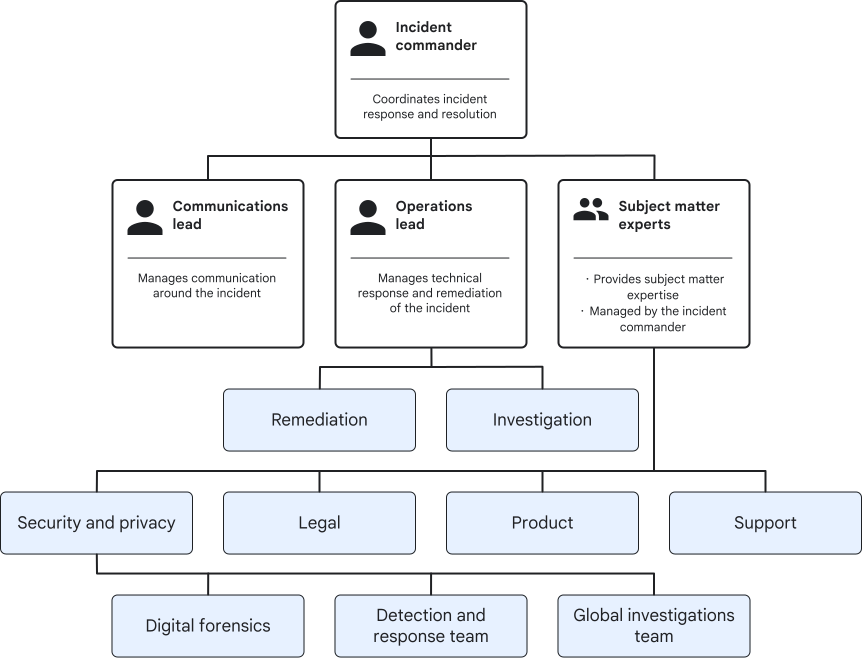
When we declare an incident, we designate an incident commander who coordinates incident response and resolution. The incident commander selects specialists from different teams and forms a response team. The incident commander delegates the responsibility for managing different aspects of the incident to these experts and manages the incident from the moment of declaration to closure. The following diagram depicts an example organization of various roles and their responsibilities during incident response. Depending on the type of incident, different roles might be assigned.
Data incident response process
Every data incident is unique, and the goal of the data incident response process is to protect customer data, restore normal service as quickly as possible, and meet both regulatory and contractual compliance requirements. The following table describes the main steps in the Google incident response program.
| Incident step | Goal | Description |
|---|---|---|
| Identification | Detection | Automated and manual processes detect potential vulnerabilities and incidents. |
| Reporting | Automated and manual processes report the issue to the incident response team. | |
| Coordination | Triage | The following activities occur:
|
| Response team engagement | The following activities occur:
|
|
| Resolution | Investigation | The following activities occur:
|
| Containment and recovery | Operations lead takes immediate steps to complete the following:
|
|
| Communication | The following activities occur:
|
|
| Closure | Lessons learned | The following activities occur:
|
| Continuous improvement | Program development | Necessary teams, training, processes, resources, and tools are maintained. |
| Prevention | Teams improve the incident response program based on lessons learned. |
The following sections describe each step in more detail.
Identification
Early and accurate identification of incidents is key to effective incident management. The focus of the identification phase is to monitor security events to detect and report on potential data incidents.
The incident detection team employs advanced detection tools, signals, and alert mechanisms that provide early indication of potential incidents. Our sources of incident detection include the following:
Automated network and system logs analysis: Automated analysis of network traffic and system access helps identify suspicious, abusive, or unauthorized activity and escalates findings to security staff. Threat detection systems use machine learning to correlate separate security signals across Google Cloud infrastructure. By grouping isolated, low-volume events that share common operational signatures, the system exposes sophisticated or coordinated attack campaigns that simple rule-based filters might miss.
Behavioral anomaly detection: Machine-learning models analyze access patterns across users, credentials, and API requests to establish baseline behaviors. Significant deviations that trigger automated alerts include unusual data exfiltration volumes, atypical geographical logins, or sudden changes in administrative permissions.
Testing: The security team actively scans for security threats using penetration tests, quality assurance (QA) measures, intrusion detection, and software security reviews.
Internal code reviews: Source code review discovers hidden vulnerabilities, design flaws, and verifies if key security controls are implemented.
Product-specific tooling and processes: Automated tooling specific to the team function is employed wherever possible to enhance our ability to detect incidents at product level.
Privileged access monitoring: Automated pipelines continuously scan and evaluate access by Google personnel to customer resources. Machine-learning classifiers analyze audit logs to detect and flag unexpected or non-standard access attempts for immediate compliance and security review.
Data center and workplace services security alerts: Security alerts in data centers scan for incidents that might affect our infrastructure.
Google employees: A Google employee detects an anomaly and reports it.
Google’s vulnerability reward program: Potential technical vulnerabilities in Google-owned browser extensions, mobile, and web applications that affect the confidentiality or integrity of user data are sometimes reported by external security researchers.
Smart alert triaging: To prevent alert fatigue, Google uses AI models to pre-classify and deduplicate high-volume alert streams. This system groups related signals into consolidated incidents, ranks them by potential severity, and attaches contextual threat diagnostics for the response team.
Coordination
When an incident is reported, the on-call responder reviews and evaluates the nature of the incident report to determine if it represents a potential data incident and initiates our incident response process.
After confirmation, the responder assesses the nature of the incident and implements a coordinated approach to the response. At this stage, the response includes completing the triage assessment of the incident, adjusting its severity if required, and activating the required incident response team with appropriate operational and technical leads who review the facts and identify key areas that require investigation. We designate a product lead and a legal lead to make key decisions on how to respond. The responder then assigns the responsibility for investigation and the facts are assembled. If necessary, an incident is declared and an incident commander is assigned.
Many aspects of our response depend on the assessment of severity, which is based on key facts that are gathered and analyzed by the incident response team. These key facts include the following:
Potential for harm to customers, third parties, and Google
Nature of the incident (for example, whether data was potentially destroyed, accessed, or altered)
Type of data that might be affected
Impact of the incident on our customers’ ability to use the service
Status of the incident (for example, whether the incident is isolated, continuing, or contained)
The incident commander and other leads periodically re-evaluate these factors throughout the response effort as new information evolves to ensure that our response is assigned the appropriate resources and urgency. Events that present the most critical impact are assigned the highest severity. A communications lead is appointed to develop a communications plan with other leads.
AI systems monitor incident-related collaboration channels and propose updates to the incident timeline.
Resolution
At the resolution stage, the focus is on investigating the root cause, limiting the impact of the incident, resolving immediate security risks (if any), implementing necessary fixes as part of remediation, and recovering affected systems, data, and services.
Affected data is restored to its original state wherever possible. Depending on what is reasonable and necessary in a particular incident, we might take a number of different steps to resolve an incident. For instance, there might be a need for technical or forensic investigation to reconstruct the root cause of an issue or to identify any impact on customer data. We might attempt to recover copies of the data from our backup copies if data is improperly altered or destroyed.
A key aspect of remediation is notifying customers when incidents impact their data. Key facts are evaluated throughout the incident to determine whether the incident affected customer data. If notifying customers is appropriate, the incident commander initiates the notification process. The communications lead develops a communication plan with input from the product and legal leads, informs those affected, and supports customer requests after notification with the help of Customer Care.
We strive to provide prompt, clear, and accurate notifications containing the known details of the data incident, steps that we have taken to mitigate the potential risks, and actions that we recommend customers take to address the incident. We do our best to provide a clear picture of the incident so that customers can assess and fulfill their own notification obligations.
Closure
Following the successful remediation and resolution of a data incident, the incident response team evaluates the lessons learned from the incident. When the incident raises critical issues, the incident commander might initiate a post-mortem analysis. AI tools auto-populate a postmortem draft using timelines, chat logs, and metadata. During this process, the incident response team reviews the causes of the incident and our response and identifies key areas for improvement. In some cases, this might require discussions with different product, engineering, and operations teams and product enhancement work. If follow-up work is required, the incident response team develops an action plan to complete that work and assigns project managers to lead the long-term effort. The incident is closed after the remediation efforts conclude.
Continuous improvement
At Google, we strive to learn from every incident and implement preventative measures to avoid future incidents.
Actionable insights from incident analysis enable us to enhance our tools, training, processes, overall security and privacy data protection program, security policies, and response efforts. The key learnings also facilitate prioritization of engineering efforts and building of better products.
Security and privacy professionals enhance our program by reviewing our security plans for all networks, systems, and services, and by providing project-specific consulting services to product and engineering teams. Security and privacy professionals deploy machine learning, data analysis, and other novel techniques to monitor for suspicious activity on our networks, address information security threats, perform routine security evaluations and audits, and engage outside experts to conduct regular security assessments. Additionally, Project Zero, aims to prevent targeted attacks by reporting bugs to software vendors and filing them in an external database.
We conduct regular training and awareness campaigns to drive innovation in security and data privacy. Dedicated incident response staff are trained in forensics and in handling evidence, including the use of third-party and proprietary tools. Testing of incident response processes and procedures is performed for key areas, such as systems that store sensitive customer information. These tests take into consideration a variety of scenarios, including insider threats and software vulnerabilities and help us better prepare for security and privacy incidents.
Our incident response process is tested regularly against regulatory frameworks to provide our customers and regulators with independent verification of our security, privacy, and compliance controls. For example, we've aligned our incident response processes with the EU Digital Operational Resilience Act (DORA) to help financial customers meet their incident classification, reporting, and timeline requirements. We've also aligned with the Network and Information Systems Directive 2.0 (NIS2) in Europe. Our products regularly undergo certification testing for ISO-27017, ISO-27018, ISO-27001, PCI-DSS, SOC 2, and FedRAMP programs. For a list of third-party certifications for Google Cloud, see the Compliance resource center.
Customer communications
Google provides several mechanisms for our customers to receive incident notifications and to integrate the notifications with their incident response workflows.
Notifications about data incidents are sent using Essential Contacts. In addition, the Google Admin console provides notifications about account security and management, service health and updates, and mandatory service announcements (MDA).
To specify who receives these notifications, you must add appropriate email addresses to Essential Contacts and Google Workspace admin accounts. If you don't configure Essential Contacts, Google Cloud sends emails to organization administrators, project owners, or billing administrators, depending on the scope of the notification.
Google sends emails using an @google.com address. The specific sender varies
depending on the service that sent the alert. Senders include
cloud-security-scanner-noreply@google.com,
google-cloud-compliance-noreply@google.com, workspace-noreply@google.com,
apps-noreply@google.com, or service-specific noreply addresses.
The notifications typically include the following:
- The affected Google Cloud services and projects
- A description of the issue or incident
- The time the issue was detected
- A unique identifier for the incident
- Links to relevant dashboards or support resources
To ingest these notifications into your incident response processes, complete the following:
- Configure an incident response group email for the Security or All category in Essential Contacts.
- Grant the Advisory Notifications Viewer
(
roles/advisorynotifications.viewer) IAM role to your security administrators so that they can view these advisories in the Google Cloud console. - Create alerts in Cloud Monitoring to receive notifications based on your logs and metrics.
For information about our incident response communication timelines, see section 7.2 Data Incidents in the Cloud Data Processing Addendum (Customers).
Use of AI in data incident response
Google uses AI during the various stages of the data incident response process to enrich context and advise our teams on next steps. For example, Google uses AI as follows:
- During the identification stage, machine-learning models analyze alert signals and correlate events.
- During the investigation stage, AI agents parse diagnostics to identify potential root causes and recommend resolutions. At this stage, AI is strictly limited to suggesting resolutions.
- During the resolution stage, AI models are prohibited from executing commands directly. Instead, AI models generate structured action payloads that must pass validation checks and receive explicit human-in-the-loop confirmation before the payloads are applied.
To assist with auditability and compliance, AI actions that occur during the incident response process are recorded in immutable audit logs.
Summary
Protecting data is core to our business. We continually invest in our overall security program, resources, and expertise, which enables our customers to rely on us to respond effectively in the event of an incident, protect customer data, and maintain the high reliability customers expect of a Google service.
Our world-class incident response program delivers these key functions:
A process built upon industry-leading techniques for resolving incidents and refined to operate efficiently at Google’s scale.
Pioneering monitoring systems, data analytics, and machine-learning services to proactively detect and contain incidents.
Dedicated subject matter experts who can respond to any type or size of data incident.
A mature process for promptly notifying affected customers, aligned with Google’s commitments in our terms of service and customer agreements.
What’s next
To learn more about incident management, read Chapter 17 of Building secure and reliable systems (O'Reilly book).
To learn more about how to implement security for customer workloads in Google Cloud, see the enterprise foundations blueprint and the Google Cloud Well-Architected Framework.