

This document describes how to include individual resources such as tables, datasets, data products, and entire projects in a data domain by creating resource bindings.
About resource binding and inclusion
Understanding resource management in data domains involves two key concepts:
- Binding: When you bind a resource to a domain, you create a link between the resource or a project and the data domain.
- Inclusion: The membership that results from binding the resource to a domain. When a container resource, such as a project or dataset, is included in a domain, all of its descendants automatically inherit inclusion in that domain.
Inheritance and overrides
Resource inclusion follows hierarchical inheritance rules:
- Automatic inheritance: If you include a dataset or a project in a domain, this means that all assets under this dataset or project are also included in the domain, unless you explicitly override this setting.
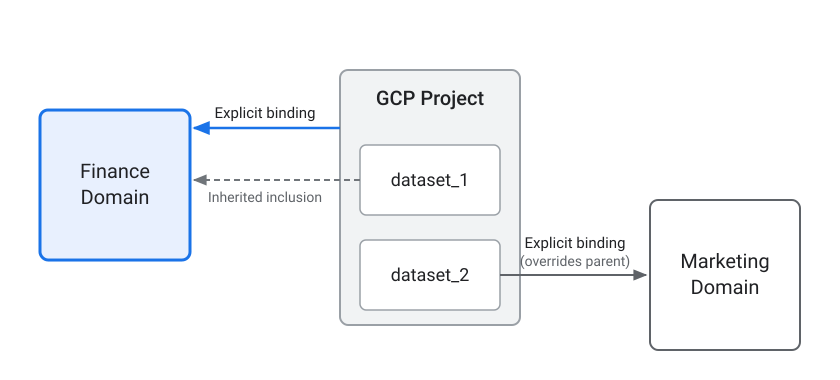
- Explicit overrides: Specific lower-level bindings take precedence over inherited parent assignments. If a child resource is explicitly bound to a different domain, that explicit binding overrides its inherited parent domain assignment.
Example: If a project containing two datasets (dataset_1 and dataset_2)
is bound to the Finance domain, both datasets inherit inclusion in
Finance. However, if dataset_2 is explicitly bound to the Marketing
domain, dataset_2 belongs to Marketing, while dataset_1 remains in
Finance.
What's next
- Learn more about data domains.
- Learn how to create data domains.
- Learn how to include resources in data domains.