

Accelerate your organization's digital transformation by providing a high-availability, production-ready foundation for modern web applications. This guide helps you understand the Three-tier web app application template, which helps you quickly deploy a three-tier web application to Google Cloud.
For example, you might implement this template to address the following business needs:
| Example | Business need | Implementation |
|---|---|---|
| Ecommerce platform | A retail company needs a web presence that can handle sudden spikes in traffic during seasonal sales while maintaining low latency for product searches and purchases. | Use the Cloud Run tier for the storefront to scale automatically based on request volume. The middle tier handles inventory logic, and Memorystore for Redis caches product catalogs to reduce database load and latency. |
| Tech support ticketing system | An enterprise IT department needs an internal portal where employees report hardware issues and track software requests. | Use the Cloud Run frontend to input employee requests. The frontend communicates with an API layer to manage ticket routing logic and priority assignments. The Cloud SQL database contains employee data and resolution audit trails. |
Architecture
The following image shows the components and connections in the application:
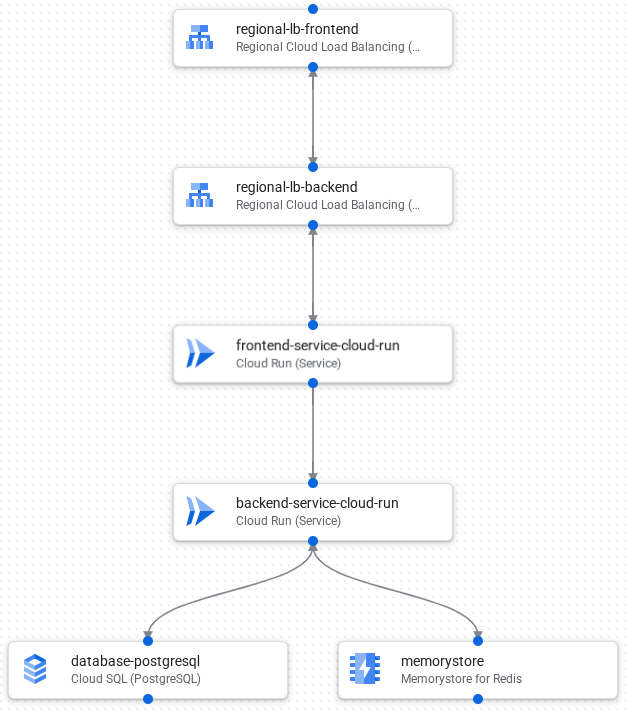
The following is the request processing flow of the application:
- A Cloud Load Balancing frontend receives external requests and distributes traffic to the Cloud Load Balancing backend.
- The Cloud Load Balancing backend distributes traffic to the Cloud Run service.
- A web-based Cloud Run frontend service renders an HTML client in the user's browser.
- The frontend service sends requests to an API layer, which is also deployed as a Cloud Run service.
- Memorystore for Redis caches and serves frequently read data.
- The API layer sends requests that it can't serve from the in-memory Redis cache to a Cloud SQL database.
What's next
- To learn how to duplicate and customize templates, see Quickstart: Customize and deploy a Google template.
- Define your own configurations by designing application templates.
- Identify general architectural best practices with the Google Cloud Architecture Framework.