

A network endpoint group (NEG) is a collection of network endpoints. Every endpoint in a NEG must point to a unique IP address of a VM's network interface. A network endpoint belongs to exactly one network endpoint group. A single IP address cannot be referenced by more than one endpoint in a NEG. However, a single IP address can be referenced by endpoints in different NEGs. The following diagram presents a stylized representation of this concept. In the diagram, "IP address - 2" and "IP address - 3" are referenced by network endpoints that are located in different network endpoint groups.
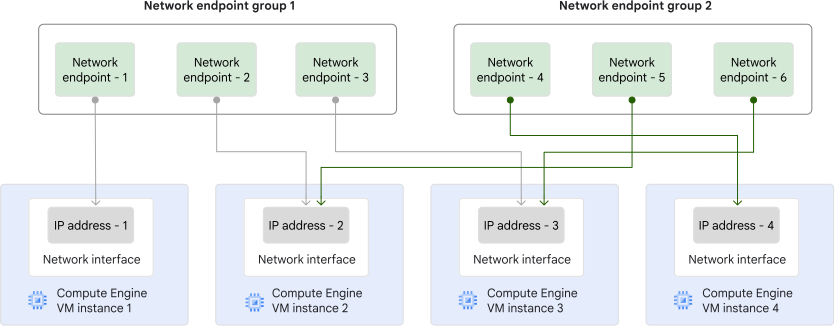
Zonal NEGs are zonal resources that represent collections of either IP addresses or IP address and port combinations for Google Cloud resources within a single VPC subnet. Zonal NEGs let you do the following:
Route packets to any network interface of a VM instance, including interfaces other than
nic0. This lets you create logical groupings of IP addresses and ports representing software services instead of entire VMs.Create a flexible set of unique endpoint IP addresses or IP addresses and ports.
There are two types of zonal NEGs, depending on the type of network endpoints that make up the NEG. The two types of zonal NEGs support different use cases and load balancer types.
Zonal NEGs with
GCE_VM_IPendpoints are supported as backends for the following load balancers:Zonal NEGs with
GCE_VM_IP_PORTendpoints are supported as backends for the following proxy-based load balancers:
NEGs with GCE_VM_IP endpoints
These zonal NEGs contain one or more GCE_VM_IP endpoints with each endpoint
having one of the following IP addresses:
- The primary internal IPv4 address of a Compute Engine VM's network interface.
- The first IPv6 address (
/128) from a/96range assigned to a Compute Engine VM's network interface.
With a GCE_VM_IP endpoint, you select the primary internal IPv4 address or the
first IPv6 address of a network interface, which provides a level of
granularity similar to selecting a network interface directly.
A GCE_VM_IP endpoint can't point
to an IP address from an alias IPv4 range.
The network interface referenced by the GCE_VM_IP endpoint must be in the
same subnet as the NEG.
As depicted in the following table, GCE_VM_IP endpoints can reference a VM's
network interface whose stack type can be IPv4-only, IPv6-only,
or dual-stack.
You cannot add an endpoint that is
simultaneously IPv4 and IPv6 (a dual-stack endpoint)
to a GCE_VM_IP zonal NEG. In other words, you can only use a single
IP address when creating a GCE_VM_IP endpoint.
| Network endpoint | Compatible VM network interface |
|---|---|
| IPv4 endpoint (primary) | IPv4-only interface |
| IPv4 endpoint (primary) | Dual-stack interface |
| IPv6 endpoint (first in range) (Preview) | IPv6-only interface |
| IPv6 endpoint (first in range) (Preview) | Dual-stack interface |
Because a GCE_VM_IP endpoint identifies a network interface, you cannot
specify a port with a GCE_VM_IP endpoint.
These types of endpoints can only be used as backends in backend services for internal passthrough Network Load Balancers and regional external passthrough Network Load Balancers.
NEGs with GCE_VM_IP_PORT endpoints
These zonal NEGs contain one or more GCE_VM_IP_PORT endpoints with each
endpoint having one of the following IP address combinations along with the
destination port:
Primary IPv4 address + port: the primary internal IPv4 address of a VM network interface plus a destination port number
Alias IPv4 address + port: an internal IPv4 address from the alias IP address range assigned to a VM network interface plus a destination port number
Primary IPv4 address + any IPv6 address + port: the primary internal IPv4 address of a VM network interface and any IPv6 address (
/128) from a/96range assigned to a VM network interface plus a destination port numberAlias IPv4 address + any IPv6 address + port: an internal IPv4 address from the alias IP address range assigned to a VM network interface and any IPv6 address (
/128) from a/96range assigned to a VM network interface plus a destination port numberIPv6 address + port: any IPv6 address (
/128) from a/96range assigned to a VM network interface plus a destination port number
Compared to a GCE_VM_IP endpoint, with a GCE_VM_IP_PORT endpoint you can
select not only the primary IP address of a network interface but any IP
address, so the level of granularity that a GCE_VM_IP_PORT endpoint
provides is greater than just selecting a network interface.
The network interface referenced by the GCE_VM_IP_PORT endpoint must be in the
same subnet as the NEG. When you omit a port number from a
GCE_VM_IP_PORT endpoint, Google Cloud uses the NEG's default port number
for the endpoint.
As depicted in the following table, GCE_VM_IP_PORT endpoints can reference a
VM's network interface whose stack type can be IPv4-only, IPv6-only,
or dual-stack.
| Network endpoint | Compatible VM network interface |
|---|---|
| IPv4 endpoint (primary or alias) | IPv4-only interface |
| IPv4 endpoint (primary or alias) | Dual-stack interface |
IPv6 endpoint (any from a /96 range) (Preview) |
IPv6-only interface |
IPv6 endpoint (any from a /96 range) (Preview) |
Dual-stack interface |
IPv4 (primary or alias) and IPv6 (any from a Also referred to as a dual-stack endpoint |
Dual-stack interface |
Because these zonal NEG backends let you specify IP addresses and ports,
you can distribute traffic in a granular fashion among applications or
containers running within VM instances—container-native load balancing.
GKE uses GCE_VM_IP_PORT endpoints for:
You can create self-managed load balancers that use zonal NEGs whose
GCE_VM_IP_PORT endpoints are managed by GKE.
For more information, see
Container-native load balancing through standalone zonal NEGs.
Application Load Balancers and proxy Network Load Balancers support zonal NEGs with
GCE_VM_IP_PORT endpoints.
Endpoint specifications
Each endpoint that you add to a zonal NEG must be a unique load balancer target interface. Each zonal NEG supports up to the maximum number of endpoints per NEG.
GCE_VM_IP zonal NEG backends and network interfaces
When you create a new zonal NEG with GCE_VM_IP endpoints, you specify a zone,
a VPC network, and a subnet in that network. None of these
attributes can be changed after the zonal NEG has been created.
The NEG's subnet must be in the same region as the NEG's zone. If the NEG's network is an auto mode VPC network, you can omit specifying the NEG's subnet. When you don't specify a subnet, Google Cloud sets the NEG's subnet to the automatically created subnet in the region that contains the NEG's zone.
Zonal NEGs with GCE_VM_IP endpoints enforce the following rules for adding
endpoints:
If you specify only an instance name for the endpoint, the instance must be in the same zone as the NEG and have a load balancer target interface in the NEG's subnet. If the endpoint references an IPv4-only or a dual-stack network interface, the primary internal IPv4 address of the instance's network interface is selected as the endpoint IP address. If the endpoint references an IPv6-only network interface, the first IPv6 address (
/128) of the instance's network interface is selected as the endpoint IP address.If you specify both an instance name and an IP address for adding an endpoint, the instance must be in the same zone as the NEG. The IP address must be set to the primary internal IPv4 address or the first IPv6 address (
/128) of the instance's network interface.
Since an instance can have only one NIC in the NEG's subnet, it can have only
one GCE_VM_IP endpoint per zonal NEG. For GCE_VM_IP endpoints, the endpoint
IP address is a redundant label whose value must be a primary internal IPv4
address or the first IPv6 address (/128) of a load balancer target interface.
The actual destination IP addresses of load-balanced packets match a
passthrough Network Load Balancer forwarding rule.
GCE_VM_IP_PORT zonal NEG backends and network interfaces
When you create a new zonal NEG with GCE_VM_IP_PORT endpoints, you specify a
zone, a default port, a VPC network, and a subnet in that
network. None of these attributes can be changed after the zonal NEG has been
created.
The NEG's subnet must be in the same region as the NEG's zone. If the NEG's network is an auto mode VPC network, you can omit specifying the NEG's subnet. When you don't specify a subnet, Google Cloud sets the NEG's subnet to the automatically created subnet in the region that contains the NEG's zone.
Zonal NEGs with GCE_VM_IP_PORT endpoints enforce the following rules for adding
endpoints:
If you specify only an instance name for the endpoint, the instance must be in the same zone as the NEG and have a load balancer target interface in the NEG's subnet. The endpoint's IP address is set to the primary internal IPv4 address of the load balancer target interface, and the endpoint's port is set to the NEG's default port.
If you specify an instance name and an IP address, or an instance name, an IP address, and port information for the endpoint, the instance must be in the same zone as the NEG, and:
If you specify an IPv4 address, the IPv4 address must be a primary internal IPv4 address or an IPv4 address from an alias IP range that's associated with a load balancer target interface in the NEG's subnet.
If you specify an IPv6 address, the IPv6 address must be a single IPv6 address (
/128) from the/96IPv6 address range of the load balancer target interface in the NEG's subnet.The endpoint's port is the port you specify. If you don't specify a port, the endpoint's port is set to the NEG's default port.
Load balancing with zonal NEGs
Zonal NEGs can be used as backend groups connected to a backend
service in a load balancer. When you use
a zonal NEG as a backend group, the backend service's other backend groups must
be zonal NEGs with the same type of endpoints (either all GCE_VM_IP or
GCE_VM_IP_PORT). You cannot use both instance groups and zonal NEGs as backend
groups on the same backend service.
You can add the same network endpoint to more than one zonal NEG. You can also use the same zonal NEG as a backend for more than one backend service.
Zonal NEGs with GCE_VM_IP_PORT endpoints are supported by proxy-based
load balancers with the balancing modes as defined in
Balancing modes for Application Load Balancers and Cloud Service Mesh and
Balancing modes for Proxy Network Load Balancers.
Zonal NEGs with GCE_VM_IP endpoints are are supported by passthrough Network Load Balancers,
with the balancing modes as defined in
Balancing modes for passthrough Network Load Balancers.
Flexible endpoint grouping
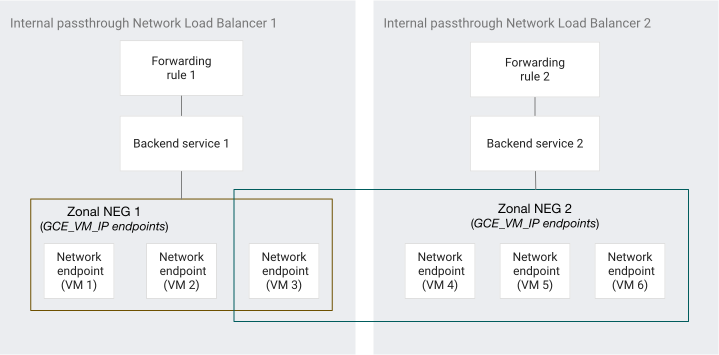
Like instance groups, you can use the same NEG as a backend for multiple passthrough Network Load Balancers. Unlike instance groups, a NEG endpoint can be a member of multiple NEGs, and each of those NEGs can be used as a backend for one or more passthrough Network Load Balancers. Compared to instance groups, you aren't constrained by the fact that a VM instance can only be a part of a single instance group.
The following figure shows a sample internal passthrough Network Load Balancer architecture with a shared VM.
Load balanced network interfaces and endpoints
Zonal NEGs support distributing load-balanced traffic to nic0 vNICs,
non-nic0 vNICs, and Dynamic NICs.
For more information, see load balancer target interfaces.
For information about using zonal NEGs with passthrough Network Load Balancers, see the following documents:
Zonal NEG backends and network interfaces for global external passthrough Network Load Balancers
Zonal NEG backends and network interfaces for regional external passthrough Network Load Balancers
Zonal NEG backends and network interfaces for internal passthrough Network Load Balancers
GKE and zonal NEGs
GKE uses zonal NEGs with GCE_VM_IP and
GCE_VM_IP_PORT endpoints:
GKE creates a unique
GCE_VM_IPNEG in each zone for each LoadBalancer Service. These NEGs contain cluster node VMs as endpoints, which GKE selects based on theexternalTrafficPolicyof the service and the number of nodes in the cluster. For more information, see Node grouping in About LoadBalancer Services document.GKE Gateway and Ingress controllers use
GCE_VM_IP_PORTNEGs to route traffic directly to Pods (container-native load balancing). Each endpoint in aGCE_VM_IP_PORTNEG contains a Pod's IP address and container port (targetPort). The way GKE creates these NEGs depends on the Gateway or Ingress resource that you use:Internal and external Gateway: GKE creates
GCE_VM_IP_PORTNEGs automatically for each referenced Service. See About Gateway API.Internal Ingress: GKE creates
GCE_VM_IP_PORTNEGs automatically for each referenced Service. See Configure Ingress for internal Application Load Balancer.External Ingress: GKE creates
GCE_VM_IP_PORTNEGs for each referenced Service that includes thecloud.google.com/neg: '{"ingress": true}'annotation. See Configure Ingress for external Application Load Balancer.
You can instruct GKE to create standalone
GCE_VM_IP_PORTNEGs and maintain their Pod endpoints so that you can attach those NEGs as backends to Application Load Balancers and proxy Network Load Balancers that you manage yourself. For more information, see Container-native load balancing through standalone zonal NEGs.
Limitations
- You cannot use zonal NEGs with legacy networks.
- The
default-portproperty is not supported forGCE_VM_IPzonal NEGs.
Quotas
- For information about NEG quotas—such as NEGs per project, NEGs per backend service, and endpoints per NEG—see the load balancing quotas page.
What's next
- For information about configuring zonal NEGs, see Set up zonal network endpoint groups.
- For information about using zonal NEGs in Google Kubernetes Engine, see Container-native load balancing through Ingress.