

ULL Multicast overview
This page provides an overview of Ultra Low Latency (ULL) Multicast in Google Cloud.
ULL Multicast shares many of the same properties as Cloud Multicast. The following sections focus on the unique properties of ULL Multicast.
Comparison of ULL Multicast and Cloud Multicast
The following table summarizes the key differences between ULL Multicast and Cloud Multicast:
| Property | Cloud Multicast | ULL Multicast |
|---|---|---|
| Overview and configuration | ||
| Summary | A multicast service based on software-defined networking that uses infrastructure in a tenant project and network managed by Google to replicate and distribute traffic. | A hardware-based multicast service for applications with strict latency and multicast variance requirements. Relies on infrastructure directly in the physical network fabric to replicate and distribute traffic. |
| API and resource model | See the following
|
See the following
|
| Configuration procedure | To configure Cloud Multicast, see the Cloud Multicast configuration overview. | To configure ULL Multicast, see Configuration overview for ULL Solution. |
| Location and scope | ||
| Supported locations | Each of the following:
|
Only the following:
|
| Traffic distribution scope | Each of the following:
A single multicast domain can be created and activated in multiple zones to enable cross-zone multicast as described in the cross-zone deployment pattern for Cloud Multicast. |
Only the following:
Each pre-configured multicast domain is created and activated once for a given zone to enable intra-zone multicast as described in the zonal deployment pattern for ULL Multicast. |
| Compatible compute and network resources | ||
| Supported Compute Engine instance types | Each of the following:
|
Only the following:
|
| Supported VPC network types | General-purpose VPC networks:
|
VPC networks with a ULL
network profile:
|
ULL Multicast resource model
ULL Multicast uses the same API and resource model as Cloud Multicast, including each resource described in Overview of the multicast resource model.
For ULL Multicast, see the following details:
- Multicast domains: are created by the exchange operator, but have unique considerations for consumers compared to Cloud Multicast. For more information, see the following Instance and network interface mapping for ULL Multicast domains section.
- Multicast consumer configurations: consumer associations and group consumer activations have the same properties described in Multicast consumer configurations. For information about creating these resources for ULL Multicast, see Enable a ULL VPC network to consume multicast traffic.
Instance and network interface mapping for ULL Multicast domains
This section describes the relationship between ULL Multicast domains, ULL Compute Engine instance types, and the network interfaces of those compute instances. The behavior described in this section assumes that corresponding multicast configurations are created as described in Configuration overview for ULL Solution.
The following table describes which instance types, network interfaces, and actions are supported for a given ULL Multicast domain. Multicast producer and consumer instances that don't adhere to this mapping can't send and receive ULL multicast traffic successfully.
| Domain | Instance type | Supported action |
|---|---|---|
|
Feed A (created with the feed-a pre-configured domain)
|
U4P instance |
Send multicast traffic A U4P instance can send traffic for this domain from any of its ULL network interfaces. |
| U4C instance |
Receive multicast traffic. A U4C instance must receive
traffic on the same network interface number from which the U4P instance
sends traffic. For example, if the U4P instance sends traffic from |
|
|
Feed B (created with the feed-b pre-configured domain)
|
U4P instance |
Send multicast traffic A U4P instance can send traffic for this domain from any of its ULL network interfaces. |
| U4C instance |
Receive multicast traffic. A U4C instance must receive
traffic on the same network interface number from which the U4P instance
sends traffic. For example, if the U4P instance sends traffic from |
ULL Multicast zonal deployment pattern
ULL Multicast supports the same topologies and deployment patterns as Cloud Multicast, except for cross-zone multicast.
This section provides the general per-zone deployment pattern for ULL Multicast that enables multicast connectivity between multicast producers in an exchange operator project and multicast consumers in exchange participant projects. This deployment pattern uses the Network Connectivity Center (NCC) star topology and redundant multicast domains.
ULL multicast traffic in a zone
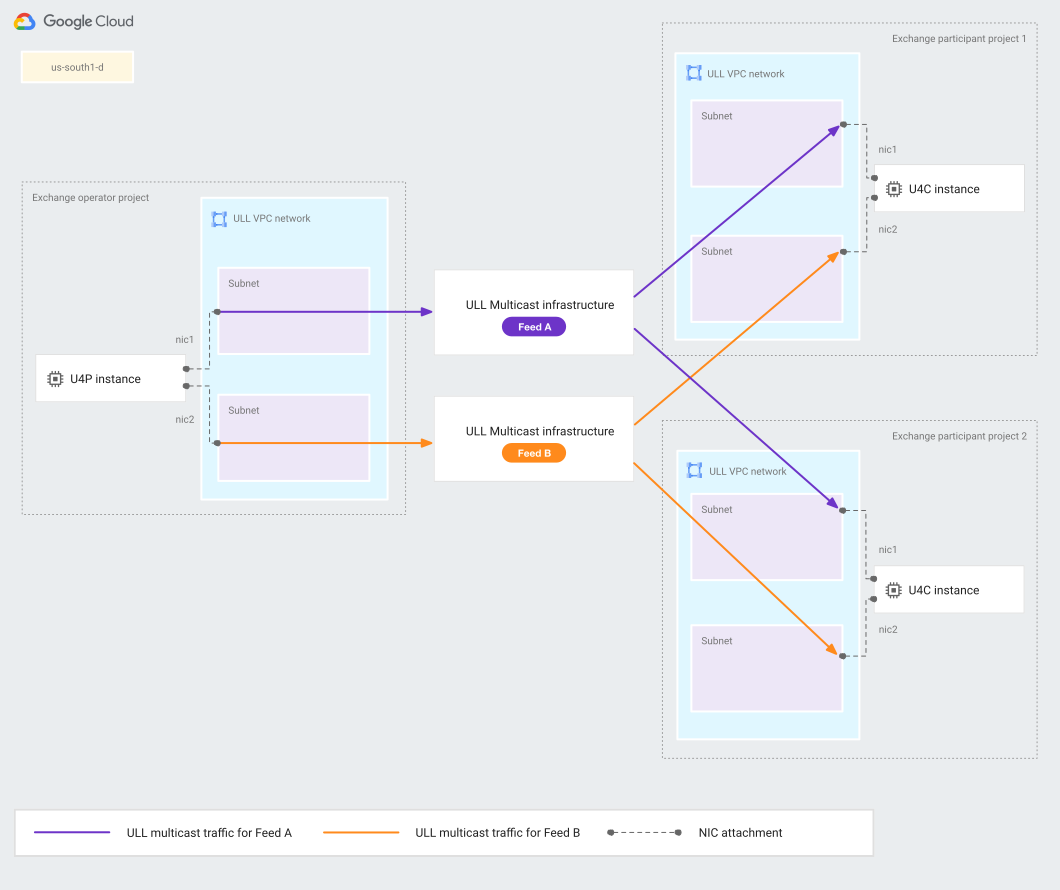
The following diagram illustrates ULL multicast traffic through redundant multicast domains in the NCC star topology.
In this example, a multicast producer sends traffic to multicast consumers in the same zone and in different ULL VPC networks through redundant multicast infrastructure that corresponds to two separate multicast domains.
Resource configuration in a zone
The following diagram illustrates the network and multicast resources that must be configured to achieve the multicast connectivity that's described in the previous section.
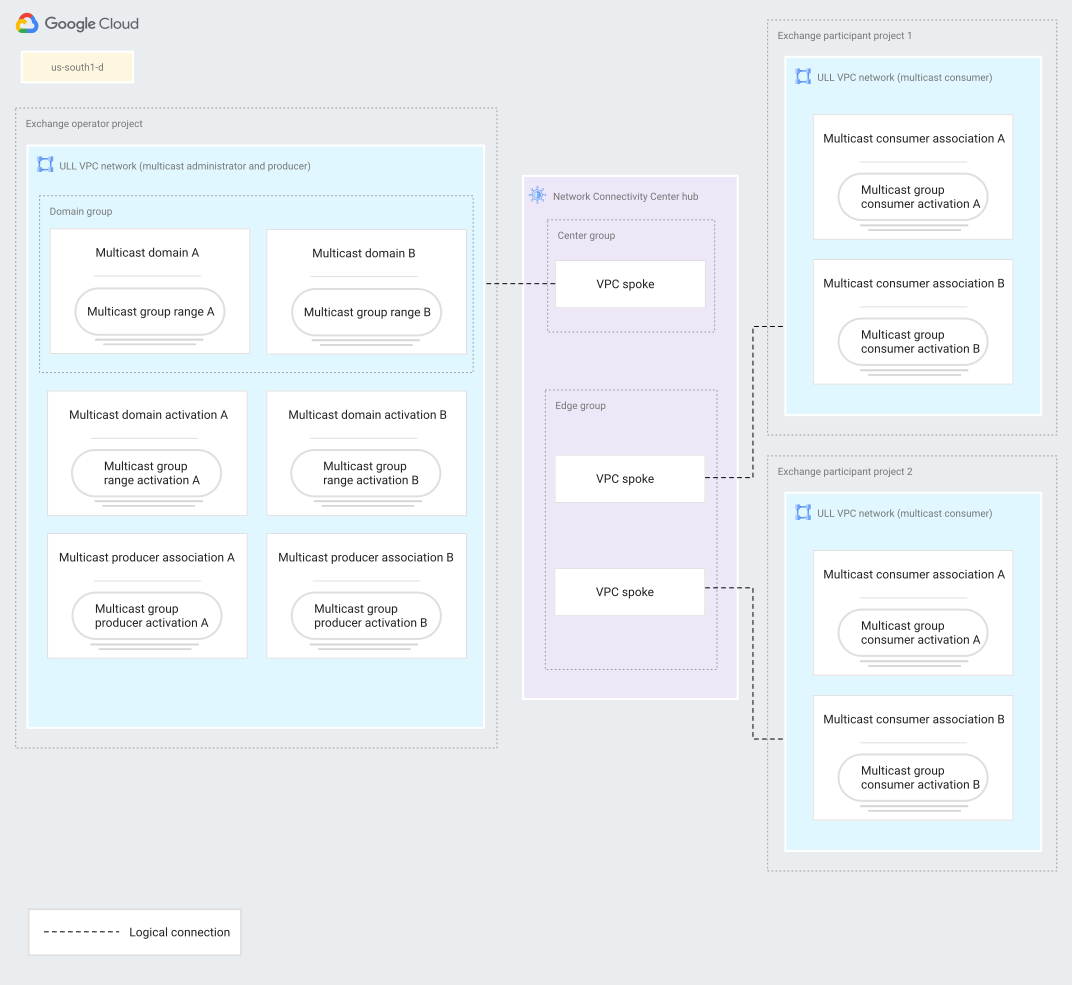
The following table describes the resource configurations in the preceding diagram. To use redundant multicast domains, you must create redundant configurations for each multicast resource type.
| Resource types | Configuration |
|---|---|
| Multicast domains and group ranges |
Resources for redundant multicast domains:
|
| Multicast producer configurations |
The example configuration uses the same network as the multicast administrator network and multicast producer network. Resources that allow
Resources that allow
|
| Multicast consumer configurations |
Two multicast consumer networks are edge spokes on the hub and each contain resources that allow multicast consumers to receive traffic. Resources that allow
Resources that allow
|
Limitations
ULL Multicast shares most of the limitations of Cloud Multicast (such as being restricted to IPv4 and UDP, and requiring a 1500 byte MTU). For limitations specific to ULL Multicast, see the following:
- ULL Multicast is supported only in the private zones for ULL Solution, and only for ULL Compute Engine instances attached to ULL VPC networks as described in Comparison of ULL Multicast and Cloud Multicast. Other locations and resource types aren't supported.
- Cross-zone multicast traffic isn't supported.
Quotas and limits
Multicast resources created for use with ULL Multicast contribute to most of the same quotas and limits for Cloud Multicast as described in Multicast quotas and limits.
What's next
- To get started, see Configuration overview for ULL Solution.