

Analyze your application using metrics
This quickstart shows you how to use Cloud Deploy to analyze your deployed Cloud Run service, based on metrics from Google Cloud Observability, to ensure the application is performing as expected.
In this quickstart, you'll do the following:
Create and deploy one Cloud Run service.
In this case, you won't use Cloud Deploy to deploy it.
Create an uptime check in Google Cloud Observability.
This check monitors your Cloud Run service to make sure it's running.
Create an alert policy in Cloud Monitoring.
By default, Cloud Deploy analysis can use many types of metrics from Google Cloud Observability. This policy creates an alert if an uptime check indicates a problem.
Create a Skaffold configuration to identify the Cloud Run service.
Define your Cloud Deploy delivery pipeline and target.
This pipeline includes only one stage and uses only one target, and includes the definition for an analysis job.
Create a release, which automatically deploys to the target.
After the application is deployed, the analysis runs as a job in the rollout.
The service should deploy successfully to the target, but the rollout should fail because the alert policy will generate an alert.
Change the Cloud Run service definition to increase the instance count for the service, and create a new release.
This time, the service will deploy successfully, and the rollout will complete successfully.
Before you begin
- Sign in to your Google Cloud account. If you're new to Google Cloud, create an account to evaluate how our products perform in real-world scenarios. New customers also get $300 in free credits to run, test, and deploy workloads.
-
In the Google Cloud console, on the project selector page, select or create a Google Cloud project.
Roles required to select or create a project
- Select a project: Selecting a project doesn't require a specific IAM role—you can select any project that you've been granted a role on.
-
Create a project: To create a project, you need the Project Creator role
(
roles/resourcemanager.projectCreator), which contains theresourcemanager.projects.createpermission. Learn how to grant roles.
-
If you're using an existing project for this guide, verify that you have the permissions required to complete this guide. If you created a new project, then you already have the required permissions.
-
Verify that billing is enabled for your Google Cloud project.
Enable the Cloud Deploy, Cloud Build, Cloud Run, and Cloud Storage APIs, if any are not already enabled.
Roles required to enable APIs
To enable APIs, you need the
serviceusage.services.enablepermission. If you created the project, then you likely already have this permission through the Owner role (roles/owner). Otherwise, you can get this permission through the Service Usage Admin role (roles/serviceusage.serviceUsageAdmin). Learn how to grant roles.-
Install the Google Cloud CLI.
-
If you're using an external identity provider (IdP), you must first sign in to the gcloud CLI with your federated identity.
-
To initialize the gcloud CLI, run the following command:
gcloud init -
In the Google Cloud console, on the project selector page, select or create a Google Cloud project.
Roles required to select or create a project
- Select a project: Selecting a project doesn't require a specific IAM role—you can select any project that you've been granted a role on.
-
Create a project: To create a project, you need the Project Creator role
(
roles/resourcemanager.projectCreator), which contains theresourcemanager.projects.createpermission. Learn how to grant roles.
-
If you're using an existing project for this guide, verify that you have the permissions required to complete this guide. If you created a new project, then you already have the required permissions.
-
Verify that billing is enabled for your Google Cloud project.
Enable the Cloud Deploy, Cloud Build, Cloud Run, and Cloud Storage APIs, if any are not already enabled.
Roles required to enable APIs
To enable APIs, you need the
serviceusage.services.enablepermission. If you created the project, then you likely already have this permission through the Owner role (roles/owner). Otherwise, you can get this permission through the Service Usage Admin role (roles/serviceusage.serviceUsageAdmin). Learn how to grant roles.-
Install the Google Cloud CLI.
-
If you're using an external identity provider (IdP), you must first sign in to the gcloud CLI with your federated identity.
-
To initialize the gcloud CLI, run the following command:
gcloud init
Required roles
To ensure that the Cloud Deploy service account has the necessary permissions to run Cloud Deploy operations and deploy to Cloud Run, ask your administrator to grant the following IAM roles to the Cloud Deploy service account on your project:
- Cloud Run Developer (
roles/run.developer) - Cloud Deploy Runner (
roles/clouddeploy.jobRunner) - IAM Service Account User (
roles/iam.serviceAccountUser) - Monitoring Alert Viewer (
roles/monitoring.alertViewer) - Service Usage Consumer (
roles/serviceusage.serviceUsageConsumer)
For more information about granting roles, see Manage access to projects, folders, and organizations.
Your administrator might also be able to give the Cloud Deploy service account the required permissions through custom roles or other predefined roles.
Learn more about the Cloud Deploy service account.
Deploy a Cloud Run service
This quickstart uses an alerting policy that requires that the
Cloud Run already exist. So we'll deploy one here, and in a later
section we'll define a service.yaml using the same service name.
Run the following command to create the initial service:
gcloud run deploy my-analysis-run-service \
  --image=us-docker.pkg.dev/cloudrun/container/hello@sha256:95ade4b17adcd07623b0a0c68359e344fe54e65d0cb01b989e24c39f2fcd296a \
  --project=PROJECT_ID \
  --region=us-central1 \
  --allow-unauthenticated
Replace PROJECT_ID with your project ID.
Create a Google Cloud Observability uptime check
This uptime check monitors your running service to confirm that it's running. In a later section, you create a Google Cloud Observability alert policy that generates an alert if your service doesn't have at least one available instance running.
To create the uptime check, run the following command:
gcloud monitoring uptime create my-analysis-run-service-cloud-run-uptime-check \
  --resource-type=cloud-run-revision \
  --resource-labels="project_id=PROJECT_ID,location=us-central1,service_name=my-analysis-run-service" \
  --project=PROJECT_ID \
  --protocol=https \
  --path="/" \
  --port=443 \
  --period=1 \
  --timeout=10 \
  --service-agent-auth="oidc-token" \
  --status-classes="2xx"
Copy the uptime check ID.
The output from the command you just ran contains the ID.
Prepare your Skaffold configuration and service definition
In this quickstart, you create a skaffold.yaml file, which identifies the
manifest to be used to deploy the sample Cloud Run service, and
you also define the service.yaml file that defines the
Cloud Run itself.
Open a terminal window.
Create a new directory and navigate into it.
mkdir deploy-analysis-run-quickstart
cd deploy-analysis-run-quickstart
- Create a file named
skaffold.yamlwith the following contents:
apiVersion: skaffold/v4beta7
kind: Config
manifests:
  rawYaml:
  - service.yaml
deploy:
  cloudrun: {}
See the skaffold.yaml reference
for more information about this configuration file.
- Create a file named
service.yaml, with the following contents:
apiVersion: serving.knative.dev/v1
kind: Service
metadata:
  name: my-analysis-run-service
  annotations:
    run.googleapis.com/scalingMode: manual
    run.googleapis.com/manualInstanceCount: 0
spec:
  template:
    spec:
      containers:
      - image: my-app-image
This file is a Cloud Run service definition, which is used to
deploy the application. The container image to deploy is set here as a
placeholder, my-app-image, which is replaced with the specific image when you
create the release.
Notice that we've set the scaling mode to manual, and the instance count to 0.
This means that the deployed service won't be able to receive traffic and there
won't be any running instances, which will trigger an alert. You'll configure
that alert next.
Create an alert policy
This quickstart uses a Google Cloud Observability alert policy. This alert policy generates an alert when the Cloud Run service fails the uptime check you created earlier.
In the
deploy-analysis-run-quickstartdirectory, create a file calledpolicy.yaml, with the following contents:displayName: Cloud Run service uptime check userLabels: policy-for: analysis-run-pipeline combiner: OR conditions: - displayName: Failure of uptime check UPTIME_ID conditionThreshold: filter: metric.type="monitoring.googleapis.com/uptime_check/check_passed" AND metric.label.check_id="UPTIME_ID" AND resource.type="cloud_run_revision" aggregations: - alignmentPeriod: 60s crossSeriesReducer: REDUCE_COUNT_FALSE groupByFields: - resource.label.* perSeriesAligner: ALIGN_NEXT_OLDER comparison: COMPARISON_GT duration: 60s thresholdValue: 1.0Replace
UPTIME_IDwith the ID of the uptime check you created before.Run the following command to create the policy:
gcloud monitoring policies create \
  --policy-from-file=policy.yaml\
  --project=PROJECT_ID
Replace
PROJECT_IDwith your project ID.Copy the policy ID from the output of the command you just ran.
This time, copy the entire resource ID, including the path. You'll use this ID in the next section, in the analysis configuration in your delivery pipeline.
Create your delivery pipeline and target
This delivery pipeline has one stage, for one target: analysis-staging.
In the
deploy-analysis-run-quickstartdirectory, create a new file,clouddeploy.yaml, with the following contents:apiVersion: deploy.cloud.google.com/v1 kind: DeliveryPipeline metadata: name: deploy-analysis-demo-app-run description: main application pipeline serialPipeline: stages: - targetId: analysis-staging profiles: [] strategy: standard: analysis: duration: 300s googleCloud: alertPolicyChecks: - id: check-1 alertPolicies: - ALERT_POLICY_ID --- apiVersion: deploy.cloud.google.com/v1 kind: Target metadata: name: analysis-staging description: staging Run service run: location: projects/PROJECT_ID/locations/us-central1In this YAML, replace
ALERT_POLICY_IDwith the output from thegcloud monitoring policies listcommand you ran previously, and replacePROJECT_IDwith the ID of the project you're using.Register your pipeline and target with the Cloud Deploy service:
gcloud deploy apply --file=clouddeploy.yaml --region=us-central1 --project=PROJECT_IDYou now have a delivery pipeline, with one target, ready to deploy your application.
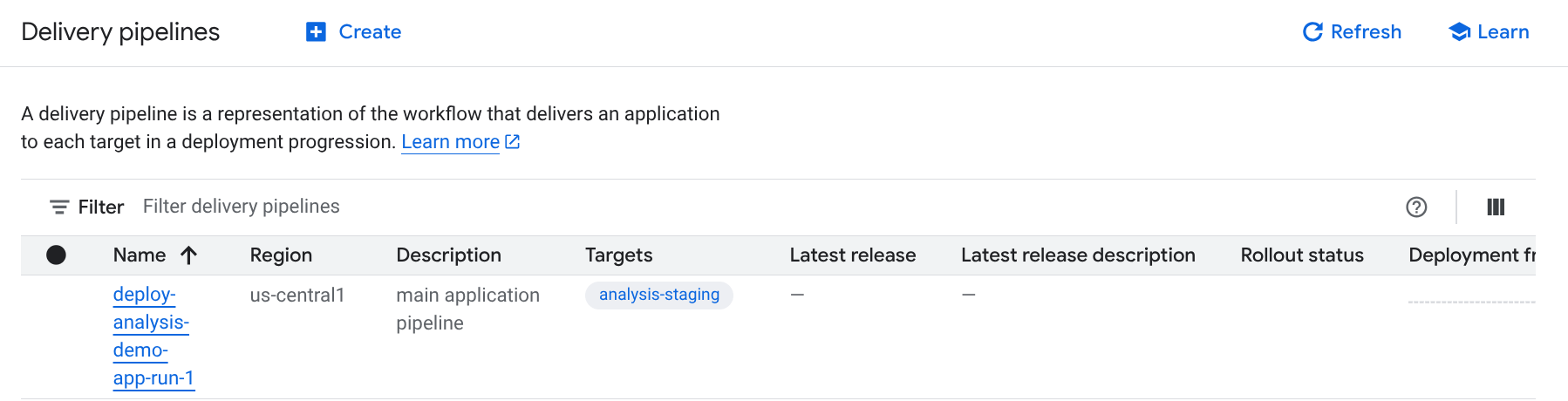
Confirm your pipeline and target:
In the Google Cloud console, navigate to the Cloud Deploy Delivery pipelines page to view of list of your available delivery pipelines.
Open the Delivery pipelines page
The delivery pipeline you just created is shown, with one target listed in the Targets column.
Create a release
A release is the central Cloud Deploy resource representing the changes being deployed. The delivery pipeline defines the lifecycle of that release. See Cloud Deploy service architecture for details about that lifecycle.
Run the following command from the deploy-analysis-run-quickstart directory to
create a release resource that represents the container image to deploy:
gcloud deploy releases create test-release-001 \
  --project=PROJECT_ID \
  --region=us-central1 \
  --delivery-pipeline=deploy-analysis-demo-app-run \
  --images=my-app-image=us-docker.pkg.dev/cloudrun/container/hello@sha256:95ade4b17adcd07623b0a0c68359e344fe54e65d0cb01b989e24c39f2fcd296a
Notice the
--images= flag, which
you use to replace the placeholder (my-app-image) in the
service definition with the specific, SHA-qualified
image. Google recommends that you templatize your service definitions this way,
and that you use SHA-qualified image names at release creation.
As with all releases (unless they include --disable-initial-rollout),
Cloud Deploy automatically creates a
rollout resource too. The application is
automatically deployed into the one target configured for this delivery
pipeline.
View the results in Google Cloud console
After a few minutes, your release is deployed into your target runtime. You can view it.
In the Google Cloud console, navigate to the Cloud Deploy Delivery pipelines page to view your delivery pipeline ("deploy-analysis-demo-app-run").
Click the name of your delivery pipeline ("deploy-analysis-demo-app-run").
The pipeline visualization shows the app's deployment status. Because there's only one stage in the pipeline, the visualization shows only one node.
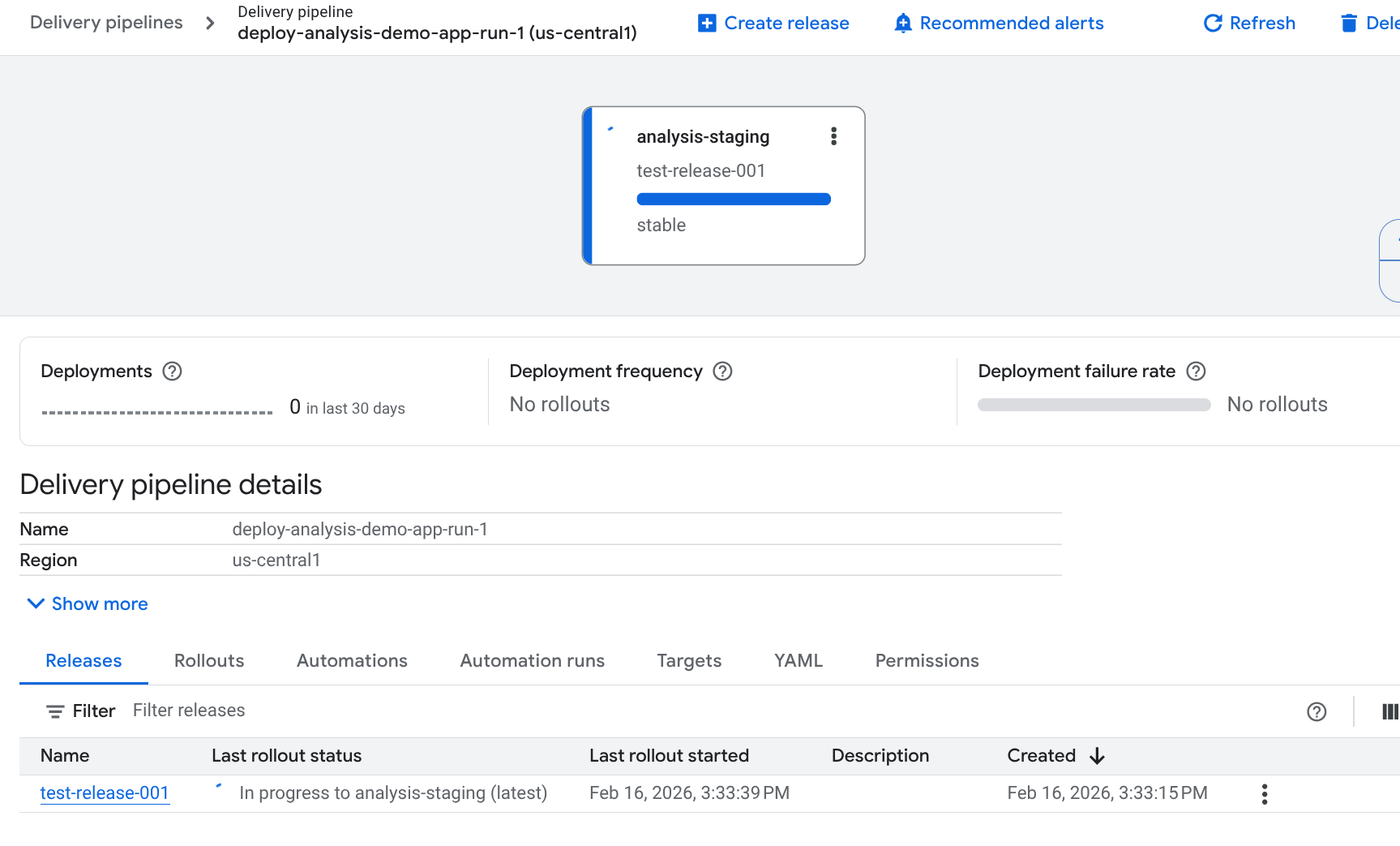
And your release is listed on the Releases tab under Delivery pipeline details.
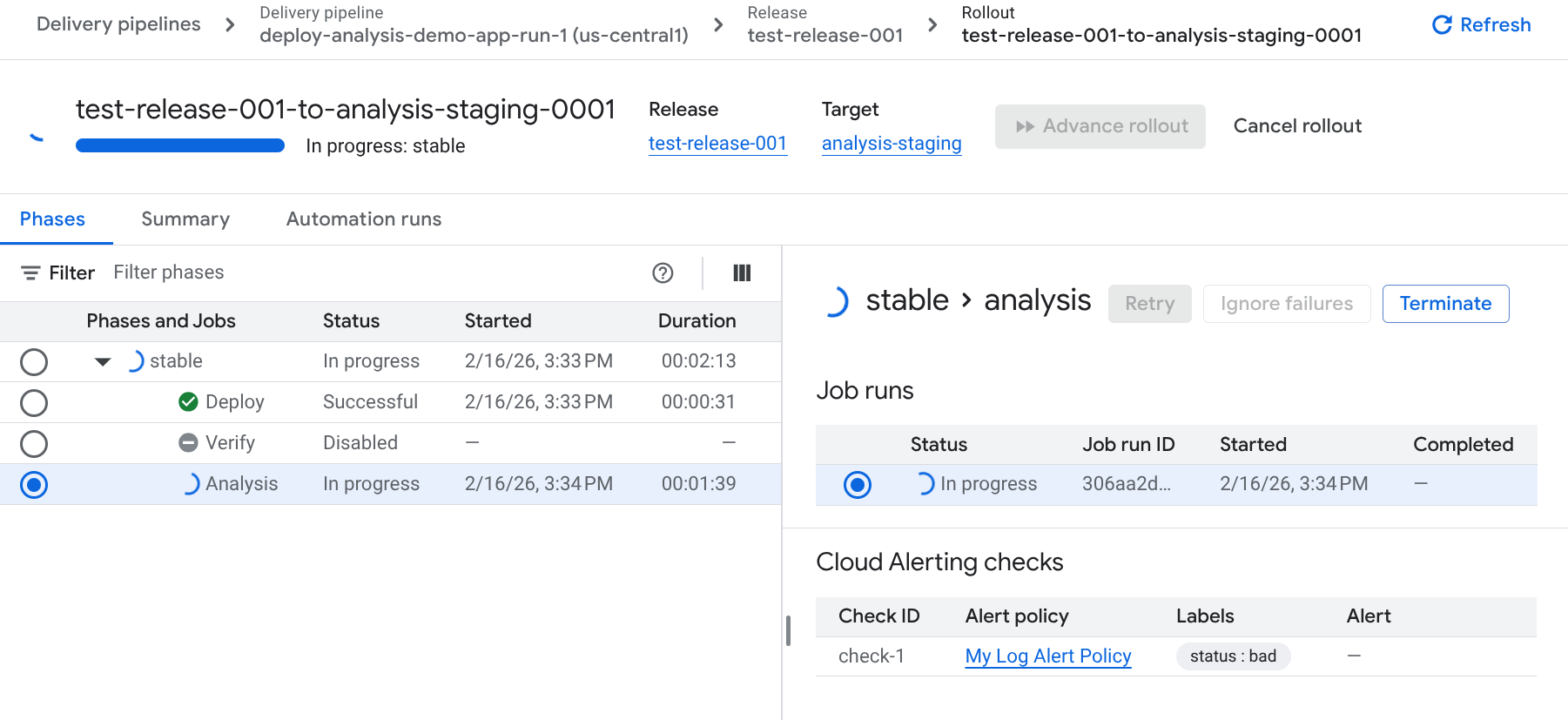
Click the Rollouts tab, under Delivery pipeline details.
Click the rollout name to view the rollout details.
Analysis is listed as a job.
A failed analysis
The analysis job we specified in our delivery pipeline config runs as part of this rollout, after the application is deployed. This analysis is meant to fail, because the alert policy should fire an alert. The rollout will fail because of this analysis failure.
We'll make a change, then create another release, which should then succeed.
Change the service definition and create a new release
Now, we change the instance count in the service definition, so that there will be a running instance of the service, and the alert won't be triggered.
Edit the Cloud Run definition file,
service.yaml, to change the value ofrun.googleapis.com/manualInstanceCountfrom0to1.Run the following command from the same
deploy-analysis-run-quickstartdirectory to create anotherrelease:gcloud deploy releases create test-release-002 \ --project=PROJECT_ID \ --region=us-central1 \ --delivery-pipeline=deploy-analysis-demo-app-run \ --images=my-app-image=us-docker.pkg.dev/cloudrun/container/hello@sha256:95ade4b17adcd07623b0a0c68359e344fe54e65d0cb01b989e24c39f2fcd296a
This time, the rollout should succeed. This is because your Cloud Run service now has one running instance, so the uptime check won't invoke an alert from the alert policy.
Clean up
To avoid incurring charges to your Google Cloud account for the resources used on this page, follow these steps.
Delete the Cloud Run service:
gcloud run services delete my-analysis-run-service \
--region=us-central1 \
--project=PROJECT_ID
To delete the delivery pipeline, target, release, and rollout, run the following command from the directory containing your delivery pipeline definition:
gcloud deploy delete --file=clouddeploy.yaml \
--force \
--region=us-central1 \
--project=PROJECT_ID
Delete the Google Cloud Observability alert policy:
gcloud monitoring policies delete ALERT_POLICY_IDDelete the Cloud Storage buckets that Cloud Deploy created.
One ends with
_clouddeploy, and the other is[region].deploy-artifacts.[project].appspot.com.
That's it, you completed this quickstart!