

Supplier Spend Analysis
This solution sample provides an example on how to accelerate insights into supplier spend position using SAP ERP or SAP BDC sourced data.
With it you can:
- Optimize total spend by material type and track country concentration.
- Understand hidden purchasing patterns to maximize procurement value.
- Use AI to uncover new insights.
Reference architecture
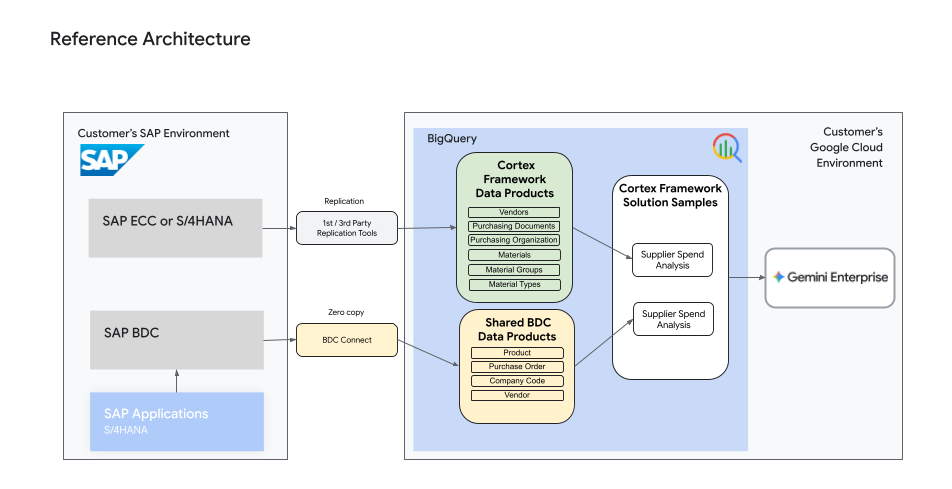
A high level reference architecture provides an overview of the source specific data products required to feed this use case.
Required data products
If building on top of SAP ERP sourced data the following Cortex Framework data products are required:
- Vendors
- Purchasing Documents
- Purchasing Organizations
- Materials
- Material Groups
- Material Types
If building on top of SAP BDC sourced data the following BDC data products are required:
- Product
- Purchase Order
- Company Code
- Vendor
Code snippets
The following code snippet provides an example on how to build a BigQuery data model for supplier spend analysis on top of Cortex Framework sourced SAP ERP data products or after integration of SAP BDC data products.
WITH purchasing_items AS (
  SELECT
    client_mandt,
    purchasing_document_number_ebeln,
    item_number_of_purchasing_document_ebelp,
    material_number_matnr,
    plant_werks,
    po_quantity_menge,
    net_order_value_in_po_currency_netwr,
    gross_order_value_in_po_currency_brtwr,
    delivery_completed_flag_elikz
  FROM
    <YOUR_PROJECT_ID>.<YOUR_CORTEX_DATA_PRODUCTS_DATASET>.purchasing_document_items
),

purchasing_headers AS (
  SELECT
    client_mandt,
    purchasing_document_number_ebeln,
    vendor_account_number_lifnr,
    purchasing_organization_ekorg,
    purchasing_document_date_bedat as order_date_bedat,
    currency_key_waers
  FROM
    <YOUR_PROJECT_ID>.<YOUR_CORTEX_DATA_PRODUCTS_DATASET>.purchasing_document_headers
),

vendor_data AS (
  SELECT
    client_mandt,
    account_number_of_vendor_or_creditor_lifnr as vendor_account_number_lifnr,
    name1_name1 as vendor_name_name1,
    country_key_land1,
    central_deletion_flag_for_master_record_loevm
  FROM
    <YOUR_PROJECT_ID>.<YOUR_CORTEX_DATA_PRODUCTS_DATASET>.vendors_md
),

material_data AS (
  SELECT
    client_mandt,
    material_number_matnr,
    material_text_maktx,
    material_type_mtart,
    material_group_matkl
  FROM
    <YOUR_PROJECT_ID>.<YOUR_CORTEX_DATA_PRODUCTS_DATASET>.materials_md
),

purchasing_orgs AS (
  SELECT
    client_mandt,
    purchasing_organization_ekorg,
    purchasing_organization_text_ekotx
  FROM
    <YOUR_PROJECT_ID>.<YOUR_CORTEX_DATA_PRODUCTS_DATASET>.purchasing_organizations_md
)

SELECT
  i.client_mandt,
  i.purchasing_document_number_ebeln,
  i.item_number_of_purchasing_document_ebelp,
  h.vendor_account_number_lifnr,
  v.vendor_name_name1,
  v.country_key_land1,
  i.material_number_matnr,
  m.material_text_maktx,
  m.material_type_mtart,
  m.material_group_matkl,
  h.purchasing_organization_ekorg,
  o.purchasing_organization_text_ekotx,

  -- Baseline financial & temporal fields
  h.order_date_bedat,
  i.po_quantity_menge,
  i.net_order_value_in_po_currency_netwr,
  i.gross_order_value_in_po_currency_brtwr,
  i.net_order_value_in_po_currency_netwr as spend_usd,

  -- Active vendor indicator (True if not deleted)
  CASE
    WHEN v.central_deletion_flag_for_master_record_loevm = 'X' THEN false
    ELSE true
  END as active_vendor_indicator,

  -- Purchase Price Variance (PPV) - Net versus Gross baseline/target difference
  (i.gross_order_value_in_po_currency_brtwr - i.net_order_value_in_po_currency_netwr) as purchase_price_variance_ppv,

  -- Delivery and overdues tracking
  i.delivery_completed_flag_elikz,
  CASE
    WHEN i.delivery_completed_flag_elikz != 'X' THEN i.net_order_value_in_po_currency_netwr
    ELSE 0
  END as open_po_net_amount,

  CASE
    WHEN i.delivery_completed_flag_elikz != 'X' AND h.order_date_bedat < DATE_SUB(CURRENT_DATE(), INTERVAL 30 DAY) THEN true
    ELSE false
  END as is_overdue,

  -- Efficiency & Performance metrics
  SAFE_DIVIDE(i.net_order_value_in_po_currency_netwr, i.po_quantity_menge) as average_spend_per_unit,
  (i.gross_order_value_in_po_currency_brtwr - i.net_order_value_in_po_currency_netwr) as gross_net_variance,
  1 as line_item_count

FROM
  purchasing_items i
LEFT JOIN
  purchasing_headers h
  ON i.client_mandt = h.client_mandt
  AND i.purchasing_document_number_ebeln = h.purchasing_document_number_ebeln
LEFT JOIN
  vendor_data v
  ON h.client_mandt = v.client_mandt
  AND h.vendor_account_number_lifnr = v.vendor_account_number_lifnr
LEFT JOIN
  material_data m
  ON i.client_mandt = m.client_mandt
  AND i.material_number_matnr = m.material_number_matnr
LEFT JOIN
  purchasing_orgs o
  ON h.client_mandt = o.client_mandt
  AND h.purchasing_organization_ekorg = o.purchasing_organization_ekorg
Enable AI agents
After creating your Supplier Spend Analysis data model in BigQuery, you can build a custom data agent. This lets you query supplier spend metrics directly using natural language, bypassing the need for complex SQL.