
In the evolving landscape of large language models (LLMs), the "one model per machine" deployment pattern is becoming a significant bottleneck for LLM serving cost efficiency in enterprises. LLMs often require substantial hardware reservations, such as full 8x H100 GPU nodes, to manage peak loads. However, during standard operations, these expensive resources often sit underutilized, leading to high total cost of ownership (TCO).
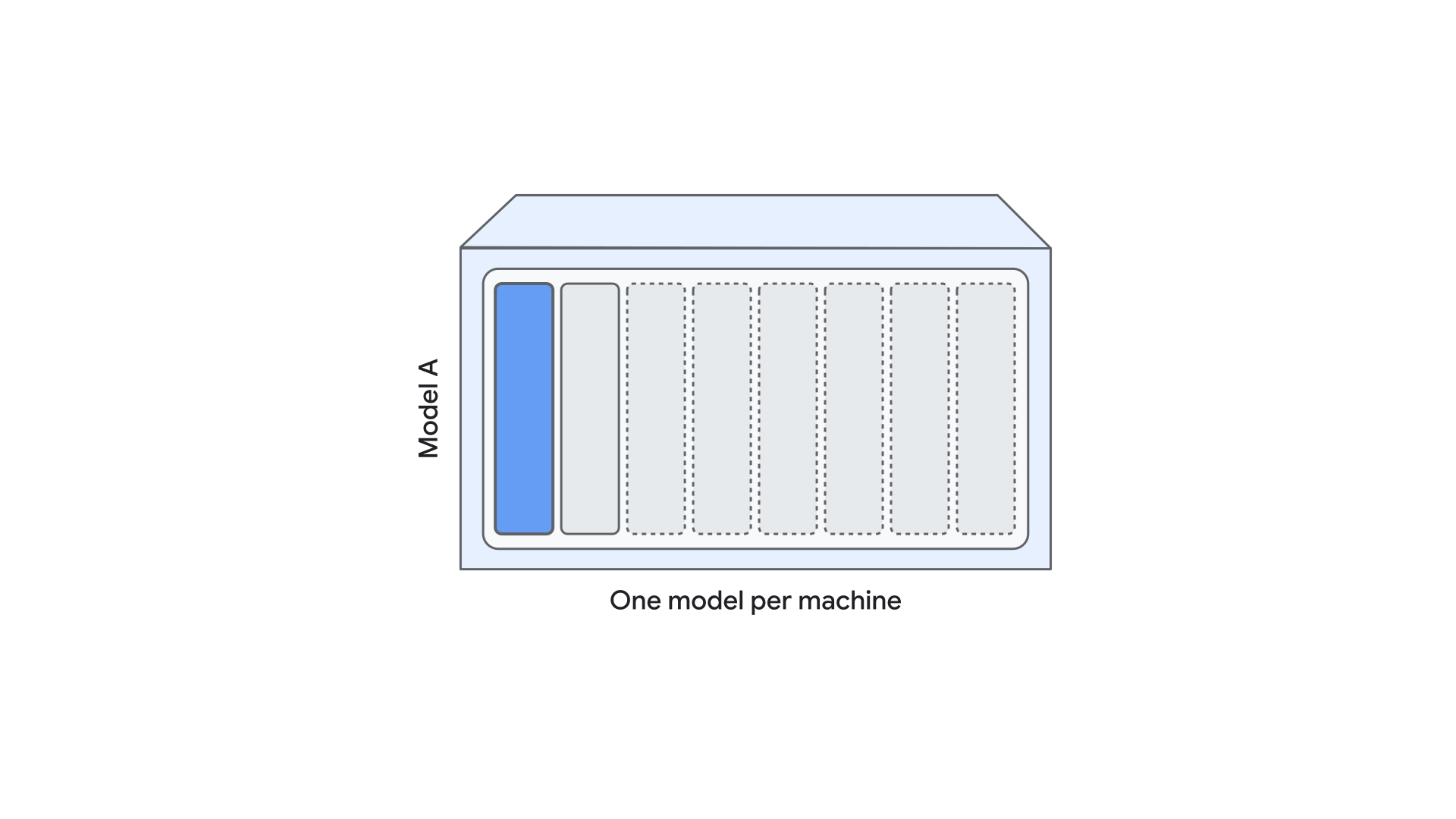
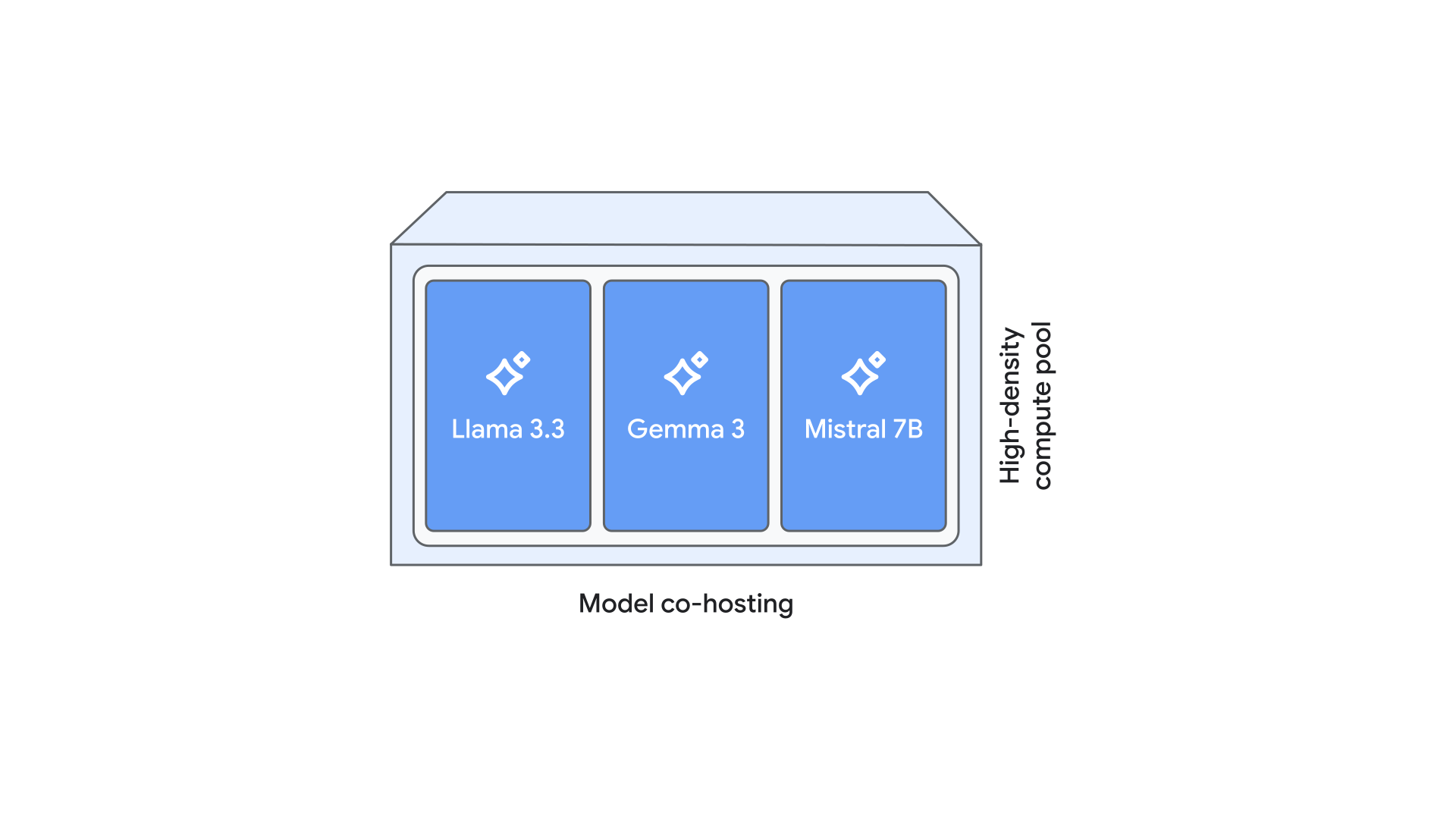
Model co-hosting addresses this efficiency gap by enabling multiple model instances to share the same virtual machine and GPU resources. This includes entirely different models, such as Llama 3.3 and Gemma 3. By utilizing sub-GPU memory slicing and intelligent resource partitioning, Vertex AI Model Garden transforms static hardware reservations into flexible, high-density compute pools.
This technical blog details Vertex AI Engineering's process in bringing model co-hosting to a production-ready cloud service. We'll share our methodology for our container-level implementation strategies, identifying optimal serving configurations, and key findings from our extensive multi-model benchmark study, enabling you to maximize your LLM serving cost efficiency.
Understanding model co-hosting: concept and architecture
Model co-hosting is a high-density serving strategy that enables multiple large language model (LLM) instances or different model architectures to share the same physical hardware resources within a single virtual machine (VM). Unlike traditional deployment models that dedicate a full VM or GPU to a single model, co-hosting utilizes granular resource partitioning to maximize hardware ROI and improve utilization of memory and computational resources.
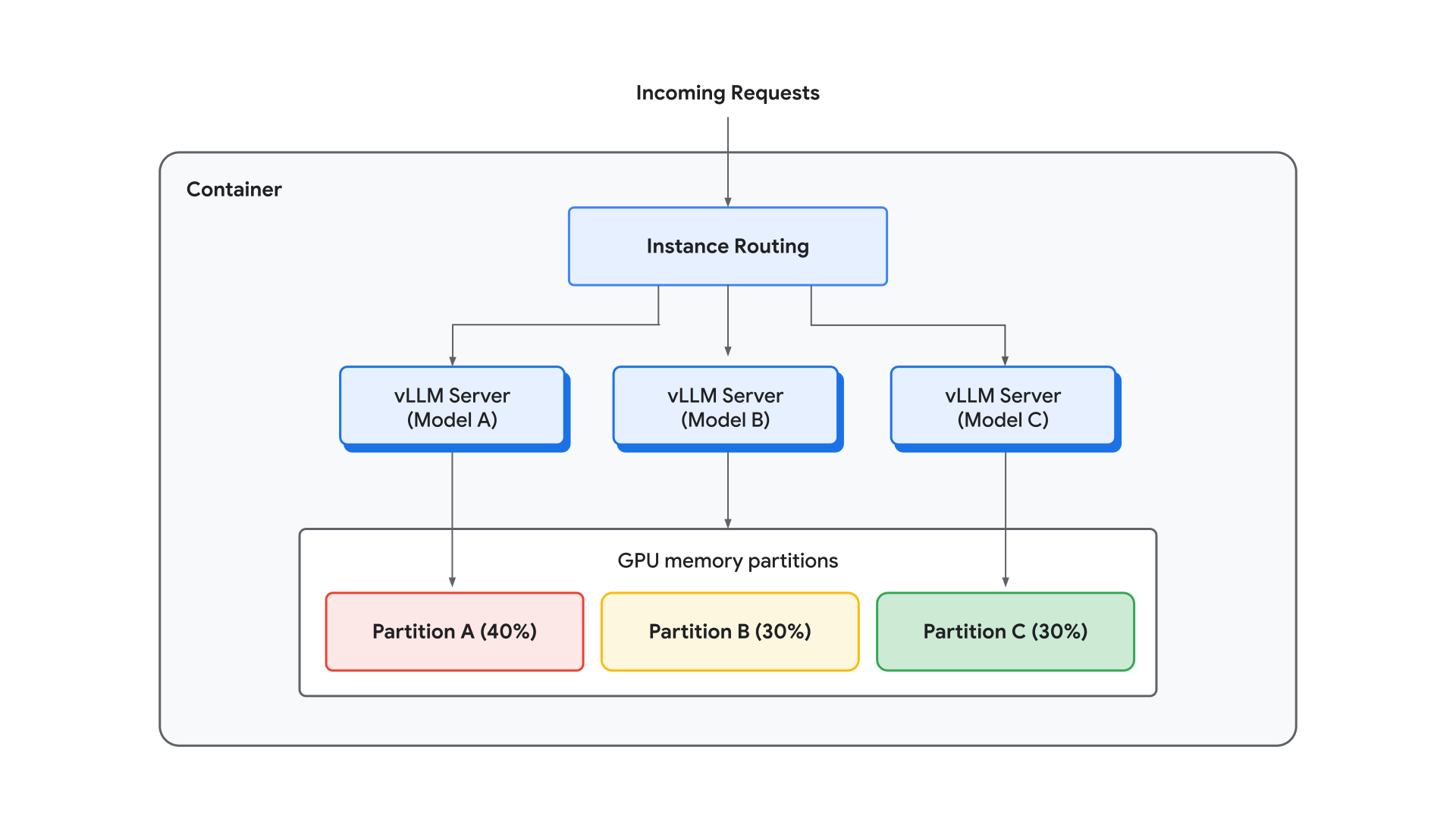
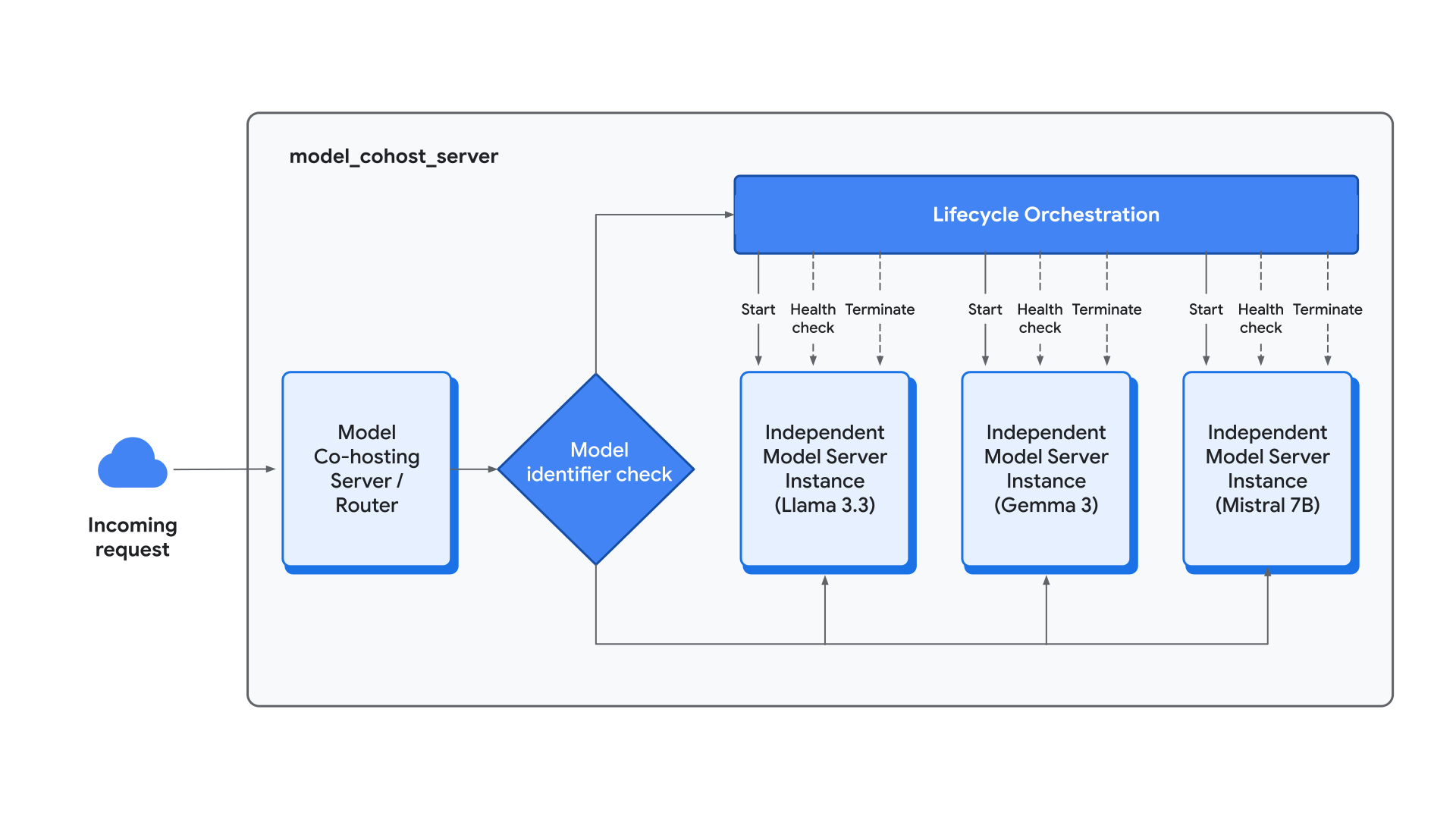
Our implementation focuses on a container-level solution that allows for the simultaneous serving of multiple models with independent configurations. This architecture operates through several integrated technical mechanisms, starting with the deployment of multiple independent model server instances within a single container. Each of these instances serves as a full, independent copy of the model server, which enables simultaneous request processing across the virtual machine. To manage this traffic, we implemented an instance routing layer within the container that efficiently distributes incoming requests among the active instances.
This design provides granular parallelism by allowing each co-hosted model to utilize a dedicated serving configuration, featuring unique settings for Tensor Parallelism (TP), Pipeline Parallelism (PP), and the specific number of model instances. This is complemented by resource slicing, where specific GPU memory partitions are assigned to each model—such as a 0.4 GPU memory partition per model—to ensure that diverse workloads coexist on the same accelerator without starving one another of critical memory resources. This architectural approach transforms a static hardware reservation, such as a full 8x H100 GPU node, into a flexible compute pool capable of serving a diverse portfolio—ranging from large reasoning models to small, low-latency chat models.
Prototyping and benchmark study
Before developing our production-ready orchestrator, we conducted a comprehensive benchmark study to validate the theoretical efficiency of model co-hosting. This phase aimed to thoroughly test vLLM's native parallelism and precisely quantify the degree of "interference" when models share the same silicon.
Parallelism investigation: Finding the "crossover point"
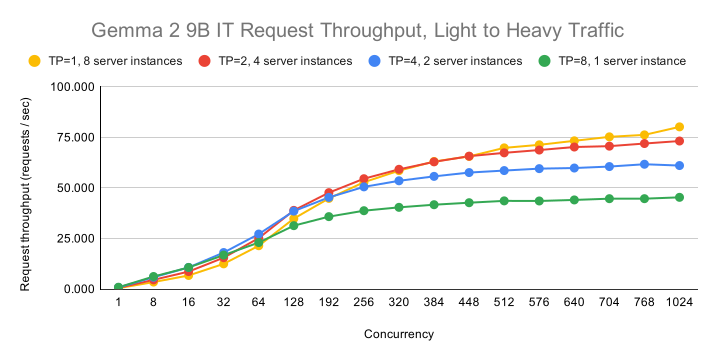
Our initial analysis focused on vLLM's native Tensor Parallelism (TP) and Vertex implementation of model instances as multiple vLLM server instances to determine how these strategies interact with varying user loads. We discovered that the optimal configuration is highly dependent on concurrency; at lower concurrencies, a high Tensor Parallelism (e.g., TP=8) provides the lowest latency for individual requests by distributing layers across all available accelerators. However, as concurrent traffic increases, the bottleneck shifts. To maximize throughput under high-load conditions, the optimal configuration transitions from TP=8 to TP=4, TP=2, and eventually TP=1, while simultaneously increasing the number of independent model instances. This transition defines a "crossover point" where the benefits of reduced inter-GPU communication latency in low-TP setups outweigh the raw speed of high-TP execution. In the following, you have a crossover point chart with the Gemma 2 9B IT model.
Optimal scaling: Single-model, multi-replica
To establish a rigorous baseline for scalability, we benchmarked serving multiple instances of the same model on a single node. Under saturating traffic conditions (2048 concurrent requests per GPU), launching eight independent vLLM server instances on an 8xH100 node yielded an approximate 7.8 times throughput improvement with virtually zero latency regression compared to a single-GPU baseline.
Infrastructure comparison: Container vs. pod co-scheduling
We further evaluated our container-level orchestration against native infrastructure-level solutions, specifically Pod co-scheduling. While both solutions delivered comparable performance for multi-replica serving, we ultimately selected the container-level approach for our Minimum Viable Product (MVP). This decision was driven by the superior flexibility the container-level solution offers for heterogeneous co-hosting, allowing developers to serve different model architectures side-by-side with granular, software-defined memory partitions that are not restricted by underlying Kubernetes scheduling constraints. In addition to that, the container-level orchestration allows iterating much faster and it is easier to customize and innovate.
The interference test: Co-hosting different models
The final prototyping milestone was the "Interference Test," where we co-hosted Gemma-3n-E2B-it and Llama-3.1-8B-Instruct on the same VM. With each model assigned a 0.4 GPU memory partition, serving performance remained almost identical to single-model benchmarks. For example, Gemma-3n reached 30.21 reqs in a co-hosted environment compared to 30.96 reqs in isolation. These results confirm that there is little to no compute interference between co-hosted models, even under heavy traffic, provided that memory resources are appropriately partitioned to prevent KV cache starvation.
MVP container implementation
The transition from a validated benchmark to a production-ready system necessitated the engineering of a robust, containerized orchestrator. This development phase centered on building a high-level software layer capable of managing the complexities of multiple model lifecycles while ensuring deterministic resource isolation.
Model co-hosting server design
The core of our implementation is the model_cohost_server, a custom entry
point designed to act as a master orchestrator within the container. Deviating
from the standard single-process model, this server implements sub-process
management, facilitating the concurrent execution of multiple independent
model server instances—such as vLLM—as isolated sub-processes. To manage
incoming traffic, the orchestrator employs high-level request routing,
identifying requests by their unique model identifiers via arguments such as
--served-model-name and directing them to the corresponding internal server
instance. Beyond routing, the server provides comprehensive lifecycle
orchestration, managing the initialization, health monitoring, and termination
of all co-hosted instances. This centralized management provides a single,
unified endpoint for external traffic while maintaining the distinct operational
boundaries of each sub-process.
GPU resource partitioning: Deterministic slicing
To eliminate the risk of a single model's workload triggering an Out-of-Memory
(OOM) error across the co-hosted environment, we implemented a strict resource
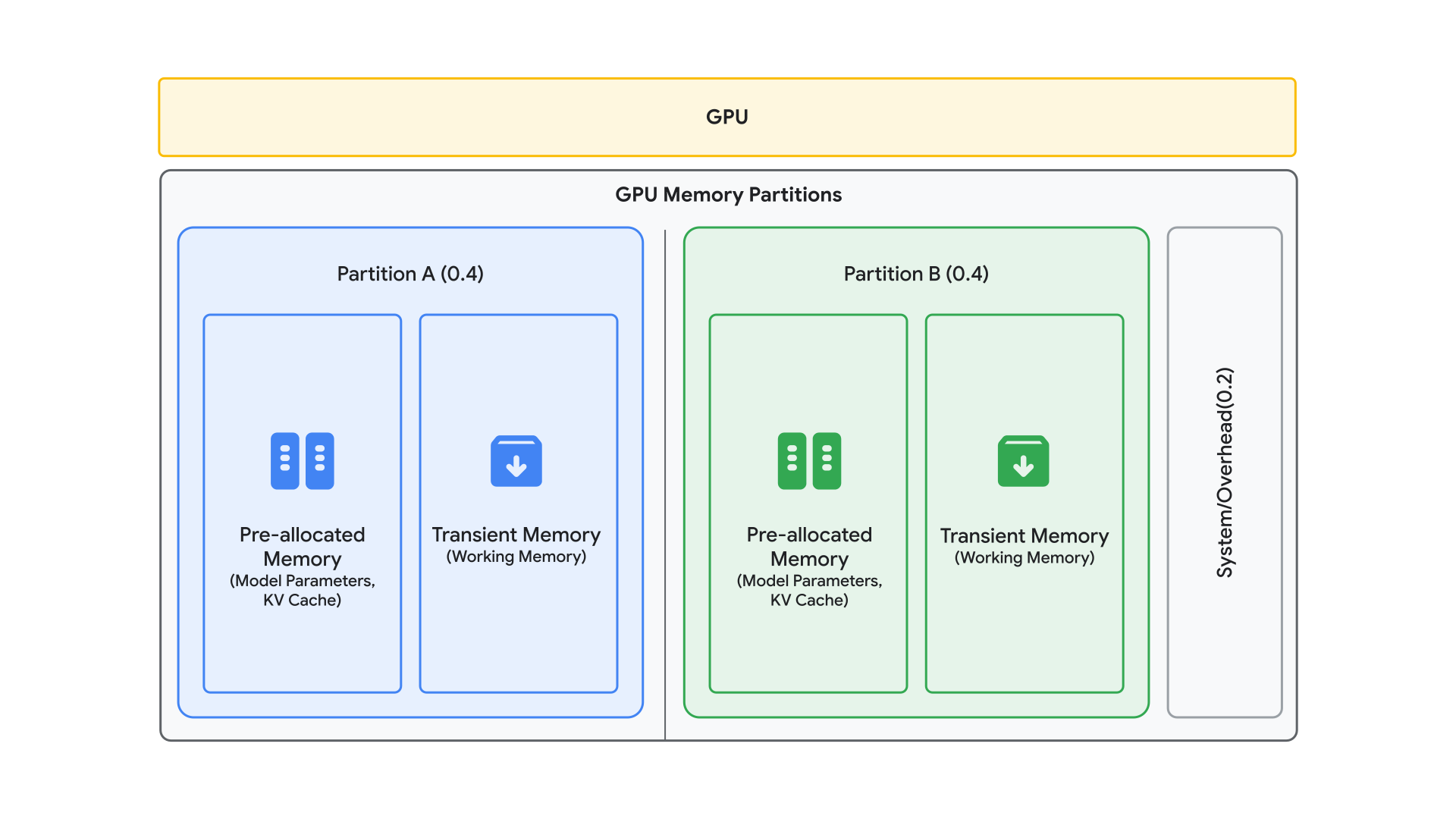
slicing mechanism. This is operationalized through the gpu-memory-partition
argument, which allows developers to define explicit memory ratios (e.g., 0.4,
0.4) to reserve a fixed percentage of the total GPU memory of a node for each
individual model instance.
To guide this allocation, we adopt a "Pre-allocated vs. Transient" memory
model, which distinguishes between static and dynamic resource requirements.
"Pre-allocated" memory consists of memory used for the model weights and KV
cache. The amount of memory used for the model weights depends on the model's
parameter count and precision. For instance, an 8B parameter model in BF16
requires approximately 16GB of static storage. The amount of memory used for the
KV cache depends on the model dimensions, precision, context length and number
of sequences. "Transient" memory consists of intermediate computations and
inference working memory. The gpu-memory-partition argument accounts for the
"pre-allocated" memory. We recommend leaving buffer room for "transient" memory
by setting the sum of gpu-memory-partitions to be smaller than 1.0.
Productization
The productization phase of model co-hosting with Vertex AI was dedicated to establishing a seamless, production-ready environment for both single-model multi-replica and multi-model serving configurations. This transition effectively translated empirical benchmark findings into simplified deployment workflows and deeply integrated infrastructure support structures.
Simplified deployment workflows
To lower the barrier to entry for high-density serving, we standardized co-hosting configurations using custom container arguments that integrate natively with existing Vertex AI APIs. For full-shape virtual machines, such as an 8x H100 node, we developed a benchmark util to customize the best recipes for your specific use cases. These benchmark util would allow you to find the configuration which automatically balances Tensor Parallelism (TP), Pipeline Parallelism (PP), and the number of model instances based on the specific parameter count and precision of the model. This is complemented by robust Deployment API support, allowing developers to specify these granular parameters—including exact GPU memory partitions—directly within a standard deployModel request and deploy models.
Dynamic multi-model serving
A significant advancement in our technical journey was the transition from static configurations to a dynamic serving architecture. This capability is critical for production environments characterized by rapidly shifting traffic patterns, as the ability to load or unload models without a full container restart is essential for maintaining infrastructure agility and high availability.
The Dynamic Update API (update_models)
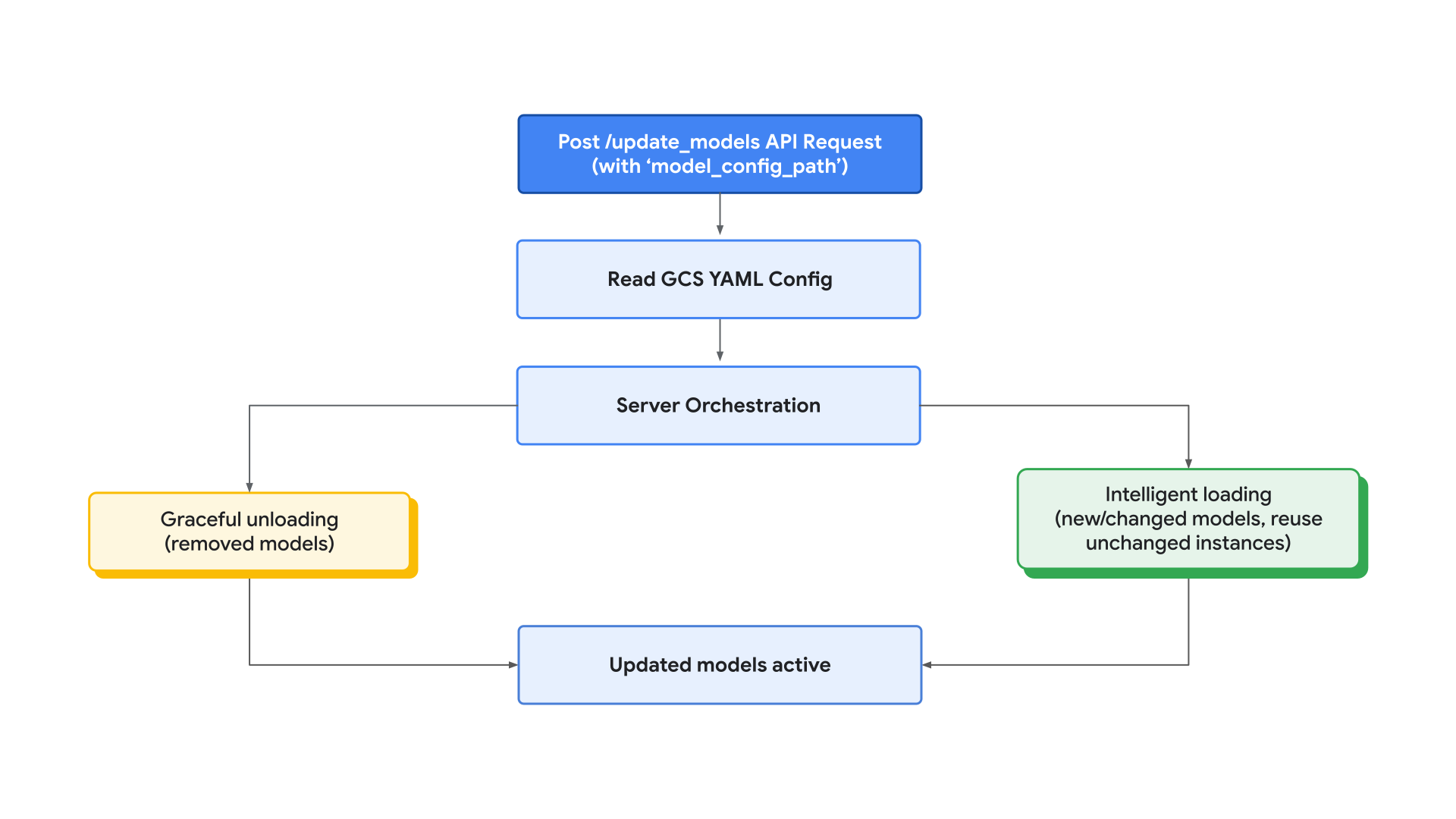
To address the inherent limitations of immutable deployments, we implemented a specialized model update API within the Vertex Model Garden vLLM model co-hosting container. This API facilitates hot re-loading, enabling the server to adjust its portfolio of hosted models on-the-fly based on a centralized configuration file stored in a Google Cloud Storage (GCS) bucket.
The update process is initiated via a POST request to the update_models
endpoint, which includes the model_config_path pointing to the GCS YAML file.
Upon receiving this request, the server executes a multi-stage orchestration
sequence optimized for minimal downtime:
- Graceful unloading: The system identifies models absent from the new configuration and terminates their sub-processes first, immediately reclaiming GPU memory and compute resources.
- Intelligent loading and re-use: The server then initializes new model instances. Crucially, if a model's parallelism settings—such as Tensor Parallelism (TP) or Pipeline Parallelism (PP)—and its allocated memory partition remain unchanged, the orchestrator re-uses the existing running instance. This optimization bypasses the costly re-initialization phase, ensuring that active services remain uninterrupted during configuration shifts.
Latency and performance analysis
Empirical analysis of these update strategies reveals that dynamic hot re-loading substantially mitigates the "cold start" penalty commonly associated with large-scale LLM serving.
Conclusion
Model co-hosting with Vertex AI represents a fundamental paradigm shift, transitioning from rigid, hardware-heavy monolithic deployments to a fluid and efficient serving architecture. By evolving beyond the "one-model-per-VM" standard into a high-density compute pool model, organizations can significantly reduce their Total Cost of Ownership (TCO) while maintaining—and often improving—performance benchmarks.
Our engineering journey and extensive multi-model benchmark studies have established a definitive set of production guidelines for this architecture:
- There is no one-size-fits-all configuration. We advocate for finding the best serving recipe for a specific use case (model, hardware, traffic), and build tools for doing so.
- Scaling throughput with replicas.
- Improve resource utilization by breaking hardware boundaries and splitting memory at a more granular level.
To successfully implement a co-hosted architecture, we recommend the following technical workflow:
- Explicit partitioning: Employ the
--gpu-memory-partitionsargument to allocate memory resources for individual models. - Iterative benchmarking: Utilize the provided Benchmark Utility to identify the specific "Concurrency Crossover" point for your workload—the "sweet spot" configuration of number of instances, TP and PP.
The implementation of co-hosting on Google Cloud Model Garden provides a scalable blueprint for building high-density AI applications. Developers are encouraged to explore these capabilities and reproduce our benchmarks using the provided tutorial notebook to optimize serving configurations for their specific enterprise requirements.
Thanks for reading
We welcome your feedback and questions about Vertex AI.
Acknowledgements
We would like to express our sincere gratitude to the Google Cloud Vertex AI team. Specifically, we thank Bo Wu and Ting Yu for their leadership and guidance, as well as Deborah He, Shawn Ma, Desmond Liu, Yang Pan, Surya K G Tangatur, and Luis Rizo for their invaluable contributions, throughout this project.