

Knowledge Studio lets you curate and unify enterprise metadata to ground generative AI applications, such as conversational analytics in BigQuery and Gemini Enterprise, in your business context. Grounding your AI agents helps reduce hallucinations and improve the accuracy of generated analytics.
With Knowledge Studio, you can unify knowledge from schemas, wikis, and past SQL queries. You can explore data in natural language, navigate a visual context graph of business semantics, and run automated workflows that draft catalog updates for human review. You can then dynamically serve these curated context blocks to agents using the Model Context Protocol (MCP) or Knowledge Catalog APIs.
This document is for data architects, governance leads, and AI engineers who want to understand how Knowledge Studio works. To start exploring your catalog or configuring automated enrichment right away, see Explore data assets in Knowledge Studio and Create enrichment tasks.
For an overview of how Knowledge Studio and self-learning enrichment ground enterprise AI agents, see the following video:
From passive catalog to active context engine
Typical metadata catalogs store static schemas, descriptions, and data dictionaries. Although sufficient for human data analysts searching for tables, static metadata is insufficient for generative AI agents that require the following:
Deep semantic relationships: Understanding how tables join across schemas, which columns represent key business metrics, and how business glossaries map to underlying storage.
Operational grounding: Incorporating real-world SQL usage patterns, query frequency, and actual agent prompts and responses into context.
Continuous self-learning: Automatically refining table descriptions, aspects, and column definitions based on user feedback and agent execution success rates.
Knowledge Studio delivers these capabilities through an always-on context engine that continuously mines operational signals, generates high-fidelity metadata proposals, and serves pre-formatted context blocks to agents through the Model Context Protocol (MCP) or Knowledge Catalog Catalog APIs.
Knowledge Studio interfaces
Knowledge Studio organizes your workflow into three primary areas:
New chat: A conversational chat interface and interactive context graph for data discovery, investigation, and semantic query validation using natural language. For more information, see Explore data assets.
Context sets: An interface to create and manage the logical containers (entry groups) that package your enriched metadata to safely ground downstream AI agents. For more information, see Manage context sets.
Enrichments: A control center to automate metadata generation, configure evaluation benchmarks, and review AI-proposed catalog updates (change requests) with human-in-the-loop curation workflows. For more information, see About enrichment tasks.
Real-world multi-product scenarios
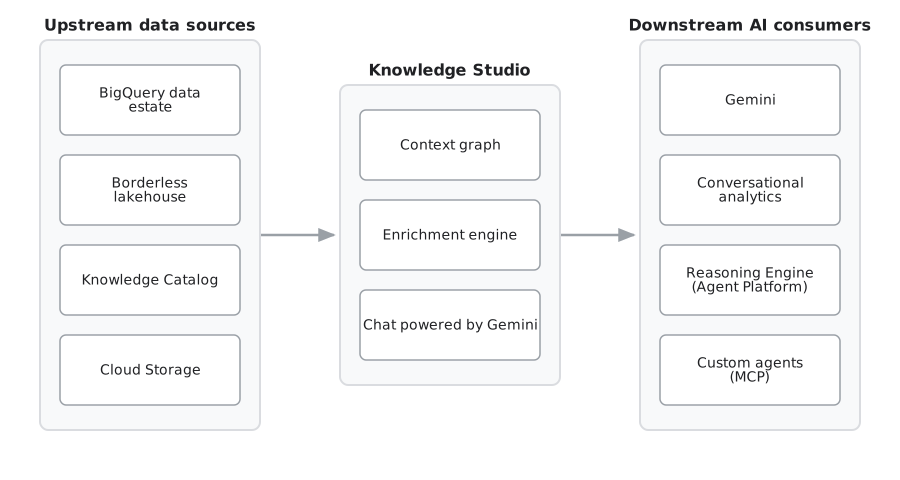
Knowledge Studio connects your data warehouse, enterprise knowledge repositories, and generative AI applications. The following scenarios illustrate how Knowledge Studio operates across multiple products in an enterprise architecture.
Ground natural language queries in BigQuery
The challenge: Business analysts use natural language in conversational analytics to ask questions such as "What was our net retention rate by region last quarter?" Without curated business semantics, the model might hallucinate join keys or mistake gross bookings for net revenue.
The Knowledge Studio solution: The analyst uses the New chat interface to verify relationships between sales staging tables and the certified
SZBank Business Glossary. Knowledge Studio grounds conversational analytics using the active context graph, ensuring generated SQL includes verified join conditions and standard KPI formulas.
Enrich metadata from enterprise SOPs
The challenge: Data engineering teams maintain dozens of datasets in BigQuery, while critical business rules and pipeline lineage live in external Confluence wikis or Jira tickets. As schemas evolve, catalog documentation becomes outdated.
The Knowledge Studio solution: A governance lead configures a recurring Enrichment task targeting the analytics dataset. Knowledge Studio ingests unstructured SOPs from Confluence and historical query logs from Cloud Logging, automatically proposing updated column definitions and table relationships. Curators inspect the proposed diffs in the Run Details page and approve verified updates to the catalog.
Provide curated context to agents
- The challenge: AI developers building customer-facing support or advisory agents using LangChain or the ADK need fresh schema semantics without hardcoding database credentials or prompt-stuffing large table definitions.
- The Knowledge Studio solution: Knowledge Studio captures curated
metadata and validated join graphs into a context set (such as
entryGroups/customer-360). To access context, agents can connect to Knowledge Studio through the Model Context Protocol (MCP) or use the Knowledge Catalog Catalog APIs. At inference time, the agent queries the MCP endpoint or Catalog APIs to dynamically retrieve certified business context and sample queries relevant to the user's intent.
Architecture overview
The following diagram illustrates how Knowledge Studio components interact with your data estate, foundation models, and consuming AI applications:
Core concepts
To work effectively with Knowledge Studio, understand how enterprise metadata is modeled, packaged, and curated.
Context graph
The context graph is the central, interactive visual topology in Knowledge Studio. It unifies your data assets (such as BigQuery tables, views, and lake houses) with business semantics (such as business glossary terms, metric formulas, and data products). In typical catalogs, a data table and its associated business glossary definition exist in separate silos. In the context graph, they exist as nodes on the same canvas. Data analysts and engineers can visually see relationships between their data, either by inferred usage, join conditions on tables and more, while Gemini uses the graph to ground natural language exploration. For more information, see Explore data assets in Knowledge Studio.
Supported resource and connection types for the context graph
The Exploration agent and context graph can discover, explore, and render all cataloged entry types in Knowledge Catalog, including the following resources:
- Tables and views: Technical BigQuery and Lakehouse tables, views, datasets, catalogs, namespaces, lakes, zones, and assets.
- Databases, storage, and AI resources: Operational databases and cloud resources (such as Spanner, Cloud SQL, AlloyDB for PostgreSQL, Pub/Sub, Cloud Storage, and Vertex AI models).
- Analytics and third-party sources: Looker projects and third-party metadata synced through managed connectivity (such as dbt models, tests, and exposures, Databricks Unity Catalog, LookML, and SAP).
- Glossary terms: Individual business definitions, categories, and terms from a business glossary.
- Data products: Curated bundles of data assets for cross-team consumption.
- Context: Context sets and curated knowledge base documents.
- Custom assets: Custom entry groups and custom entry types.
The graph defines how these resources are connected by visualizing the following semantic relationship edges:
Schema join: Structural and operational join relationships between tables. The system automatically scans BigQuery jobs for queries that indicate columns across different tables share the same meaning and can be joined together.
Definition: Links mapping a technical data asset or column to its corresponding business glossary definition.
Reference: Directed links (
dataplex-types.global.reference) that connect context set documents and data asset entries to the target catalog assets they describe.Context: Links attributing specialized context sets or custom domain documentation to a target data asset.
Packages: Aggregation links showing which data assets are bundled into a specific data product.
Entry links
An entry link represents a directed or non-directional semantic edge in the context graph. These links visually join your data assets and other unified resources on the canvas. You can selectively filter these links to isolate specific relationships across your data estate.
Entry links connect distinct entities across your enterprise:
Reference links: Connect context set entries (such as curated knowledge base documents and data asset entries) to the cataloged assets they describe using the
referenceentry link type (projects/dataplex-types/locations/global/entryLinkTypes/reference).Definition links: Connect underlying table columns directly to certified business glossary terms and KPI formulas.
Relationship links: Map verified primary key, foreign key, and multi-table join paths.
Agent trace links: Associate real-world AI user prompts with the specific tables used to answer them.
Packages links: Join sets of data assets to a curated data product.
Entry links serve as the individual connections traversed to assemble context sets. During automated enrichment runs, the agent proposes new entry links for curator approval whenever it identifies candidate joins or unlinked terms.
Context sets
A context set is a bounded container of semantic information and data asset
references. Each context set is implemented as a specialized Entry Group
(type="context-set").
Context sets establish hermetic execution boundaries that prevent agents from performing open-ended searches across the entire enterprise catalog. This method reduces hallucinations and token consumption.
To understand how context sets differ from related constructs, such as data products and the semantic context graph, or for detailed architectural capabilities, categories, namespaces, and agent consultation patterns, see Context sets overview.
Enrichment tasks and runs
Automated metadata enhancement in Knowledge Studio is organized into enrichment tasks, enrichment jobs, and enrichment runs.
Enrichment task: A durable configuration that defines how the enrichment agent analyzes a targeted set of data assets. An enrichment task specifies the target context set, contextual input sources, and evaluation benchmarks.
Enrichment job: The backend orchestration process within Knowledge Studio that executes an enrichment task.
Enrichment run: A single, point-in-time execution instance of a task. Each run inspects target assets, extracts semantic signals, and generates change requests (proposals) that data stewards can review.
For more information about enrichment workflows, see About enrichment tasks.
Context graph compared to data lineage
Understanding the difference between the Knowledge Studio context graph and Knowledge Catalog data lineage helps you choose the right capability for your workflow:
| Capability | Primary questions answered | Graph structure | Nodes and edges | When to use |
|---|---|---|---|---|
| Data lineage | Where did this data originate? Which ETL pipeline populated this table? If this upstream schema changes, which downstream dashboards break? | Directed acyclic graph (DAG) of historical data movement and transformations. | Nodes represent physical assets and transformation jobs (such as Dataflow pipelines or BigQuery jobs); directed edges represent data flow. | Use for root-cause debugging, pipeline impact analysis, and regulatory provenance audits. |
| Context graph | What does this column mean in business terms? How do these tables relate conceptually? How should an AI agent join these assets to answer a question? | Multi-modal semantic knowledge graph of business meaning and relationships. | Nodes represent data assets alongside glossary terms, data products, and context set documents; edges represent schema joins, definitions, references, and context links. | Use for interactive discovery, semantic disambiguation, and curating context sets to ground AI agents. |
For more information about pipeline traceability, see Knowledge Catalog data lineage.
Enterprise security and governance
Knowledge Studio is built on an enterprise-grade security architecture designed for strictly governed environments.
Role-based access: Identity and Access Management (IAM) roles control who can create, discover, and read context sets, curate context set entries, and approve and publish proposed metadata changes.
User-managed execution identity: Enrichment tasks run using a user-managed service account, which is an identity you create and manage in your project to allow services to act on your behalf. The Dataplex Service Agent (P4SA) impersonates this service account by using the Service Account Token Creator (
roles/iam.serviceAccountTokenCreator) role to generate short-lived OAuth 2.0 credentials. Generating these short-lived credentials limits the lifespan of access tokens, minimizing the risk of credential exposure compared to using long-lived service account keys.Third-party authentication: Connecting remote SaaS knowledge sources (such as Microsoft SharePoint, Atlassian Confluence, Jira, and GitHub) uses Google Cloud's Agent Identity Auth Manager, ensuring human operators never handle raw client secrets.
For information about how to configure these security features, see Configure enrichment prerequisites.
Limitations
Assured Workloads compliance regimes (including FedRAMP, CJIS, IL4/IL5, and HIPAA).
Data Residency (DRZ) commitments. Data processed by this feature might be stored or processed outside of your strictly configured geographic boundaries.
Customer-managed encryption keys (CMEK). Data stored or processed by this feature is encrypted using Google-owned and Google-owned and Google-managed encryption keys instead of your Cloud Key Management Service or Cloud EKM keys. For more information, see Customer-managed encryption keys (CMEK), Default encryption at rest, and Cloud External Key Manager.
VPC Service Controls. VPC Service Controls is not supported.
Access Transparency (AXT) notifications and Access Approval controls. Actions taken by Google personnel to support or maintain this preview won't be logged in your Access Transparency Cloud Access Ledger (CAL).
During Preview, Knowledge Studio operates within the following additional boundaries:
Context set regional scope: A single-region context set (for example,
us-central1) can only reference assets in that region. Multi-region (such asusoreu) andglobalcontext sets can span compatible regions, and you select a single execution region when configuring an enrichment task for them.Console-first management: Enrichment tasks and exploration sessions are managed through the Google Cloud console. Direct REST APIs and
gcloudCLI commands for task management aren't available in Preview. However, downstream agents can programmatically discover and query curated context sets using the Knowledge Catalog Catalog APIs (ListEntriesandLookupEntry) and the Model Context Protocol (MCP). For more information, see Method: projects.locations.entryGroups.entries.list and Method: projects.locations.lookupEntry.Centralized curation: All metadata review and approval occurs within the Enrichment run details page.
Pricing
During Preview, Knowledge Studio data exploration, running enrichment tasks, and staging unapproved batch change requests are offered at no charge.
Using Knowledge Studio features can incur standard charges for underlying Google Cloud resources in your project:
- Data exploration: When the exploration agent in chat invokes BigQuery query jobs or BigQuery conversational analytics, standard BigQuery query processing and conversational analytics charges apply.
- Context sets and enrichment: An empty context set entry group or an unapproved batch change request incurs no metadata storage charge. When entries are created in a context set (for example, when you approve a batch change request), standard Knowledge Catalog metadata storage charges apply to the project hosting the entry group. Standard usage charges, including BigQuery query processing and Cloud Storage staging reads and writes, apply in your project when an enrichment task uses optional customer-managed resources, such as Cloud Storage buckets for knowledge signals or evaluation sets and BigQuery agent analytics trace tables for self-learning.
What's next
Explore data assets in Knowledge Studio
Use the visual canvas in Knowledge Studio to chat with your data and trace semantic relationships.
Context sets overview
Learn about Knowledge Studio's packaged context containers used to safely ground your downstream AI agents.
About enrichment tasks
Learn how to configure AI-driven metadata extraction workflows to build data context automatically.
Establish foundational data context
Build a business glossary, define custom aspect types, and enrich assets in BigQuery.
About MCP servers in Knowledge Catalog
Connect AI agents and developer tools to Knowledge Catalog using Model Context Protocol.
Self-learning context enrichment for AI agents
Learn how Knowledge Studio uses self-learning context enrichment and interactive context graphs to ground enterprise AI agents.