

Knowledge Catalog context sets let you package data schemas, semantic definitions, and validated query patterns into bounded, domain-specific knowledge containers. This targeted domain knowledge reliably grounds autonomous AI applications such as Gemini Enterprise and custom agents so they can operate with high precision.
This document is for data architects, governance leads, and AI engineers who want to understand how context sets structure domain knowledge for AI agents.
What is a context set?
A context set is a specialized Knowledge Catalog entry group (a logical container for metadata records) that packages a self-contained collection of semantic information and data asset references for specific analytical domains and AI agents.
Inside this container, knowledge is organized into entries, which represent individual business concepts, documents, or data assets. These entries are enriched with aspects, which are modular metadata attributes that store specific details like business terms, SQL templates, and Markdown documentation.
Rather than forcing agents to search an entire enterprise catalog, which introduces latency, wastes prompt tokens, and risks hallucinated answers, context sets establish hermetic, domain-scoped knowledge containers that agents can consult with high precision.
Because context sets act as administrative containers, you can organize metadata by project ownership and apply Identity and Access Management (IAM) access control policies across all bundled entries at once without configuring permissions individually. For more information about entry groups, entries, and aspects, see About metadata management.
AI agent grounding requirements
As organizations deploy autonomous AI agents (such as Gemini Enterprise, Antigravity, and custom Agent Development Kit agents) to orchestrate data workflows and generate analytics, agents require reliable grounding:
- Semantic definitions: What does a specific column or metric mean in business terms?
- Validated query patterns: How have domain experts successfully queried and joined these tables?
- Operational rules: What business policies, exception criteria, and standard operating procedures (SOPs) govern this data?
Recommended context set naming patterns
The following architecture diagram illustrates how the four core logical naming naming conventions operate together within the entry group boundary to ground downstream AI applications:
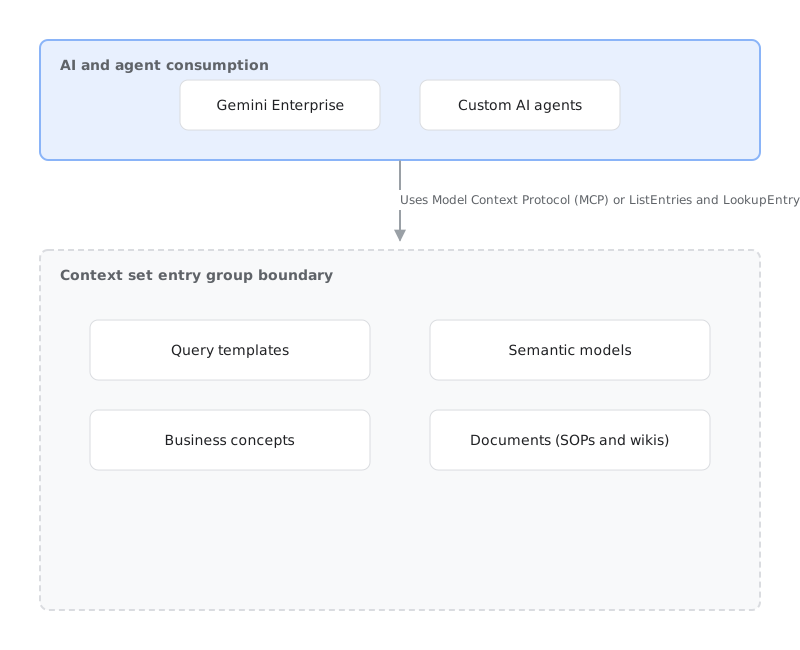
While a context set doesn't strictly require every type of entry to function, we recommend organizing your entries using the following logical naming naming conventions. Using these naming conventions helps ensure humans and autonomous agents can consistently discover and interpret knowledge:
| Naming pattern | Entry type | Description and purpose | Attached aspects |
|---|---|---|---|
Business concepts concepts_<id> |
generic |
Business glossary terms, metric definitions, acronyms, and calculation formulas. | glossary-term-aspect, contacts. |
Documents documents_<path> |
document |
Narrative context, standard operating procedures (SOPs), onboarding wikis, and pointers to external documentation. | Document, overview (rich text Markdown and links). |
Query templates query-templates_<path> |
query-template |
Pre-validated, parameterized SQL query templates, high-frequency join logic, and execution patterns. | query-template (includes fields such as sources, intent, nlQuery, parameters, and query). |
Semantic models semantic-models_<id> |
semantic-model, semantic-entity, semantic-metric |
Formal relational models, entity definitions, dimensional hierarchies, and measures. | semantic-model, semantic-entity, semantic-metric. |
Business concepts
A business concept entry (Entry of type generic using the concepts_*
naming convention) defines standardized business terminology, domain
metrics, acronyms,
and calculation formulas (glossary-term-aspect).
Key capabilities include:
- Terminology alignment: Eliminates terminology ambiguity across business units and analytical teams.
- KPI formulas: Provides mathematical formulas and logic for domain-specific key performance indicators (KPIs).
- Organizational ownership: Establishes clear organizational ownership
through attached governance aspects (
contacts).
For example, within an ecommerce context set, an entry at
concepts_net_items_sold specifies the exact net units sold calculation. When
an agent receives a prompt asking for "net items sold," it consults the concept
entry to apply the verified calculation rather than inventing SQL logic.
Example resource representation:
name: projects/cymbal-style/locations/us-central1/entryGroups/online-apparel-store/entries/concepts_net_items_sold
entryType: generic
aspects:
  dataplex-types.global.glossary-term-aspect:
    definition: "Calculates the absolute number of items sold minus customer returns in a given time period."
Documents
A document entry (Entry of type document using the documents_* naming convention)
stores narrative and procedural context in structured Markdown
(Document, overview).
Key capabilities include:
- Standard operating procedures (SOPs): Captures SOPs, runbook checklists, and onboarding guides directly within the catalog.
- Compliance policies: Documents compliance policies, regulatory constraints (such as GDPR or HIPAA handling rules), and exception criteria.
- External reference wikis: References external living wikis (such as
Google documents, Atlassian Confluence, Notion, or GitHub) through source
URI pointers (
overviewlinks).
For example, an apparel context set includes documents_return_policy_rules to
instruct agents on how to exclude finalized sales and damaged-in-transit items
when calculating standard return rates.
Example resource representation:
name: projects/cymbal-style/locations/us-central1/entryGroups/online-apparel-store/entries/documents_return_policy_rules
entryType: document
aspects:
  dataplex-types.global.overview:
    content: "## Return Policy Rules\nItems marked FINAL_SALE or DAMAGED_IN_TRANSIT are excluded from return rates..."
Query templates
A query template entry (Entry of type query-template using the query-templates_* naming convention) contains human-verified, parameterized SQL
queries mapped to common natural language analytical intents (using the
query-template aspect).
Key capabilities include:
- Pre-validated queries: Stores pre-validated join paths, filter conditions, and aggregation patterns for high-frequency business questions.
- Runtime parameterization: Supports runtime parameter substitution (such
as
@start_date,@region, and@limit) for dynamic agent execution. - Error prevention: Prevents hallucinated table joins and SQL dialect syntax errors.
For example, when an agent needs to answer a question about top-performing
accounts, it matches query-templates_sales_top_accounts_by_arr and substitutes
the requested date range into the verified SQL template.
Example resource representation:
name: projects/cymbal-style/locations/us-central1/entryGroups/online-apparel-store/entries/query-templates_top_categories_by_season
entryType: query-template
aspects:
  dataplex-types.global.query-template:
    intent: "Which e-commerce product categories performed best this season?"
    query: "SELECT category, SUM(revenue) FROM sales WHERE season = @season GROUP BY category ORDER BY 2 DESC LIMIT @limit"
    parameters:
      -   name: "season"
        type: "STRING"
      -   name: "limit"
        type: "INTEGER"
Semantic models
Semantic model entries (using the semantic-model, semantic-entity, and
semantic-metric entry types using the semantic-models_* naming convention)
formalize relational structures, dimensional hierarchies, and aggregation
measures across normalized tables.
Key capabilities include:
Relational definition: Defines primary keys, foreign keys, and join cardinalities (such as one-to-many or many-to-many relationships).
Business dimension mapping: Maps raw underlying columns to business dimensions, time grains, and reusable measures.
Agent guidance: Guides autonomous agents when assembling complex, multi-table analytical queries when no exact query template exists.
Abstracting underlying complexity: Unlike raw schema-join entry links that only document mechanical table connections in the source dataset, semantic models operate at the logical business layer to prevent the AI agent from hallucinating incorrect ER diagram traversals.
For example, an apparel context set uses semantic-models_apparel_sales_model
to define how warehouses, shipments, and line_items join across
star-schema fact and dimension tables.
Example resource representation:
name: projects/cymbal-style/locations/us-central1/entryGroups/online-apparel-store/entries/semantic-models_apparel_sales_model
entryType: semantic-model
aspects:
  dataplex-types.global.semantic-model:
    entities:
      -   name: "products"
      -   name: "orders"
    relationships:
      -   sourceEntity: "orders"
        foreignKey: "product_id"
        targetEntity: "products"
        primaryKey: "id"
        type: "MANY_TO_ONE"
Example: Online clothing store context set
To show how the four naming conventions work together, consider an online clothing retailer deploying an AI assistant for store merchandisers. Without bounded context, the agent might query raw staging tables or miscount popular items by not subtracting customer returns.
To ground the agent, a data steward creates a context set named
online-apparel-store:
EntryGroup: projects/cymbal-style/locations/us-central1/entryGroups/online-apparel-store
(EntryGroup.type = "context-set")
│
├── concepts_* (Business concepts)
│   ├── concepts_net_items_sold
│   │     Formula: SUM(orders.quantity) - SUM(returns.quantity)
│   └── concepts_bestseller
│         Definition: Any clothing item with >= 500 net units sold within a 30-day window
│
├── documents_* (Documents and SOPs)
│   ├── documents_return_policy_rules
│   │     Markdown SOP: Exclude items marked 'FINAL_SALE' or 'DAMAGED_IN_TRANSIT' from standard return rates
│   └── documents_size_chart_guide
│         Markdown guide: Sizing conversions across US, UK, and EU clothing labels
│
├── query-templates_* (Golden SQL queries)
│   └── query-templates_top_categories_by_season
│         Verified SQL template with parameters: @season, @limit
│
└── semantic-models_* (Semantic models)
    └── semantic-models_apparel_sales_model
          Join keys: orders.product_id = products.product_id (many-to-one)
                     orders.order_id = returns.order_id (one-to-many)
How an agent resolves a prompt
When a merchandiser asks the agent, "What were our top 5 bestselling winter jacket styles, excluding damaged returns?", the agent resolves the prompt through the context set:
Query template lookup: The agent checks
query-templates_*and matchesquery-templates_top_categories_by_season, substituting@season = 'Winter'and@limit = 5.Concept verification: The agent inspects
concepts_net_items_soldandconcepts_bestsellerto confirm that returned items must be subtracted from total order quantities.SOP rule enforcement: The agent reads
documents_return_policy_rulesand adds the filter conditionWHERE return_reason != 'DAMAGED_IN_TRANSIT'.Schema and join validation: Using
semantic-models_apparel_sales_modeland the linked@bigquerytables, the agent joinsstore.orders,store.products, andstore.returnsusing verified foreign keys and runs the SQL query.
Architectural capabilities
Context sets provide several core capabilities for enterprise data environments:
Hermetic execution boundaries: By bounding context to a curated set of assets and semantic entries, agents operate within a hermetic sandbox. This eliminates extraneous catalog noise, helps ensure deterministic evaluations, and minimizes token usage.
Fast upload and bulk indexing: Teams can upload and index sets of concepts, queries, and documents as a single atomic operation, which lets you integrate with continuous integration and deployment (CI/CD) pipelines.
Zero-copy packaging: Context sets package metadata and relationships without copying or moving underlying data storage, avoiding redundant storage costs and data synchronization lag.
Agent consultation patterns
Downstream agents consume context sets through the Model Context Protocol (MCP) or direct Knowledge Catalog APIs. For more information, see Retrieve data context with the Catalog APIs. To optimize response latency and minimize token consumption, agents follow a three-tier consultation hierarchy:
Query template matching: The agent searches
query-templates_*. If a verified template matches the user's intent, the agent parameterizes the query and runs it directly. This provides the fastest response with near-zero risk of query error.Semantic model assembly: If no query template matches, the agent evaluates
semantic-models_*to understand entity relationships and construct a multi-table SQL statement.Document and concept consultation: For ambiguous edge cases (such as fiscal calendar cutoffs or dispute exclusions), the agent reads
concepts_*anddocuments_*to apply business rules.
Consuming context in generative AI applications
Generative AI applications use curated context sets to understand enterprise domain semantics, navigate complex schemas, and generate reliable SQL without hallucinations. Applications typically consume these context sets through two primary patterns:
Dynamic context discovery: In conversational or self-service analytics environments, users ask ad hoc questions in natural language. The application dynamically evaluates the user's intent to identify and retrieve the most relevant context set from Knowledge Catalog, injecting the retrieved domain knowledge into the active prompt.
Pre-configured context sets: For dedicated agent applications, you can pre-configure the agent with an explicit context set reference by supplying its resource URI. Binding a dedicated context set provides deterministic grounding, guaranteeing that all interactions use certified business definitions without runtime search overhead. The agent automatically inherits quality improvements as recurring enrichment workflows refine the context set over time.
To optimize these enrichment and self-learning capabilities, we recommend specifying a Gemini 3.8 Flash or later model in the Gemini Enterprise application. For more information about the model selection steps, see the "Create an agent using the flow builder" section in Design agents in Agent Studio.
How context sets compare to related constructs
To choose the right metadata construct for your architecture, read how Knowledge Catalog context sets compare to related platform capabilities.
Context sets compared to context graphs
The context graph and context sets are two separate constructs with distinct roles in the Knowledge Studio architecture:
Context graph: The live, comprehensive semantic topology across your organization. It links underlying data assets, business glossary terms, and interaction traces. You explore and traverse this open graph interactively in the Explore interface.
Context set: A bounded, regional, and curated packaging unit. It extracts and hermetically packages a specific subset of domain knowledge into an entry group (
type="context-set") for downstream AI agents to query through the Model Context Protocol (MCP). A context set acts as a cohesive, high-density sub-graph within the broader context graph.
Knowledge Catalog context sets compared to database context sets
Both Knowledge Catalog and Google Cloud operational databases use the term context set to refer to curated information that grounds generative AI models.
While both variations share the same underlying architecture—they are stored
natively as Knowledge Catalog context sets (extensible
entry groups with type="context-set") and use standard
Knowledge Catalog APIs they target different layers of
the enterprise data stack:
- Database context sets (QueryData): Built to serve operational, transactional databases (such as AlloyDB for PostgreSQL, Cloud SQL, and Spanner). These context sets are heavily optimized for SQL configurations. They bundle golden query templates, schema metadata, and filtering facets that a dedicated context engineering agent evaluates to improve natural language-to-SQL (NL2SQL) translation in operational runtimes.
- Knowledge Catalog context sets (Knowledge Studio): Built to serve analytical data estates (such as BigQuery, data lake houses, and Knowledge Catalog data products). These context sets package broader, multi-modal knowledge across multiple naming conventions, including business concepts, Markdown documentation wikis, and semantic models. They are curated using Knowledge Studio enrichment workflows and served to downstream analytical agents through the Model Context Protocol (MCP).
Context sets compared to data products
Understanding how context sets interact with Knowledge Catalog data products helps you establish clear data and AI governance boundaries:
Data products manage the underlying resources: Data products securely bundle concrete resources like BigQuery tables, buckets, and streams, establishing a primary unit for data sharing, data contracts, and data-plane access control.
Context sets bundle conversational semantics: Context sets do not grant data access; instead, they bundle domain knowledge such as concepts, query templates, and documents required by AI agents and humans to understand the data. Data stewards can link a context set to a data product by declaring it in the product's
additional_contextreferences.
Enterprise security and governance
Context sets integrate with Google Cloud security and governance controls to help protect sensitive enterprise metadata:
Context set IAM roles: Because context sets often contain sensitive semantic information, access is governed by IAM roles applied directly to the
context-setentry group. This lets you organize curated knowledge by geographic region and domain ownership, granting modification permissions to domain stewards and read permissions to consuming AI agents. To create a context set, you must have thedataplex.entryGroups.setIamPolicyIAM permission. This permission is required to automatically grant you owner permissions during context set creation. You can get this permission through predefined roles such as the Dataplex Catalog Admin (roles/dataplex.catalogAdmin) or Dataplex Entry Group Owner (roles/dataplex.entryGroupOwner) roles.Zero-copy underlying data security: Granting an agent access to a context set lets the agent read semantic metadata and query templates, but it doesn't bypass access controls on underlying tables. To run a SQL query against BigQuery or read files in Cloud Storage, the identity running the query must hold the required data-plane IAM permissions on those underlying resources.
Human-in-the-loop governance: When autonomous Knowledge Studio enrichment tasks extract new concepts, SOPs, or query templates from operational logs, the proposals are staged as reviewable change requests. Data stewards inspect diff comparisons and evaluation scores before approving changes to a production context set. For more information about proposal review, see Manage requests.
User-managed execution identity: Automated enrichment tasks that populate context sets run under a user-managed service account impersonated by the Dataplex Service Agent through the Service Account Token Creator role (
roles/iam.serviceAccountTokenCreator).
Preview scope and boundaries
During Preview, context sets operate within the following boundaries:
Regional scope: Global context sets linked to regional data assets are not supported. A context set must align with the regional boundaries of the assets it packages.
Authoring and consumption interfaces: You can create context sets through the Knowledge Studio container in the Google Cloud console, keeping them logically distinct from standard Knowledge Catalog administrative entry groups. You can populate context sets automatically through Knowledge Studio enrichment workflows. Downstream AI agents can discover and query context sets programmatically by using the Knowledge Catalog APIs (
ListEntriesandLookupEntry) and the Model Context Protocol (MCP). For more information, see About MCP servers.Billing: Knowledge Catalog doesn't charge a separate standalone SKU for creating context set entry groups.
Shared quotas: Because context sets are fundamentally specialized entry groups (
type="context-set"), they consume and share the same resource quotas as standard Knowledge Catalog entry groups.
What's next
Knowledge Studio overview
Learn how to orchestrate rich data context, build context sets, and ground AI agents using Knowledge Studio interfaces.
Explore data assets and the context graph
Use the visual canvas in Knowledge Studio to chat with your data and trace semantic relationships.
About metadata management
Understand how entries, entry groups, and aspects form the structural foundation of context sets.
About MCP servers
Expose context sets and rich metadata to downstream generative AI agents using MCP.
Retrieve data context with the Catalog APIs
Programmatically discover and retrieve context sets for generative AI reasoning using the `ListEntries` and `LookupEntry` APIs.
Manage context sets
Learn how to create, view, edit, and delete context sets in the to organize domain knowledge.