


本页面介绍了如何为使用 Looker 数据源(基于 Looker Explore)的数据代理编写系统指令。
编写的上下文是数据代理所有者可以提供的指导,用于引导数据代理的行为并优化 API 的回答。有效的编写上下文可为 Conversational Analytics API 数据代理提供有用的上下文,以便回答有关数据源的问题。
对于 Looker 数据源,您可以通过
结构化上下文和系统
指令的组合来提供编写的上下文。请尽可能通过结构化上下文字段提供上下文。然后,您可以使用 system_instruction 参数来提供结构化字段未涵盖的补充指导。系统指令是一种由数据代理所有者提供的编写上下文,可用于告知代理其角色、基调和整体行为。通常,系统指令比结构化上下文更自由。
虽然结构化上下文字段和系统指令都是可选的,但提供可靠的上下文可让代理给出更准确且相关的回答。在创建数据代理期间,您提供的任何结构化上下文信息都会自动添加到系统指令中。
定义结构化上下文
您可以在结构化上下文中为数据代理提供黄金问题和答案。定义结构化上下文后,您可以使用直接 HTTP 请求或 Python SDK 将其提供给数据代理。
对于 Looker 数据源,黄金查询会捕获在 looker_golden_queries 键中,该键定义了自然语言问题及其对应的 Looker 查询对。通过为代理提供自然语言问题及其对应的 Explore 元数据对,您可以引导代理提供更高质量且更一致的结果。本页包含 Looker
黄金查询的示例。
如需定义每个 Looker 黄金查询,请为以下两个字段提供值:
natural_language_questions:用户可能会提出的自然语言问题looker_query:与自然语言问题对应的 Looker 黄金查询
以下是来自名为“Airports”的 Explore 的 natural_language_questions - looker_query 对的示例:
  natural_language_questions: ["What are the major airport codes and cities in CA?"]
  looker_query": {
        "model": "airports",
        "explore": "airports",
        "fields": ["airports.city", "airports.code"],
        "filters": [
          {
            "field": "airports.major",
            "value": "Y"
          },
          {
            "field": "airports.state",
            "value": "CA"
          }
        ]
  }
定义 Looker 黄金查询
如需为给定的 Explore 定义 Looker 黄金查询,请为 natural_language_questions 和 looker_query 字段提供值。对于 natural_language_questions 字段,请考虑用户可能会针对该 Explore 提出的问题,并以自然语言编写这些问题。您可以在此字段的值中添加多个问题。您可以从 Explore 的查询元数据中获取 looker_query 字段的值。
Looker 查询 对象 支持以下字段:
model(字符串):用于生成查询的 LookML 模型。这是一个必填字段。explore(字符串):用于生成查询的 Explore。这是一个必填字段。fields[](字符串):要从 Explore 中检索的字段,包括维度和指标。这是一个可选字段。filters[](object (Filter)): 要应用于 Explore 的过滤条件。这是一个可选字段。sorts[](字符串):要应用于 Explore 的排序。这是一个可选字段。limit(字符串):要应用于 Explore 的数据行数上限。这是一个可选字段。
您可以通过以下方式检索 Explore 的查询元数据:
从 Explore 界面检索查询元数据
- 在 Explore 中,选择 探索操作 菜单, 然后选择 Get LookML。
- 选择信息中心 标签页。
- 从 LookML 复制查询详细信息。例如,下图显示了名为“Order Items”的 Explore 的 LookML:
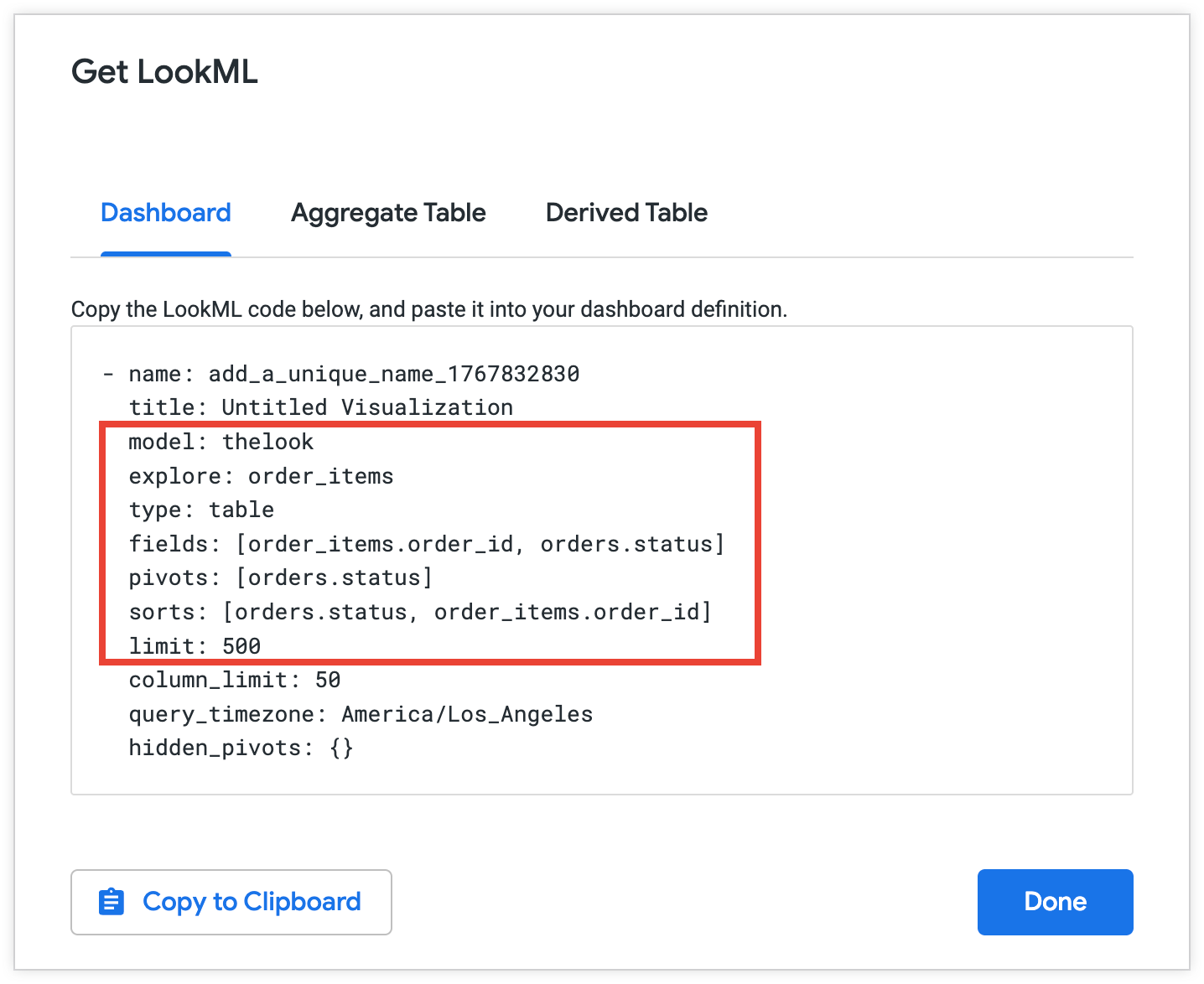
复制所选元数据以在 Looker 黄金查询中使用:
  model: thelook
  explore: order_items
  fields: [order_items.order_id, orders.status]
  sorts: [orders.status, order_items.order_id]
  limit: 500
使用 Looker API 检索 Looker 查询对象
如需使用 Looker API 检索有关 Explore 的信息,请按以下步骤操作:
- 在 Explore 中,选择 探索操作
菜单,
然后选择 分享。Looker 会显示您可以复制以分享 Explore 的网址。分享网址通常类似于
https://looker.yourcompany/x/vwGSbfc。分享网址中的尾随vwGSbfc是分享 slug。 - 复制分享 slug。
- 向 Looker API 发出请求:
GET /queries/slug/Explore_slug,并在Explore_slug中以 字符串形式传递 Explore 网址 slug。在请求中,添加您希望返回的 Explore 查询元数据中的字段。如需了解详情,请参阅 Get Query for Slug API 参考文档页面。 - 从 API 响应中复制查询元数据。
Looker 黄金查询示例
以下示例展示了如何使用直接 HTTP 请求和 Python SDK 为 airports Explore 提供黄金查询。
HTTP
在直接 HTTP 请求中,为 looker_golden_queries 键提供 Looker 黄金查询对象列表。每个对象都必须包含 natural_Language_questions 键和相应的 looker_query 键。
looker_golden_queries = [
  {
    "natural_language_questions": ["What is the highest observed positive longitude?"],
    "looker_query": {
      "model": "airports",
      "explore": "airports",
      "fields": ["airports.longitude"],
      "filters": [
        {
          "field": "airports.longitude",
          "value": ">0"
        }
      ],
      "sorts": ["airports.longitude desc"],
      "limit": "1"
    }
  },
 {
    "natural_language_questions": ["What are the major airport codes and cities in CA?", "Can you list the cities and airport codes of airports in CA?"],
    "looker_query": {
      "model": "airports",
      "explore": "airports",
      "fields": ["airports.city", "airports.code"],
      "filters": [
        {
          "field": "airports.major",
          "value": "Y"
        },
        {
          "field": "airports.state",
          "value": "CA"
        }
      ]
    }
  },
]
Python SDK
使用 Python SDK 时,您可以提供 LookerGoldenQuery 对象列表。对于每个对象,请为 natural_language_questions 和 looker_query 参数提供值。
looker_golden_queries = [geminidataanalytics.LookerGoldenQuery(
      natural_language_questions=[
          "What is the highest observed positive longitude?"
      ],
      looker_query=geminidataanalytics.LookerQuery(
          model="airports",
          explore="airports",
          fields=["airports.longitude"],
          filters=[
              geminidataanalytics.LookerQuery.Filter(
                  field="airports.longitude", value=">0"
              )
          ],
          sorts=["airports.longitude desc"],
          limit="1",
      ),
  ),
  geminidataanalytics.LookerGoldenQuery(
      natural_language_questions=[
          "What are the major airport codes and cities in CA?",
          "Can you list the cities and airport codes of airports in CA?",
      ],
      looker_query=geminidataanalytics.LookerQuery(
          model="airports",
          explore="airports",
          fields=["airports.city", "airports.code"],
          filters=[
              geminidataanalytics.LookerQuery.Filter(
                  field="airports.major", value="Y"
              ),
              geminidataanalytics.LookerQuery.Filter(
                  field="airports.state", value="CA"
              ),
          ],
      ),
  ),
]
在系统指令中定义其他上下文
系统指令由一系列关键组件和对象组成,这些组件和对象为数据代理提供了有关数据源的详细信息,以及有关代理在回答问题时的角色的指导。您可以使用 system_instruction 参数以 YAML 格式的字符串形式向数据代理提供系统指令。
以下 YAML 模板展示了如何为 Looker 数据源构建系统指令的示例:
-   system_instruction: str # Describe the expected behavior of the agent
-   glossaries: # Define business terms, jargon, and abbreviations that are relevant to your use case
    -   glossary:
            -   term: str
            -   description: str
            -   synonyms: list[str]
-   additional_descriptions: # List any additional general instructions
    -   text: str
系统指令的关键组成部分说明
以下部分包含 Looker 中系统指令的关键组成部分示例。这些键包括:
system_instruction
使用 system_instruction 键定义代理的角色及角色设定。此初始指令可为 API 的回答设定基调和风格,并帮助智能体理解其核心目标。
例如,您可以将智能体定义成一个虚构网店的销售分析师,如下所示:
-   system_instruction: You are an expert sales analyst for a fictitious
    ecommerce store. You will answer questions about sales, orders, and customer
    data. Your responses should be concise and data-driven.
glossaries
glossaries 键列出了与您的数据及应用场景相关的业务术语、行话和缩写的定义,但这些术语、行话和缩写尚未出现在您的数据中。例如,您可以根据特定业务情境定义常见业务状态和“忠实客户”等字词,如下所示:
-   glossaries:
    -   glossary:
            -   term: Loyal Customer
            -   description: A customer who has made more than one purchase.
                Maps to the dimension 'user_order_facts.repeat_customer' being
                'Yes'. High value loyal customers are those with high
                'user_order_facts.lifetime_revenue'.
            -   synonyms:
                -   repeat customer
                -   returning customer
additional_descriptions
additional_descriptions 键列出了系统指令中未涵盖的任何其他一般性说明或上下文信息。例如,您可以使用 additional_descriptions 键提供有关代理的信息,如下所示:
-   additional_descriptions:
    -   text: The user is typically a Sales Manager, Product Manager, or
        Marketing Analyst. They need to understand performance trends, build
        customer lists for campaigns, and analyze product sales.
示例:Looker 中的系统指令
以下示例展示了虚构的销售分析师智能体的示例系统指令:
-   system_instruction: "You are an expert sales, product, and operations
    analyst for our e-commerce store. Your primary function is to answer
    questions by querying the 'Order Items' Explore. Always be concise and
    data-driven. When asked about 'revenue' or 'sales', use
    'order_items.total_sale_price'. For 'profit' or 'margin', use
    'order_items.total_gross_margin'. For 'customers' or 'users', use
    'users.count'. The default date for analysis is 'order_items.created_date'
    unless specified otherwise. For advanced statistical questions, such as
    correlation or regression analysis, use the Python tool to fetch the
    necessary data, perform the calculation, and generate a plot (like a scatter
    plot or heatmap)."
-   glossaries:
    -   term: Revenue
    -   description: The total monetary value from items sold. Maps to the
        measure 'order_items.total_sale_price'.
    -   synonyms:
        -   sales
        -   total sales
        -   income
        -   turnover
    -   term: Profit
    -   description: Revenue minus the cost of goods sold. Maps to the measure
        'order_items.total_gross_margin'.
    -   synonyms:
        -   margin
        -   gross margin
        -   contribution
    -   term: Buying Propensity
    -   description: Measures the likelihood of a customer to purchase again
        soon. Primarily maps to the 'order_items.30_day_repeat_purchase_rate'
        measure.
    -   synonyms:
        -   repeat purchase rate
        -   repurchase likelihood
        -   customer velocity
    -   term: Customer Lifetime Value
    -   description: The total revenue a customer has generated over their
        entire history with us. Maps to 'user_order_facts.lifetime_revenue'.
    -   synonyms:
        -   CLV
        -   LTV
        -   lifetime spend
        -   lifetime value
    -   term: Loyal Customer
    -   description: "A customer who has made more than one purchase. Maps to
        the dimension 'user_order_facts.repeat_customer' being 'Yes'. High value
        loyal customers are those with high
        'user_order_facts.lifetime_revenue'."
    -   synonyms:
        -   repeat customer
        -   returning customer
    -   term: Active Customer
    -   description: "A customer who is currently considered active based on
        their recent purchase history. Mapped to
        'user_order_facts.currently_active_customer' being 'Yes'."
    -   synonyms:
        -   current customer
        -   engaged shopper
    -   term: Audience
    -   description: A list of customers, typically identified by their email
        address, for marketing or analysis purposes.
    -   synonyms:
        -   audience list
        -   customer list
        -   segment
    -   term: Return Rate
    -   description: The percentage of items that are returned by customers
        after purchase. Mapped to 'order_items.return_rate'.
    -   synonyms:
        -   returns percentage
        -   RMA rate
    -   term: Processing Time
    -   description: The time it takes to prepare an order for shipment from the
        moment it is created. Maps to 'order_items.average_days_to_process'.
    -   synonyms:
        -   fulfillment time
        -   handling time
    -   term: Inventory Turn
    -   description: "A concept related to how quickly stock is sold. This can
        be analyzed using 'inventory_items.days_in_inventory' (lower days means
        higher turn)."
    -   synonyms:
        -   stock turn
        -   inventory turnover
        -   sell-through
    -   term: New vs Returning Customer
    -   description: "A classification of whether a purchase was a customer's
        first ('order_facts.is_first_purchase' is Yes) or if they are a repeat
        buyer ('user_order_facts.repeat_customer' is Yes)."
    -   synonyms:
        -   customer type
        -   first-time buyer
-   additional_descriptions:
    -   text: The user is typically a Sales Manager, Product Manager, or
        Marketing Analyst. They need to understand performance trends, build
        customer lists for campaigns, and analyze product sales.
    -   text: This agent can answer complex questions by joining data about
        sales line items, products, users, inventory, and distribution centers.
后续步骤
定义构成编写的上下文的结构化字段和系统指令后,您可以通过以下任一调用将该上下文提供给 Conversational Analytics API:
- 创建持久化数据代理:在请求正文的
published_context对象中添加编写的上下文,以配置可在多轮对话中保持的代理行为。如需了解详情,请参阅创建数据代理 (HTTP) 或为有状态或无状态聊天设置上下文 (Python SDK)。 - 发送无状态请求:在聊天请求的
inline_context对象中提供编写的上下文,以定义该代理在相应 API 调用期间的行为。如需了解详情,请参阅创建无状态多轮对话 (HTTP) 或发送包含内嵌上下文的无状态聊天请求 (Python SDK)。 - 发送查询数据请求:对于数据库数据源,请在查询数据请求的
agent_context_reference对象中提供编写的上下文的上下文集 ID。如需了解详情,请参阅为数据库数据源定义数据代理上下文。