

This page describes how to write system instructions for data agents that are using Looker data sources, which are based on Looker Explores.
Authored context is guidance that data agent owners can provide to shape the behavior of a data agent and to refine the API's responses. Effective authored context provides your Conversational Analytics API data agents with useful context for answering questions about your data sources.
For Looker data sources, you can provide authored context through
a combination of structured context and system
instructions. Whenever possible, provide
context through structured context fields. You can then use the
system_instruction parameter for supplemental guidance that isn't covered by
the structured fields. System instructions are a kind of authored context that
data agent owners can provide an agent to inform the agent of its role, tone,
and overall behavior. Often system instructions can be more free-form that
structured context.
While both structured context fields and system instructions are optional, providing robust context enables the agent to give more accurate and relevant responses. During the creation of your data agent, any structured context information that you've provided will be added to the system instructions automatically.
Define structured context
You can provide golden questions and answers in structured context for your data agent. Once you've defined your structured context, you can provide it to your data agent using direct HTTP requests or with the Python SDK.
For Looker data sources, golden queries are captured in the
looker_golden_queries key, which defines pairs of natural language questions
and their corresponding Looker queries. By providing the agent
with a pair of natural language questions and their corresponding Explore
metadata, you can guide the agent to provide higher quality and more consistent
results. Examples of Looker
golden queries are included on this page.
To define each Looker golden query, provide values for both of the following fields:
natural_language_questions: The natural language question that a user might asklooker_query: The Looker golden query that corresponds to the natural language question
Here's an example of a natural_language_questions — looker_query pair
from an Explore called "Airports":
  natural_language_questions: ["What are the major airport codes and cities in CA?"]
  looker_query": {
        "model": "airports",
        "explore": "airports",
        "fields": ["airports.city", "airports.code"],
        "filters": [
          {
            "field": "airports.major",
            "value": "Y"
          },
          {
            "field": "airports.state",
            "value": "CA"
          }
        ]
  }
Define a Looker golden query
Define a Looker golden query for a given Explore by providing
values for the natural_language_questions and looker_query fields. For the
natural_language_questions field, consider the questions a user might ask
about that Explore, and write those questions in natural language. You can
include more than one question in this field's value. You can obtain the value
for the looker_query field from the Explore's query metadata.
The LookerQuery
object
supports the following fields:
model(string): The LookML model used to generate the query. This is a required field.explore(string): The Explore that was used to generate the query. This is a required field.fields[](string): The fields to retrieve from the Explore, including dimensions and measures. This is an optional field.filters[](object (Filter)): The filters to apply to the Explore. This is an optional field.sorts[](string): The sorting to apply to the Explore. This is an optional field.limit(string): The data row limit to apply to the Explore. This is an optional field.
You can retrieve the Explore's query metadata in the following ways:
- Retrieve the query metadata from the Explore page
- Retrieve the Looker query object from the
GetQueryForSlugAPI endpoint
Retrieve the query metadata from the Explore user interface
- In the Explore, select the Explore actions menu, and then select Get LookML.
- Select the Dashboard tab.
- Copy the query details from the LookML. For example, the following image shows the LookML for an Explore called Order Items:
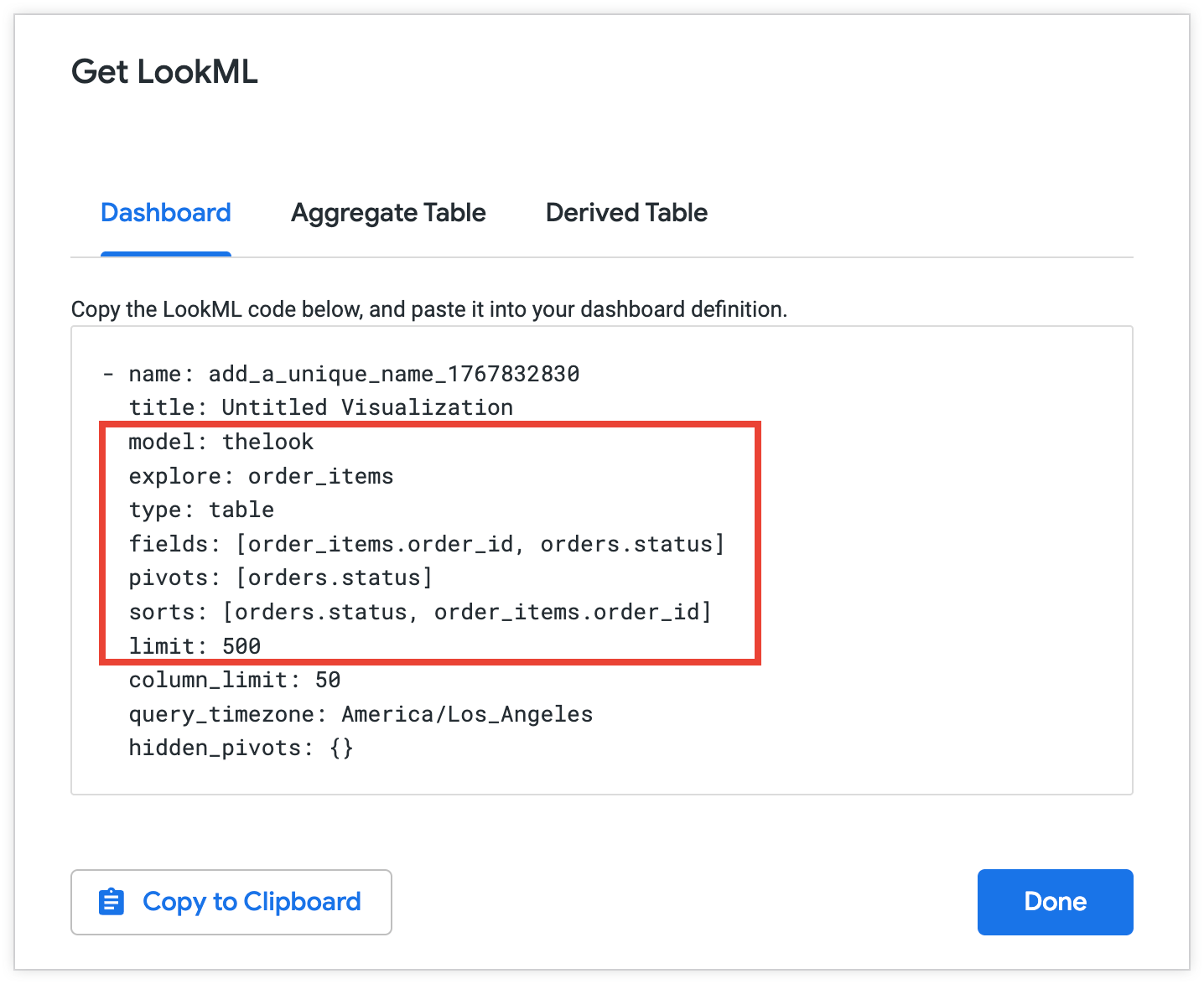
Copy the selected metadata for use in your Looker golden query:
  model: thelook
  explore: order_items
  fields: [order_items.order_id, orders.status]
  sorts: [orders.status, order_items.order_id]
  limit: 500
Retrieve the Looker query object using the Looker API
To retrieve information about your Explore using the Looker API, follow these steps:
- In the Explore, select the Explore actions
menu,
and then select Share. Looker displays URLs that you can
copy to share the Explore. Share URLs generally look something like
https://looker.yourcompany/x/vwGSbfc. The trailingvwGSbfcin the share URL is the share slug. - Copy the share slug.
- Make a request to the Looker API:
GET /queries/slug/Explore_slugpassing the Explore URL slug as a string inExplore_slug. In your request, include the fields from your Explore query metadata that you want returned. See the Get Query for Slug API reference page for more information. - Copy the query metadata from the API response.
Example Looker golden queries
The following examples show how to provide golden queries for the airports
Explore with direct HTTP requests and with the Python SDK.
HTTP
In a direct HTTP request, provide a list of Looker golden
query objects for the looker_golden_queries key. Each object must contain
a natural_Language_questions key and a corresponding looker_query key.
looker_golden_queries = [
  {
    "natural_language_questions": ["What is the highest observed positive longitude?"],
    "looker_query": {
      "model": "airports",
      "explore": "airports",
      "fields": ["airports.longitude"],
      "filters": [
        {
          "field": "airports.longitude",
          "value": ">0"
        }
      ],
      "sorts": ["airports.longitude desc"],
      "limit": "1"
    }
  },
 {
    "natural_language_questions": ["What are the major airport codes and cities in CA?", "Can you list the cities and airport codes of airports in CA?"],
    "looker_query": {
      "model": "airports",
      "explore": "airports",
      "fields": ["airports.city", "airports.code"],
      "filters": [
        {
          "field": "airports.major",
          "value": "Y"
        },
        {
          "field": "airports.state",
          "value": "CA"
        }
      ]
    }
  },
]
Python SDK
When using the Python SDK, you can provide a list of LookerGoldenQuery
objects. For each object, provide values for the
natural_language_questions and looker_query parameters.
looker_golden_queries = [geminidataanalytics.LookerGoldenQuery(
      natural_language_questions=[
          "What is the highest observed positive longitude?"
      ],
      looker_query=geminidataanalytics.LookerQuery(
          model="airports",
          explore="airports",
          fields=["airports.longitude"],
          filters=[
              geminidataanalytics.LookerQuery.Filter(
                  field="airports.longitude", value=">0"
              )
          ],
          sorts=["airports.longitude desc"],
          limit="1",
      ),
  ),
  geminidataanalytics.LookerGoldenQuery(
      natural_language_questions=[
          "What are the major airport codes and cities in CA?",
          "Can you list the cities and airport codes of airports in CA?",
      ],
      looker_query=geminidataanalytics.LookerQuery(
          model="airports",
          explore="airports",
          fields=["airports.city", "airports.code"],
          filters=[
              geminidataanalytics.LookerQuery.Filter(
                  field="airports.major", value="Y"
              ),
              geminidataanalytics.LookerQuery.Filter(
                  field="airports.state", value="CA"
              ),
          ],
      ),
  ),
]
Define additional context in system instructions
System instructions consist of a series of key components and objects that provide the data agent with details about the data source and guidance about the agent's role when answering questions. You can provide system instructions to the data agent in the system_instruction parameter as a YAML-formatted string.
The following YAML template shows an example of how you might structure system instructions for a Looker data source:
-   system_instruction: str # Describe the expected behavior of the agent
-   glossaries: # Define business terms, jargon, and abbreviations that are relevant to your use case
    -   glossary:
            -   term: str
            -   description: str
            -   synonyms: list[str]
-   additional_descriptions: # List any additional general instructions
    -   text: str
Descriptions of key components of system instructions
The following sections contain examples of key components of system instructions in Looker. These keys include the following:
system_instruction
Use the system_instruction key to define the agent's role and persona. This initial instruction sets the tone and style for the API's responses and helps the agent understand its core purpose.
For example, you can define an agent as a sales analyst for a fictitious ecommerce store as follows:
-   system_instruction: You are an expert sales analyst for a fictitious
    ecommerce store. You will answer questions about sales, orders, and customer
    data. Your responses should be concise and data-driven.
glossaries
The glossaries key lists definitions for business terms, jargon, and
abbreviations that are relevant to your data and use case but that don't already
appear in your data. As an example, you can define terms like common business
statuses and "Loyal Customer" according to your specific business context as
follows:
-   glossaries:
    -   glossary:
            -   term: Loyal Customer
            -   description: A customer who has made more than one purchase.
                Maps to the dimension 'user_order_facts.repeat_customer' being
                'Yes'. High value loyal customers are those with high
                'user_order_facts.lifetime_revenue'.
            -   synonyms:
                -   repeat customer
                -   returning customer
additional_descriptions
The additional_descriptions key lists any additional general instructions or
context that is not covered elsewhere in the system instructions. As an example,
you can use the additional_descriptions key to provide information about your
agent as follows:
-   additional_descriptions:
    -   text: The user is typically a Sales Manager, Product Manager, or
        Marketing Analyst. They need to understand performance trends, build
        customer lists for campaigns, and analyze product sales.
Example: System instructions in Looker
The following example shows sample system instructions for a fictitious sales analyst agent:
-   system_instruction: "You are an expert sales, product, and operations
    analyst for our e-commerce store. Your primary function is to answer
    questions by querying the 'Order Items' Explore. Always be concise and
    data-driven. When asked about 'revenue' or 'sales', use
    'order_items.total_sale_price'. For 'profit' or 'margin', use
    'order_items.total_gross_margin'. For 'customers' or 'users', use
    'users.count'. The default date for analysis is 'order_items.created_date'
    unless specified otherwise. For advanced statistical questions, such as
    correlation or regression analysis, use the Python tool to fetch the
    necessary data, perform the calculation, and generate a plot (like a scatter
    plot or heatmap)."
-   glossaries:
    -   term: Revenue
    -   description: The total monetary value from items sold. Maps to the
        measure 'order_items.total_sale_price'.
    -   synonyms:
        -   sales
        -   total sales
        -   income
        -   turnover
    -   term: Profit
    -   description: Revenue minus the cost of goods sold. Maps to the measure
        'order_items.total_gross_margin'.
    -   synonyms:
        -   margin
        -   gross margin
        -   contribution
    -   term: Buying Propensity
    -   description: Measures the likelihood of a customer to purchase again
        soon. Primarily maps to the 'order_items.30_day_repeat_purchase_rate'
        measure.
    -   synonyms:
        -   repeat purchase rate
        -   repurchase likelihood
        -   customer velocity
    -   term: Customer Lifetime Value
    -   description: The total revenue a customer has generated over their
        entire history with us. Maps to 'user_order_facts.lifetime_revenue'.
    -   synonyms:
        -   CLV
        -   LTV
        -   lifetime spend
        -   lifetime value
    -   term: Loyal Customer
    -   description: "A customer who has made more than one purchase. Maps to
        the dimension 'user_order_facts.repeat_customer' being 'Yes'. High value
        loyal customers are those with high
        'user_order_facts.lifetime_revenue'."
    -   synonyms:
        -   repeat customer
        -   returning customer
    -   term: Active Customer
    -   description: "A customer who is currently considered active based on
        their recent purchase history. Mapped to
        'user_order_facts.currently_active_customer' being 'Yes'."
    -   synonyms:
        -   current customer
        -   engaged shopper
    -   term: Audience
    -   description: A list of customers, typically identified by their email
        address, for marketing or analysis purposes.
    -   synonyms:
        -   audience list
        -   customer list
        -   segment
    -   term: Return Rate
    -   description: The percentage of items that are returned by customers
        after purchase. Mapped to 'order_items.return_rate'.
    -   synonyms:
        -   returns percentage
        -   RMA rate
    -   term: Processing Time
    -   description: The time it takes to prepare an order for shipment from the
        moment it is created. Maps to 'order_items.average_days_to_process'.
    -   synonyms:
        -   fulfillment time
        -   handling time
    -   term: Inventory Turn
    -   description: "A concept related to how quickly stock is sold. This can
        be analyzed using 'inventory_items.days_in_inventory' (lower days means
        higher turn)."
    -   synonyms:
        -   stock turn
        -   inventory turnover
        -   sell-through
    -   term: New vs Returning Customer
    -   description: "A classification of whether a purchase was a customer's
        first ('order_facts.is_first_purchase' is Yes) or if they are a repeat
        buyer ('user_order_facts.repeat_customer' is Yes)."
    -   synonyms:
        -   customer type
        -   first-time buyer
-   additional_descriptions:
    -   text: The user is typically a Sales Manager, Product Manager, or
        Marketing Analyst. They need to understand performance trends, build
        customer lists for campaigns, and analyze product sales.
    -   text: This agent can answer complex questions by joining data about
        sales line items, products, users, inventory, and distribution centers.
What's next
After you define the structured fields and system instructions that make up your authored context, you can provide that context to the Conversational Analytics API in one of the following calls:
- Creating a persistent data agent: Include authored context within the
published_contextobject in the request body to configure agent behavior that persists across multiple conversations. For more information, see Create a data agent (HTTP) or Set up context for stateful or stateless chat (Python SDK). - Sending a stateless request: Provide authored context within the
inline_contextobject in a chat request to define the agent's behavior for that specific API call. For more information, see Create a stateless multi-turn conversation (HTTP) or Send a stateless chat request with inline context (Python SDK). - Send a query data request: For database data sources, provide the context set ID of the authored context within the
agent_context_referenceobject in the query data request. For more information, see Define data agent context for database data sources.