To access your workstations, you can specify a trusted, custom domain rather
than using the `cloudworkstations.dev` domain.
## Architecture
To use Cloud Workstations with a custom hostname,
[set up a private cluster](https://docs.cloud.google.com/workstations/docs/set-up-custom-domains-for-cloud-workstations#create_a_private_cluster)
and
[set up the Private Service Connect (PSC) endpoint](https://docs.cloud.google.com/workstations/docs/set-up-custom-domains-for-cloud-workstations#create-application-load-balancer-with-psc-backend)
for HTTP ingress for your private cluster. You must also create an
Application Load Balancer with PSC backend that targets the PSC endpoint created
for your private cluster. This Application Load Balancer can be either external or
internal, and manages the SSL certificate for your custom domain.
The following diagram illustrates a cluster with a custom domain:
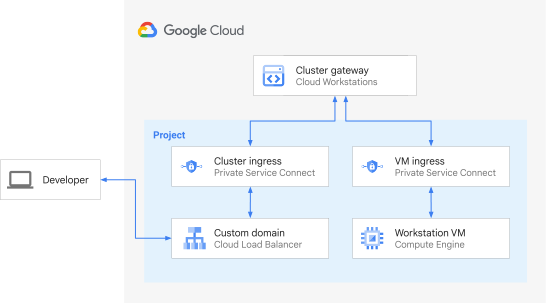
Figure 1. Cluster with custom domain
## Before you begin
To set up a Cloud Workstations custom domain, follow these steps:
1. [Create a private cluster](https://docs.cloud.google.com/workstations/docs/set-up-custom-domains-for-cloud-workstations#create_a_private_cluster)
and specify a trusted, custom domain using the `gcloud` CLI or
REST API commands.
**Important:**
- The domain is an immutable field and cannot be changed after creation.
- Make sure that you add the `--enable-private-endpoint` flag because to use custom domains, you must enable private clusters.
- We recommend specifying a domain that will be used exclusively for the workstation cluster. If you are planning to host multiple workstation clusters, we recommend using a separate domain for each cluster---for example, `us-west1-cluster1.example.com`.
2. [Create an Application Load Balancer with a Private Service Connect
(PSC) backend](https://docs.cloud.google.com/workstations/docs/set-up-custom-domains-for-cloud-workstations#create-application-load-balancer-with-psc-backend)
in the same project you used for the workstation cluster project.
Note the following:
1. If you want your workstations to be private (inaccessible through the
public internet), make sure that you create an internal load balancer.
To do so, create a private DNS zone and add a record that maps the
domain to the internal IP address used by the load balancer.
For more information about how to create an internal load balancer, see
[Internal Application Load Balancers](https://docs.cloud.google.com/load-balancing/docs/l7-internal#load-balancer-mode).
2. The service attachment that you need to reference in the load balancer
can be obtained on the workstation cluster resource after you create the
cluster.
3. Make sure that you obtain a certificate and specify it on the load
balancer as a wildcard certificate for your domain---for example,
`*.us-west1-cluster1.example.com`. See
[Certificates and Google Cloud load balancers](https://docs.cloud.google.com/load-balancing/docs/ssl-certificates#certificate-summary)
for the types of certificates that are supported for the load balancer
that you selected.
4. You can also create the load balancer in a different project as long as
you add it to the `PrivateClusterConfig.allowedProjects` list.
5. If you have multiple workstation clusters in your organization, you can
use a single load balancer with separate backend services, certificates,
and routing rules.
3. [Set up a Domain Name System](https://docs.cloud.google.com/workstations/docs/set-up-custom-domains-for-cloud-workstations#set-up-dns)
(DNS). Because this is a domain you manage, set up a DNS for this domain by
mapping all subdomains of the provided domain to the load balancer. For
example, create a DNS zone for `us-west1-cluster1.example.com` and add an
entry mapping `*.us-west1-cluster1.example.com` to the external IP address
used by your load balancer.
4. To access workstations using the custom domain, use the cluster you created
to [create a workstation configuration](https://docs.cloud.google.com/workstations/docs/create-configuration),
and then [create a workstation](https://docs.cloud.google.com/workstations/docs/create-workstation)
using that workstation configuration.
5. Start your workstation and check the URL. When you specify a custom domain,
the workstation URL uses the following format:
https://PORT-WORKSTATION_NAME.DOMAIN
The following parts of the URL depend on your configuration:
- `PORT`: the port number, which is port `80` by default.
- `WORKSTATION_NAME`: your workstation name.
- `DOMAIN`: your cluster-specific domain name
## Create a private cluster
Create a private workstation cluster with a private endpoint:
### gcloud
1. Before you begin, be sure that you
[initialized the `gcloud` CLI](https://docs.cloud.google.com/sdk/docs/initialize) by
running `gcloud init` and that you specified a default project.
The examples that follow assume that you've set your default project.
2. To create a private workstation cluster, run the following command:
```sh
gcloud workstations clusters create WORKSTATION_CLUSTER \
--region=REGION \
--domain=DOMAIN \
--network=NETWORK \
--subnetwork=SUBNETWORK \
--enable-private-endpoint
```
Replace the following:
- `WORKSTATION_CLUSTER`: the name of the workstation cluster to create.
- `REGION`: the name of the region of the cluster.
- `DOMAIN`: the domain name used by Cloud Workstations for HTTP ingress. Use a subdomain unique to this cluster, for example, `us-west1-cluster1.example.com`.
- `NETWORK`: the name of the VPC network. If omitted, the default VPC network is used.
- `SUBNETWORK`: the name of the subnetwork in the VPC network. If both network and subnetwork are omitted, the default VPC network is used, and the default subnetwork in the specified `REGION` is used.
For more information about this `gcloud` CLI command, see the
[`gcloud workstations clusters create`](https://docs.cloud.google.com/sdk/gcloud/reference/workstations/clusters/create)
reference documentation.
### curl
curl -H "Authorization: Bearer $(gcloud auth print-access-token)" -H "Content-Type: application/json" -d '{"domain_config": {"domain": "DOMAIN"}, "private_cluster_config": {"enable_private_endpoint":true}, "network": "NETWORK", "subnetwork": "SUBNETWORK"}' https://workstations.googleapis.com/v1/projects/PROJECT_NAME/locations/REGION/workstationClusters?workstation_cluster_id=WORKSTATION_CLUSTER
Replace the following:
- `DOMAIN`: the domain name used by Cloud Workstations for HTTP ingress. This must be a subdomain unique to this cluster, for example, `us-west1-cluster1.example.com`.
- `NETWORK`: the name of the VPC network. If omitted, the default VPC network is used.
- `SUBNETWORK`: the name of the subnetwork in the VPC network. If both network and subnetwork are omitted, the default VPC network is used, and the default subnetwork in the specified `REGION` is used.
- `PROJECT_NAME`: the name of the project.
- `REGION`: the name of the region of the cluster.
- `WORKSTATION_CLUSTER`: the name of the workstation cluster to create.
For more information about this API method, see the
[`workstationClusters.create`](https://docs.cloud.google.com/workstations/docs/reference/rest/v1/projects.locations.workstationClusters/create)
reference documentation.
### REST
```json
POST https://workstations.googleapis.com/v1/projects/PROJECT_NAME/locations/REGION/workstationClusters?workstationClusterId=WORKSTATION_CLUSTER
{
"domainConfig": {
"domain": "DOMAIN"
},
"privateClusterConfig": {
"enablePrivateEndpoint": true
},
"network": "NETWORK",
"subnetwork": "SUBNETWORK"
}
```
Replace the following:
- `PROJECT_NAME`: the name of the project.
- `REGION`: the name of the region of the cluster.
- `WORKSTATION_CLUSTER`: the name of the workstation cluster to create.
- `DOMAIN`: the domain name used by Cloud Workstations for HTTP ingress. This should be a subdomain unique to this cluster, for example, `us-west1-cluster1.example.com`.
- `NETWORK`: the name of the VPC network. If omitted, the default VPC network is used.
- `SUBNETWORK`: the name of the subnetwork in the VPC network. If both network and subnetwork are omitted, the default VPC network is used, and the default subnetwork in the specified `REGION` is used.
For more information about this API method, see the
[`workstationClusters.create`](https://docs.cloud.google.com/workstations/docs/reference/rest/v1/projects.locations.workstationClusters/create)
reference documentation.
## Create an Application Load Balancer with PSC backend
Follow these `gcloud` CLI and REST API steps to create an
Application Load Balancer with a PSC backend:
1. [Create a NEG to connect to a published service](https://docs.cloud.google.com/workstations/docs/set-up-custom-domains-for-cloud-workstations#neg-published-service)
2. [Add a backend to a global external Application Load Balancer](https://docs.cloud.google.com/workstations/docs/set-up-custom-domains-for-cloud-workstations#add-backend-to-global-ext-app-lb)
3. [Create a URL map to route incoming requests to the backend service](https://docs.cloud.google.com/workstations/docs/set-up-custom-domains-for-cloud-workstations#create-url-map)
4. [Create a target HTTPS proxy](https://docs.cloud.google.com/workstations/docs/set-up-custom-domains-for-cloud-workstations#create-target-https-proxy)
5. [Create a global address](https://docs.cloud.google.com/workstations/docs/set-up-custom-domains-for-cloud-workstations#create-global-address)
6. [Create a forwarding rule](https://docs.cloud.google.com/workstations/docs/set-up-custom-domains-for-cloud-workstations#create-forwarding-rule)
7. Optional: [Configure a regional or internal Application Load Balancer](https://docs.cloud.google.com/workstations/docs/set-up-custom-domains-for-cloud-workstations#configure-regional-or-internal-alb)
> [!NOTE]
> **Note:** The steps for creating an Application Load Balancer with PSC backend are provided as an example to get started. There are various other types of load balancers you can choose based on your requirements. For more information about the available load balancer configurations, see the [Cloud Load Balancing overview](https://docs.cloud.google.com/load-balancing/docs/load-balancing-overview).
> [!NOTE]
> **Note:** If you require [data residency](https://docs.cloud.google.com/assured-workloads/docs/data-residency) for data in transit, use a [regional external Application Load Balancer](https://docs.cloud.google.com/load-balancing/docs/https#load-balancer-mode) instead.
### Create a NEG to connect to a published service
When you create a NEG that points to a published service, you need the service
attachment URI for the service. The service attachment has this format:
`projects/SERVICE_PROJECT/regions/REGION/serviceAttachments/SERVICE_NAME`.
You can find the URI on the workstation cluster resource.
### gcloud
```sh
gcloud compute network-endpoint-groups create NEG_NAME \
--network-endpoint-type=private-service-connect \
--psc-target-service=TARGET_SERVICE \
--region=REGION \
--network=NETWORK \
--subnet=SUBNET
```
Replace the following:
- `NEG_NAME`: a name for the network endpoint group.
- `TARGET_SERVICE`: the URI of the service attachment.
- `REGION`: the region to create the network endpoint group in. The region must be the same region as the target service.
- `NETWORK`: the VPC network to create the network endpoint group in. If omitted, the default network is used.
- `SUBNET`: the subnet to create the network endpoint group in. The subnet must be in the same region as the target service. A subnet must be provided if you provide the network. If both network and subnet are omitted, the default network is used, and the default subnet in the specified `REGION` is used.
For more information about this `gcloud` CLI command, see the
[`gcloud compute network-endpoint-groups create`](https://docs.cloud.google.com/sdk/gcloud/reference/compute/network-endpoint-groups/create)
reference documentation.
### REST
```json
POST https://compute.googleapis.com/compute/v1/projects/PROJECT_NAME/regions/REGION/networkEndpointGroups
{
"pscTargetService": "TARGET_SERVICE",
"networkEndpointType": "PRIVATE_SERVICE_CONNECT",
"name": "NEG_NAME",
"network": "https://www.googleapis.com/compute/v1/projects/PROJECT_NAME/global/networks/NETWORK",
"subnetwork": "https://www.googleapis.com/compute/v1/projects/PROJECT_NAME/regions/REGION/subnetworks/SUBNET"
}
```
Replace the following:
- `PROJECT_NAME`: the name of the project.
- `REGION`: the region to create the network endpoint group in. The region must be the same region as the target service.
- `TARGET_SERVICE`: the URI of the service attachment.
- `NEG_NAME`: a name for the network endpoint group.
- `NETWORK`: the VPC network to create the network endpoint group in. If omitted, the default network is used.
- `SUBNET`: the subnet to create the network endpoint group in. The subnet must be in the same region as the target service. A subnet must be provided if you provide the network. If both network and subnet are omitted, the default network is used, and the default subnet in the specified `REGION` is used.
### Add a backend to a global external Application Load Balancer
### gcloud
1. Create a backend service for the target service:
```sh
gcloud compute backend-services create BACKEND_SERVICE_NAME \
--load-balancing-scheme=EXTERNAL_MANAGED \
--protocol=HTTPS \
--global
```
Replace `BACKEND_SERVICE_NAME` with the name of the
backend service.
2. Add the Private Service Connect NEG that points to the
target service.
```sh
gcloud compute backend-services add-backend BACKEND_SERVICE_NAME \
--network-endpoint-group=NEG_NAME \
--network-endpoint-group-region=NEG_REGION \
--global
```
Replace the following:
- `BACKEND_SERVICE_NAME`: the name of the backend service.
- `NEG_NAME`: the name of the network endpoint group.
- `NEG_REGION`: the region of the network endpoint group.
For more information about this `gcloud` CLI command, see the
[`gcloud compute backend-services create`](https://docs.cloud.google.com/sdk/gcloud/reference/compute/backend-services/create)
and
[`gcloud compute backend-services add-backend`](https://docs.cloud.google.com/sdk/gcloud/reference/compute/backend-services/add-backend)
reference documentation.
### REST
1. Create a backend service for the target service:
```json
POST https://compute.googleapis.com/compute/v1/projects/PROJECT_NAME/global/backendServices
{
"protocol": "HTTPS",
"loadBalancingScheme": "EXTERNAL_MANAGED",
"name": "BACKEND_SERVICE_NAME"
}
```
Replace `BACKEND_SERVICE_NAME` with the name of the
backend service.
2. Add the Private Service Connect NEG that points to the
target service.
```json
PATCH https://compute.googleapis.com/compute/v1/projects/PROJECT_NAME/global/backendServices/BACKEND_SERVICE_NAME
{
"backends": [
{
"group": "https://www.googleapis.com/compute/v1/projects/PROJECT_NAME/regions/NEG_REGION/networkEndpointGroups/NEG_NAME "
}
]
}
```
Replace the following:
- `PROJECT_NAME`: the name of the project.
- `BACKEND_SERVICE_NAME`: the name of the backend service.
- `NEG_REGION`: the region of the network endpoint group.
- `NEG_NAME`: the name of the network endpoint group.
> [!NOTE]
> **Note:** If you want your workstations to be private (inaccessible through the public internet), make sure that you create an internal load balancer. If you require [data residency](https://docs.cloud.google.com/assured-workloads/docs/data-residency) for data in transit, use a [regional external Application Load Balancer](https://docs.cloud.google.com/load-balancing/docs/https#load-balancer-mode) instead.
### Create a URL map to route incoming requests to the backend service
### gcloud
```sh
gcloud compute url-maps create URL_MAP_NAME \
--default-service=BACKEND_SERVICE_NAME \
--global
```
Replace the following:
- `URL_MAP_NAME`: the name of the URL map to create.
- `BACKEND_SERVICE_NAME`: the name of the backend service to use for requests when this URL map has no mappings.
For more information about this `gcloud` CLI command, see the
[`gcloud compute url-maps create`](https://docs.cloud.google.com/sdk/gcloud/reference/compute/url-maps/create)
reference documentation.
### REST
```json
POST https://compute.googleapis.com/compute/v1/projects/PROJECT_NAME/global/urlMaps
{
"name": "URL_MAP_NAME",
"defaultService": "https://www.googleapis.com/compute/v1/projects/PROJECT_NAME/global/backendServices/BACKEND_SERVICE_NAME "
}
```
Replace the following:
- `PROJECT_NAME`: the name of the project.
- `URL_MAP_NAME`: the name of the URL map to create.
- `BACKEND_SERVICE_NAME`: the name of the backend service to use for requests when this URL map has no mappings.
### Create a target HTTPS proxy
Create a target HTTPS proxy to route requests to your URL map. The proxy is
the portion of the load balancer that holds the SSL certificate for HTTPS
Load Balancing, so you also load your certificate in this step:
### gcloud
```sh
gcloud compute target-https-proxies create TARGET_HTTPS_PROXY_NAME \
--ssl-certificates=SSL_CERTIFICATE_NAME \
--url-map=URL_MAP_NAME \
--global
```
Replace the following:
- `TARGET_HTTPS_PROXY_NAME`: the name of the target HTTPS proxy to create.
- `SSL_CERTIFICATE_NAME`: the SSL certificate associated with the load balancer.
- `URL_MAP_NAME`: the URL map resource.
For more information about this `gcloud` CLI command, see the
[`gcloud compute target-https-proxies create`](https://docs.cloud.google.com/sdk/gcloud/reference/compute/target-https-proxies/create)
reference documentation.
### REST
```json
POST https://compute.googleapis.com/compute/v1/projects/PROJECT_NAME/global/targetHttpsProxies
{
"sslCertificates": [
"https://www.googleapis.com/compute/v1/projects/PROJECT_NAME/global/sslCertificates/SSL_CERTIFICATE_NAME"
],
"urlMap": "https://www.googleapis.com/compute/v1/projects/PROJECT_NAME/global/urlMaps/URL_MAP_NAME",
"name": "TARGET_HTTPS_PROXY_NAME"
}
```
Replace the following:
- `PROJECT_NAME`: the name of the project.
- `SSL_CERTIFICATE_NAME`: the SSL certificate associated with the load balancer.
- `URL_MAP_NAME`: the URL map resource.
- `TARGET_HTTPS_PROXY_NAME`: the name of the target HTTPS proxy to create.
### Create a global address
Reserve a static IP address to be used by your load balancer:
### gcloud
```sh
gcloud compute addresses create LB_IP_ADDRESS_NAME \
--global
```
Replace the following:
- `LB_IP_ADDRESS_NAME`: the name for the reserved static external or internal IP address of the load balancer.
For more information about this `gcloud` CLI command, see the
[`gcloud compute addresses create`](https://docs.cloud.google.com/sdk/gcloud/reference/compute/addresses/create)
reference documentation.
### REST
```json
POST https://compute.googleapis.com/compute/v1/projects/PROJECT_NAME/global/addresses
{
"name": "LB_IP_ADDRESS_NAME"
}
```
Replace the following:
- `PROJECT_NAME`: the name of the project.
- `LB_IP_ADDRESS_NAME`: the name for the reserved static external or internal IP address of the load balancer.
### Create a forwarding rule
Create a forwarding rule to route incoming requests to the proxy:
### gcloud
```sh
gcloud compute forwarding-rules create HTTPS_FORWARDING_RULE_NAME \
--load-balancing-scheme=EXTERNAL_MANAGED \
--network-tier=PREMIUM \
--address=LB_IP_ADDRESS_NAME \
--target-https-proxy=TARGET_HTTPS_PROXY_NAME \
--global \
--ports=443
```
Replace the following:
- `HTTPS_FORWARDING_RULE_NAME`: the name of the forwarding rule to create.
- `LB_IP_ADDRESS_NAME`: the name for the reserved static external or internal IP address of the load balancer.
- `TARGET_HTTPS_PROXY_NAME`: the target HTTPS proxy that receives the traffic.
For more information about this `gcloud` CLI command, see the
[`gcloud compute forwarding-rules create`](https://docs.cloud.google.com/sdk/gcloud/reference/compute/forwarding-rules/create)
reference documentation.
### REST
```json
POST https://compute.googleapis.com/compute/v1/projects/PROJECT_NAME/global/forwardingRules
{
"loadBalancingScheme": "EXTERNAL_MANAGED",
"networkTier": "PREMIUM",
"IPAddress": "https://www.googleapis.com/compute/v1/projects/PROJECT_NAME/global/addresses/LB_IP_ADDRESS_NAME",
"target": "https://www.googleapis.com/compute/v1/projects/PROJECT_NAME/global/targetHttpsProxies/TARGET_HTTPS_PROXY_NAME",
"name": "HTTPS_FORWARDING_RULE_NAME",
"portRange": "443-443"
}
```
Replace the following:
- `PROJECT_NAME`: the name of the project.
- `LB_IP_ADDRESS_NAME`: the name for the reserved static external or internal IP address of the load balancer.
- `TARGET_HTTPS_PROXY_NAME`: the target HTTPS proxy that receives the traffic.
- `HTTPS_FORWARDING_RULE_NAME`: the name of the forwarding rule to create.
### Configure a regional or internal Application Load Balancer
If you are configuring a [regional external Application Load Balancer](https://docs.cloud.google.com/load-balancing/docs/https#load-balancer-mode)
(for example, for data residency requirements) or an
[internal Application Load Balancer](https://docs.cloud.google.com/load-balancing/docs/l7-internal#load-balancer-mode),
note the following requirements.
Before configuring regional load balancer resources, make sure you have created
the Private Service Connect NEG pointing to your workstation cluster
as described in
[Create a NEG to connect to a published service](https://docs.cloud.google.com/workstations/docs/set-up-custom-domains-for-cloud-workstations#neg-published-service).
1. **Configure a proxy-only subnet** : Regional Envoy-based load balancers
require a [proxy-only subnet](https://docs.cloud.google.com/load-balancing/docs/proxy-only-subnets)
in the region and VPC network where the load balancer is located.
You must create the proxy-only subnet before creating the forwarding rule:
### gcloud
```sh
gcloud compute networks subnets create PROXY_ONLY_SUBNET \
--purpose=REGIONAL_MANAGED_PROXY \
--role=ACTIVE \
--region=REGION \
--network=NETWORK \
--range=PROXY_ONLY_RANGE
```
Replace the following:
- `PROXY_ONLY_SUBNET`: a name for the proxy-only subnet.
- `REGION`: the region where the workstation cluster and load balancer are located.
- `NETWORK`: the VPC network where the workstation cluster and load balancer are located.
- `PROXY_ONLY_RANGE`: an unused CIDR block within your VPC network, such as `10.0.0.0/24`, with a minimum size of `/26` (64 addresses).
For more information, see
[Proxy-only subnets for Envoy-based load balancers](https://docs.cloud.google.com/load-balancing/docs/proxy-only-subnets)
and the
[`gcloud compute networks subnets create`](https://docs.cloud.google.com/sdk/gcloud/reference/compute/networks/subnets/create)
reference documentation.
### REST
```json
POST https://compute.googleapis.com/compute/v1/projects/PROJECT_NAME/regions/REGION/subnetworks
{
"name": "PROXY_ONLY_SUBNET",
"network": "https://www.googleapis.com/compute/v1/projects/PROJECT_NAME/global/networks/NETWORK",
"ipCidrRange": "PROXY_ONLY_RANGE",
"purpose": "REGIONAL_MANAGED_PROXY",
"role": "ACTIVE"
}
```
Replace the following:
- `PROJECT_NAME`: the name of the project.
- `REGION`: the region where the workstation cluster and load balancer are located.
- `PROXY_ONLY_SUBNET`: a name for the proxy-only subnet.
- `NETWORK`: the VPC network where the workstation cluster and load balancer are located.
- `PROXY_ONLY_RANGE`: an unused CIDR block within your VPC network, such as `10.0.0.0/24`, with a minimum size of `/26` (64 addresses).
2. **Create regional load balancer resources**: Create the backend service,
add the Private Service Connect NEG backend, create the
URL map, create the target HTTPS proxy, and reserve a static IP address in
the same region as your workstation cluster:
### gcloud
1. Create a regional backend service. Set `--load-balancing-scheme` to
`EXTERNAL_MANAGED` for a regional external Application Load Balancer or `INTERNAL_MANAGED`
for an internal Application Load Balancer:
```sh
gcloud compute backend-services create BACKEND_SERVICE_NAME \
--load-balancing-scheme=SCHEME \
--protocol=HTTPS \
--region=REGION
```
Replace the following:
- `BACKEND_SERVICE_NAME`: a name for the backend service.
- `SCHEME`: the load balancing scheme (`EXTERNAL_MANAGED` for a regional external Application Load Balancer or `INTERNAL_MANAGED` for an internal Application Load Balancer).
- `REGION`: the region where the workstation cluster and load balancer are located.
2. Add the Private Service Connect NEG that points to your
workstation cluster to the backend service:
```sh
gcloud compute backend-services add-backend BACKEND_SERVICE_NAME \
--network-endpoint-group=NEG_NAME \
--network-endpoint-group-region=REGION \
--region=REGION
```
Replace the following:
- `BACKEND_SERVICE_NAME`: the name of the backend service.
- `NEG_NAME`: the name of the network endpoint group.
- `REGION`: the region of the network endpoint group and backend service.
3. Create a regional URL map to route incoming requests to the backend service:
```sh
gcloud compute url-maps create URL_MAP_NAME \
--default-service=BACKEND_SERVICE_NAME \
--region=REGION
```
Replace the following:
- `URL_MAP_NAME`: a name for the URL map.
- `BACKEND_SERVICE_NAME`: the name of the backend service.
- `REGION`: the region of the URL map.
4. Create a regional target HTTPS proxy:
```sh
gcloud compute target-https-proxies create TARGET_HTTPS_PROXY_NAME \
--ssl-certificates=SSL_CERTIFICATE_NAME \
--url-map=URL_MAP_NAME \
--url-map-region=REGION \
--region=REGION
```
Replace the following:
- `TARGET_HTTPS_PROXY_NAME`: a name for the target HTTPS proxy.
- `SSL_CERTIFICATE_NAME`: the regional SSL certificate associated with the load balancer.
- `URL_MAP_NAME`: the name of the URL map.
- `REGION`: the region of the target HTTPS proxy and URL map.
5. Reserve a static IP address for the load balancer:
**For a regional external load balancer:**
```sh
gcloud compute addresses create LB_IP_ADDRESS_NAME \
--region=REGION
```
**For an internal load balancer:**
```sh
gcloud compute addresses create LB_IP_ADDRESS_NAME \
--region=REGION \
--subnet=SUBNET
```
Replace the following:
- `LB_IP_ADDRESS_NAME`: a name for the reserved static IP address.
- `REGION`: the region of the IP address.
- `SUBNET`: for internal load balancers, the VPC subnet in which to reserve the internal IP address.
### REST
1. Create a regional backend service:
```json
POST https://compute.googleapis.com/compute/v1/projects/PROJECT_NAME/regions/REGION/backendServices
{
"name": "BACKEND_SERVICE_NAME",
"loadBalancingScheme": "SCHEME",
"protocol": "HTTPS"
}
```
Replace the following:
- `PROJECT_NAME`: the name of the project.
- `REGION`: the region of the backend service.
- `BACKEND_SERVICE_NAME`: a name for the backend service.
- `SCHEME`: the load balancing scheme (`EXTERNAL_MANAGED` for a regional external Application Load Balancer or `INTERNAL_MANAGED` for an internal Application Load Balancer).
2. Add the Private Service Connect NEG that points to your
workstation cluster to the backend service:
```json
PATCH https://compute.googleapis.com/compute/v1/projects/PROJECT_NAME/regions/REGION/backendServices/BACKEND_SERVICE_NAME
{
"backends": [
{
"group": "https://www.googleapis.com/compute/v1/projects/PROJECT_NAME/regions/REGION/networkEndpointGroups/NEG_NAME"
}
]
}
```
Replace the following:
- `PROJECT_NAME`: the name of the project.
- `REGION`: the region of the backend service and NEG.
- `BACKEND_SERVICE_NAME`: the name of the backend service.
- `NEG_NAME`: the name of the network endpoint group.
3. Create a regional URL map to route incoming requests to the backend service:
```json
POST https://compute.googleapis.com/compute/v1/projects/PROJECT_NAME/regions/REGION/urlMaps
{
"name": "URL_MAP_NAME",
"defaultService": "https://www.googleapis.com/compute/v1/projects/PROJECT_NAME/regions/REGION/backendServices/BACKEND_SERVICE_NAME"
}
```
Replace the following:
- `PROJECT_NAME`: the name of the project.
- `REGION`: the region of the URL map.
- `URL_MAP_NAME`: a name for the URL map.
- `BACKEND_SERVICE_NAME`: the name of the backend service.
4. Create a regional target HTTPS proxy:
```json
POST https://compute.googleapis.com/compute/v1/projects/PROJECT_NAME/regions/REGION/targetHttpsProxies
{
"name": "TARGET_HTTPS_PROXY_NAME",
"sslCertificates": [
"https://www.googleapis.com/compute/v1/projects/PROJECT_NAME/regions/REGION/sslCertificates/SSL_CERTIFICATE_NAME"
],
"urlMap": "https://www.googleapis.com/compute/v1/projects/PROJECT_NAME/regions/REGION/urlMaps/URL_MAP_NAME"
}
```
Replace the following:
- `PROJECT_NAME`: the name of the project.
- `REGION`: the region of the target HTTPS proxy.
- `TARGET_HTTPS_PROXY_NAME`: a name for the target HTTPS proxy.
- `SSL_CERTIFICATE_NAME`: the regional SSL certificate.
- `URL_MAP_NAME`: the URL map resource.
5. Reserve a static IP address for the load balancer:
**For a regional external load balancer:**
```json
POST https://compute.googleapis.com/compute/v1/projects/PROJECT_NAME/regions/REGION/addresses
{
"name": "LB_IP_ADDRESS_NAME"
}
```
**For an internal load balancer:**
```json
POST https://compute.googleapis.com/compute/v1/projects/PROJECT_NAME/regions/REGION/addresses
{
"name": "LB_IP_ADDRESS_NAME",
"subnetwork": "https://www.googleapis.com/compute/v1/projects/PROJECT_NAME/regions/REGION/subnetworks/SUBNET",
"addressType": "INTERNAL"
}
```
Replace the following:
- `PROJECT_NAME`: the name of the project.
- `REGION`: the region of the IP address.
- `LB_IP_ADDRESS_NAME`: a name for the reserved static IP address.
- `SUBNET`: for internal load balancers, the VPC subnet in which to reserve the internal IP address.
3. **Specify the network on the forwarding rule** : When creating the forwarding
rule, specify the `--network` flag (and the `--subnet` flag for internal
load balancers):
### gcloud
**For a regional external load balancer:**
```sh
gcloud compute forwarding-rules create HTTPS_FORWARDING_RULE_NAME \
--load-balancing-scheme=EXTERNAL_MANAGED \
--network-tier=PREMIUM \
--network=NETWORK \
--address=LB_IP_ADDRESS_NAME \
--ports=443 \
--region=REGION \
--target-https-proxy=TARGET_HTTPS_PROXY_NAME \
--target-https-proxy-region=REGION
```
**For an internal load balancer:**
```sh
gcloud compute forwarding-rules create HTTPS_FORWARDING_RULE_NAME \
--load-balancing-scheme=INTERNAL_MANAGED \
--network=NETWORK \
--subnet=SUBNET \
--address=LB_IP_ADDRESS_NAME \
--ports=443 \
--region=REGION \
--target-https-proxy=TARGET_HTTPS_PROXY_NAME \
--target-https-proxy-region=REGION
```
Replace the following:
- `HTTPS_FORWARDING_RULE_NAME`: the name of the forwarding rule to create.
- `NETWORK`: the VPC network where the load balancer and workstation cluster are located.
- `SUBNET`: for internal load balancers, the VPC subnet where the reserved internal IP address is located.
- `LB_IP_ADDRESS_NAME`: the name for the reserved static external or internal IP address of the load balancer.
- `REGION`: the region of the forwarding rule and target HTTPS proxy.
- `TARGET_HTTPS_PROXY_NAME`: the target HTTPS proxy that receives the traffic.
### REST
**For a regional external load balancer:**
```json
POST https://compute.googleapis.com/compute/v1/projects/PROJECT_NAME/regions/REGION/forwardingRules
{
"loadBalancingScheme": "EXTERNAL_MANAGED",
"networkTier": "PREMIUM",
"network": "https://www.googleapis.com/compute/v1/projects/PROJECT_NAME/global/networks/NETWORK",
"IPAddress": "https://www.googleapis.com/compute/v1/projects/PROJECT_NAME/regions/REGION/addresses/LB_IP_ADDRESS_NAME",
"target": "https://www.googleapis.com/compute/v1/projects/PROJECT_NAME/regions/REGION/targetHttpsProxies/TARGET_HTTPS_PROXY_NAME",
"name": "HTTPS_FORWARDING_RULE_NAME",
"portRange": "443-443"
}
```
**For an internal load balancer:**
```json
POST https://compute.googleapis.com/compute/v1/projects/PROJECT_NAME/regions/REGION/forwardingRules
{
"loadBalancingScheme": "INTERNAL_MANAGED",
"network": "https://www.googleapis.com/compute/v1/projects/PROJECT_NAME/global/networks/NETWORK",
"subnetwork": "https://www.googleapis.com/compute/v1/projects/PROJECT_NAME/regions/REGION/subnetworks/SUBNET",
"IPAddress": "https://www.googleapis.com/compute/v1/projects/PROJECT_NAME/regions/REGION/addresses/LB_IP_ADDRESS_NAME",
"target": "https://www.googleapis.com/compute/v1/projects/PROJECT_NAME/regions/REGION/targetHttpsProxies/TARGET_HTTPS_PROXY_NAME",
"name": "HTTPS_FORWARDING_RULE_NAME",
"portRange": "443-443"
}
```
Replace the following:
- `PROJECT_NAME`: the name of the project.
- `REGION`: the region of the forwarding rule and target HTTPS proxy.
- `NETWORK`: the VPC network where the load balancer and workstation cluster are located.
- `LB_IP_ADDRESS_NAME`: the name for the reserved static external or internal IP address of the load balancer.
- `TARGET_HTTPS_PROXY_NAME`: the target HTTPS proxy that receives the traffic.
- `HTTPS_FORWARDING_RULE_NAME`: the name of the forwarding rule to create.
- `SUBNET`: for internal load balancers, the VPC subnet where the reserved internal IP address is located.
## Configure DNS
Configure DNS and add a record that maps `*.DOMAIN`---for example,
`*.example.com`---to the IP address reserved in the previous step:
- **External Application Load Balancer** : Add a DNS record mapping
`*.DOMAIN` to the reserved static external IP address in your
public DNS zone. If you are using Cloud DNS to manage DNS for your domain,
see [Add a DNS record](https://docs.cloud.google.com/dns/docs/records#add-rrset).
- **Internal Application Load Balancer** : Add a DNS record mapping
`*.DOMAIN` to the reserved static internal IP address in a
private DNS zone authorized for your VPC network. If you are
using Cloud DNS, see
[Create a private zone](https://docs.cloud.google.com/dns/docs/zones#create-private-zone) and
[Add a DNS record](https://docs.cloud.google.com/dns/docs/records#add-rrset).
## Create your workstation configuration and workstation
To access workstations using the custom domain, do the following:
1. Use the cluster with the custom domain to
[create a workstation configuration](https://docs.cloud.google.com/workstations/docs/create-configuration).
2. [Create a workstation](https://docs.cloud.google.com/workstations/docs/create-workstation)
using the workstation configuration with the custom domain.
## What's next
For more information about setting up custom domains and private clusters, see
the following:
- [Tutorial: Set up a domain by using Cloud DNS](https://docs.cloud.google.com/dns/docs/tutorials/create-domain-tutorial)
- [Configure VPC Service Controls and private clusters](https://docs.cloud.google.com/workstations/docs/configure-vpc-service-controls-private-clusters)