This page describes how to estimate the cost of profiling BigQuery data
in a project. If you want to create an estimate for an organization or folder,
see [Estimate data profiling cost for an organization or
folder](https://docs.cloud.google.com/sensitive-data-protection/docs/estimate-org-folder).
For more information about profiling BigQuery data, see
[Data profiles for BigQuery data](https://docs.cloud.google.com/sensitive-data-protection/docs/data-profiles.md.txt).
## Overview
Before you start generating data profiles, you can run an estimation to
understand how much BigQuery data you have and how much it might
cost to profile that data. To run an estimation, you create an estimate.
When creating an estimate, you specify the resource (organization, folder, or
project) containing the data that you want to profile. You can set filters to
fine-tune the data selection. You can also set conditions that must be met
before Sensitive Data Protection profiles a table. Sensitive Data Protection bases the
estimation on the shape, size, and type of the data at the time you create the
estimate.
Each estimate includes details like the number of matching tables found in the
resource, the total size of all those tables, and the estimated cost of
profiling the resource once and on a monthly basis.
For more information about how pricing is calculated, see [Data
profiling pricing](https://cloud.google.com/sensitive-data-protection/pricing#data_profiling_pricing).
## Estimation pricing
Creating an estimate is free of charge.
## Retention
Each estimate is automatically deleted after 28 days.
## Before you begin
To get the permissions that
you need to create and manage data profiling cost estimates,
ask your administrator to grant you the
[DLP Administrator](https://docs.cloud.google.com/iam/docs/roles-permissions/dlp.md.txt#dlp.admin) (`roles/dlp.admin`) IAM role on the project.
For more information about granting roles, see [Manage access to projects, folders, and organizations](https://docs.cloud.google.com/iam/docs/granting-changing-revoking-access.md.txt).
You might also be able to get
the required permissions through [custom
roles](https://docs.cloud.google.com/iam/docs/creating-custom-roles) or other [predefined
roles](https://docs.cloud.google.com/iam/docs/roles-overview#predefined).
1. Make sure the Cloud Data Loss Prevention API is enabled on your project:
2.
To get the permissions that
you need to create and manage data profiling cost estimates,
ask your administrator to grant you the
[DLP Administrator](https://docs.cloud.google.com/iam/docs/roles-permissions/dlp.md.txt#dlp.admin) (`roles/dlp.admin`) IAM role on the project.
For more information about granting roles, see [Manage access to projects, folders, and organizations](https://docs.cloud.google.com/iam/docs/granting-changing-revoking-access.md.txt).
You might also be able to get
the required permissions through [custom
roles](https://docs.cloud.google.com/iam/docs/creating-custom-roles) or other [predefined
roles](https://docs.cloud.google.com/iam/docs/roles-overview#predefined).
## Create an estimate
1. Go to the **Create data profile estimate** page.
[Go to Create data profile estimate](https://console.cloud.google.com/security/sensitive-data-protection/create/dataProfileEstimate;source=7)
2. Select your project.
The following sections provide more information about the steps on the **Create
data profile estimate** page. At the end of each section, click **Continue**.
### Select resource to scan
Make sure **Scan entire project** is selected.
### Input filters and conditions
You can skip this section if you want to include all BigQuery tables in the project in your estimate.
In this section, you create filters to specify certain subsets of your data that
you want to include in, or exclude from, the estimate. For subsets that you
include in the estimate, you also specify any conditions that a table in the
subset must meet to be included in the estimate.
To set filters and conditions, follow these steps:
1. Click **Add filters and conditions**.
2. In the **Filters** section, you define one or more filters that specify
which tables are in the scope of the estimate.
Specify at least one of the following:
- A project ID or a regular expression that specifies one or more projects.
- A dataset ID or a regular expression that specifies one or more datasets.
- A table ID or a regular expression that specifies one or more tables.
Regular expressions must follow
[RE2 syntax](https://github.com/google/re2/wiki/Syntax).
For example, if you want all tables in a dataset to be included in the filter,
specify that dataset's ID and leave the two other fields blank.
If you want to add more filters, click **Add filter** and repeat this step.
3. If the subsets of data that are defined by your filters should be excluded
from the estimate, turn off **Include the matching tables in my estimate**.
If you turn off this option, the conditions described in the rest of this
section are hidden.
4. Optional: In the **Conditions** section, specify any conditions that the
matching tables must meet to be included in the estimate. If
you skip this step, Sensitive Data Protection includes all
[supported tables](https://docs.cloud.google.com/sensitive-data-protection/docs/data-profiles.md.txt#supported-tables) that match your
filters regardless of their sizes and ages.
Configure the following options:
- **Minimum conditions**: To exclude small or new tables from the estimate,
set a minimum row count or table age.
- **Time condition**: To exclude old tables, turn on the time condition.
Then, pick a date and time. Any table created on or before that date is
excluded from the estimate.
For example, if you set the time condition to **5/4/22, 11:59 PM**,
Sensitive Data Protection excludes any tables created on or before May 4,
2022, 11:59 PM from the estimate.
- **Tables to profile** : To specify the types of tables to be included in
the estimate, select **Only include tables of a specified type or types**.
Then, select the types of tables you want to include.
If you don't turn on this condition, or if you don't select any table types,
Sensitive Data Protection includes all supported tables in the estimate.
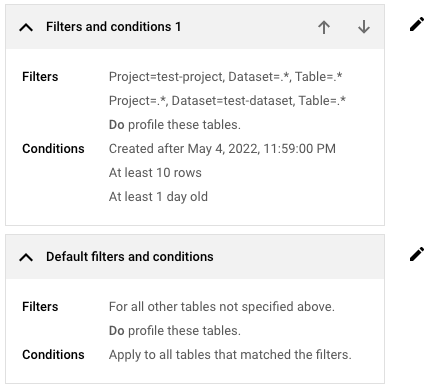
Suppose you have the following configuration:
- **Minimum conditions**
- Minimum row count: 10 rows
- Minimum duration: 24 hours
- **Time condition**
- Timestamp: 5/4/22, 11:59 PM
- **Tables to profile**
The **Only include tables of a specified type or types** option is
selected. In the list of table types, only **Profile BigLake tables**
is selected.
In this case, Sensitive Data Protection excludes any tables created on or before
May 4, 2022, 11:59 PM. Among the tables created after this date and time,
Sensitive Data Protection profiles only the BigLake tables that
either have 10 rows *or* are at least 24 hours old.
5. Click **Done**.
6. If you want to add more filters and conditions, click **Add filters and
conditions** and repeat the previous steps.
The last item in the list of filters and conditions is always the one labeled
**Default filters and conditions**. This default setting is applied to the
tables in your project that don't match any of the filters and conditions
that you created.
[](https://docs.cloud.google.com/static/sensitive-data-protection/docs/images/estimate-graph.png)
7. If you want to adjust the default filters and conditions, click **Edit filters and conditions**, and
adjust the settings as needed.
### Set location to store estimate
1. In the **Resource location** list, select the region where you
want to store this estimate.
Where you choose to store your estimate doesn't affect the
data to be scanned. Also, it doesn't affect where the data profiles are later
stored. Your data is scanned in the same region where that data is stored
(as set in BigQuery). For more information, see
[Data residency considerations](https://docs.cloud.google.com/sensitive-data-protection/docs/data-profiles.md.txt#data-residency).
2. Review your settings and click **Create**.
Sensitive Data Protection creates the estimate and adds it to the estimates
list. Then, it runs the estimation.
Depending on how much data is in the resource, an estimation can take up to
24 hours to complete. In the meantime, you can close the Sensitive Data Protection
page and check back later. A notification appears in the Google Cloud console
when the estimate is ready.
## View an estimate
1. Go to the estimates list.
[Go to estimates](https://console.cloud.google.com/security/sensitive-data-protection/landing/dataProfiles/estimates;source=7)
2. Click the estimate that you want to view. The estimate contains the
following:
- The number of tables in the resource, minus any tables that you excluded through filters and conditions.
- The total amount of data the tables equate to.
- The number of subscription units required to profile this amount of data every month.
- The *cost of initial discovery*, which is the approximate cost of profiling the tables that were found. This estimate is based only on a snapshot of the current data and doesn't consider how much your data grows within a given time period.
- Additional cost estimates for profiling only tables that are less than 6, 12, or 24 months old. These additional estimates are provided to show you how further limiting your data coverage can help you control your data profiling cost.
- The estimated monthly cost of profiling your data, assuming that your BigQuery usage every month is the same as your usage this month.
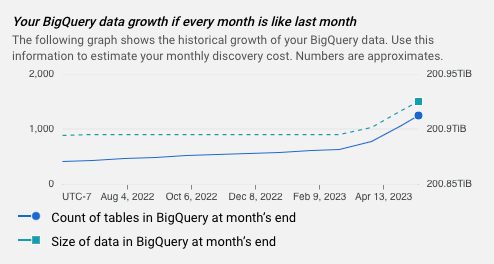
- A graph that shows the growth of your BigQuery over time.
- The configuration details that you set.
## Estimate graph
Each estimate includes a graph that shows the historical growth of your
BigQuery data. You can use this
information to estimate your monthly data profiling cost.
[](https://docs.cloud.google.com/static/sensitive-data-protection/docs/images/estimate-graph.png)
## What's next
- Learn about [data profiling pricing](https://cloud.google.com/sensitive-data-protection/pricing#data_profiling_pricing).
- Learn more about [data profiles for BigQuery
data](https://docs.cloud.google.com/sensitive-data-protection/docs/data-profiles).
- Learn how to [profile data in an organization or folder](https://docs.cloud.google.com/sensitive-data-protection/docs/profile-org-folder.md.txt).
- Learn how to [profile data in a single project](https://docs.cloud.google.com/sensitive-data-protection/docs/profile-project.md.txt).