This page shows you how to manually scale your worker pool.
## Overview
Manual scaling lets you set a specific instance
count
without requiring redeployment.
This gives you the option to write your own
scaling logic using an external system. See [Autoscale worker pools with external metrics](https://docs.cloud.google.com/run/docs/configuring/workerpools/crema-autoscaling.md.txt)
for an example of this.
## Billing considerations when using manual scaling
When you use manual scaling, all the instances that you requested are
billed as *active* instances, even if they happen to be idle.
For complete billing details, see the [pricing page](https://cloud.google.com/run/pricing).
## Required roles
To get the permissions that
you need to deploy Cloud Run worker pools,
ask your administrator to grant you the
following IAM roles:
- [Cloud Run Developer](https://docs.cloud.google.com/iam/docs/roles-permissions/run.md.txt#run.developer) (`roles/run.developer`) on the Cloud Run service
- [Service Account User](https://docs.cloud.google.com/iam/docs/roles-permissions/iam.md.txt#iam.serviceAccountUser) (`roles/iam.serviceAccountUser`) on the service identity
- [Artifact Registry Reader](https://docs.cloud.google.com/iam/docs/roles-permissions/artifactregistry.md.txt#artifactregistry.reader) (`roles/artifactregistry.reader`) on the Artifact Registry repository of the deployed container image (if applicable)
For a list of IAM roles and permissions that are associated with
Cloud Run, see
[Cloud Run IAM roles](https://docs.cloud.google.com/run/docs/reference/iam/roles.md.txt)
and [Cloud Run IAM permissions](https://docs.cloud.google.com/run/docs/reference/iam/permissions.md.txt).
If your Cloud Run worker pool interfaces with
Google Cloud APIs, such as Cloud Client Libraries, see the
[service identity configuration guide](https://docs.cloud.google.com/run/docs/configuring/workerpools/service-identity.md.txt).
For more information about granting roles, see
[deployment permissions](https://docs.cloud.google.com/run/docs/reference/iam/roles.md.txt#additional-configuration)
and [manage access](https://docs.cloud.google.com/iam/docs/granting-changing-revoking-access.md.txt).
## Configure scaling
Changing scaling mode or changing the manual instance count
does not create a new revision.
To configure the scaling mode, use the Google Cloud console, the Google Cloud CLI,
YAML, Terraform, or REST API:
### Console
1. In the Google Cloud console, go to Cloud Run:
[Go to Cloud Run](https://console.cloud.google.com/run/worker-pools)
2. If you are configuring a new worker pool, select **Worker pools** from the menu, and
click **Deploy container** . If you are
configuring an existing worker pool, click the worker pool to display its
detail pane, then click the pen icon next to **Scaling** at the top right
of the detail panel.
3. Locate the **Scaling** form (for a new worker pool) or the
**Edit scaling** form for an existing worker pool.
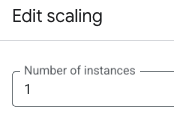
4. In the field labelled **Number of instances**, specify the number of container instances for the service.
5. Finish the specification.
6. Click **Create** for a new worker pool or **Save** for an existing worker pool.
### gcloud
To specify scaling for a new worker pool, use the [deploy](https://docs.cloud.google.com/sdk/gcloud/reference/run/worker-pools/deploy.md.txt)
command:
```bash
gcloud run worker-pools deploy WORKER_POOL \
--instances=INSTANCE_COUNT \
--image IMAGE_URL
```
Replace the following:
- WORKER_POOL: the name of your worker pool.
- INSTANCE_COUNT: the number of instances for the worker pool. This sets the worker pool to manual scaling. Specify a value of `0` to disable the worker pool.
- `IMAGE_URL`: a reference to the container image that contains the worker pool, such as `us-docker.pkg.dev/cloudrun/container/worker-pool:latest`.
Specify scaling for an existing worker pool by using the following
[update](https://docs.cloud.google.com/sdk/gcloud/reference/run/worker-pools/update.md.txt) command:
```bash
gcloud run worker-pools update WORKER_POOL \
--instances=INSTANCE_COUNT
```
### YAML
1. If you are creating a new worker pool, skip this step.
If you are updating an existing worker pool, download its [YAML configuration](https://docs.cloud.google.com/run/docs/reference/yaml/v1.md.txt):
```bash
gcloud run worker-pools describe WORKER_POOL --format export > worker-pool.yaml
```
2. The following example contains the YAML configuration:
```yaml
apiVersion: run.googleapis.com/v1
kind: WorkerPool
metadata:
name: WORKER_POOL
annotations:
run.googleapis.com/manualInstanceCount: `INSTANCE_COUNT`
```
Replace the following:
- WORKER_POOL: the name of your Cloud Run worker pool.
- INSTANCE_COUNT: the number of instances you are manually scaling for the worker pool. Specify a value of `0` to disable the worker pool.
3. Create or update the worker pool using the following command:
```bash
gcloud run worker-pools replace worker-pool.yaml
```
The `gcloud run worker-pools replace` command defaults to using `worker-pool.yaml` file if present.
### Terraform
To learn how to apply or remove a Terraform configuration, see
[Basic Terraform commands](https://docs.cloud.google.com/docs/terraform/basic-commands.md.txt).
```terraform
resource "google_cloud_run_v2_worker_pool" "default" {
name = "WORKER_POOL"
location = "REGION"
template {
containers {
image = "IMAGE_URL"
}
}
scaling {
scaling_mode = "MANUAL"
manual_instance_count = "INSTANCE_COUNT"
}
}
```
Replace the following:
- WORKER_POOL: the name of the worker pool.
- REGION: the Google Cloud region---for example, `europe-west1`.
- `IMAGE_URL`: a reference to the container image that contains the worker pool, such as `us-docker.pkg.dev/cloudrun/container/worker-pool:latest`.
- INSTANCE_COUNT: the number of instances for the worker pool. This sets the worker pool to manual scaling. Specify a value of `0` to disable the worker pool.
### REST API
To update the number of instances for a given worker pool, send a `PATCH`
HTTP request to the Cloud Run Admin API
[`workerPools` endpoint](https://docs.cloud.google.com/run/docs/reference/rest/v2/projects.locations.workerPools/patch.md.txt).
For example, using `curl`:
```bash
curl -H "Content-Type: application/json" \
-H "Authorization: Bearer ACCESS_TOKEN" \
-X PATCH \
-d '{"scaling":{"manualInstanceCount":INSTANCE_COUNT }}' \
https://run.googleapis.com/v2/projects/PROJECT_ID/locations/REGION/workerPools/WORKER_POOL?update_mask=scaling.manualInstanceCount
```
Replace the following:
- ACCESS_TOKEN: a valid access token for an account that has the [IAM permissions to update a worker pool](https://docs.cloud.google.com/run/docs/reference/iam/permissions.md.txt). For example, if you are logged into `gcloud`, you can retrieve an access token using `gcloud auth print-access-token`. From within a Cloud Run container instance, you can retrieve an access token using the [container instance metadata server](https://docs.cloud.google.com/run/docs/container-contract.md.txt#metadata-server).
- INSTANCE_COUNT: the number of instances for the worker pool.
- PROJECT_ID: the Google Cloud project ID.
- REGION: the Google Cloud region that the worker pool is deployed in.
- WORKER_POOL: the name of the worker pool.
## View scaling configuration for a worker pool
1. In the Google Cloud console, go to Cloud Run:
[Go to Cloud Run](https://console.cloud.google.com/run/worker-pools)
2. Click **Worker pools** to display the list of deployed worker pools.
3. Click the worker pool you want to examine to display its details pane.
4. The current scaling setting is shown above the worker pools revision list:
**Scaling: Manual (Instances: )**.
> [!NOTE]
> **Note:** You can also use the Google Cloud CLI command [`gcloud run worker-pools describe`](https://docs.cloud.google.com/sdk/gcloud/reference/run/worker-pools/describe.md.txt) to view configuration details.
## Disable a worker pool
To disable a worker pool, use the following command to set scaling to zero:
```bash
gcloud run worker-pools update WORKER_POOL --instances=0
```
Replace WORKER_POOL with the name of your worker pool.