This page explains how to view, understand, and apply role recommendations for
projects, folders, and organizations. Role recommendations help you enforce the
principle of least privilege by ensuring that principals have only the
permissions that they actually need.
## Before you begin
-
Enable the IAM and Recommender APIs, if any are not already enabled.
**Roles required to enable APIs**
To enable APIs, you need the `serviceusage.services.enable` permission. If you
created the project, then you likely already have this permission through the
Owner role (`roles/owner`). Otherwise, you can get this permission through the
Service Usage Admin role (`roles/serviceusage.serviceUsageAdmin`).
[Learn how to grant roles](https://docs.cloud.google.com/iam/docs/granting-changing-revoking-access.md.txt).
[Enable the APIs](https://console.cloud.google.com/apis/enableflow?apiid=iam.googleapis.com,recommender.googleapis.com&redirect=https://console.cloud.google.com)
- Understand [role recommendations](https://docs.cloud.google.com/policy-intelligence/docs/role-recommendations-overview.md.txt).
- Review the
[Best practices for role recommendations](https://docs.cloud.google.com/policy-intelligence/docs/role-recommendations-best-practices.md.txt).
- Optional: If you want to view and manage role recommendations for non-basic
and custom roles, ensure that you have an organization-level or project-level
activation of [the Premium or Enterprise tier of Security Command Center](https://docs.cloud.google.com/security-command-center/pricing#security-command-center-pricing).
For more information, see [Billing questions](https://docs.cloud.google.com/policy-intelligence/docs/billing-questions.md.txt).
- Set up authentication.
Select the tab for how you plan to use the samples on this page:
### gcloud
In the Google Cloud console, activate Cloud Shell.
[Activate Cloud Shell](https://console.cloud.google.com/?cloudshell=true)
At the bottom of the Google Cloud console, a
[Cloud Shell](https://docs.cloud.google.com/shell/docs/how-cloud-shell-works.md.txt)
session starts and displays a command-line prompt. Cloud Shell is a shell environment
with the Google Cloud CLI
already installed and with values already set for
your current project. It can take a few seconds for the session to initialize.
### REST
To use the REST API samples on this page in a local development environment, you use the
credentials you provide to the gcloud CLI.
1. [Install](https://docs.cloud.google.com/sdk/docs/install) the Google Cloud CLI.
2. If you're using an external identity provider (IdP), you must first [sign in to the gcloud CLI with your federated identity](https://docs.cloud.google.com/iam/docs/workforce-log-in-gcloud.md.txt).
For more information, see
[Authenticate for using REST](https://docs.cloud.google.com/docs/authentication/rest.md.txt)
in the Google Cloud authentication documentation.
## Required IAM roles
This section describes the IAM roles and permissions that you
need in order to work with role recommendations.
### View recommendations
To get the permissions that
you need to view role recommendations,
ask your administrator to grant you the
following IAM roles on the resource that you want to view recommendations for
(project, folder, or organization):
- [Role Viewer](https://docs.cloud.google.com/iam/docs/roles-permissions/iam.md.txt#iam.roleViewer) (`roles/iam.roleViewer`)
- [IAM Recommender Viewer](https://docs.cloud.google.com/iam/docs/roles-permissions/recommender.md.txt#recommender.iamViewer) (`roles/recommender.iamViewer`)
- To view project-level recommendations in the Google Cloud console: [Project IAM Admin](https://docs.cloud.google.com/iam/docs/roles-permissions/resourcemanager.md.txt#resourcemanager.projectIamAdmin) (`roles/resourcemanager.projectIamAdmin`)
- To view folder-level recommendations in the Google Cloud console: [Folder IAM Admin](https://docs.cloud.google.com/iam/docs/roles-permissions/resourcemanager.md.txt#resourcemanager.folderIamAdmin) (`roles/resourcemanager.folderIamAdmin`)
- To view organization-level recommendations in the Google Cloud console: [Organization Admin](https://docs.cloud.google.com/iam/docs/roles-permissions/resourcemanager.md.txt#resourcemanager.organizationAdmin) (`roles/resourcemanager.organizationAdmin`)
For more information about granting roles, see [Manage access to projects, folders, and organizations](https://docs.cloud.google.com/iam/docs/granting-changing-revoking-access.md.txt).
These predefined roles contain
the permissions required to view role recommendations. To see the exact permissions that are
required, expand the **Required permissions** section:
#### Required permissions
The following permissions are required to view role recommendations:
- `iam.roles.get`
- `iam.roles.list`
- `recommender.iamPolicyRecommendations.get`
- `recommender.iamPolicyRecommendations.list`
- `recommender.iamPolicyInsights.get`
- `recommender.iamPolicyInsights.list`
- `recommender.iamPolicyLateralMovementInsights.get`
- `recommender.iamPolicyLateralMovementInsights.list`
- To view recommendations in the Google Cloud console: `resourcemanager.RESOURCE.getIamPolicy`, where `RESOURCE` is the resource type that you want to view recommendations for (`projects`, `folders`, or `organizations`)
You might also be able to get
these permissions
with [custom roles](https://docs.cloud.google.com/iam/docs/creating-custom-roles.md.txt) or
other [predefined roles](https://docs.cloud.google.com/iam/docs/roles-overview.md.txt#predefined).
### Apply and dismiss recommendations
To get the permissions that
you need to view, apply, and dismiss role recommendations,
ask your administrator to grant you the
following IAM roles on the resource that you want to manage recommendations for
(project, folder, or organization):
- [Role Viewer](https://docs.cloud.google.com/iam/docs/roles-permissions/iam.md.txt#iam.roleViewer) (`roles/iam.roleViewer`)
- [IAM Recommender Admin](https://docs.cloud.google.com/iam/docs/roles-permissions/recommender.md.txt#recommender.iamAdmin) (`roles/recommender.iamAdmin`)
- To manage project-level recommendations: [Project IAM Admin](https://docs.cloud.google.com/iam/docs/roles-permissions/resourcemanager.md.txt#resourcemanager.projectIamAdmin) (`roles/resourcemanager.projectIamAdmin`)
- To manage folder-level recommendations: [Folder IAM Admin](https://docs.cloud.google.com/iam/docs/roles-permissions/resourcemanager.md.txt#resourcemanager.folderIamAdmin) (`roles/resourcemanager.folderIamAdmin`)
- To manage organization-level recommendations: [Organization Admin](https://docs.cloud.google.com/iam/docs/roles-permissions/resourcemanager.md.txt#resourcemanager.organizationAdmin) (`roles/resourcemanager.organizationAdmin`)
For more information about granting roles, see [Manage access to projects, folders, and organizations](https://docs.cloud.google.com/iam/docs/granting-changing-revoking-access.md.txt).
These predefined roles contain
the permissions required to view, apply, and dismiss role recommendations. To see the exact permissions that are
required, expand the **Required permissions** section:
#### Required permissions
The following permissions are required to view, apply, and dismiss role recommendations:
- `iam.roles.get`
- `iam.roles.list`
- `recommender.iamPolicyRecommendations.get`
- `recommender.iamPolicyRecommendations.list`
- `recommender.iamPolicyInsights.get`
- `recommender.iamPolicyInsights.list`
- `recommender.iamPolicyLateralMovementInsights.get`
- `recommender.iamPolicyLateralMovementInsights.list`
- `recommender.iamPolicyRecommendations.update`
- `resourcemanager.RESOURCE.getIamPolicy`, where `RESOURCE` is the resource type that you want to manage recommendations for (`projects`, `folders`, or `organizations`)
- `resourcemanager.RESOURCE.setIamPolicy`, where `RESOURCE` is the resource type that you want to manage recommendations for (`projects`, `folders`, or `organizations`)
You might also be able to get
these permissions
with [custom roles](https://docs.cloud.google.com/iam/docs/creating-custom-roles.md.txt) or
other [predefined roles](https://docs.cloud.google.com/iam/docs/roles-overview.md.txt#predefined).
> [!NOTE]
> **Note:** Some project-level recommendations suggest [creating a new custom
> role](https://docs.cloud.google.com/policy-intelligence/docs/role-recommendations-overview#custom-roles) as part of the recommendation. To create a custom role, you need the `iam.roles.create` permission on the project. To gain this permission while following the principle of least privilege, ask your administrator to grant you the Role Administrator role (`roles/iam.roleAdmin`) instead of the Role Viewer role (`roles/iam.roleViewer`).
## Review and apply recommendations
The easiest way to review and apply your recommendations is to use the
Google Cloud console. Additionally, if you want to automatically create a custom
role when you apply a recommendation, you must use the Google Cloud console.
You can also review and apply recommendations with the Google Cloud CLI and the
Recommender API.
> [!NOTE]
> **Note:** The IAM recommender does not take other forms of access controls into account when making recommendations. If you use access controls that are separate from IAM, such as Cloud Storage [access control lists (ACLs)](https://docs.cloud.google.com/storage/docs/access-control/lists.md.txt) or Kubernetes [role-based access control (RBAC)](https://docs.cloud.google.com/kubernetes-engine/docs/how-to/role-based-access-control.md.txt), ensure that each recommendation will not disrupt those access controls before you apply the recommendation.
### Console
1. In the Google Cloud console, go to the **IAM** page.
[Go to IAM](https://console.cloud.google.com/projectselector/iam-admin/iam?supportedpurview=project,folder,organizationId)
2. Select a project, folder, or organization.
3. In the list of principals that have access to your project, find the **Security insights**
column.
> [!NOTE]
> **Note:** The Google Cloud console does not automatically display role grants for service agents. To view these role grants and their associated recommendations, select **Include Google-provided role grants**.
For each role granted to a principal, this column shows any security-related
[insights](https://docs.cloud.google.com/recommender/docs/insights/using-insights.md.txt). These insights highlight patterns in how
your principals access resources. For example, some insights highlight
*excess permissions* , or permissions that a principal does not need. Other
insights highlight service accounts with [lateral movement
capabilities](https://docs.cloud.google.com/policy-intelligence/docs/role-recommendations-overview#lateral-movement-insights):
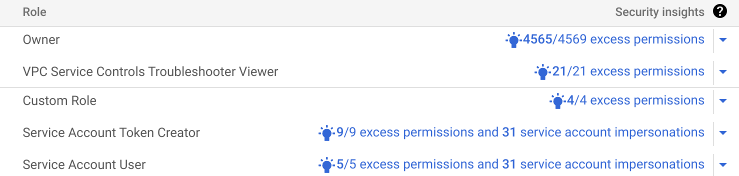
If there is a recommendation available to address an insight, the
Google Cloud console displays the **Recommendation available**
 icon.
> [!NOTE]
> **Note:** Recommender does not analyze permissions for all roles. To learn which roles Recommender analyzes, see [Availability of IAM policy recommendations](https://docs.cloud.google.com/policy-intelligence/docs/role-recommendations-overview.md.txt#availability).
4. If there are recommendations to review, click a **Recommendation available**
 icon to
get details about the recommendation.
If the recommendation is to replace the role, the role recommendation
always suggests a set of [predefined roles](https://docs.cloud.google.com/iam/docs/understanding-roles) that you
can apply.
In some cases, the role recommendation also suggests creating a new
[custom role](https://docs.cloud.google.com/iam/docs/understanding-custom-roles) at the project level. If a custom
role recommendation is available, the Google Cloud console shows it by
default. To switch to the predefined role recommendation, click **View
recommended predefined role**.
Only for group principals with excessive permissions, you have an option to
replace permanent access with temporary, on-demand access
([Preview](https://cloud.google.com/products#product-launch-stages)) using
Privileged Access Manager.
If members of a group don't need permanent access to a role's permissions,
but might need them for unanticipated reasons in the future, you can remove
their permanent access and use Privileged Access Manager to allow them to request
temporary access when they need it.
To learn how to remediate excessive permissions with Privileged Access Manager, see
[Remediate excessive permissions with Privileged Access Manager](https://docs.cloud.google.com/iam/docs/pam-remediate-iam-recommendations.md.txt).
5. Review the recommendation carefully and make sure you understand when it was
last refreshed and how it will change the principal's access to
Google Cloud resources. Except in the case of
[recommendations for service agents](https://docs.cloud.google.com/policy-intelligence/docs/role-recommendations-overview.md.txt#service-agents), a recommendation
will never increase a principal's level of access. For more information, see
[How role recommendations are generated](https://docs.cloud.google.com/policy-intelligence/docs/role-recommendations-overview.md.txt#how-recommender-works).
To learn how to review recommendations in the console, see [Review
recommendations](https://docs.cloud.google.com/policy-intelligence/docs/review-apply-role-recommendations#review) on this page.
6. Optional: If the recommendation is to create a custom role, update the
**Title** , **Description** , **ID** , and **Role launch stage** as needed.
If you need to add permissions to the custom role, click **Add
permissions**.
If you need to remove permissions from the custom role, clear the checkbox
for each permission that you want to remove.
7. Take action on the recommendation.
To apply the recommendation, click **Apply** or **Create and apply** . If you
change your mind in the next 90 days, use the
[recommendations history](https://docs.cloud.google.com/policy-intelligence/docs/review-apply-role-recommendations.md.txt#history) to revert your choice.
To dismiss the recommendation, click **Dismiss** , then confirm your choice.
You can [restore a dismissed recommendation](https://docs.cloud.google.com/policy-intelligence/docs/review-apply-role-recommendations.md.txt#history) as long as the
recommendation is still valid.
> [!NOTE]
> **Note:** You can also quickly apply and dismiss recommendations by clicking the expander arrow next to an insight with a recommendation, then clicking **Apply recommendation** or **Dismiss recommendation**. You cannot apply recommendations to create custom roles in this way.
8. Repeat the previous steps until you have reviewed all of your
recommendations.
### gcloud
**Review your recommendations:**
To list your recommendations, run the
[`gcloud recommender recommendations list`](https://docs.cloud.google.com/sdk/gcloud/reference/recommender/recommendations/list)
command:
```bash
gcloud recommender recommendations list \
--location=global \
--recommender=google.iam.policy.Recommender \
--RESOURCE_TYPE=RESOURCE_ID \
--format=json
```
Replace the following values:
- `RESOURCE_TYPE`: The resource type that you want to list recommendations for. Use the value `project`, `folder`, or `organization`.
- `RESOURCE_ID`: The ID of the Google Cloud project, folder, or organization that you want to list recommendations for. Project IDs are alphanumeric strings, like `my-project`. Folder and organization IDs are numeric, like `123456789012`.
The response is similar to the following example. In this example, a service
account has not used any permissions from the Compute Admin role
(`roles/compute.admin`) in the past 90 days. As a result,
the role recommendation suggests that you revoke the role:
```json
[
{
"associatedInsights": [
{
"insight": "projects/123456789012/locations/global/insightTypes/google.iam.policy.Insight/insights/279ef748-408f-44db-9a4a-1ff8865b9839"
}
],
"content": {
"operationGroups": [
{
"operations": [
{
"action": "remove",
"path": "/iamPolicy/bindings/*/members/*",
"pathFilter": {
"/iamPolicy/bindings/*/condition/expression": "",
"/iamPolicy/bindings/*/members/*": "serviceAccount:id-1234567890@example-project.iam.gserviceaccount.com",
"/iamPolicy/bindings/\*/role": "roles/compute.admin"
},
"resource": "//cloudresourcemanager.googleapis.com/projects/example-project",
"resourceType": "cloudresourcemanager.googleapis.com/Project"
}
]
}
]
},
"description": "This role has not been used during the observation window.",
"recommenderSubtype": "REMOVE_ROLE",
"etag": "\\"770237e2c0decf40\\"",
"lastRefreshTime": "2020-01-09T06:06:17Z",
"name": "projects/123456789012/locations/global/recommenders/google.iam.policy.Recommender/recommendations/fb927dc1-9695-4436-0000-f0f285007c0f",
"primaryImpact": {
"category": "SECURITY",
"securityProjection": {
"details": {
"revokedIamPermissionsCount": 708
}
}
},
"priority": "P4",
"stateInfo": {
"state": "ACTIVE"
}
}
]
```
Review each recommendation carefully and consider when it was last refreshed
and how it will change the principal's access to Google Cloud resources.
To learn how to review recommendations from the gcloud CLI, see
[Review recommendations](https://docs.cloud.google.com/policy-intelligence/docs/review-apply-role-recommendations.md.txt#review) on this page.
**To apply a recommendation:**
1. Use the
[`gcloud recommender recommendations mark-claimed` command](https://docs.cloud.google.com/sdk/gcloud/reference/recommender/recommendations/mark-claimed)
to change the recommendation's state to `CLAIMED,` which prevents the
recommendation from changing while you apply it:
```bash
gcloud recommender recommendations mark-claimed \
RECOMMENDATION_ID \
--location=global \
--recommender=google.iam.policy.Recommender \
--RESOURCE_TYPE=RESOURCE_ID \
--format=FORMAT \
--etag=ETAG \
--state-metadata=STATE_METADATA
```
Replace the following values:
- `RECOMMENDATION_ID`: The unique identifier for the recommendation. This value appears at the end of the `name` field in the recommendation. In the example shown above, the ID is `fb927dc1-9695-4436-0000-f0f285007c0f`.
- `RESOURCE_TYPE`: The resource type that you want to manage recommendations for. Use the value `project`, `folder`, or `organization`.
- `RESOURCE_ID`: The ID of the Google Cloud project, folder, or organization that you want to manage recommendations for. Project IDs are alphanumeric strings, like `my-project`. Folder and organization IDs are numeric, like `123456789012`.
- `FORMAT`: The format of the response. Use `json` or `yaml`.
- `ETAG`: The value of the `etag` field in the recommendation, such as `"dd0686e7136a4cbb"`. Note that this value can include quotes.
- `STATE_METADATA`: Optional. Comma-separated key-value pairs that contain your choice of metadata about the recommendation. For example, `--state-metadata=reviewedBy=alice,priority=high`. The metadata replaces the `stateInfo.stateMetadata` field in the recommendation.
If the command succeeds, the response shows the recommendation in a
`CLAIMED` state, as shown in the following example. For clarity, the example
omits most fields:
```json
[
{
"description": "This role has not been used during the observation window.",
"recommenderSubtype": "REMOVE_ROLE",
"etag": "\"df7308cca9719dcc\"",
"name": "projects/123456789012/locations/global/recommenders/google.iam.policy.Recommender/recommendations/fb927dc1-9695-4436-0000-f0f285007c0f",
"stateInfo": {
"state": "CLAIMED",
"stateMetadata": {
"reviewedBy": "alice",
"priority": "high"
}
}
}
]
```
2. [Get the allow policy](https://docs.cloud.google.com/iam/docs/granting-changing-revoking-access.md.txt#getting-policy) for the project, then
[modify and set the allow policy](https://docs.cloud.google.com/iam/docs/granting-changing-revoking-access.md.txt#modifying-policy) so that it reflects the
recommendation.
3. Update the recommendation's state to `SUCCEEDED`, if you were able to apply
the recommendation, or `FAILED`, if you could not apply the recommendation:
```bash
gcloud recommender recommendations COMMAND \
RECOMMENDATION_ID \
--location=global \
--recommender=google.iam.policy.Recommender \
--RESOURCE_TYPE=RESOURCE_ID \
--format=FORMAT \
--etag=ETAG \
--state-metadata=STATE_METADATA
```
Replace the following values:
- `COMMAND`: Use `mark-succeeded`, if you were able to apply the recommendation, or `mark-failed`, if you could not apply the recommendation.
- `RECOMMENDATION_ID`: The unique identifier for the recommendation. This value appears at the end of the `name` field in the recommendation. In the example shown above, the ID is `fb927dc1-9695-4436-0000-f0f285007c0f`.
- `RESOURCE_TYPE`: The resource type that you want to manage recommendations for. Use the value `project`, `folder`, or `organization`.
- `RESOURCE_ID`: The ID of the Google Cloud project, folder, or organization that you want to manage recommendations for. Project IDs are alphanumeric strings, like `my-project`. Folder and organization IDs are numeric, like `123456789012`.
- `FORMAT`: The format of the response. Use `json` or `yaml`.
- `ETAG`: The value of the `etag` field in the recommendation, such as `"dd0686e7136a4cbb"`. Note that this value can include quotes.
- `STATE_METADATA`: Optional. Comma-separated key-value pairs that contain your choice of metadata about the recommendation. For example, `--state-metadata=reviewedBy=alice,priority=high`. The metadata replaces the `stateInfo.stateMetadata` field in the recommendation.
For example, if you marked the recommendation as having succeeded, the
response shows the recommendation in a `SUCCEEDED` state. For clarity, this
example omits most fields:
```json
[
{
"description": "This role has not been used during the observation window.",
"recommenderSubtype": "REMOVE_ROLE",
"etag": "\"dd0686e7136a4cbb\"",
"name": "projects/123456789012/locations/global/recommenders/google.iam.policy.Recommender/recommendations/fb927dc1-9695-4436-0000-f0f285007c0f",
"stateInfo": {
"state": "SUCCEEDED",
"stateMetadata": {
"reviewedBy": "alice",
"priority": "high"
}
}
}
]
```
### REST
**Review your recommendations:**
To list all available recommendations for your project, folder, or organization, use the Recommender API's
`recommendations.list`
method.
Before using any of the request data,
make the following replacements:
- `RESOURCE_TYPE`: The type of the resource that you want to manage recommendations for. Use the value `projects`, `folders`, or `organizations`.
- `RESOURCE_ID`: The ID of the Google Cloud project, folder, or organization that you want to manage recommendations for. Project IDs are alphanumeric strings, like `my-project`. Folder and organization IDs are numeric, like `123456789012`.
- `PAGE_SIZE`: Optional. The maximum number of results to return from this request. If not specified, the server will determine the number of results to return. If the number of recommendations is greater than the page size, the response contains a pagination token that you can use to retrieve the next page of results.
- `PAGE_TOKEN`: Optional. The pagination token returned in an earlier response from this method. If specified, the list of recommendations will start where the previous request ended.
- `FILTER`: Optional. A filter expression to restrict the recommendations returned. You can filter recommendations based on the `stateInfo.state` field. For example, `stateInfo.state:"DISMISSED"` or `stateInfo.state:"FAILED"`.
- `PROJECT_ID`: Your Google Cloud project ID. Project IDs are alphanumeric strings, like `my-project`.
HTTP method and URL:
```
GET https://recommender.googleapis.com/v1/RESOURCE_TYPE/RESOURCE_ID/locations/global/recommenders/google.iam.policy.Recommender/recommendations?pageSize=PAGE_SIZE&pageToken=PAGE_TOKEN&filter=FILTER
```
To send your request, expand one of these options:
#### curl (Linux, macOS, or Cloud Shell)
> [!NOTE]
> **Note:** The following command assumes that you have logged in to the `gcloud` CLI with your user account by running [`gcloud init`](https://docs.cloud.google.com/sdk/gcloud/reference/init) or [`gcloud auth login`](https://docs.cloud.google.com/sdk/gcloud/reference/auth/login.md.txt) , or by using [Cloud Shell](https://docs.cloud.google.com/shell/docs.md.txt), which automatically logs you into the `gcloud` CLI . You can check the currently active account by running [`gcloud auth list`](https://docs.cloud.google.com/sdk/gcloud/reference/auth/list.md.txt).
Execute the following command:
```
curl -X GET \
-H "Authorization: Bearer $(gcloud auth print-access-token)" \
-H "x-goog-user-project: PROJECT_ID" \
"https://recommender.googleapis.com/v1/RESOURCE_TYPE/RESOURCE_ID/locations/global/recommenders/google.iam.policy.Recommender/recommendations?pageSize=PAGE_SIZE&pageToken=PAGE_TOKEN&filter=FILTER"
```
#### PowerShell (Windows)
> [!NOTE]
> **Note:** The following command assumes that you have logged in to the `gcloud` CLI with your user account by running [`gcloud init`](https://docs.cloud.google.com/sdk/gcloud/reference/init) or [`gcloud auth login`](https://docs.cloud.google.com/sdk/gcloud/reference/auth/login.md.txt) . You can check the currently active account by running [`gcloud auth list`](https://docs.cloud.google.com/sdk/gcloud/reference/auth/list.md.txt).
Execute the following command:
```
$cred = gcloud auth print-access-token
$headers = @{ "Authorization" = "Bearer $cred"; "x-goog-user-project" = "PROJECT_ID" }
Invoke-WebRequest `
-Method GET `
-Headers $headers `
-Uri "https://recommender.googleapis.com/v1/RESOURCE_TYPE/RESOURCE_ID/locations/global/recommenders/google.iam.policy.Recommender/recommendations?pageSize=PAGE_SIZE&pageToken=PAGE_TOKEN&filter=FILTER" | Select-Object -Expand Content
```
The response is similar to the following example. In this example, a service account in the
project `example-project` has not used any permissions from the Compute Admin role
(`roles/compute.admin`) in the past 90 days. As a result,
Recommender suggests that you revoke the role:
```
{
"recommendations": [
"name": "projects/123456789012/locations/global/recommenders/google.iam.policy.Recommender/recommendations/fb927dc1-9695-4436-0000-f0f285007c0f",
"description": "This role has not been used during the observation window.",
"lastRefreshTime": "2020-01-09T06:06:17Z",
"primaryImpact": {
"category": "SECURITY",
"securityProjection": {
"details": {
"revokedIamPermissionsCount": 708
}
}
},
"priority": "P4",
"content": {
"operationGroups": [
{
"operations": [
{
"action": "remove",
"path": "/iamPolicy/bindings/*/members/*",
"pathFilter": {
"/iamPolicy/bindings/*/condition/expression": "",
"/iamPolicy/bindings/*/members/*": "serviceAccount:id-1234567890@example-project.iam.gserviceaccount.com",
"/iamPolicy/bindings/*/role": "roles/compute.admin"
},
"resource": "//cloudresourcemanager.googleapis.com/projects/example-project",
"resourceType": "cloudresourcemanager.googleapis.com/Project"
}
]
}
]
},
"stateInfo": {
"state": "ACTIVE"
}
"etag": "\"770237e2c0decf40\"",
"recommenderSubtype": "REMOVE_ROLE",
"associatedInsights": [
{
"insight": "projects/123456789012/locations/global/insightTypes/google.iam.policy.Insight/insights/279ef748-408f-44db-9a4a-1ff8865b9839"
}
]
}
```
Review each recommendation carefully and consider when it was last refreshed
and how it will change the principal's access to Google Cloud resources.
To learn how to review recommendations from the REST API, see [Review
recommendations](https://docs.cloud.google.com/policy-intelligence/docs/review-apply-role-recommendations#review) on this page.
**To apply a recommendation:**
1. Mark the recommendation as `CLAIMED`:
To mark a recommendation as `CLAIMED`, which prevents the recommendation from changing while you apply it, use the Recommender API's
`recommendations.markClaimed`
method.
Before using any of the request data,
make the following replacements:
- `RESOURCE_TYPE`: The type of the resource that you want to manage recommendations for. Use the value `projects`, `folders`, or `organizations`.
- `RESOURCE_ID`: The ID of the Google Cloud project, folder, or organization that you want to manage recommendations for. Project IDs are alphanumeric strings, like `my-project`. Folder and organization IDs are numeric, like `123456789012`.
- `RECOMMENDATION_ID`: The unique identifier for the recommendation. This value appears at the end of the `name` field in the recommendation. For example, if the `name` field is `projects/example-project/locations/global/recommenders/google.iam.policy.Recommender/recommendations/fb927dc1-9695-4436-0000-f0f285007c0f`, the recommendation ID is `fb927dc1-9695-4436-0000-f0f285007c0f`.
- `ETAG`: The value of the `etag` field in the recommendation, such as `"dd0686e7136a4cbb"`. Use backslashes to escape quotes, for example, `"\"df7308cca9719dcc\""`.
- `STATE_METADATA`: Optional. An object that contains key-value pairs with your choice of metadata about the recommendation. For example, `{"reviewedBy": "alice", "priority": "high"}`. The metadata replaces the `stateInfo.stateMetadata` field in the recommendation.
- `PROJECT_ID`: Your Google Cloud project ID. Project IDs are alphanumeric strings, like `my-project`.
HTTP method and URL:
```
POST https://recommender.googleapis.com/v1/RESOURCE_TYPE/RESOURCE_ID/locations/global/recommenders/google.iam.policy.Recommender/recommendations/RECOMMENDATION_ID:markClaimed
```
Request JSON body:
```
{
"etag": "ETAG",
"stateMetadata": {
"STATE_METADATA"
}
}
```
To send your request, expand one of these options:
#### curl (Linux, macOS, or Cloud Shell)
> [!NOTE]
> **Note:** The following command assumes that you have logged in to the `gcloud` CLI with your user account by running [`gcloud init`](https://docs.cloud.google.com/sdk/gcloud/reference/init) or [`gcloud auth login`](https://docs.cloud.google.com/sdk/gcloud/reference/auth/login.md.txt) , or by using [Cloud Shell](https://docs.cloud.google.com/shell/docs.md.txt), which automatically logs you into the `gcloud` CLI . You can check the currently active account by running [`gcloud auth list`](https://docs.cloud.google.com/sdk/gcloud/reference/auth/list.md.txt).
Save the request body in a file named `request.json`,
and execute the following command:
```
curl -X POST \
-H "Authorization: Bearer $(gcloud auth print-access-token)" \
-H "x-goog-user-project: PROJECT_ID" \
-H "Content-Type: application/json; charset=utf-8" \
-d @request.json \
"https://recommender.googleapis.com/v1/RESOURCE_TYPE/RESOURCE_ID/locations/global/recommenders/google.iam.policy.Recommender/recommendations/RECOMMENDATION_ID:markClaimed"
```
#### PowerShell (Windows)
> [!NOTE]
> **Note:** The following command assumes that you have logged in to the `gcloud` CLI with your user account by running [`gcloud init`](https://docs.cloud.google.com/sdk/gcloud/reference/init) or [`gcloud auth login`](https://docs.cloud.google.com/sdk/gcloud/reference/auth/login.md.txt) . You can check the currently active account by running [`gcloud auth list`](https://docs.cloud.google.com/sdk/gcloud/reference/auth/list.md.txt).
Save the request body in a file named `request.json`,
and execute the following command:
```
$cred = gcloud auth print-access-token
$headers = @{ "Authorization" = "Bearer $cred"; "x-goog-user-project" = "PROJECT_ID" }
Invoke-WebRequest `
-Method POST `
-Headers $headers `
-ContentType: "application/json; charset=utf-8" `
-InFile request.json `
-Uri "https://recommender.googleapis.com/v1/RESOURCE_TYPE/RESOURCE_ID/locations/global/recommenders/google.iam.policy.Recommender/recommendations/RECOMMENDATION_ID:markClaimed" | Select-Object -Expand Content
```
The response shows the recommendation in a `CLAIMED` state, as shown in the following
example.
For clarity, this example omits most fields:
```
{
"description": "This role has not been used during the observation window.",
"stateInfo": {
"state": "CLAIMED",
"stateMetadata": {
"reviewedBy": "alice",
"priority": "high"
}
},
"etag": "\"dd0686e7136a4cbb\"",
"recommenderSubtype": "REMOVE_ROLE"
}
```
2. [Get the allow policy](https://docs.cloud.google.com/iam/docs/granting-changing-revoking-access.md.txt#getting-policy) for the project, then
[modify the allow policy](https://docs.cloud.google.com/iam/docs/granting-changing-revoking-access.md.txt#modifying-policy) so that it reflects the
recommendation.
3. Update the recommendation's state to `SUCCEEDED`, if you were able to apply
the recommendation, or `FAILED`, if you could not apply the recommendation:
### `SUCCEEDED`
To mark a recommendation as `SUCCEEDED`, indicating that you were able to apply it, use the Recommender API's
`recommendations.markSucceeded`
method.
Before using any of the request data,
make the following replacements:
- `RESOURCE_TYPE`: The type of the resource that you want to manage recommendations for. Use the value `projects`, `folders`, or `organizations`.
- `RESOURCE_ID`: The ID of the Google Cloud project, folder, or organization that you want to manage recommendations for. Project IDs are alphanumeric strings, like `my-project`. Folder and organization IDs are numeric, like `123456789012`.
- `RECOMMENDATION_ID`: The unique identifier for the recommendation. This value appears at the end of the `name` field in the recommendation. For example, if the `name` field is `projects/example-project/locations/global/recommenders/google.iam.policy.Recommender/recommendations/fb927dc1-9695-4436-0000-f0f285007c0f`, the recommendation ID is `fb927dc1-9695-4436-0000-f0f285007c0f`.
- `ETAG`: The value of the `etag` field in the recommendation, such as `"dd0686e7136a4cbb"`. Use backslashes to escape quotes, for example, `"\"df7308cca9719dcc\""`.
- `STATE_METADATA`: Optional. An object that contains key-value pairs with your choice of metadata about the recommendation. For example, `{"reviewedBy": "alice", "priority": "high"}`. The metadata replaces the `stateInfo.stateMetadata` field in the recommendation.
- `PROJECT_ID`: Your Google Cloud project ID. Project IDs are alphanumeric strings, like `my-project`.
HTTP method and URL:
```
POST https://recommender.googleapis.com/v1/RESOURCE_TYPE/RESOURCE_ID/locations/global/recommenders/google.iam.policy.Recommender/recommendations/RECOMMENDATION_ID:markSucceeded
```
Request JSON body:
```
{
"etag": "ETAG",
"stateMetadata": {
"STATE_METADATA"
}
}
```
To send your request, expand one of these options:
#### curl (Linux, macOS, or Cloud Shell)
> [!NOTE]
> **Note:** The following command assumes that you have logged in to the `gcloud` CLI with your user account by running [`gcloud init`](https://docs.cloud.google.com/sdk/gcloud/reference/init) or [`gcloud auth login`](https://docs.cloud.google.com/sdk/gcloud/reference/auth/login.md.txt) , or by using [Cloud Shell](https://docs.cloud.google.com/shell/docs.md.txt), which automatically logs you into the `gcloud` CLI . You can check the currently active account by running [`gcloud auth list`](https://docs.cloud.google.com/sdk/gcloud/reference/auth/list.md.txt).
Save the request body in a file named `request.json`,
and execute the following command:
```
curl -X POST \
-H "Authorization: Bearer $(gcloud auth print-access-token)" \
-H "x-goog-user-project: PROJECT_ID" \
-H "Content-Type: application/json; charset=utf-8" \
-d @request.json \
"https://recommender.googleapis.com/v1/RESOURCE_TYPE/RESOURCE_ID/locations/global/recommenders/google.iam.policy.Recommender/recommendations/RECOMMENDATION_ID:markSucceeded"
```
#### PowerShell (Windows)
> [!NOTE]
> **Note:** The following command assumes that you have logged in to the `gcloud` CLI with your user account by running [`gcloud init`](https://docs.cloud.google.com/sdk/gcloud/reference/init) or [`gcloud auth login`](https://docs.cloud.google.com/sdk/gcloud/reference/auth/login.md.txt) . You can check the currently active account by running [`gcloud auth list`](https://docs.cloud.google.com/sdk/gcloud/reference/auth/list.md.txt).
Save the request body in a file named `request.json`,
and execute the following command:
```
$cred = gcloud auth print-access-token
$headers = @{ "Authorization" = "Bearer $cred"; "x-goog-user-project" = "PROJECT_ID" }
Invoke-WebRequest `
-Method POST `
-Headers $headers `
-ContentType: "application/json; charset=utf-8" `
-InFile request.json `
-Uri "https://recommender.googleapis.com/v1/RESOURCE_TYPE/RESOURCE_ID/locations/global/recommenders/google.iam.policy.Recommender/recommendations/RECOMMENDATION_ID:markSucceeded" | Select-Object -Expand Content
```
The response shows the recommendation in a `SUCCEEDED` state, as shown in the following
example.
For clarity, this example omits most fields:
```
{
"description": "This role has not been used during the observation window.",
"stateInfo": {
"state": "SUCCEEDED",
"stateMetadata": {
"reviewedBy": "alice",
"priority": "high"
}
},
"etag": "\"dd0686e7136a4cbb\"",
"recommenderSubtype": "REMOVE_ROLE"
}
```
### `FAILED`
To mark a recommendation as `FAILED`, indicating that you were not able to apply it, use the Recommender API's
`recommendations.markFailed`
method.
Before using any of the request data,
make the following replacements:
- `RESOURCE_TYPE`: The type of the resource that you want to manage recommendations for. Use the value `projects`, `folders`, or `organizations`.
- `RESOURCE_ID`: The ID of the Google Cloud project, folder, or organization that you want to manage recommendations for. Project IDs are alphanumeric strings, like `my-project`. Folder and organization IDs are numeric, like `123456789012`.
- `RECOMMENDATION_ID`: The unique identifier for the recommendation. This value appears at the end of the `name` field in the recommendation. For example, if the `name` field is `projects/example-project/locations/global/recommenders/google.iam.policy.Recommender/recommendations/fb927dc1-9695-4436-0000-f0f285007c0f`, the recommendation ID is `fb927dc1-9695-4436-0000-f0f285007c0f`.
- `ETAG`: The value of the `etag` field in the recommendation, such as `"dd0686e7136a4cbb"`. Use backslashes to escape quotes, for example, `"\"df7308cca9719dcc\""`.
- `STATE_METADATA`: Optional. An object that contains key-value pairs with your choice of metadata about the recommendation. For example, `{"reviewedBy": "alice", "priority": "high"}`. The metadata replaces the `stateInfo.stateMetadata` field in the recommendation.
- `PROJECT_ID`: Your Google Cloud project ID. Project IDs are alphanumeric strings, like `my-project`.
HTTP method and URL:
```
POST https://recommender.googleapis.com/v1/RESOURCE_TYPE/RESOURCE_ID/locations/global/recommenders/google.iam.policy.Recommender/recommendations/RECOMMENDATION_ID:markFailed
```
Request JSON body:
```
{
"etag": "ETAG",
"stateMetadata": {
"STATE_METADATA"
}
}
```
To send your request, expand one of these options:
#### curl (Linux, macOS, or Cloud Shell)
> [!NOTE]
> **Note:** The following command assumes that you have logged in to the `gcloud` CLI with your user account by running [`gcloud init`](https://docs.cloud.google.com/sdk/gcloud/reference/init) or [`gcloud auth login`](https://docs.cloud.google.com/sdk/gcloud/reference/auth/login.md.txt) , or by using [Cloud Shell](https://docs.cloud.google.com/shell/docs.md.txt), which automatically logs you into the `gcloud` CLI . You can check the currently active account by running [`gcloud auth list`](https://docs.cloud.google.com/sdk/gcloud/reference/auth/list.md.txt).
Save the request body in a file named `request.json`,
and execute the following command:
```
curl -X POST \
-H "Authorization: Bearer $(gcloud auth print-access-token)" \
-H "x-goog-user-project: PROJECT_ID" \
-H "Content-Type: application/json; charset=utf-8" \
-d @request.json \
"https://recommender.googleapis.com/v1/RESOURCE_TYPE/RESOURCE_ID/locations/global/recommenders/google.iam.policy.Recommender/recommendations/RECOMMENDATION_ID:markFailed"
```
#### PowerShell (Windows)
> [!NOTE]
> **Note:** The following command assumes that you have logged in to the `gcloud` CLI with your user account by running [`gcloud init`](https://docs.cloud.google.com/sdk/gcloud/reference/init) or [`gcloud auth login`](https://docs.cloud.google.com/sdk/gcloud/reference/auth/login.md.txt) . You can check the currently active account by running [`gcloud auth list`](https://docs.cloud.google.com/sdk/gcloud/reference/auth/list.md.txt).
Save the request body in a file named `request.json`,
and execute the following command:
```
$cred = gcloud auth print-access-token
$headers = @{ "Authorization" = "Bearer $cred"; "x-goog-user-project" = "PROJECT_ID" }
Invoke-WebRequest `
-Method POST `
-Headers $headers `
-ContentType: "application/json; charset=utf-8" `
-InFile request.json `
-Uri "https://recommender.googleapis.com/v1/RESOURCE_TYPE/RESOURCE_ID/locations/global/recommenders/google.iam.policy.Recommender/recommendations/RECOMMENDATION_ID:markFailed" | Select-Object -Expand Content
```
The response shows the recommendation in a `FAILED` state, as shown in the following
example.
For clarity, this example omits most fields:
```
{
"description": "This role has not been used during the observation window.",
"stateInfo": {
"state": "FAILED",
"stateMetadata": {
"reviewedBy": "alice",
"priority": "high"
}
},
"etag": "\"dd0686e7136a4cbb\"",
"recommenderSubtype": "REMOVE_ROLE"
}
```
## Understand recommendations
Each recommendation includes information to help you understand why the
recommendation was made.
### Console
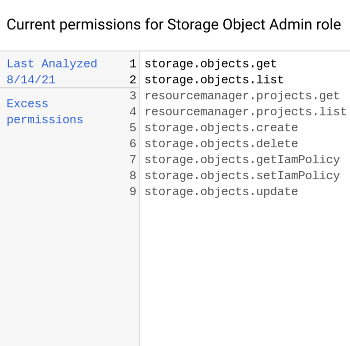
To help you understand why the recommendation was made, the
Google Cloud console shows the principal's permission usage, as reported by
the [policy insight](https://docs.cloud.google.com/policy-intelligence/docs/role-recommendations-overview.md.txt#how-policy-insights-work) associated with the recommendation. For
example, it might show a list like the following:

> [!NOTE]
>
> **Note** : If a recommendation is for a [basic role](https://docs.cloud.google.com/iam/docs/roles-overview.md.txt#basic), the list of
> permissions in the Google Cloud console might not include all of the
> permissions that a principal needs. This is because some services use basic
> roles to indirectly grant additional roles. The list of permissions might
> not include permissions from these additional roles, even if a principal
> used them. Role recommendations automatically account for this discrepancy.
>
>
> Indirectly granted roles include roles granted through
> [Cloud Storage convenience
> values](https://docs.cloud.google.com/storage/docs/access-control/iam#convenience-values) and
> [BigQuery special group
> membership](https://docs.cloud.google.com/bigquery/docs/access-control-basic-roles).
To help you understand the impact of applying the recommendation, the
Google Cloud console also shows a color- and symbol-coded list of permissions.
This list indicates how the principal's permissions will change if you apply the
recommendation. For example, it might show a list like the following:
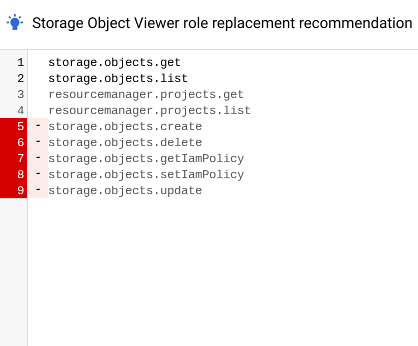

The types of permissions associated with each color and symbol are as follows:
- **Gray with no symbol**: Permissions that are in both the principal's current
role and the recommended roles.

- **Red with a minus sign**: Permissions
that are in the principal's current role, but not in the recommended roles
because the principal hasn't used them in the past
90 days.

- **Green with a plus sign** : Permissions
that are not in the principal's current role, but are in the recommended
roles. This type of permission appears only in [recommendations for service
agents](https://docs.cloud.google.com/policy-intelligence/docs/role-recommendations-overview#service-agents).

- **Blue with a *Machine learning* icon** :
Permissions that are in both the principal's current role and the recommended
roles, not because the principal has used the permissions in the past
90 days, but because Recommender has
determined through [machine learning](https://docs.cloud.google.com/policy-intelligence/docs/role-recommendations-overview.md.txt#ml) that they are likely
to need those permissions in the future.

Some recommendations are also associated with [lateral movement
insights](https://docs.cloud.google.com/policy-intelligence/docs/role-recommendations-overview#lateral-movement-insights). Lateral movement insights identify roles
that allow a service account in one project to impersonate a service account in
another project. If a recommendation is associated with a lateral movement
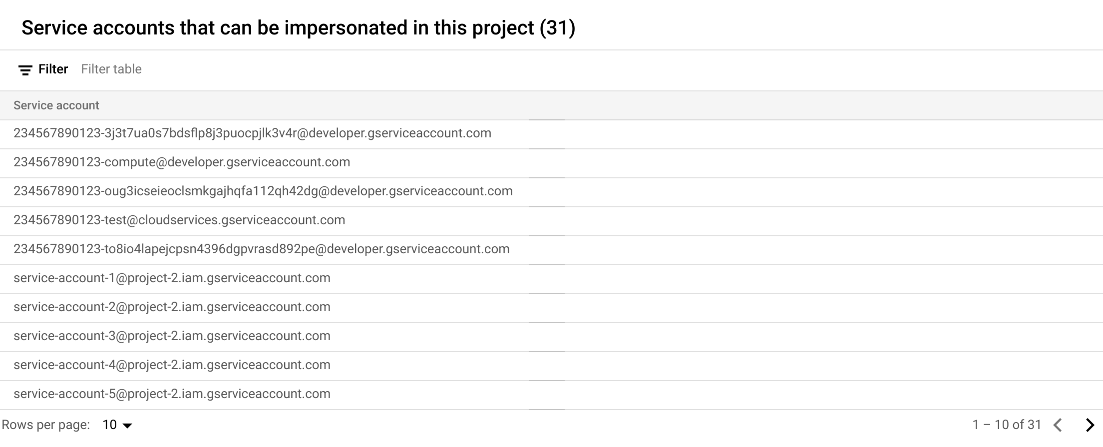
insight, the Google Cloud console also shows the following:
- **The service account's origin project**: The project that the service
account with impersonation permissions was created in.


- **Service accounts that can be impersonated in this project**: A list
of all of the service accounts in the current project that the service account
with impersonation permissions can impersonate.

### gcloud
For details on the fields of a recommendation, see the
[`Recommendation` reference](https://docs.cloud.google.com/recommender/docs/reference/rest/v1/projects.locations.recommenders.recommendations.md.txt#resource-recommendation).
To see the permission usage that this recommendation is based on, view the
[policy insights](https://docs.cloud.google.com/policy-intelligence/docs/role-recommendations-overview.md.txt#how-policy-insights-work) that are associated with the recommendation.
These insights are listed in the `associatedInsights` field. To view a policy
insight that is associated with the recommendation, do the following:
- Identify which insights in the `associatedInsights` field are policy insights. Policy insights have the insight type `google.iam.policy.insight`. This type appears after `insightTypes` in the `insight` field.
- Copy the policy insight's ID. The ID is everything after `insights/` in the `insight` field. In the preceding example, the insight ID is `279ef748-408f-44db-9a4a-1ff8865b9839`.
- Follow the instructions to [get a policy insight](https://docs.cloud.google.com/policy-intelligence/docs/policy-insights.md.txt#get-insight), using the insight ID you copied.
Some recommendations are also associated with
[lateral movement insights](https://docs.cloud.google.com/policy-intelligence/docs/role-recommendations-overview.md.txt#lateral-movement-insights), which identify roles
that allow service accounts in one project to impersonate service accounts in
another project. These insights are also listed in the `associatedInsights`
field. To view a lateral movement insight that is associated with the
recommendation, do the following:
- Identify which insights in the `associatedInsights` field are lateral movement insights. Lateral movement insights have the insight type `google.iam.policy.LateralMovementInsight`. This type appears after `insightTypes` in the `insight` field.
- Copy the policy insight's ID. The ID is everything after `insights/` in the `insight` field. In the preceding example, the insight ID is `279ef748-408f-44db-9a4a-1ff8865b9839`.
- Follow the instructions to [get a lateral movement
insight](https://docs.cloud.google.com/policy-intelligence/docs/lateral-movement-insights#get-insight), using the insight ID you copied.
### REST
For details on the fields of a recommendation, see the
[`Recommendation` reference](https://docs.cloud.google.com/recommender/docs/reference/rest/v1/projects.locations.recommenders.recommendations.md.txt#resource-recommendation).
To see the permission usage that this recommendation is based on, view the
[policy insights](https://docs.cloud.google.com/policy-intelligence/docs/role-recommendations-overview.md.txt#how-policy-insights-work) that are associated with the recommendation.
These insights are listed in the `associatedInsights` field. To view a policy
insight that is associated with the recommendation, do the following:
1. Identify which insights in the `associatedInsights` field are policy insights. Policy insights have the insight type `google.iam.policy.insight`. This type appears after `insightTypes` in the `insight` field.
2. Copy the policy insight's ID. The ID is everything after `insights/` in the `insight` field. For example, if the `insight` field reads `projects/123456789012/locations/global/insightTypes/google.iam.policy.Insight/insights/279ef748-408f-44db-9a4a-1ff8865b9839`, then the insight ID is `279ef748-408f-44db-9a4a-1ff8865b9839`.
3. Follow the instructions to [get a policy insight](https://docs.cloud.google.com/policy-intelligence/docs/policy-insights.md.txt#get-insight), using the insight ID you copied.
Some recommendations are also associated with
[lateral movement insights](https://docs.cloud.google.com/policy-intelligence/docs/role-recommendations-overview.md.txt#lateral-movement-insights), which identify roles
that allow service accounts in one project to impersonate service accounts in
another project. These insights are also listed in the `associatedInsights`
field. To view a lateral movement insight that is associated with the
recommendation, do the following:
1. Identify which insights in the `associatedInsights` field are lateral movement insights. Lateral movement insights have the insight type `google.iam.policy.LateralMovementInsight`. This type appears after `insightTypes` in the `insight` field.
2. Copy the policy insight's ID. The ID is everything after `insights/` in the `insight` field. For example, if the `insight` field reads `projects/123456789012/locations/global/insightTypes/google.iam.policy.LateralMovementInsight/insights/13088eec-9573-415f-81a7-46e1a260e860`, then the insight ID is `13088eec-9573-415f-81a7-46e1a260e860`.
3. Follow the instructions to [get a lateral movement
insight](https://docs.cloud.google.com/policy-intelligence/docs/lateral-movement-insights#get-insight), using the insight ID you copied.
## View, revert, and restore changes
After you apply or dismiss a recommendation for a project-level role binding,
that action appears in the recommendations history.
To view the recommendations history:
1. In the Google Cloud console, go to the **IAM** page.
[Go to IAM](https://console.cloud.google.com/projectselector/iam-admin/iam?supportedpurview=project,folder,organizationId)
2. Select a project, folder, or organization.
3. Near the top of the screen, click **Recommendations history**.
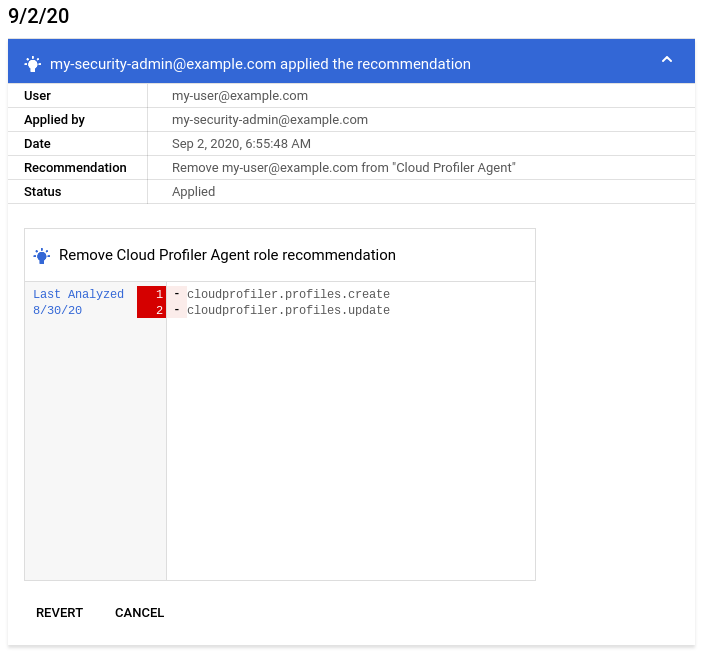
The Google Cloud console shows a list of previous actions on your
role recommendations.
4. To view details about a recommendation, click the
expander
arrow.
The Google Cloud console shows details about the action that was taken,
including the principal that took the action:

5. (Optional) If necessary, you can revert the recommendation, which undoes the
changes in the recommendation, or restore a recommendation that you
dismissed.
To revert a previously applied change for a recommendation, click
**Revert**. The Google Cloud console reverts the changes to the
principal's roles. The recommendation no longer appears in the
Google Cloud console.
If you revert the recommendation that replaced permanent access with
temporary, on-demand access, the system restores the original IAM
binding and deletes the created Privileged Access Manager entitlement. If the revert
process fails, then [delete the entitlement manually](https://docs.cloud.google.com/iam/docs/pam-view-update-delete-entitlements.md.txt).
> [!NOTE]
> **Note:** If the previously applied change created a custom role, then reverting the change does not delete the custom role. You can [disable](https://docs.cloud.google.com/iam/docs/creating-custom-roles.md.txt#disabling-custom-role) or [delete](https://docs.cloud.google.com/iam/docs/creating-custom-roles.md.txt#deleting-custom-role) the custom role if you no longer need it.
To restore a recommendation that was dismissed, click **Restore** . The
recommendation becomes visible on the **IAM** page in the
Google Cloud console. No roles or permissions are changed.
## What's next
- Learn more about [Recommender](https://docs.cloud.google.com/recommender/docs/overview).
- Learn how to use [allow policy insights](https://docs.cloud.google.com/policy-intelligence/docs/policy-insights.md.txt).
- Learn how to use [lateral movement insights](https://docs.cloud.google.com/policy-intelligence/docs/lateral-movement-insights.md.txt).