

To protect institutional Bitcoin reserves without creating a single point of compromise, you can distribute signing keys across hardware-isolated enclaves by using Google Cloud Multi-party Compute. This document compares Cloud Key Management Service (Cloud KMS) and Cloud HSM with Multi-party Compute, evaluates both security models for Bitcoin custody, and presents a reference topology.
When you move Bitcoin custody to the cloud, you choose between two key management architectures:
- Single-key hardware security modules (HSMs): Cloud KMS and Cloud HSM manage static cryptographic keys inside physical HSM boundaries.
- Distributed threshold signing: Multi-party Compute distributes key shares across hardware-isolated trusted execution environments (TEEs) backed by HSM root-of-trust keys.
Cloud KMS and Cloud HSM support enterprise envelope encryption and web public key infrastructure. However, they weren't designed for Bitcoin custody primitives such as hierarchical deterministic (HD) key derivation under Bitcoin Improvement Proposal 32 (BIP32), BIP340 Schnorr signing, and granular multi-party governance.
Key challenges in cloud-based Bitcoin custody
The following table summarizes three primary challenges that you encounter when evaluating standard cloud key management services for Bitcoin custody, and how Multi-party Compute addresses each requirement.
| Requirement | Limitation in Cloud KMS and Cloud HSM | How Multi-party Compute addresses this requirement |
|---|---|---|
| BIP32 key derivation |
Multi-tenant Cloud HSM partitions are designed for static, flat key management, such as enterprise envelope encryption. To preserve hypervisor-level security in shared cloud environments, cloud providers don't permit custom HSM firmware modules, so Cloud HSM can't compute BIP32 derivation paths natively. Because of this constraint, Cloud KMS requires flat key architectures. Applications must either track discrete key resources or derive child keys in unencrypted host memory. |
Multi-party Compute uses the linear homomorphism of the DKLS23
monotone span program to compute non-hardened BIP32 derivation paths
locally. Each node independently calculates the public scalar offset
tweak ( In single-key wallets, compromising both a parent extended public key
( |
| Single point of compromise |
The complete private key resides inside a single physical HSM boundary. A compromised authorization credential or insider threat exposes the entire wallet. |
The complete private key doesn't exist in plaintext in any single location. Key shares are mathematically distributed across independent compute nodes. |
| Algorithm agility (Schnorr and Taproot) |
Physical HSM hardware cycles are slow. Adding support for elliptic
curves or signature schemes such as BIP340 Schnorr on the
|
Cryptographic operations run inside hardware-isolated Confidential VM enclaves, which lets Multi-party Compute adopt protocol updates without modifying the physical HSM boundary. |
Compare Cloud KMS and Multi-party Compute
When you design digital asset signing infrastructure on Google Cloud, you can evaluate the single-key HSM model against the distributed threshold model.
Single-key Cloud KMS and Cloud HSM model
In a Cloud KMS deployment, Cloud HSM generates an asymmetric signing
key that uses the EC_SIGN_SECP256K1_SHA256 algorithm directly inside a FIPS
140-2 Level 3 validated physical HSM. The following figure shows how an
application layer interacts with Cloud HSM when deriving child keys:

This architecture provides managed FIPS 140-2 Level 3 validation and produces
low-S normalized secp256k1 Elliptic Curve Digital Signature Algorithm (ECDSA)
signatures that the Bitcoin network accepts. However, it introduces two
architectural limitations for Bitcoin custody:
- Key management fragmentation: because Cloud HSM can't compute BIP32
derivation paths, your application must track millions of discrete
CryptoKeyresource IDs in Cloud KMS, removing single-root recovery workflows. - Memory exposure risk: to perform hardened derivation, your application must export the root seed into host memory, which breaks the hardware security perimeter.
Distributed Multi-party Compute threshold model
Multi-party Compute implements a hardened extension of the DKLS23 threshold ECDSA protocol. Instead of generating a single complete key, independent nodes running inside Confidential Space on AMD SEV-SNP hardware-encrypted enclaves generate and hold mathematical key shares. For more information about the protocol, see DKLS23 cryptographic background.
The following figure shows how Multi-party Compute distributes signing across TEE nodes backed by independent HSM key encryption keys:
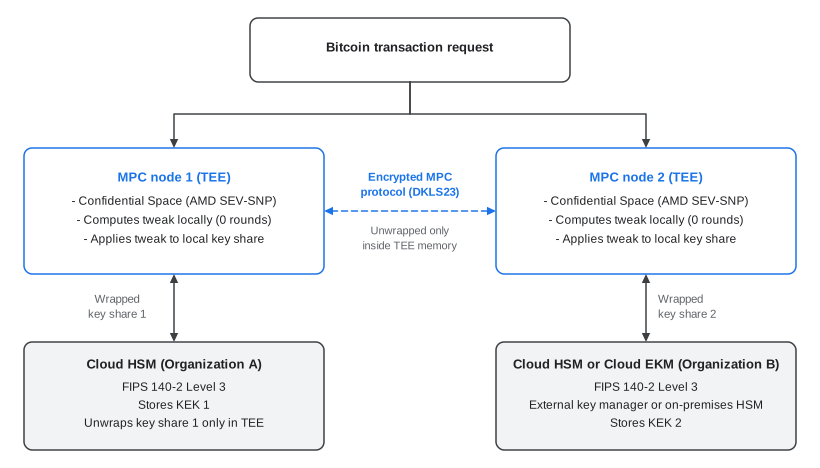
This distributed threshold model provides three primary security benefits:
- No complete private key: no single physical device, enclave, or operator holds the complete private key.
- Hardware-anchored root of trust: key shares are encrypted at rest under key encryption keys (KEKs) protected by FIPS 140-2 Level 3 Cloud HSM partitions or external on-premises HSMs connected through Cloud External Key Manager.
- Attestation-enforced decryption: Cloud KMS unwraps key shares into enclave memory only when a hardware attestation quote confirms that the node runs verified, untampered Multi-party Compute container images.
Cryptographic mechanics for BIP32 and Taproot
When you evaluate threshold signing for Bitcoin custody, check that the protocol supports hierarchical address derivation and Taproot tweaking without adding inter-node network rounds.
Non-hardened BIP32 additive derivation
BIP32 defines non-hardened child private key derivation as modular scalar addition:
\[ k_{\text{child} } = (k_{\text{par} } + \text{parse}_{256}(I_L)) \bmod n \]
Because Multi-party Compute uses a linear secret sharing scheme built on monotone span programs, participant nodes derive child key shares locally with zero network communication rounds. The following figure illustrates this zero-round local derivation flow:

BIP341 Taproot key tweaking
This linear property also supports BIP341 Taproot key tweaking without modifying the underlying key share distribution:
\[ Q = P + t \cdot G \quad \text{where} \quad t = H_{\text{TapTweak} }(P \parallel \text{MerkleRoot}) \]
Before participating in the threshold signing ceremony, a participant node applies the scalar tweak (t) directly to its local key share. This capability lets you interact with Taproot script trees, Ordinals, and Discreet Log Contracts without regenerating or resharing keys.
Architectural comparison
The following table compares Cloud KMS and Cloud HSM with Multi-party Compute across core custody dimensions.
| Architectural dimension | Cloud KMS and Cloud HSM | Multi-party Compute |
|---|---|---|
| Cryptographic primitives | Single-signature ECDSA on the secp256k1 curve |
Threshold ECDSA (DKLS23) and threshold Edwards-curve Digital
Signature Algorithm (EdDSA) on the Ed25519 curve, extensible
to threshold Schnorr on the secp256k1 curve |
| Hardware boundary | Physical PCIe HSM card | AMD SEV-SNP Confidential Space enclaves anchored to a Cloud HSM root of trust |
| BIP32 HD wallet support | Manual management of discrete Cloud KMS keys | Zero-round local additive key share tweaking |
| Physical key protection | FIPS 140-2 Level 3 | FIPS 140-2 Level 3 for HSM-resident KEKs that wrap key shares |
| Signing latency (p95) | 20-50 ms | Less than 1,000 ms (sub-second) across distributed regions |
| Affected scope of a credential breach | Complete key exposure if caller credentials or Identity and Access Management (IAM) policies are compromised | No unauthorized signing unless an attacker compromises a threshold of independent enclaves and KEKs simultaneously |
| Auditability | Cloud Audit Logs | Cloud Audit Logs and Key Access Justifications hardware attestation logs |
Evolution from BIP32 to threshold key management
When you design an in-house digital asset custody platform, distinguish between derivation standards created for individual hardware wallets and distributed key management designed for institutional governance. Although BIP32 is widely used for address tracking, relying on BIP32 derivation trees for security inside a multi-party computation (MPC) architecture is redundant and can add operational complexity.
Historical context of single-seed BIP32 wallets
BIP32 was designed around the constraints of individual self-custody before threshold cryptography and hardware enclaves became widely available:
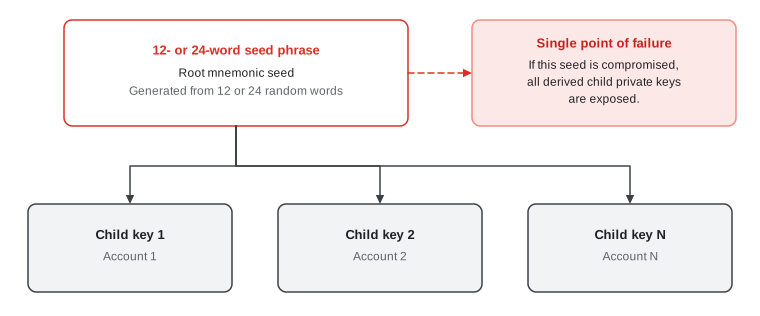
- Root seed dependency: early Bitcoin custody relied on physically securing a single human-readable mnemonic phrase of 12 or 24 words.
- Single-backup recovery: BIP32 HD wallets let an individual back up one seed phrase and deterministically derive addresses across multiple accounts.
- Single point of failure: the root mnemonic seed represents a total single point of failure. If an attacker compromises that phrase or physical backup, every derived child private key across all accounts is exposed.
The following figure illustrates how compromising a single root seed exposes every derived child account:
Remove the root seed with threshold signing
In a zero-trust institutional cloud architecture, a human-readable root mnemonic seed isn't required. Multi-party Compute eliminates the central root private key altogether. Because no complete private key exists in plaintext on any single machine or backup medium, you don't need single-phrase address recovery. Instead of deriving a key tree from one secret, Multi-party Compute distributes independent key shares across cryptographically isolated enclaves.
Compare BIP32 derivation paths in Multi-party Compute
If your integration requires BIP32 compatibility for external address trackers or accounting workflows, compare the two technical implementation paths in the following table.
| Implementation path | Cryptographic mechanism | Security and exposure profile | Latency and signing performance |
|---|---|---|---|
| Non-hardened BIP32 with Multi-party Compute |
Local additive tweaking:
Each node computes the public scalar offset
( |
|
|
| Hardened BIP32 with Multi-party Compute |
Interactive multi-party |
|
|
Recommendations for institutional custody
Multi-party Compute supports non-hardened BIP32 additive derivation for compatibility with existing systems and external address trackers. For dedicated institutional custody, consider transitioning to independent threshold keys managed directly in Multi-party Compute:
- Eliminate single-root dependencies: generate, rotate, and back up independent key shares inside isolated enclaves instead of deriving keys as mathematical offsets from a single root key.
- Increase algorithm agility: decouple your orchestration layer from
Bitcoin-specific BIP32 derivation paths so that you can adopt non-ECDSA
signature schemes, such as the
Ed25519signature scheme for smart contract networks, under one governance model. - Reduce signing complexity: manage discrete threshold keys to simplify database lookups, keep transaction requests concise, and minimize signing latency.