This document describes how to enable
[data lineage](https://docs.cloud.google.com/dataplex/docs/about-data-lineage) for your
Managed Service for Apache Spark jobs either at the
[project](https://docs.cloud.google.com/managed-spark/docs/guides/spark-lineage.md.txt#enable-spark-data-lineage-at-the-project-level) or
[cluster](https://docs.cloud.google.com/managed-spark/docs/guides/spark-lineage.md.txt#enable-spark-data-lineage-at-the-cluster-level) level.
[Data lineage](https://docs.cloud.google.com/dataplex/docs/about-data-lineage)
is a [Knowledge Catalog](https://docs.cloud.google.com/dataplex/docs/introduction)
feature that lets you track how data moves through your systems: where it comes
from, where it is passed to, and what transformations are applied to it.
Data lineage is available for all Managed Service for Apache Spark jobs
except SparkR and Spark streaming jobs, and supports BigQuery and Cloud Storage
data sources. It is included with Managed Service for Apache Spark `2.0.74`+, `2.1.22`+,
`2.2.50`+, `2.3.1`+, and `3.0` image versions.
Once you enable the feature in your Managed Service for Apache Spark cluster, Managed Service for Apache Spark
Spark jobs capture data lineage events and publish them to the Knowledge Catalog
[Data Lineage API](https://docs.cloud.google.com/dataplex/docs/reference/data-lineage/rest). Managed Service for Apache Spark
integrates with the Data Lineage API through
[OpenLineage](https://openlineage.io/), using the
[OpenLineage Spark plugin](https://github.com/OpenLineage/OpenLineage/tree/main/integration/spark).
You can access data lineage information through Knowledge Catalog, using the
following:
- [Data lineage graphs](https://docs.cloud.google.com/dataplex/docs/about-data-lineage#lineage-feature-graph)
- [Data Lineage API](https://docs.cloud.google.com/dataplex/docs/reference/data-lineage/rest)
## Before you begin
1. In the Google Cloud console, on the project selector page, select the project
that contains the Managed Service for Apache Spark cluster for which you want to track
lineage.
[Go to project selector](https://console.cloud.google.com/projectselector2/home/dashboard)
2. Enable the Data Lineage API.
[Enable the APIs](https://console.cloud.google.com/apis/enableflow?apiid=datalineage.googleapis.com)
**Upcoming Spark data lineage changes** See the
[Managed Service for Apache Spark release notes](https://docs.cloud.google.com/managed-spark/docs/release-notes.md.txt)
for the announcement of a change that will automatically make
Spark data lineage available to your projects and clusters when you
enable the Data Lineage API (see
[Control lineage ingestion for a service](https://docs.cloud.google.com/dataplex/docs/use-lineage#control-ingestion))
without requiring additional project or cluster level settings.
## Required roles
If you create a Managed Service for Apache Spark cluster using the
[default VM service account](https://docs.cloud.google.com/managed-spark/docs/concepts/configuring-clusters/service-accounts.md.txt#VM_service_account),
it has the [`Dataproc Worker`](https://docs.cloud.google.com/iam/docs/roles-permissions/dataproc.md.txt#dataproc.worker)
role. This role includes the `datalineage.locations.processOpenLineageMessage` permission,
which the OpenLineage Spark plugin uses to capture and publish lineage events to the
Data Lineage API. No additional action is necessary.
If you create a Managed Service for Apache Spark cluster that uses a
[custom service account](https://docs.cloud.google.com/managed-spark/docs/concepts/configuring-clusters/service-accounts.md.txt#create_a_cluster_with_a_custom_vm_service_account),
the service account must have permission to publish lineage events.
To follow the principle of least privilege, grant the minimum role required
for your use case:
- **Dataproc Worker (`roles/dataproc.worker`)** : the standard role required for Managed Service for Apache Spark data plane operations. Because this role already includes the `datalineage.locations.processOpenLineageMessage` permission, if your custom service account already has this role, you don't need to grant an additional Data Lineage role.
- **Data Lineage Events Producer (`roles/datalineage.producer`)**: the minimum standalone Data Lineage role required for a custom service account to publish lineage events. Grant this role if the service account doesn't have the Dataproc Worker role.
- **Data Lineage Editor (`roles/datalineage.editor`)**: grants permissions to edit and delete lineage processes and events, in addition to publishing them. This role provides more permissions than needed for standard pipeline execution, and is only required if workloads must modify existing lineage metadata.
- **Data Lineage Administrator (`roles/datalineage.admin`)**: grants full administrative access to Data Lineage resources. This role is not required for cluster service accounts.
> [!NOTE]
> **Note:** To view data lineage in Knowledge Catalog or the Google Cloud console, users require the [Data Lineage Viewer (`roles/datalineage.viewer`)](https://docs.cloud.google.com/iam/docs/roles-permissions/datalineage.md.txt#datalineage.viewer) role. This role is intended for users who view lineage, not for the cluster service account.
## Enable Spark data lineage
You can enable Spark data lineage at the project or cluster level.
### Enable Spark data lineage at the project level
After you enable Spark data lineage at the project level, subsequent
Spark jobs that run on Managed Service for Apache Spark clusters in the project will
have Spark data lineage enabled.
To enable Spark data lineage at the project level,
[set the following custom project metadata](https://docs.cloud.google.com/compute/docs/metadata/setting-custom-metadata.md.txt#set-custom-project-wide-metadata):
| Key | Value |
|---|---|
| `DATAPROC_LINEAGE_ENABLED` | `true` |
| `DATAPROC_CLUSTER_SCOPES` | [`https://www.googleapis.com/auth/cloud-platform`](https://docs.cloud.google.com/managed-spark/docs/concepts/iam/iam.md.txt#dataproc_vm_access_scopes) Setting this [VM access scope](https://docs.cloud.google.com/managed-spark/docs/concepts/iam/iam.md.txt#dataproc_vm_access_scopes) is only necessary for `2.0` image version clusters. It is automatically set on `2.1` and later image version clusters. |
You can disable Spark data lineage at the project level by setting the
`DATAPROC_LINEAGE_ENABLED` metadata to `false`.
> [!NOTE]
> **Note:** You can also disable Spark data lineage for a project by [disabling lineage ingestion for Managed Service for Apache Spark](https://docs.cloud.google.com/dataplex/docs/use-lineage#disable-lineage-ingestion). This setting overrides all other data lineage settings.
### Enable Spark data lineage at the cluster level
If you enable Spark data lineage when you create a cluster, supported
Spark jobs that run on Managed Service for Apache Spark clusters will
have Spark data lineage enabled. This setting overrides any Spark data lineage
setting at the [project level](https://docs.cloud.google.com/managed-spark/docs/guides/spark-lineage.md.txt#enable-spark-data-lineage-at-the-project-level): if Spark
data lineage is disabled at the project level but enabled at the cluster level,
the cluster level takes precedence, and supported Spark jobs that run on the cluster
will have data lineage enabled.
To enable Spark data lineage on a cluster,
[create a Managed Service for Apache Spark cluster](https://docs.cloud.google.com/managed-spark/docs/guides/create-cluster.md.txt#creating_a_cloud_dataproc_cluster)
with the `dataproc:dataproc.lineage.enabled` cluster property set to `true`.
gcloud CLI example:
```bash
gcloud dataproc clusters create CLUSTER_NAME \
--project PROJECT_ID \
--region REGION \
--properties 'dataproc:dataproc.lineage.enabled=true'
```
You can disable Spark data lineage on a cluster
by setting the `dataproc:dataproc.lineage.enabled` property to `false`
when you create the cluster.
> [!NOTE]
> **Note:** You can also disable Spark data lineage by [disabling lineage ingestion for Managed Service for Apache Spark](https://docs.cloud.google.com/dataplex/docs/use-lineage#disable-lineage-ingestion). This setting overrides all other data lineage settings.
- **Disabling data lineage on a cluster** : To create a cluster with lineage
disabled, set `dataproc:dataproc.lineage.enabled=false`.
After cluster creation, you can't disable Spark data lineage on the
cluster. To disable Spark data lineage on an existing cluster, you can
[recreate the cluster](https://docs.cloud.google.com/managed-spark/docs/guides/recreate-cluster.md.txt)
with the `dataproc:dataproc.lineage.enabled` property set to `false`.
- **Set scope on 2.0 image version clusters:** Managed Service for Apache Spark cluster
VM access
[`cloud-platform` scope](https://docs.cloud.google.com/managed-spark/docs/concepts/iam/iam.md.txt#dataproc_vm_access_scopes)
is required for Spark data lineage. Managed Service for Apache Spark image
version clusters created with image version `2.1` and later have
`cloud-platform` enabled. If you specify Managed Service for Apache Spark
image version `2.0` when you create a cluster, set the
scope to `cloud-platform`.
#### Disable Spark data lineage on a job
If Spark data lineage is enabled on a cluster, you can disable
Spark data lineage on a job by passing the `spark.extraListeners`
property with an empty value ("") when you submit the job.
```bash
gcloud dataproc jobs submit spark \
--cluster=CLUSTER_NAME \
--project PROJECT_ID \
--region REGION \
--class CLASS \
--jars=gs://APPLICATION_BUCKET/spark-application.jar \
--properties=spark.extraListeners=''
```
### Submit a Spark job
When you [submit a supported Spark job](https://docs.cloud.google.com/managed-spark/docs/guides/submit-job.md.txt#how_to_submit_a_job)
on a Managed Service for Apache Spark cluster that was created with Spark data lineage enabled,
Managed Service for Apache Spark captures and reports the data lineage information to the
Data Lineage API.
```bash
gcloud dataproc jobs submit spark \
--cluster=CLUSTER_NAME \
--project PROJECT_ID \
--region REGION \
--class CLASS \
--jars=gs://APPLICATION_BUCKET/spark-application.jar \
--properties=spark.openlineage.namespace=CUSTOM_NAMESPACE,spark.openlineage.appName=CUSTOM_APPNAME
```
Notes:
- Adding the `spark.openlineage.namespace` and `spark.openlineage.appName` properties, which are used to uniquely identify the job, is optional. If you don't add these properties, Managed Service for Apache Spark uses the following default values:
- Default value for `spark.openlineage.namespace`: PROJECT_ID
- Default value for `spark.openlineage.appName`: `spark.app.name`
### View lineage in Knowledge Catalog
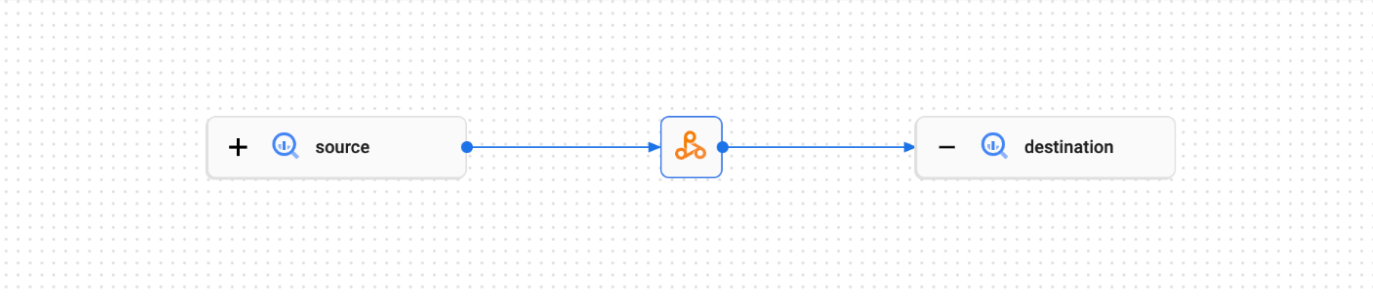
A lineage graph displays relationships between your project
resources and the processes that created them. You can
[view data lineage information](https://docs.cloud.google.com/dataplex/docs/use-lineage)
in the Google Cloud console, or
retrieve it from the [Data Lineage API](https://docs.cloud.google.com/dataplex/docs/reference/data-lineage/rest)
in the form of JSON data.
**PySpark example code:**
The following PySpark job reads data from a public BigQuery
table, and then writes the output a new table in an existing BigQuery
dataset. It uses a Cloud Storage bucket for temporary storage.
```python
#!/usr/bin/env python
from pyspark.sql import SparkSession
import sys
spark = SparkSession \
.builder \
.appName('LINEAGE_BQ_TO_BQ') \
.getOrCreate()
bucket = 'gs://BUCKET`
spark.conf.set('temporaryCloudStorageBucket', bucket)
source = 'bigquery-public-data:samples.shakespeare'
words = spark.read.format('bigquery') \
.option('table', source) \
.load()
words.createOrReplaceTempView('words')
word_count = spark.sql('SELECT word, SUM(word_count) AS word_count FROM words GROUP BY word')
destination_table = 'PROJECT_ID:DATASET.TABLE'
word_count.write.format('bigquery') \
.option('table', destination_table) \
.save()
```
Make the following replacements:
- BUCKET: The name of an existing Cloud Storage bucket
- PROJECT_ID, DATASET, and TABLE: The
project ID, the name of an existing BigQuery dataset, and
the name of a new table to create in the dataset (the table must not exist)
You can view the lineage graph in the Knowledge Catalog UI.
## What's next
- Learn more about [data lineage](https://docs.cloud.google.com/dataplex/docs/about-data-lineage).