You can use the [spark-bigquery-connector](https://github.com/GoogleCloudDataproc/spark-bigquery-connector)
with Managed Service for Apache Spark to read and write data from and to [BigQuery](https://docs.cloud.google.com/bigquery "BigQuery"). This tutorial demonstrates a PySpark application that uses the
`spark-bigquery-connector`.
> [!IMPORTANT]
> The spark-bigquery-connector takes advantage of the [BigQuery
> Storage API](https://docs.cloud.google.com/bigquery/docs/reference/storage) when reading data from BigQuery.
## Confirm the connector version
See [Managed Service for Apache Spark runtime releases](https://docs.cloud.google.com/managed-spark/docs/concepts/versions/spark-runtime-versions)
to determine the BigQuery connector version that is installed in
your batch workload or interactive session runtime version. If the connector is
not listed, see [Make the connector available to applications](https://docs.cloud.google.com/managed-spark/docs/guides/spark-bigquery-connector.md.txt#make_the_connector_available_to_applications_if_needed).
> [!NOTE]
> **Note:** You can update the installed BigQuery connector version using the `dataproc.sparkBqConnector.version` property (see [Other Spark properties](https://docs.cloud.google.com/managed-spark/docs/concepts/properties#other_properties)).
### Make the connector available to applications (if needed)
The BigQuery connector is installed in all
[supported Managed Service for Apache Spark runtime versions](https://docs.cloud.google.com/managed-spark/docs/concepts/versions/serverless-versions.md.txt#supported-dataproc-serverless-for-spark-runtime-versions).
If you are using an
[unsupported runtime version](https://docs.cloud.google.com/managed-spark/docs/concepts/versions/serverless-versions.md.txt#unsupported-dataproc-serverless-for-spark-runtime-versions)
that does not install the connector (`Spark runtime 1.0`), you can make the connector available to an
application in **either** of the following two ways:
- Use the `jars` parameter to point to a connector jar file when you submit a Managed Service for Apache Spark batch workload or run an interactive session. The following batch workload example specifies a connector jar file (see the [GoogleCloudDataproc/spark-bigquery-connector](https://github.com/GoogleCloudDataproc/spark-bigquery-connector/releases) repository on GitHub for a list of available connector jar files).
- Google Cloud CLI example:
```
gcloud dataproc batches submit pyspark \
--region=REGION \
--jars=spark-3.5-bigquery-version.jar \
... other args
```
> [!NOTE]
> **Note:** If the connector is not available to your application at runtime, a `ClassNotFoundException` is thrown.
## Calculate costs
This tutorial uses billable components of Google Cloud, including:
- Managed Service for Apache Spark
- BigQuery
- Cloud Storage
Use the [Pricing Calculator](https://cloud.google.com/products/calculator/) to generate a cost
estimate based on your projected usage.
New Cloud Platform users may be eligible for a [free trial](https://cloud.google.com/free).
## Configure billing
By default, the project associated with the credentials or service account is
billed for API usage. To bill a different project, set the following
configuration property: `spark.conf.set("parentProject", "")`.
You can also add this property to a read or write operation, as follows:
`.option("parentProject", "")`.
## Submit a PySpark wordcount batch workload
This example reads data from
[BigQuery](https://console.cloud.google.com/bigquery)
into a Spark DataFrame to perform a word count using the [standard data source
API](https://spark.apache.org/docs/latest/sql-data-sources.html "Data Sources").
The connector writes the wordcount output to BigQuery in the
following sequence of operations:
1. Buffers the data into temporary files in your Cloud Storage bucket
2. Copies the data in one operation from your Cloud Storage bucket into
BigQuery
3. Deletes the temporary files in Cloud Storage after the BigQuery
load operation completes (temporary files are also deleted after
the Spark application terminates). If deletion fails, you will need to delete
any unwanted temporary Cloud Storage files, which typically are placed
in `gs://BUCKET_NAME/.spark-bigquery-JOB_ID-UUID`.
### Steps to run the wordcount workload
1. Open a local terminal or [Cloud Shell](https://console.cloud.google.com/?cloudshell=true).
2. Create the `wordcount_dataset` with the [bq](https://docs.cloud.google.com/bigquery/bq-command-line-tool) command-line tool in a local terminal or in [Cloud Shell](https://console.cloud.google.com/?cloudshell=true).
```
bq mk wordcount_dataset
```
3. Create a Cloud Storage bucket with the [Google Cloud CLI](https://docs.cloud.google.com/sdk/gcloud/reference/storage.md.txt).
```
gcloud storage buckets create gs://BUCKET_NAME
```
Replace `BUCKET_NAME` with the name of the Cloud Storage bucket you created.
4. Create the file `wordcount.py` locally in a text editor by copying the following PySpark code.
```
#!/usr/bin/python
"""BigQuery I/O PySpark example."""
from pyspark.sql import SparkSession
spark = SparkSession \
.builder \
.appName('spark-bigquery-demo') \
.getOrCreate()
# Cloud Storage bucket used by the connector for temporary BigQuery
# export data.
bucket = "BUCKET_NAME"
spark.conf.set('temporaryGcsBucket', bucket)
# Enable reading from BigQuery views and materializing query results.
spark.conf.set('viewsEnabled', 'true')
spark.conf.set('materializationDataset', 'wordcount_dataset')
# Load data from BigQuery.
words = spark.read.format('bigquery') \
.load('bigquery-public-data.samples.shakespeare')
words.createOrReplaceTempView('words')
# Perform word count.
word_count = spark.sql(
'SELECT word, SUM(word_count) AS word_count FROM words GROUP BY word')
word_count.show()
word_count.printSchema()
# Save the data to BigQuery
word_count.write.format('bigquery') \
.save('wordcount_dataset.wordcount_output')
```
5. Submit the PySpark batch workload:
```
gcloud dataproc batches submit pyspark wordcount.py \
--region=REGION \
--deps-bucket=BUCKET_NAME
```
**Sample terminal output:**
```
...
+---+---+
| word|word_count|
+---+---+
| XVII| 2|
| spoil| 28|
| Drink| 7|
|forgetful| 5|
| Cannot| 46|
| cures| 10|
| harder| 13|
| tresses| 3|
| few| 62|
| steel'd| 5|
| tripping| 7|
| travel| 35|
| ransom| 55|
| hope| 366|
| By| 816|
| some| 1169|
| those| 508|
| still| 567|
| art| 893|
| feign| 10|
+---+---+
only showing top 20 rows
root
|-- word: string (nullable = false)
|-- word_count: long (nullable = true)
```
To preview the output table in the Google Cloud console, open the [BigQuery](https://console.cloud.google.com/bigquery) page, select the `wordcount_output` table, and then click **Preview** . 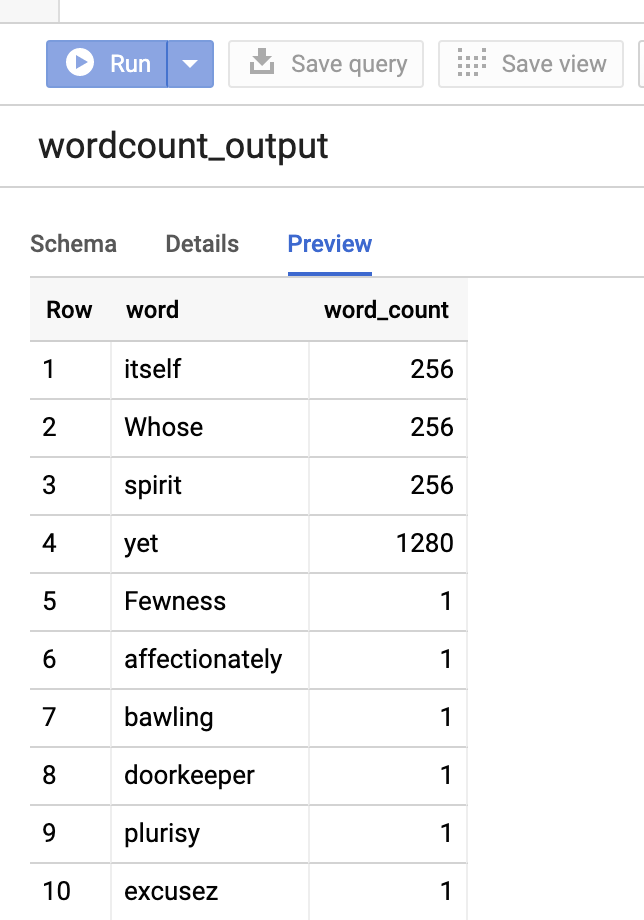 **Figure 1:** Preview the output table in BigQuery
## For more information
- [BigQuery Storage \& Spark SQL - Python](https://github.com/tfayyaz/cloud-dataproc/blob/master/notebooks/python/1.2.%20BigQuery%20Storage%20%26%20Spark%20SQL%20-%20Python.ipynb)
- [Creating a table definition file for an external data source](https://docs.cloud.google.com/bigquery/external-table-definition)
- [Use externally partitioned data](https://docs.cloud.google.com/bigquery/docs/hive-partitioned-queries-gcs)