When you use Managed Service for Apache Spark to create clusters and run
jobs on your clusters, the service sets up the necessary
[Managed Service for Apache Spark roles and permissions](https://docs.cloud.google.com/managed-spark/docs/concepts/iam/iam.md.txt)
in your project to access and use the Google Cloud resources it needs to accomplish
these tasks. However, if you do cross-project work, for example to access data
in another project, you will need to set up the necessary roles and permissions
to access cross-project resources.
To help you do cross-project work successfully, this document lists the different
principals that use Managed Service for Apache Spark
and the roles that contain the necessary permissions for those principals to access
and use Google Cloud resources.
There are three principals (identities) that access and use the Managed Service for Apache Spark:
1. User Identity
2. Control Plane Identity
3. Data Plane Identity
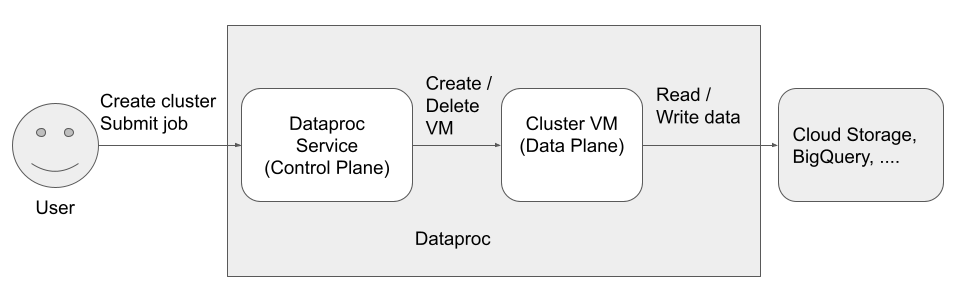
## Dataproc API User (User identity)
Example: *username@example.com*
This is the user that calls Managed Service for Apache Spark to create
clusters, submit jobs, and make other requests to the service. The user
is usually an individual, but it can also be a
[service account](https://docs.cloud.google.com/iam/docs/understanding-service-accounts)
if Managed Service for Apache Spark is invoked through an API client or from another
Google Cloud service such as Compute Engine, Cloud Run functions, or Managed Service for Apache Airflow.
**Related roles**
- [Dataproc roles](https://docs.cloud.google.com/managed-spark/docs/concepts/iam/iam.md.txt#roles), [Project roles](https://docs.cloud.google.com/managed-spark/docs/concepts/iam/iam.md.txt#project_roles)
**Notes**
- Dataproc API-submitted jobs run as `root` on Linux.
- Managed Service for Apache Spark clusters inherit project-wide Compute Engine
SSH metadata unless explicitly blocked by setting
`--metadata=block-project-ssh-keys=true` when you create your cluster
(see
[Cluster metadata](https://docs.cloud.google.com/managed-spark/docs/concepts/configuring-clusters/metadata.md.txt)).
- HDFS user directories are created for each project-level SSH user. These
HDFS directories are created at cluster deployment time, and a new (post-deployment)
SSH user is not given an HDFS directory on existing clusters.
## Managed Service for Apache Spark Service Agent (Control Plane identity)
Example: *service-project-number@dataproc-accounts.iam.gserviceaccount.com*
The
[Managed Service for Apache Spark Service Agent service account](https://docs.cloud.google.com/managed-spark/docs/concepts/configuring-clusters/service-accounts.md.txt#service_agent_account)
is used to perform a broad set of system operations on resources located
in the project where a Managed Service for Apache Spark cluster is created, including:
- Creation of Compute Engine resources, including VM instances, instance groups, and instance templates
- `get` and `list` operations to confirm the configuration of resources such as images, firewalls, Managed Service for Apache Spark initialization actions, and Cloud Storage buckets
- Auto-creation of the Managed Service for Apache Spark [staging and temp buckets](https://docs.cloud.google.com/managed-spark/docs/concepts/configuring-clusters/staging-bucket.md.txt) if the staging or temp bucket is not specified by the user
- Writing cluster configuration metadata to the staging bucket
- Accessing [VPC networks in a host project](https://docs.cloud.google.com/managed-spark/docs/concepts/configuring-clusters/network.md.txt#create_a_cluster_that_uses_a_network_in_another_project)
**Related roles**
- [Dataproc Service Agent](https://docs.cloud.google.com/iam/docs/roles-permissions/dataproc.md.txt#dataproc.serviceAgent)
## Managed Service for Apache Spark VM service account (Data Plane identity)
Example: *project-number-compute@developer.gserviceaccount.com*
Your application code runs as the
[VM service account](https://docs.cloud.google.com/managed-spark/docs/concepts/configuring-clusters/service-accounts.md.txt#VM_service_account)
on Managed Service for Apache Spark VMs. User jobs are granted the roles (with their
associated permissions) of this service account.
The VM service account does the following:
- Communicates with the [Managed Service for Apache Spark control plane](https://docs.cloud.google.com/managed-spark/docs/concepts/iam/principals.md.txt#service-agent).
- Reads and writes data from and to the [Managed Service for Apache Spark staging and temp buckets](https://docs.cloud.google.com/managed-spark/docs/concepts/configuring-clusters/staging-bucket.md.txt).
- As needed by your Managed Service for Apache Spark jobs, reads and writes data from and to Cloud Storage, BigQuery, Cloud Logging, and other Google Cloud resources.
**Related roles**
- [Dataproc Worker](https://docs.cloud.google.com/managed-spark/docs/concepts/iam/iam.md.txt#roles)
- [Cloud Storage roles](https://docs.cloud.google.com/storage/docs/access-control/iam-roles.md.txt#standard-roles)
- [BigQuery roles](https://docs.cloud.google.com/bigquery/docs/access-control.md.txt#bigquery)
> [!NOTE]
> **Note:** For interactive workloads, users can opt to use their user identity to access Cloud Storage objects in buckets owned by the same project that contains the cluster (see [Managed Service for Apache Spark Personal Cluster Authentication](https://docs.cloud.google.com/managed-spark/docs/concepts/iam/personal-auth.md.txt)).
## What's next
- Learn more about [Managed Service for Apache Spark roles and permissions](https://docs.cloud.google.com/managed-spark/docs/concepts/iam/iam.md.txt).
- Learn more about [Managed Service for Apache Spark service accounts](https://docs.cloud.google.com/managed-spark/docs/concepts/configuring-clusters/service-accounts.md.txt).
- See [BigQuery Access Control](https://docs.cloud.google.com/bigquery/docs/access-control.md.txt).
- See [Cloud Storage Access Control options](https://docs.cloud.google.com/storage/docs/access-control.md.txt).