

Co-Scientist and AlphaEvolve are Google-developed agents that accelerate research and development processes. These agents leverage Gemini to automate complex scientific reasoning and algorithmic discovery.
Overview of Co-Scientist agent
Co-Scientist is a multi-agent AI system built on Gemini, designed to act as a virtual scientific collaborator. The system helps researchers uncover original knowledge and formulate novel research hypotheses and experimental proposals. By combining AI reasoning with the scientific method, Co-Scientist enables scientists to navigate literature, synthesize insights across domains, and accelerate biomedical discoveries.
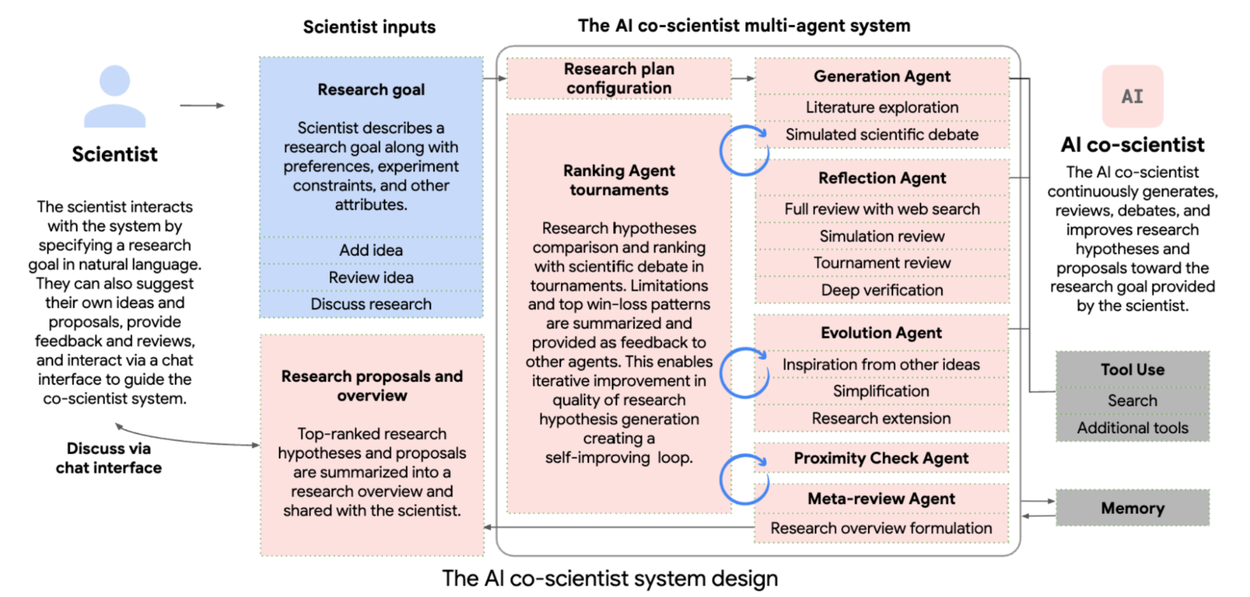
How it works
Co-Scientist is built on a multi-agent architecture and an asynchronous task execution framework to scale test-time computation. This design allows the system to reason, debate, and improve outputs iteratively.
When you provide a research goal in natural language, Co-Scientist coordinates the following specialized agents:
- Generation agent: Explores literature using web search, synthesizes findings, and formulates initial hypotheses.
- Reflection agent: Acts as a peer reviewer to examine the correctness, quality, and safety of generated hypotheses.
- Ranking agent: Evaluates and prioritizes research proposals using an Elo-based tournament.
- Evolution agent: Refines top-ranked hypotheses by grounding them in literature and combining innovative ideas.
- Proximity agent: Organizes tournament matches and deduplicates hypotheses using a proximity graph.
- Meta-review agent: Synthesizes insights from all reviews and debates into a comprehensive research roadmap.
A dedicated Supervisor agent orchestrates the process, allocates resources, and manages the worker queue to maintain a self-improving loop of scientific reasoning.
Use cases
Co-Scientist solves complex problems across multiple scientific disciplines, specifically those requiring deep subject matter expertise and trans-disciplinary insights. Example use cases include:
Drug repurposing: Identify novel therapeutic indications for approved drugs by analyzing molecular signatures, signaling pathways, and literature-based information.
Target discovery: Propose new biological components and epigenetic targets for complex diseases and streamline hypothesis selection for experimental validation.
Mechanistic explanations: Generate hypotheses for intricate problems, such as antimicrobial resistance, by synthesizing fragmented scientific data.
For more information and additional use cases, see the Accelerating scientific breakthroughs with an AI Co-Scientist blog.