Glossaries in Vertex AI Translation on Google Distributed Cloud (GDC) air-gapped let you
define domain-specific terminology for consistent translation across language
pairs. By configuring source and target term pairs, you control how the service
translates specialized vocabulary such as product names, ambiguous words, and
borrowed terms.
Glossary entries can consist of single words (also referred to as *tokens* ) or
short phrases, typically shorter than five words. Vertex AI Translation applies
matching entries during translation but ignores entries that match
[stopwords](https://docs.cloud.google.com/distributed-cloud/hosted/docs/1.16/gdcag/application/ao-user/stopwords).
## Glossary methods
Vertex AI Translation offers the following glossary methods in
GDC:
| Method | Description |
|---|---|
| [`CreateGlossary`](https://docs.cloud.google.com/distributed-cloud/hosted/docs/1.16/gdcag/application/ao-user/vertex-ai-glossary#create-glossary) | Create a glossary. |
| [`GetGlossary`](https://docs.cloud.google.com/distributed-cloud/hosted/docs/1.16/gdcag/application/ao-user/vertex-ai-glossary#get-glossary) | Return a stored glossary. |
| [`ListGlossaries`](https://docs.cloud.google.com/distributed-cloud/hosted/docs/1.16/gdcag/application/ao-user/vertex-ai-glossary#list-glossaries) | Return a list of glossaries in a project. |
| [`DeleteGlossary`](https://docs.cloud.google.com/distributed-cloud/hosted/docs/1.16/gdcag/application/ao-user/vertex-ai-glossary#delete-glossary) | Delete a glossary that you no longer need. |
## Before you begin
Before creating a glossary to define your terminology for translation, you must
have a project named `translation-glossary-project`. The custom resource of the
project must look like in the following example:
apiVersion: resourcemanager.gdc.goog/v1
kind: Project
metadata:
labels:
atat.config.google.com/clin-number: CLIN_NUMBER
atat.config.google.com/task-order-number: TASK_ORDER_NUMBER
name: translation-glossary-project
namespace: platform
To get the permissions you need to use a glossary, ask your IAM Project Admin to
grant you the following roles in your project namespace:
- **AI Translation Developer** : Get the AI Translation Developer (`ai-translation-developer`) role to access the Vertex AI Translation service.
- **Project Bucket Admin** : Get the Project Bucket Admin (`project-bucket-admin`) role to manage storage buckets and objects within buckets, which lets you create and upload files.
For more information about prerequisites, see
[Set up a translation project](https://docs.cloud.google.com/distributed-cloud/hosted/docs/1.16/gdcag/application/ao-user/vai-set-up-translation).
## Create a glossary file
You must create a glossary file to store your source language and target
language terms. This section contains the two different glossary layouts you can
use to define your terms.
The following table describes the limits supported on Distributed Cloud for
glossary files:
| Description | Limit |
|---|---|
| Maximum file size | 10.4 million (10,485,760) UTF-8 bytes |
| Maximum length of a glossary term | 1,024 UTF-8 bytes |
| Maximum number of glossary resources for a project | 10,000 |
Choose one of the following layouts for your glossary file:
- [**Unidirectional glossary**](https://docs.cloud.google.com/distributed-cloud/hosted/docs/1.16/gdcag/application/ao-user/vertex-ai-glossary#unidirectional): Specify the expected translation for a pair of source and target terms in a specific language. Unidirectional glossaries support TSV, CSV, and TMX file formats.
- [**Equivalent term set glossary**](https://docs.cloud.google.com/distributed-cloud/hosted/docs/1.16/gdcag/application/ao-user/vertex-ai-glossary#equiv-glossary): Specify the expected translation in multiple languages on each row. Equivalent term set glossaries support CSV file formats.
> [!NOTE]
> **Note:** Backing up the glossary isn't supported. Therefore, save a copy of the glossary file. If the glossary is erased, upload the saved copy file to your [storage bucket](https://docs.cloud.google.com/distributed-cloud/hosted/docs/1.16/gdcag/application/ao-user/vertex-ai-glossary#upload-file). Then, [send a request](https://docs.cloud.google.com/distributed-cloud/hosted/docs/1.16/gdcag/application/ao-user/vertex-ai-glossary#create-glossary) again to restore your glossary.
### Unidirectional glossary
The Vertex AI Translation API accepts tab-separated values (TSV) and
comma-separated values (CSV). Each row contains a pair of terms separated by a
tab (`\t`) or a comma (`,`) for these file formats.
The Vertex AI Translation API also accepts the Translation Memory eXchange (TMX)
format, a standard XML format for providing the translation's source and target
term pairs. The supported input files are in a format based on TMX version 1.4.
The following examples show the required structure for TSV, CSV, and TMX file
formats of unidirectional glossaries:
### TSV and CSV
The following image shows two columns in a TSV or CSV file. The first column
contains the source language term, and the second column contains the target
language term.
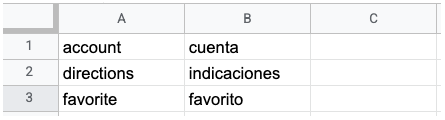
Don't include a header row in a unidirectional TSV or CSV file; the first row
must contain term data.
The [glossary request](https://docs.cloud.google.com/distributed-cloud/hosted/docs/1.16/gdcag/application/ao-user/vertex-ai-glossary#create-glossary) makes the file available to the
Vertex AI Translation API.
### TMX
The following example illustrates the required structure in a TMX file:
account
cuenta
directions
indicaciones
If your file contains XML tags that are not shown in this example, the
Vertex AI Translation API ignores those tags.
Include the following elements in your TMX file to ensure successful
processing by the Vertex AI Translation API:
- ``: Identify the source language using the `srclang` attribute.
- ``: Include a pair of `` elements with the same source and target
languages. These `` elements comply with the following:
- Each `` element identifies the language of the contained text using the `xml:lang` attribute. Use ISO-639-1 codes to identify the source and target languages. See the list of [supported languages](https://docs.cloud.google.com/distributed-cloud/hosted/docs/1.16/gdcag/application/ao-user/vai-translation-langs) and their respective language codes.
- If a `` element contains more than two `` elements, the Vertex AI Translation API only processes the first `` element matching the source language and the first `` element matching the target language. The service ignores the rest of the `` elements.
- If a `` element doesn't have a matching pair of `` elements, the Vertex AI Translation API ignores the invalid `` element.
- ``: Represent generalized strings of text. The Vertex AI Translation API
excludes the markup tags from a `` element before processing the file.
If a `` element contains more than one `` element, the
Vertex AI Translation API concatenates the text into a single element with a
space between the text strings.
After identifying the glossary terms in your unidirectional glossary,
[upload the file to a storage bucket](https://docs.cloud.google.com/distributed-cloud/hosted/docs/1.16/gdcag/application/ao-user/vertex-ai-glossary#upload-file) and make it available to the
Vertex AI Translation API by [creating and importing a glossary](https://docs.cloud.google.com/distributed-cloud/hosted/docs/1.16/gdcag/application/ao-user/vertex-ai-glossary#create-glossary).
### Equivalent term set glossary
The Vertex AI Translation API accepts glossary files for equivalent term sets using the CSV format. To define equivalent term sets, create a multi-column CSV
file in which each row lists a single glossary term in multiple languages. See
the list of [supported languages](https://docs.cloud.google.com/distributed-cloud/hosted/docs/1.16/gdcag/application/ao-user/vai-translation-langs)
and their respective language codes.
The following image shows an example of a multi-column CSV file. Each row
represents a glossary term, and each column represents a translation of the term
into different languages.
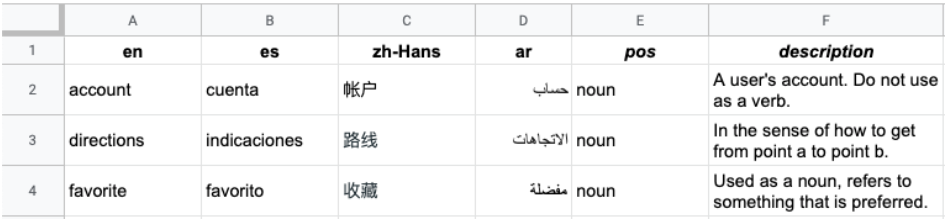
The header is the first row in the file, which identifies the language for each
column. The header row uses the ISO-639-1 or BCP-47 standard language codes. The
Vertex AI Translation API doesn't use part-of-speech (`pos`)
information, and specific position values aren't validated.
Each subsequent row contains equivalent glossary terms in the languages
identified in the header. You can leave columns blank if the term isn't
available in all languages.
After identifying the glossary terms in your equivalent term set,
[upload the file to a storage bucket](https://docs.cloud.google.com/distributed-cloud/hosted/docs/1.16/gdcag/application/ao-user/vertex-ai-glossary#upload-file) and make it available to the
Vertex AI Translation API by [creating and importing a glossary](https://docs.cloud.google.com/distributed-cloud/hosted/docs/1.16/gdcag/application/ao-user/vertex-ai-glossary#create-glossary).
## Upload your glossary file to a storage bucket
Follow these steps to upload your glossary file to a storage bucket:
1. [Configure the gdcloud CLI for object storage](https://docs.cloud.google.com/distributed-cloud/hosted/docs/1.16/gdcag/application/ao-user/install-configure-storage-cli).
2. [Create a storage bucket](https://docs.cloud.google.com/distributed-cloud/hosted/docs/1.16/gdcag/application/ao-user/create-storage-buckets) in your project namespace. Use a `Standard` storage class.
You can create the storage bucket by deploying a `Bucket` resource in your
project namespace:
apiVersion: object.gdc.goog/v1
kind: Bucket
metadata:
name: glossary-bucket
namespace: translation-glossary-project
spec:
description: bucket for translation glossary
storageClass: Standard
bucketPolicy:
lockingPolicy:
defaultObjectRetentionDays: 90
3. Grant `read` permissions on the bucket and `get`, `list`, and `watch`
permissions on `secrets` in the project namespace to the service accounts
(`ai-translation-system-sa` and `g-vai-translation-sie-sa`) used by the
Vertex AI Translation service.
Follow these steps to create the role and role binding using custom
resources on the management API server. A user who already holds the
`secrets` permissions must apply these resources, or the request fails with
`attempting to grant RBAC permissions not currently held`:
1. Create the role by deploying a `Role` resource in the project
namespace:
apiVersion: rbac.authorization.k8s.io/v1
kind: Role
metadata:
name: ai-translation-glossary-reader
namespace: translation-glossary-project
rules:
-
apiGroups:
- object.gdc.goog
resources:
- buckets
verbs:
- read-object
-
apiGroups:
- ""
resources:
- secrets
verbs:
- get
- list
- watch
2. Create the role binding by deploying a `RoleBinding` resource in the
project namespace:
apiVersion: rbac.authorization.k8s.io/v1
kind: RoleBinding
metadata:
name: ai-translation-glossary-reader-rolebinding
namespace: translation-glossary-project
roleRef:
apiGroup: rbac.authorization.k8s.io
kind: Role
name: ai-translation-glossary-reader
subjects:
-
kind: ServiceAccount
name: ai-translation-system-sa
namespace: g-vai-translation-sie
-
kind: ServiceAccount
name: g-vai-translation-sie-sa
namespace: g-vai-translation-sie
4. Upload your [glossary file](https://docs.cloud.google.com/distributed-cloud/hosted/docs/1.16/gdcag/application/ao-user/vertex-ai-glossary#create-glossary-file) to the storage bucket you created. For more information, see [Upload and download storage objects in projects](https://docs.cloud.google.com/distributed-cloud/hosted/docs/1.16/gdcag/application/ao-user/upload-download-storage-objects#upload_objects_to_storage_buckets).
## Create a glossary
The `CreateGlossary` method creates a glossary and returns the identifier to the
[long-running operation](https://docs.cloud.google.com/distributed-cloud/hosted/docs/1.16/gdcag/resources/glossary#longrunning) that
generates the glossary.
To create a glossary, replace the following before using any of the request
data:
- `ENDPOINT`: the Vertex AI Translation endpoint that you use for your organization. For more information, [view service status and endpoints](https://docs.cloud.google.com/distributed-cloud/hosted/docs/1.16/gdcag/application/ao-user/vertex-ai-api-status).
- `PROJECT_ID`: your project ID.
- `BUCKET_NAME`: the name of the [storage bucket](https://docs.cloud.google.com/distributed-cloud/hosted/docs/1.16/gdcag/application/ao-user/vertex-ai-glossary#upload-file) where your glossary file is located.
- `GLOSSARY_FILENAME`: the name of your glossary file in the storage bucket.
> [!NOTE]
> **Note:** The service assigns `GLOSSARY_ID` (`G` followed by digits) and ignores any `name` field in the create request. Read the `GLOSSARY_ID` suffix from `projects/PROJECT_ID/glossaries/GLOSSARY_ID` in `metadata.name` of the create operation response or from [List glossaries](https://docs.cloud.google.com/distributed-cloud/hosted/docs/1.16/gdcag/application/ao-user/vertex-ai-glossary#list-glossaries), and pass that `GLOSSARY_ID` in get, translate, and delete requests.
The following is the syntax for an HTTP request to create a glossary:
POST https://ENDPOINT/v3/projects/PROJECT_ID/glossaries
According to the [glossary file](https://docs.cloud.google.com/distributed-cloud/hosted/docs/1.16/gdcag/application/ao-user/vertex-ai-glossary#create-glossary-file) you created, choose one
of the following options to create a glossary:
### Unidirectional
To create a unidirectional glossary, specify a language pair
(`language_pair`) with a source language (`source_language_code`) and a
target language (`target_language_code`).
Follow these steps to create a unidirectional glossary:
1. Save the following request body in a JSON file named `request.json`:
{
"language_pair": {
"source_language_code": "SOURCE_LANGUAGE",
"target_language_code": "TARGET_LANGUAGE"
},
"input_config": {
"s3_source": {
"input_uri": "s3://BUCKET_NAME/GLOSSARY_FILENAME"
}
}
}
Replace the following:
- `SOURCE_LANGUAGE`: the language code of the source language of the glossary. See the list of [supported languages](https://docs.cloud.google.com/distributed-cloud/hosted/docs/1.16/gdcag/application/ao-user/vai-translation-langs) and their respective language codes.
- `TARGET_LANGUAGE`: the language code of the target language of the glossary. See the list of [supported languages](https://docs.cloud.google.com/distributed-cloud/hosted/docs/1.16/gdcag/application/ao-user/vai-translation-langs) and their respective language codes.
2. [Get an authentication token](https://docs.cloud.google.com/distributed-cloud/hosted/docs/1.16/gdcag/application/ao-user/vertex-ai-api-auth).
3. Make the request. The following examples use a REST API method and the command line, but you can also [use client libraries](https://docs.cloud.google.com/distributed-cloud/hosted/docs/1.16/gdcag/application/ao-user/vertex-ai-install-libraries) to create a unidirectional glossary.
### curl
curl -X POST \
-H "Authorization: Bearer TOKEN" \
-H "Content-Type: application/json; charset=utf-8" \
-d @request.json \
"https://ENDPOINT/v3/projects/PROJECT_ID/glossaries"
Replace `TOKEN` with
[the authentication token](https://docs.cloud.google.com/distributed-cloud/hosted/docs/1.16/gdcag/application/ao-user/vertex-ai-api-auth)
you obtained.
### PowerShell
$cred = TOKEN
$headers = @{ "Authorization" = "Bearer $cred" }
Invoke-WebRequest
-Method POST
-Headers $headers
-ContentType: "application/json; charset=utf-8"
-InFile request.json
-Uri "https://ENDPOINT/v3/projects/PROJECT_ID/glossaries"
| Select-Object -Expand Content
Replace `TOKEN` with
[the authentication token](https://docs.cloud.google.com/distributed-cloud/hosted/docs/1.16/gdcag/application/ao-user/vertex-ai-api-auth)
you obtained.
### Python
1. [Install the latest version of the Vertex AI Translation client library](https://docs.cloud.google.com/distributed-cloud/hosted/docs/1.16/gdcag/application/ao-user/vertex-ai-install-libraries).
2. [Set the required environment variables on a Python script](https://docs.cloud.google.com/distributed-cloud/hosted/docs/1.16/gdcag/application/ao-user/vai-set-up-translation#set-env-var).
3. Add the following code to the Python script you created:
import time
import google.auth
import google.auth.transport.requests
import requests
def create_glossary(project_id="PROJECT_ID", input_uri="s3://BUCKET_NAME/GLOSSARY_FILENAME",
source_lang_code="SOURCE_LANGUAGE", target_lang_code="TARGET_LANGUAGE"):
# Client 3.8.0 has no s3_source field, so call REST (token audience without :443).
creds, _ = google.auth.default()
creds = creds.with_gdch_audience("https://ENDPOINT")
creds.refresh(google.auth.transport.requests.Request())
session = requests.Session()
session.verify = "CERT_NAME"
session.headers["Authorization"] = f"Bearer {creds.token}"
body = {"language_pair": {"source_language_code": source_lang_code,
"target_language_code": target_lang_code},
"input_config": {"s3_source": {"input_uri": input_uri}}}
r = session.post(f"https://ENDPOINT/v3/projects/{project_id}/glossaries", json=body)
r.raise_for_status()
op = r.json()
while not op.get("done"):
time.sleep(2)
op = session.get(f"https://ENDPOINT/v3/{op['name']}").json()
return op # The service assigns the glossary ID: op["metadata"]["name"]
Replace the following:
- `SOURCE_LANGUAGE`: the language code of the source language of the glossary. See the list of [supported languages](https://docs.cloud.google.com/distributed-cloud/hosted/docs/1.16/gdcag/application/ao-user/vai-translation-langs) and their respective language codes.
- `TARGET_LANGUAGE`: the language code of the target language of the glossary. See the list of [supported languages](https://docs.cloud.google.com/distributed-cloud/hosted/docs/1.16/gdcag/application/ao-user/vai-translation-langs) and their respective language codes.
- `CERT_NAME`: the name of the Certificate Authority (CA) certificate file, such as `org-1-trust-bundle-ca.cert`. For more information, see [Generate the trust bundle CA certificate file in a development environment](https://docs.cloud.google.com/distributed-cloud/hosted/docs/1.16/gdcag/application/ao-user/vertex-ai-set-up-project#generate-trust-bunde-ca-cert-file).
4. Save the Python script.
5. Run the Python script:
python SCRIPT_NAME
Replace `SCRIPT_NAME` with the name you gave to your
Python script, such as `glossary.py`.
For more information on the `projects.glossaries.create` method, see the [Vertex AI Translation REST API reference](https://docs.cloud.google.com/distributed-cloud/hosted/docs/1.16/gdcag/apis/vertex-ai/translation/rest/v3/projects.glossaries/create).
You must receive a JSON response similar to the following:
{
"name": "projects/PROJECT_ID/operations/OPERATION_ID",
"metadata": {
"@type": "type.googleapis.com/google.cloud.translation.v3.CreateGlossaryMetadata",
"name": "projects/PROJECT_ID/glossaries/GLOSSARY_ID",
"state": "RUNNING",
"submitTime": "TIME"
}
}
In the response:
- `OPERATION_ID`: the server-assigned ID of the [long-running operation](https://docs.cloud.google.com/distributed-cloud/hosted/docs/1.16/gdcag/apis/vertex-ai/translation/rest/v3/projects.operations#Operation) that creates the glossary. The service returns this ID in the `name` field of the response, or you can find it by calling [`projects.operations.list`](https://docs.cloud.google.com/distributed-cloud/hosted/docs/1.16/gdcag/apis/vertex-ai/translation/rest/v3/projects.operations/list). You can pass `projects/PROJECT_ID/operations/OPERATION_ID` to [`projects.operations.get`](https://docs.cloud.google.com/distributed-cloud/hosted/docs/1.16/gdcag/apis/vertex-ai/translation/rest/v3/projects.operations/get) to check the status of the glossary creation operation.
- `GLOSSARY_ID`: the server-assigned ID of the glossary (`G` followed by digits), which you use in get, translate, and delete requests.
### Equivalent term set
To create an equivalent term set glossary, specify a language set
(`language_codes_set`) with the language codes (`language_codes`) of the
glossary.
Follow these steps to create an equivalent term set glossary:
1. Save the following request body in a JSON file named `request.json`:
{
"language_codes_set": {
"language_codes": ["LANGUAGE_CODE_1",
"LANGUAGE_CODE_2",
"LANGUAGE_CODE_3"
]
},
"input_config": {
"s3_source": {
"input_uri": "s3://BUCKET_NAME/GLOSSARY_FILENAME"
}
}
}
Replace `LANGUAGE_CODE_1`,
`LANGUAGE_CODE_2`, and
`LANGUAGE_CODE_3` with the codes of the languages of the
glossary. See the list of
[supported languages](https://docs.cloud.google.com/distributed-cloud/hosted/docs/1.16/gdcag/application/ao-user/vai-translation-langs)
and their respective language codes.
2. [Get an authentication token](https://docs.cloud.google.com/distributed-cloud/hosted/docs/1.16/gdcag/application/ao-user/vertex-ai-api-auth).
3. Make the request:
### curl
curl -X POST \
-H "Authorization: Bearer TOKEN" \
-H "Content-Type: application/json; charset=utf-8" \
-d @request.json \
"https://ENDPOINT/v3/projects/PROJECT_ID/glossaries"
Replace `TOKEN` with
[the authentication token](https://docs.cloud.google.com/distributed-cloud/hosted/docs/1.16/gdcag/application/ao-user/vertex-ai-api-auth)
you obtained.
You must receive a JSON response similar to the following:
{
"name": "projects/PROJECT_ID/operations/OPERATION_ID",
"metadata": {
"@type": "type.googleapis.com/google.cloud.translation.v3.CreateGlossaryMetadata",
"name": "projects/PROJECT_ID/glossaries/GLOSSARY_ID",
"state": "RUNNING",
"submitTime": "TIME"
}
}
In the response:
- `OPERATION_ID`: the server-assigned ID of the [long-running operation](https://docs.cloud.google.com/distributed-cloud/hosted/docs/1.16/gdcag/apis/vertex-ai/translation/rest/v3/projects.operations#Operation) that creates the glossary. The service returns this ID in the `name` field of the response, or you can find it by calling [`projects.operations.list`](https://docs.cloud.google.com/distributed-cloud/hosted/docs/1.16/gdcag/apis/vertex-ai/translation/rest/v3/projects.operations/list). You can pass `projects/PROJECT_ID/operations/OPERATION_ID` to [`projects.operations.get`](https://docs.cloud.google.com/distributed-cloud/hosted/docs/1.16/gdcag/apis/vertex-ai/translation/rest/v3/projects.operations/get) to check the status of the glossary creation operation.
- `GLOSSARY_ID`: the server-assigned ID of the glossary (`G` followed by digits), which you use in get, translate, and delete requests.
### PowerShell
$cred = TOKEN
$headers = @{ "Authorization" = "Bearer $cred" }
Invoke-WebRequest `
-Method POST `
-Headers $headers `
-ContentType: "application/json; charset=utf-8" `
-InFile request.json `
-Uri "https://ENDPOINT/v3/projects/PROJECT_ID/glossaries"
| Select-Object -Expand Content
Replace `TOKEN` with
[the authentication token](https://docs.cloud.google.com/distributed-cloud/hosted/docs/1.16/gdcag/application/ao-user/vertex-ai-api-auth)
you obtained.
You must receive a JSON response similar to the following:
{
"name": "projects/PROJECT_ID/operations/OPERATION_ID",
"metadata": {
"@type": "type.googleapis.com/google.cloud.translation.v3.CreateGlossaryMetadata",
"name": "projects/PROJECT_ID/glossaries/GLOSSARY_ID",
"state": "RUNNING",
"submitTime": "TIME"
}
}
In the response:
- `OPERATION_ID`: the server-assigned ID of the [long-running operation](https://docs.cloud.google.com/distributed-cloud/hosted/docs/1.16/gdcag/apis/vertex-ai/translation/rest/v3/projects.operations#Operation) that creates the glossary. The service returns this ID in the `name` field of the response, or you can find it by calling [`projects.operations.list`](https://docs.cloud.google.com/distributed-cloud/hosted/docs/1.16/gdcag/apis/vertex-ai/translation/rest/v3/projects.operations/list). You can pass `projects/PROJECT_ID/operations/OPERATION_ID` to [`projects.operations.get`](https://docs.cloud.google.com/distributed-cloud/hosted/docs/1.16/gdcag/apis/vertex-ai/translation/rest/v3/projects.operations/get) to check the status of the glossary creation operation.
- `GLOSSARY_ID`: the server-assigned ID of the glossary (`G` followed by digits), which you use in get, translate, and delete requests.
### Python
1. [Install the latest version of the Vertex AI Translation client library](https://docs.cloud.google.com/distributed-cloud/hosted/docs/1.16/gdcag/application/ao-user/vertex-ai-install-libraries).
2. [Set the required environment variables on a Python script](https://docs.cloud.google.com/distributed-cloud/hosted/docs/1.16/gdcag/application/ao-user/vai-set-up-translation#set-env-var).
3. Add the following code to the Python script you created:
import time
import google.auth
import google.auth.transport.requests
import requests
def create_glossary(project_id="PROJECT_ID", input_uri="s3://BUCKET_NAME/GLOSSARY_FILENAME",
lang_1="LANGUAGE_CODE_1", lang_2="LANGUAGE_CODE_2"):
# Client 3.8.0 has no s3_source field, so call REST (token audience without :443).
creds, _ = google.auth.default()
creds = creds.with_gdch_audience("https://ENDPOINT")
creds.refresh(google.auth.transport.requests.Request())
session = requests.Session()
session.verify = "CERT_NAME"
session.headers["Authorization"] = f"Bearer {creds.token}"
body = {"language_codes_set": {"language_codes": [lang_1, lang_2]},
"input_config": {"s3_source": {"input_uri": input_uri}}}
r = session.post(f"https://ENDPOINT/v3/projects/{project_id}/glossaries", json=body)
r.raise_for_status()
op = r.json()
while not op.get("done"):
time.sleep(2)
op = session.get(f"https://ENDPOINT/v3/{op['name']}").json()
return op # The service assigns the glossary ID: op["metadata"]["name"]
Replace the following:
- `LANGUAGE_CODE_1` and `LANGUAGE_CODE_2`: the language codes of the languages in the glossary. See the list of [supported languages](https://docs.cloud.google.com/distributed-cloud/hosted/docs/1.16/gdcag/application/ao-user/vai-translation-langs) and their respective language codes.
- `CERT_NAME`: the name of the Certificate Authority (CA) certificate file, such as `org-1-trust-bundle-ca.cert`. For more information, see [Generate the trust bundle CA certificate file in a development environment](https://docs.cloud.google.com/distributed-cloud/hosted/docs/1.16/gdcag/application/ao-user/vertex-ai-set-up-project#generate-trust-bunde-ca-cert-file).
4. Save the Python script.
5. Run the Python script:
python SCRIPT_NAME
Replace `SCRIPT_NAME` with the name you gave to your
Python script, such as `glossary.py`.
For more information on the `projects.glossaries.create` method, see the [Vertex AI Translation REST API reference](https://docs.cloud.google.com/distributed-cloud/hosted/docs/1.16/gdcag/apis/vertex-ai/translation/rest/v3/projects.glossaries/create).
Depending on the size of the glossary file, creating a glossary typically takes
less than 10 minutes to complete.
You can [retrieve the status of this operation](https://docs.cloud.google.com/distributed-cloud/hosted/docs/1.16/gdcag/application/ao-user/quickstart-translation#get-op)
to know when it is finished.
## Get a glossary
The `GetGlossary` method returns a stored glossary. If the glossary doesn't
exist, the output returns the `NOT_FOUND` value. To call the `GetGlossary`
method, specify your project ID and the glossary ID. Both the
[`CreateGlossary`](https://docs.cloud.google.com/distributed-cloud/hosted/docs/1.16/gdcag/application/ao-user/vertex-ai-glossary#create-glossary) and [`ListGlossaries`](https://docs.cloud.google.com/distributed-cloud/hosted/docs/1.16/gdcag/application/ao-user/vertex-ai-glossary#list-glossaries)
methods return the glossary ID. The Vertex AI Translation API accepts HTTPS
requests only.
For example, the following requests return information about a specific glossary
in your project:
### curl
curl -X GET \
-H "Authorization: Bearer TOKEN" \
"https://ENDPOINT/v3/projects/PROJECT_ID/glossaries/GLOSSARY_ID"
Replace `TOKEN` with
[the authentication token](https://docs.cloud.google.com/distributed-cloud/hosted/docs/1.16/gdcag/application/ao-user/vertex-ai-api-auth)
you obtained.
### Python
from google.cloud import translate_v3 as translate
from google.api_core.client_options import ClientOptions
def get_glossary(creds, name="projects/PROJECT_ID/glossaries/GLOSSARY_ID"):
"""Get a glossary by its full name. The service assigns the glossary ID."""
client = translate.TranslationServiceClient(
credentials=creds, client_options=ClientOptions(api_endpoint="ENDPOINT:443"))
response = client.get_glossary(name=name)
print(f"Glossary name: {response.name}")
Pass Distributed Cloud credentials (`creds`) configured with audience
`https://ENDPOINT:443`, as shown in
[Translate text](https://docs.cloud.google.com/distributed-cloud/hosted/docs/1.16/gdcag/application/ao-user/quickstart-translation#translate-text).
For more information on the `get_glossary` method, see the [Python client library](https://docs.cloud.google.com/distributed-cloud/hosted/docs/1.16/gdcag/apis/vertex-ai/translation/Python/google.cloud.translate_v3.services.translation_service.TranslationServiceClient#google_cloud_translate_v3_services_translation_service_TranslationServiceClient_get_glossary).
## List glossaries
The `ListGlossaries` method returns a list of `Glossary` resources in a project,
each containing the full `name`
(`projects/PROJECT_ID/glossaries/GLOSSARY_ID`).
If the project has no glossaries, the output returns `{}`. If the project
doesn't exist, the output returns the `NOT_FOUND` value. To call the
`ListGlossaries` method, specify your project ID and the
[Vertex AI Translation endpoint](https://docs.cloud.google.com/distributed-cloud/hosted/docs/1.16/gdcag/application/ao-user/vertex-ai-api-status).
The Vertex AI Translation API accepts HTTPS requests only.
For example, the following request returns the glossaries in your project:
curl -X GET \
-H "Authorization: Bearer TOKEN" \
"https://ENDPOINT/v3/projects/PROJECT_ID/glossaries?page_size=10"
Replace `TOKEN` with
[the authentication token](https://docs.cloud.google.com/distributed-cloud/hosted/docs/1.16/gdcag/application/ao-user/vertex-ai-api-auth)
you obtained.
## Delete a glossary
The `DeleteGlossary` method deletes a glossary. If the glossary doesn't exist,
the output returns the `NOT_FOUND` value. To call the `DeleteGlossary` method,
specify your project ID, glossary ID, and the
[Vertex AI Translation endpoint](https://docs.cloud.google.com/distributed-cloud/hosted/docs/1.16/gdcag/application/ao-user/vertex-ai-api-status).
Both the
[`CreateGlossary`](https://docs.cloud.google.com/distributed-cloud/hosted/docs/1.16/gdcag/application/ao-user/vertex-ai-glossary#create-glossary) and [`ListGlossaries`](https://docs.cloud.google.com/distributed-cloud/hosted/docs/1.16/gdcag/application/ao-user/vertex-ai-glossary#list-glossaries)
methods return the glossary ID. The Vertex AI Translation API accepts HTTPS
requests only.
For example, the following request deletes a glossary from your project:
curl -X DELETE \
-H "Authorization: Bearer TOKEN" \
"https://ENDPOINT/v3/projects/PROJECT_ID/glossaries/GLOSSARY_ID"
Replace `TOKEN` with
[the authentication token](https://docs.cloud.google.com/distributed-cloud/hosted/docs/1.16/gdcag/application/ao-user/vertex-ai-api-auth)
you obtained.