By: Gilbert Lau, Principal Cloud Architect, [Redis](https://redis.io/)
This document describes an architecture to migrate from Redis compatible
sources like Redis Open Source (Redis OSS), AWS ElastiCache, and Azure Cache for
Redis to fully managed Redis Enterprise Cloud in Google Cloud using the
[Redis Input and Output Tool (RIOT)](https://developer.redis.com/riot/)
Live Migration service. This document is intended for database architects,
database administrators, and database engineers who want to migrate from
Redis-compatible sources to fully managed Redis Enterprise Cloud.
Redis Enterprise Cloud is a fully managed, enterprise-grade Redis solution that
can help support your mission-critical applications. Compared to
Redis-compatible sources, it provides enhanced scalability, availability,
security, and operational efficiency. By using RIOT---a free,
command-line utility---you can migrate your data from Redis to Redis
Enterprise Cloud without any service interruption or downtime.
## Architecture
The following diagram shows the migration architecture:
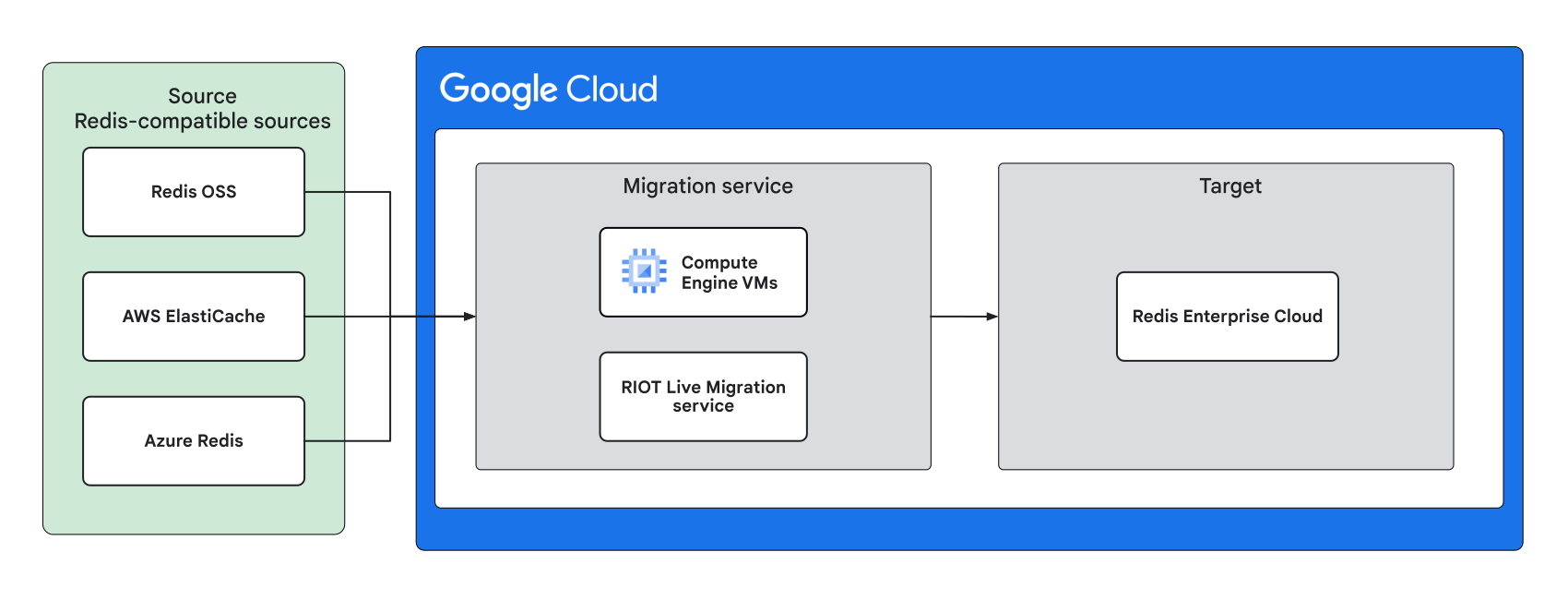
In the diagram, RIOT Live Migration Service is used to migrate Redis-compatible
sources to Redis Enterprise Cloud.
The architecture contains the following components:
- **Source**: Redis-compatible sources like Redis OSS, AWS ElastiCache, and Azure Redis.
- **Target**: Redis Enterprise Cloud running in a Redis managed VPC.
- **Migration Service** : RIOT running on [Compute Engine virtual machines (VMs)](https://docs.cloud.google.com/compute).
## Products used
This reference architecture uses the following Google Cloud and
third-party products:
- [Compute Engine](https://cloud.google.com/compute): A secure and customizable compute service that lets you create and run VMs on Google's infrastructure.
- [RIOT Live Migration](https://developer.redis.com/riot/): A free, command-line utility that's designed to help you get data in and out of Redis.
- [Redis Enterprise Cloud on Google Cloud](https://console.cloud.google.com/marketplace/product/redis-marketplace-isaas/redis-enterprise-cloud-flexible-plan): A fully managed, enterprise-grade Redis solution that can help support your mission-critical applications.
## Use case
Redis offers sub-millisecond latency, advanced data structure support,
resiliency, and open source portability. However, it can be difficult to scale
self-managed Redis-compatible sources to meet the demanding workloads of
enterprises while maintaining ultra-low latencies. When you outgrow your
self-managed Redis cluster deployment, you might struggle to scale. It's
time-consuming and error-prone to architect a highly available solution and
manage replication. Scaling also presents logistic challenges and costs
associated with hardware management, patching, and upgrades.
To help you solve these challenges, Redis Enterprise Cloud fully integrates
with Google Cloud to provide a real time database service to run, scale,
and manage Redis. Redis Enterprise Cloud offers an open source core, full
enterprise grade functionality and security, market-leading performance,
[scalability](https://redis.com/redis-enterprise/technology/linear-scaling-redis-enterprise/),
and
[availability](https://redis.com/redis-enterprise/technology/highly-available-redis/)
that business-critical applications require. Redis Enterprise Cloud offers
sub-millisecond latency, single digit seconds failover, and five-nines uptime.
## Design alternatives
RIOT provides a flexible migration solution in and out of Redis. The
following sections present potential design alternatives for this architecture.
The alternatives either incur downtime or require that the target database is in
a Redis
[Flexible (or Annual) subscription](https://docs.redis.com/latest/rc/subscriptions/create-flexible-subscription/).
### RDB snapshots
[Redis Database (RDB) snapshot](https://redis.io/docs/management/persistence/)
is one way that you can persist your data in Redis on durable storage. It
performs point-in-time snapshots of your dataset, and it's commonly used to back
up data in Redis. As an alternative to using RIOT to perform your migration, you
can use RDB snapshot to migrate from a Redis OSS instance to Redis Enterprise.
However, unlike RIOT, RDB snapshot doesn't support live migration and will incur
downtime.
### Sync using Active-Passive
You can use the Redis OSS `ReplicaOf` command to configure a Redis instance as
a replica of another Redis server. The command is used in the context of Redis
replication, which lets you create copies of your data in different Redis
instances. Like RIOT, the `ReplicaOf` command supports live migration and incurs
zero downtime, but the command is built in to Redis OSS, so you don't need to
install any tools.
Redis Enterprise's
[Active-Passive](https://redis.com/redis-enterprise/technology/active-passive-geo-distribution/)Geo
Distribution uses the `ReplicaOf` command to scale a Redis deployment in
multiple geographical locations. If the target database is in a
[Flexible (or Annual) subscription](https://docs.redis.com/latest/rc/subscriptions/create-flexible-subscription/),
the command can also be used to migrate data from a Redis database to Redis
Enterprise Cloud subscriptions. However, the command doesn't work if the target
is a Fixed subscription, and it doesn't work between flexible subscriptions from
different Redis Cloud accounts.
## Design considerations
The following guidelines can help you to develop an architecture that meets
your organization's requirements for reliability, cost, and performance.
### Reliability
The migration in this architecture is a one-way migration from a source Redis
OSS instance to a target Redis Enterprise instance. After you complete a cutover
from the source Redis OSS to the target Redis Enterprise cluster, the source
isn't kept up to date with changes to the target cluster. Therefore, if you
implement this architecture in a production environment, you can't switch your
applications to up-to-date source instances in a fallback.
### Cost optimization
When you migrate Redis OSS instances to Redis Enterprise, we recommend that you
group your target Redis Enterprise databases into
[subscriptions](https://docs.redis.com/latest/rc/subscriptions/create-flexible-subscription/)
so that you can lower the total cost of ownership by using multi-tenancy. For
example, if you have a group of databases that are designed for development and
testing, you can group them in a single subscription because they share common
characteristics and network requirements. Similarly, a group of databases for
production can be hosted on a different subscription.
### Performance
RIOT Live Migration supports near-zero downtime. During the migration from the
source Redis OSS instance, your applications can still access the source Redis
OSS instance without any impact. During the migration process, after the initial
load of data from Redis OSS, RIOT Live Migration continues to migrate changes
from Rediss OSS as they occur.
After the initial key-value pairs data is migrated, you perform the cutover
from the source Redis OSS instance to the target Redis Enterprise instance. As
part of the cutover process, you suspend client writes to the source Redis OSS
instance. You then wait for RIOT to process any remaining changes from the
source Redis OSS instance to the target Redis Enterprise instance.
## Deployment
To deploy this architecture, see
[Deploy RIOT Live Migration to migrate from Redis Open Source to Redis Enterprise Cloud](https://docs.cloud.google.com/architecture/partners/riot-live-migration-redis-enterprise-cloud/deployment).
## What's Next?
- Read [Google Cloud data migration content](https://docs.cloud.google.com/solutions/database-migration).
- For more in-depth documentation and best practices, review [RIOT documentation](https://developer.redis.com/riot/).
- For more reference architectures, diagrams, and best practices, explore the [Cloud Architecture Center](https://docs.cloud.google.com/architecture).
## Contributors
Authors:
- [Saurabh Kumar](https://www.linkedin.com/in/saurabh-kumar-48556a19) \| ISV Partner Engineer
- [Gilbert Lau](https://www.linkedin.com/in/gilau) \| Principal Cloud Architect, Redis
Other contributors:
- [Chris Mague](https://www.linkedin.com/in/chris-mague-35b1624) \| Customer Engineer, Data Management
- [Gabe Weiss](https://www.linkedin.com/in/weissgabriel) \| Developer Advocacy Manager
- [Marco Ferrari](https://www.linkedin.com/in/ferrarimark) \| Cloud Solutions Architect