This document is part of a design guide series for Cross-Cloud Network.
This part explores the network security layer.
The series consists of the following parts:
- [Cross-Cloud Network for distributed applications](https://docs.cloud.google.com/architecture/ccn-distributed-apps-design)
- [Network segmentation and connectivity for distributed applications in Cross-Cloud Network](https://docs.cloud.google.com/architecture/ccn-distributed-apps-design/connectivity)
- [Service networking for distributed applications in Cross-Cloud Network](https://docs.cloud.google.com/architecture/ccn-distributed-apps-design/service-networking)
- Network security for distributed applications in Cross-Cloud Network (this document)
## Security surfaces
When you design the security layer for the Cross-Cloud Network,
you must consider the following security surfaces:
- Workload security
- Domain perimeter security
Workload security controls the communication between workloads across and within
the Virtual Private Cloud (VPC). Workload security uses security enforcement
points that are close to the workloads in the architecture. Whenever possible,
Cross-Cloud Network provides workload security by using
Cloud Next Generation Firewall from Google Cloud.
Perimeter security is required at all network boundaries. Because the perimeter
usually interconnects networks that are managed by different organizations,
tighter security controls are often required. You must ensure that the following
communications across networks are secured:
- Communications across VPCs
- Communications across hybrid connections to other cloud providers or on-premises data centers
- Communications to the internet
The ability to insert third-party network virtual appliances (NVAs) within the
Google Cloud environment is critical to address the requirements for
perimeter security across hybrid connections.
## Workload security in cloud
Use [firewall policies](https://docs.cloud.google.com/firewall/docs/firewall-policies-overview) in
Google Cloud to secure workloads and provide stateful firewall
capabilities that are horizontally scalable and applied to each VM instance. The
distributed nature of Google Cloud firewalls helps you implement security
policies for network micro-segmentation without negatively impacting the
performance of your workloads.
Use [Hierarchical firewall policies](https://docs.cloud.google.com/firewall/docs/firewall-policies) to
improve the manageability and enforce posture compliance for your firewall
policies. Hierarchical firewall policies let you create and enforce a consistent
firewall policy across your organization. You can assign
Hierarchical firewall policies to the organization or to individual folders.
In addition, Hierarchical firewall policies rules can delegate evaluation to
lower-level policies (global or regional network firewall policies) with a
`goto_next` action.
Lower-level rules cannot override a rule from a higher level in the resource
hierarchy. This rule structure lets organization-wide administrators manage
mandatory firewall rules in one place. Common use cases for
Hierarchical firewall policies include organization or multi-project bastion host
access, permitting centralized probing or health check systems, and enforcing a
virtual network boundary across an organization or group of projects. For
additional examples of using
Hierarchical firewall policies, see [Hierarchical firewall policies
examples](https://docs.cloud.google.com/firewall/docs/firewall-policies-examples).
Use [global](https://docs.cloud.google.com/firewall/docs/network-firewall-policies) and [regional network
firewall policies](https://docs.cloud.google.com/firewall/docs/regional-firewall-policies) to define rules on
an individual VPC-network basis, either for all regions of the
network (global) or a single
[region](https://docs.cloud.google.com/docs/geography-and-regions#regions_and_zones) (regional).
To achieve more granular controls enforced at the virtual machine (VM) level, we
recommend that you use Identity and Access Management (IAM)-governed
[tags](https://docs.cloud.google.com/resource-manager/docs/tags/tags-overview) at the organization or project
level. IAM-governed tags allows applying firewall rules based on the identity of
workload host, as opposed to host IP address, and works across
VPC Network Peering. Firewall rules deployed using tags can provide intra-subnet
micro-segmentation with policy coverage that automatically applies to workloads
wherever they are deployed, independent of the network architecture.
In addition to stateful inspection capabilities and tag support,
[Cloud Next Generation Firewall](https://docs.cloud.google.com/firewall) also supports Threat Intelligence, FQDN, and
geolocation filtering.
We recommend that you [migrate from VPC firewall rules to
firewall policies](https://cloud.google.com/blog/products/identity-security/best-practices-for-migrating-to-network-firewall-policies).
To assist with the migration, use the [migration
tool](https://services.google.com/fh/files/misc/vpc_firewall_rules_network_firewall_policy_migration_guide.pdf),
which creates a global network firewall policy and converts existing
VPC firewall rules into the new policy.
## Perimeter security in cloud
In a multicloud network environment, perimeter security is usually
implemented at each network. For example, the on-premises network has its own
set of perimeter firewalls, while each cloud network implements separate
perimeter firewalls.
Because the Cross-Cloud Network is designed to be the hub for all
communications, you can unify and centralize the perimeter security controls and
deploy a single set of perimeter firewalls in your
Cross-Cloud Network. To deliver a built-in perimeter security
stack of choice, Cross-Cloud Network provides flexible
options for you to insert NVAs.
In the designs shown in the diagrams, you can deploy third-party NVAs in the transit
VPC in the hub project.
NVAs can be deployed over a single network interface (single-NIC mode) or over
multiple network interfaces across multiple VPCs (multi-NIC
mode). For Cross-Cloud Network, we recommend a single-NIC
deployment for NVAs, because this option lets you do the following:
- Insert the NVAs with policy-based routes.
- Avoid creating rigid topologies.
- Deploy in a variety of inter-VPC topologies.
- Enable autoscaling for the NVAs.
- Scale to many VPCs over time, without required changes to the NVA interface deployment.
If your design requires multi-NIC, recommendations are detailed in [Multi-NIC
NVA perimeter security](https://docs.cloud.google.com/architecture/ccn-distributed-apps-design/security#multi-nic-nva-perimeter-security).
To accomplish the traffic steering that's required for NVA deployment, this
guide recommends the selective enforcement of policy-based and static routes
in the VPC routing tables. The policy-based routes are more
flexible than standard routes because policy-based routes match on both source and destination
information. These policy-based routes are also enforced only at specific places
in the cloud network topology. This granularity allows the definition of very
specific traffic steering behavior for very specific connectivity flows.
In addition, this design enables the resiliency mechanisms required by the
NVAs. NVAs are fronted by an [internal TCP/UDP load
balancer](https://docs.cloud.google.com/load-balancing/docs/internal) to enable NVA redundancy, autoscaling
for elastic capacity, and flow symmetry to support stateful bi-directional
traffic processing.
### Single-NIC NVA perimeter security
In the design described in [Inter-VPC connectivity for
centralized
services](https://docs.cloud.google.com/architecture/ccn-distributed-apps-design/connectivity#inter-vpc-connectivity-for-centralized-services),
the transit VPC acts as a hub to the spoke VPCs
that are connected by using VPC Network Peering and HA VPN.
The transit VPC also enables connectivity between the external
networks and the spoke VPCs.
For the purpose of single-NIC NVA insertion, this design combines the following
two patterns:
- Insert NVAs at a VPC Network Peering hub with external hybrid connections
- Insert NVAs at an HA VPN VPC hub with external hybrid connections
The following diagram shows NVAs inserted at the hubs for
VPC Network Peering and HA VPN:

The preceding diagram illustrates a combined pattern:
- A transit VPC that hosts the Cloud Interconnect VLAN attachments that provide hybrid or multicloud connectivity. This VPC also contains the single-NIC NVAs that monitor the hybrid connections.
- Application VPCs connected to the transit VPC over VPC Network Peering.
- A central services VPC connected to the transit VPC over HA VPN.
In this design the spokes that are connected using HA VPN
use the transit VPC to communicate with the spokes that are
connected by VPC Network Peering. The communication is steered through the
third-party NVA firewalls by using the following combination of passthrough load
balancing, static routes, and policy-based routes:
1. To steer HA VPN traffic to the internal load balancer, apply untagged policy-based routes to the Transit VPC. On these policy-based routes, use source and destination CIDR ranges that provide for traffic symmetry.
2. To steer incoming traffic to the internal passthrough Network Load Balancer, apply policy-based routes to the Cloud Interconnect connections in the Transit VPC. These are regional routes.
3. So that traffic leaving the NVA doesn't get routed directly back to the NVA, make all NVA interfaces the target of a [skip-policy-based
route](https://docs.cloud.google.com/vpc/docs/policy-based-routes#skip-option) to skip other policy-based routes. Traffic then follows the VPC routing table once it has been processed by the NVAs.
4. To steer traffic to the NVA internal load balancers in the Transit VPC, apply static routes to the application VPCs. These can be scoped regionally using network tags.
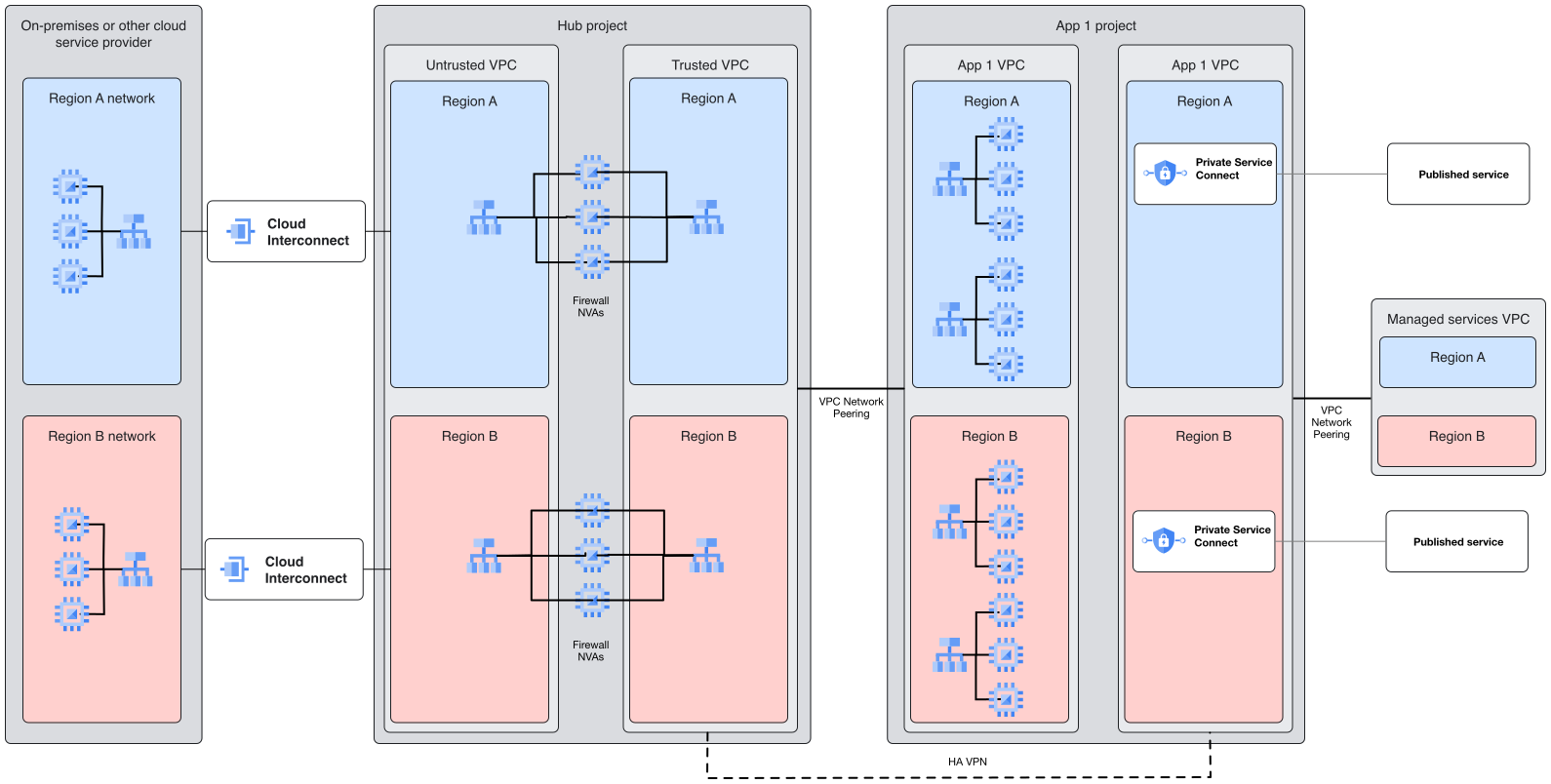
### Multi-NIC NVA perimeter security
In multi-NIC mode, the topology is more static because NVAs bridge the
connectivity between the different VPCs in which the different
network interfaces reside.
When interface-based zones are required in a firewall, the following multi-NIC
design enables the required external connectivity. This design assigns different
firewall interfaces to the external networks. The external networks are referred
to by security practitioners as untrusted networks and the internal networks are
known as trusted networks. For the multi-NIC NVA deployment, this design is implemented
using trusted and untrusted VPCs.
For internal communications, firewalling can be enforced using a single-NIC
insertion model that corresponds to a CIDR-based zone model.
In this design, you insert NVAs by configuring the following:
1. To steer HA VPN traffic to the internal load balancer, apply untagged policy-based routes to the trusted VPC. On these policy-based routes, use source and destination CIDR ranges that provide for traffic symmetry.
2. To steer incoming traffic to the internal passthrough Network Load Balancer, apply policy-based routes to the Cloud Interconnect connections in the untrusted VPC. These are regional routes.
3. So that traffic leaving the NVA doesn't get routed directly back to the NVA, make all NVA interfaces the target of a [skip-policy-based
route](https://docs.cloud.google.com/vpc/docs/policy-based-routes#skip-option) to skip other policy-based routes. Traffic then follows the VPC routing table once it has been processed by the NVAs.
4. To steer traffic to the NVA internal load balancers in the trusted VPC, apply static routes to the application VPCs. These can be scoped regionally using network tags.
The following diagram shows multi-NIC NVAs inserted between the untrusted and
trusted VPC networks in the hub project:
## What's next
- Learn more about the Google Cloud products used in this design guide:
- [VPC networks](https://docs.cloud.google.com/vpc/docs/vpc)
- [VPC Network Peering](https://docs.cloud.google.com/vpc/docs/vpc-peering)
- [Cloud Interconnect](https://docs.cloud.google.com/network-connectivity/docs/interconnect/concepts/overview)
- [HA VPN](https://docs.cloud.google.com/network-connectivity/docs/vpn/concepts/overview)
- For more reference architectures, design guides, and best practices, explore the [Cloud Architecture Center](https://docs.cloud.google.com/architecture).
## Contributors
Authors:
- [Victor Moreno](https://www.linkedin.com/in/vimoreno) \| Product Manager, Cloud Networking
- [Ghaleb Al-habian](https://www.linkedin.com/in/galhabian) \| Network Specialist
- Deepak Michael \| Networking Specialist Customer Engineer
- [Osvaldo Costa](https://www.linkedin.com/in/osvaldocostajr) \| Networking Specialist Customer Engineer
- [Jonathan Almaleh](https://www.linkedin.com/in/jonathan-almaleh) \| Staff Technical Solutions Consultant
Other contributors:
- [Zach Seils](https://www.linkedin.com/in/zachseils) \| Networking Specialist
- [Christopher Abraham](https://www.linkedin.com/in/christopher-abraham-33291b) \| Networking Specialist Customer Engineer
- [Emanuele Mazza](https://www.linkedin.com/in/emanuelemazza) \| Networking Product Specialist
- [Aurélien Legrand](https://www.linkedin.com/in/aurelienlegrand) \| Strategic Cloud Engineer
- [Eric Yu](https://www.linkedin.com/in/eyu719) \| Networking Specialist Customer Engineer
- [Kumar Dhanagopal](https://www.linkedin.com/in/kumardhanagopal) \| Cross-Product Solution Developer
- [Mark Schlagenhauf](https://www.linkedin.com/in/mark-schlagenhauf-63b98) \| Technical Writer, Networking
- [Marwan Al Shawi](https://www.linkedin.com/in/marwanalshawi) \| Partner Customer Engineer
- [Ammett Williams](https://www.linkedin.com/in/ammett) \| Developer Relations Engineer