This page provides an overview of pull queues in the App Engine
standard environment.
In *push* queues tasks are delivered to a worker service
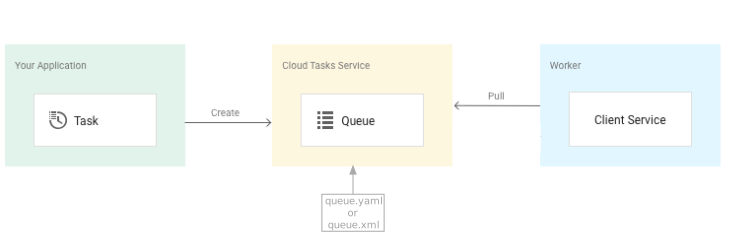
based on the queue's configuration. In *pull* queues the worker service must *ask*
the queue for tasks. The queue responds by allowing that worker unique access
to process the task for a specified period of time, which is called a *lease*.
Using pull queues, you can also group related tasks using tags and then configure your
worker to pull multiple tasks with a certain tag all at once. This process is
called *batching*.
If a worker cannot process a task before its lease expires, it can either renew the
lease or let it expire, at which point another worker can acquire it. Once the
work associated with a task is complete, the worker must delete it.
Using pull queues requires your code to handle some functions that are automated
in push queues:
Scaling your workers
: Your code needs to scale the number of workers based on
processing volume. If your code does not handle scaling, you risk
wasting computing resources if there are no tasks to process; you also risk
latency if you have too many tasks to process.
Deleting the tasks
: Your code also needs to explicitly delete tasks after processing.
In push queues, App Engine deletes the tasks for you. If your worker does
not delete pull queue tasks after processing, another worker will re-process
the task. This wastes computing resources and risks errors if tasks are
not [idempotent](https://wikipedia.org/wiki/Idempotence).
Pull queues in the App Engine standard environment are created by setting a property in a
configuration file called `
queue.yaml
`.
## Pull queue workflow
Workers that process tasks from pull queues must be defined within a service that runs
in the App Engine standard environment.
The workflow is as follows:
1. You [create a pull queue](https://docs.cloud.google.com/appengine/docs/standard/services/taskqueue/pull/creating-pull-queues), using `
queue.yaml
`.
2. You [create tasks](https://docs.cloud.google.com/appengine/docs/standard/services/taskqueue/pull/creating-tasks) and add them to the queue.
3. The worker you have created [leases the task](https://docs.cloud.google.com/appengine/docs/standard/services/taskqueue/pull/leasing-pull-tasks), using \[TaskQueue\](/appengine/docs/standard/go/reference/services/bundled/latest/taskqueue).
4. App Engine sends task data to the worker in the lease response.
5. The worker processes the task. If the task fails to execute before the lease expires, the worker can modify the lease duration. If the lease expires, the task will be available to be leased to another worker.
6. After a task is processed successfully, the [worker deletes it](https://docs.cloud.google.com/appengine/docs/standard/services/taskqueue/pull/leasing-pull-tasks#deleting-tasks).
## What's next
- Learn how to [create pull queues](https://docs.cloud.google.com/appengine/docs/standard/services/taskqueue/pull/creating-pull-queues).