- [Latest](https://docs.cloud.google.com/anthos/clusters/docs/bare-metal/latest/how-to/egress-nat)
- [Version 1.16](https://docs.cloud.google.com/anthos/clusters/docs/bare-metal/1.16/how-to/egress-nat.md.txt)
- [Earlier versions (unsupported)](https://docs.cloud.google.com/anthos/clusters/docs/bare-metal/1.13/getting-support.md.txt#version-support)
This document describes how to set up an egress NAT gateway for
Google Distributed Cloud. This gateway provides persistent, deterministic SNAT IP
addresses for the egress traffic from your clusters. When you run workloads that
have egress user traffic (outside of your clusters), your customers want to
identify this traffic by using a few deterministic IP addresses. This allows
your customers to establish IP-based security measures, like allowlisting
policies.
The egress NAT gateway is enabled using two custom resources. For a given
namespace, the `NetworkGatewayGroup` custom resource specifies floating IP
addresses that can be configured on the network interface of a Node that is
chosen to act as a gateway. The `EgressNatPolicy` custom resource lets you
specify egress routing policies to control the traffic on the egress gateway.
If you do not set up an egress NAT gateway, or if egress traffic does not meet
traffic selection rules, egress traffic from a given Pod to a destination
outside your cluster is masqueraded to the IP address of the node where the Pod
is running. In this scenario, there is no guarantee that all egress traffic from
a particular Pod will have the same source IP address or will masquerade to the
same Node IP address.
Egress NAT gateway is an advanced networking offering built on top of
[Dataplane V2](https://docs.cloud.google.com/anthos/clusters/docs/dataplane-v2).
> [!NOTE]
> **Note:** If your nodes run Ubuntu 18.04, the Linux kernel must be version 5.4 or higher. For more information, see [Configure Ubuntu](https://docs.cloud.google.com/anthos/clusters/docs/bare-metal/1.13/installing/configure-os/ubuntu.md.txt).
## How the egress NAT gateway works
The [egress traffic selection logic](https://docs.cloud.google.com/anthos/clusters/docs/bare-metal/1.13/how-to/egress-nat.md.txt#set_traffic_selection_rules) is based
on a namespace selector, a Pod selector, and a set of destination IP address
ranges in CIDR block notation. To illustrate how the egress NAT gateway works,
let's consider the flow of a packet from a Pod to an external consumer and the
corresponding response. Assume the Node subnet has IP addresses in the
192.168.1.0/24 CIDR block.
The following diagram shows the network architecture for egress traffic through
a gateway node.
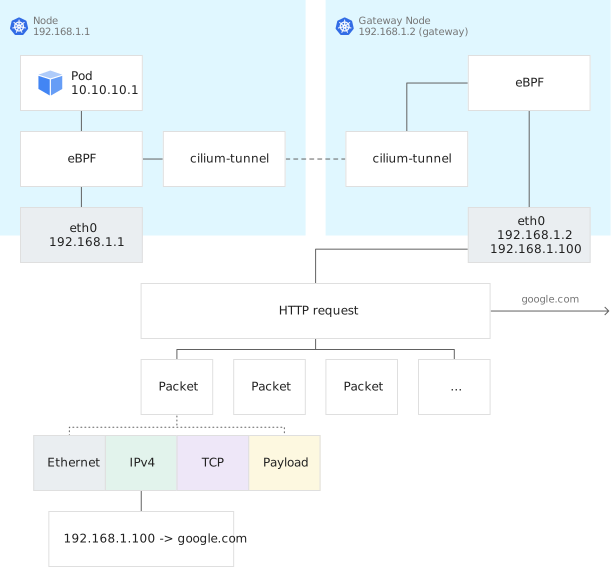
The packet flow through the egress NAT gateway might look like this:
1. Egress traffic is generated from a Pod with IP address `10.10.10.1` in a
Node with IP address `192.168.1.1`.
The traffic's destination address is an endpoint outside of the cluster.
2. If the traffic matches an egress rule, the eBPF program routes the egress
traffic to the gateway Node, instead of directly masquerading with the Node
IP address.
3. The gateway Node receives the egress traffic.
4. The gateway node masquerades the originating traffic's source IP address,
`10.10.10.1`, with the source egress IP address, `192.168.1.100` specified
in the `EgressNATPolicy` custom resource.
5. Return traffic comes back to the gateway Node with destination as
`192.168.1.100`.
6. The gateway node matches the conntrack of the return traffic with that of
the original egress traffic and rewrites the destination IP address as
`10.10.10.1`.
7. `10.10.10.1` is treated as in-cluster traffic, routed to the original Node,
and delivered back to the original Pod.
## Configure floating IP addresses for Node traffic
The Network Gateway Group custom resource is a bundled component of
Google Distributed Cloud. The resource manages a list of one
or more floating IP addresses to use for egress traffic from Nodes in your
cluster. Participating Nodes are determined by the specified namespace. The
Network Gateway Group makes a floating IP address available at all times on a
best-effort basis. If a Node using a floating IP address goes down, the
advanced network operator moves the assigned IP address to the next available Node.
All workload egress traffic using that IP address will move as well.
Include the Network Gateway Group details (annotation and spec) in the cluster
configuration file when you create a new 1.13.10 cluster.
### Create the `NetworkGatewayGroup` custom resource
You enable the Network Gateway Group by setting the
`spec.clusterNetwork.advancedNetworking` field
to `true` in the cluster configuration file when you create a cluster as
shown in the following example:
```yaml
apiVersion: baremetal.cluster.gke.io/v1
kind: Cluster
metadata:
name: cluster1
namespace: cluster-cluster1
spec:
clusterNetwork:
...
advancedNetworking: true
...
```
When you create the `NetworkGatewayGroup` custom resource, set its namespace to
the cluster namespace and specify a list of floating IP addresses, as shown in
the following example:
> [!NOTE]
> **Note:** The cluster operator creates a copy of the `NetworkGatewayGroup` custom resource in the `kube-system` namespace. This copy of the `NetworkGatewayGroup` custom resource in the `kube-system` namespace is responsible for defining the floating IP addresses that are used by the advanced networking operator.
```yaml
kind: NetworkGatewayGroup
apiVersion: networking.gke.io/v1
metadata:
namespace: cluster-cluster1
name: default
spec:
floatingIPs:
- 192.168.1.100
- 192.168.1.101
- 192.168.1.102
```
> [!NOTE]
> **Note:** The egress NAT gateway doesn't support a high availability (HA) configuration. If the network gateway node handling the floating IP address goes down or has connectivity issues, egress traffic may be interrupted for short periods of time. The advanced networking operator automatically reassigns the floating IP address to a new node to restore egress traffic.
The advanced networking operator assigns the floating IPs to Nodes based on the
following criteria:
- Node subnet: the floating IP address has to match Node's subnet.
- Node role (control plane, worker): worker Nodes take precedence over control plane Nodes when assigning floating IP addresses.
- Whether a Node has a floating IP address: the operator prioritizes assignments to Nodes that do not have a floating IP assigned already.
The address/node mapping can be found in the `status` section when you get the
`NetworkGatewayGroup` object. Note that the `NetworkGatewayGroup` object is in
the `kube-system` namespace. If a gateway node is down, the advanced network
operator assigns the floating IP addresses to the next available Node.
### Verify the gateway configuration
After you have applied your gateway configuration changes, you can use `kubectl`
to check the status of the gateway and retrieve the floating IP addresses
specified for the gateway.
1. Use the following command to check the status of the `NetworkGatewayGroup`
and see how the floating IP addresses are allocated:
```bash
kubectl -n kube-system get networkgatewaygroups.networking.gke.io default -o yaml
```
The response for a cluster with two nodes, `worker1` and `worker2` might
look like this:
```yaml
kind: NetworkGatewayGroup
apiVersion: networking.gke.io/v1
metadata:
namespace: kube-system
name: default
spec:
floatingIPs:
- 192.168.1.100
- 192.168.1.101
- 192.168.1.102
status:
nodes:
worker1: Up
worker2: Up // Or Down
floatingIPs:
192.168.1.100: worker1
192.168.1.101: worker2
192.168.1.102: worker1
```
## Set traffic selection rules
The `EgressNATPolicy` custom resource specifies traffic selection rules and
assigns a deterministic IP address for egress traffic that leaves the cluster.
When specifying the CR, `egress` (with at least one rule), `destinationCIDRs`,
and `egressSourceIP` are all required.
Use `kubectl apply` to create the `EgressNATPolicy` custom resource. The
following sections provide details and examples for defining the specification.
### Specify egress routing rules
The `EgressNatPolicy` custom resource lets you specify the following rules for
egress traffic:
- You must specify one or more egress traffic selection rules in the `egress`
section.
- Each rule consists of a `podSelector` and a `namespaceSelector`.
- Selection is based on a namespace label, `namespaceSelector.matchLabels.user`, and a Pod label, `podSelector.matchLabels.role`.
- If a Pod matches any of the rules (matching uses an OR relationship), it is selected for egress traffic.
- Specify allowed destination addresses in the `destinationCIDRs` section.
- `destinationCIDRs` takes a list of CIDR blocks.
- If outgoing traffic from a Pod has a destination IP address that falls within the range of any of the specified CIDR blocks, it is selected for egress traffic.
In the following example, egress traffic from a Pod is permitted when the
following criteria are met:
- Pod is labeled with `role: frontend`.
- Pod is in a namespace labeled as either `user: alice` or `user: paul`.
- Pod is communicating to IP addresses in the `8.8.8.0/24` CIDR block.
```yaml
kind: EgressNATPolicy
apiVersion: networking.gke.io/v1
metadata:
name: egress
spec:
sources:
- namespaceSelector:
matchLabels:
user: alice
podSelector:
matchLabels:
role: frontend
- namespaceSelector:
matchLabels:
user: paul
podSelector:
matchLabels:
role: frontend
action: SNAT
destinations:
- cidr: 8.8.8.0/24
gatewayRef:
name: default
namespace: kube-system
```
For more information about using labels, refer to
[Labels and Selectors](https://kubernetes.io/docs/concepts/overview/working-with-objects/labels/)
in the Kubernetes documentation.
### Get a source IP address for egress traffic
The `EgressNATPolicy` custom resource (policy) uses the `gatewayRef.name` and
`gatewayRef.namespace` values to find a `NetworkGatewayGroup` object (gateway).
The policy uses one of the gateway's floating IP addresses as the source IP
address for egress traffic. If there are multiple floating IP addresses in the
matching gateway, the policy uses the first IP address in the `floatingIPs` list
and ignores any other IP addresses. For the
[example gateway](https://docs.cloud.google.com/anthos/clusters/docs/bare-metal/1.13/how-to/egress-nat.md.txt#create_the_networkgatewaygroup_custom_resource), the first
address in the `floatingIPs` list is `192.168.1.100`. Having invalid fields or
values in the `gatewayRef` section will result in failure to apply the policy
object.
### Multiple egress policies and multiple gateway objects
As described in the previous section, each `egressNATPolicy` object (policy)
uses the first IP address in the `floatingIPs` list from the gateway object that
matches `gatewayRef.name` and `gatewayRef.namespace`. You can create multiple
policies and, if you intend to use different IP addresses, you need to create
multiple `NetworkGatewayGroup` objects and refer to them respectively.
A limitation of `NetworkGatewayGroup` in Google Distributed Cloud for this release
is that only the "default" object is reconciled for floating IP allocations.
Additionally, only the default gateway reports the allocation status for all the
floating IP addresses.
The default gateway is defined by the `NetworkGatewayGroup` with the `default`
name in the `kube-system` namespace. Therefore, when creating multiple gateway
objects, you need to make sure that the IP addresses in the non-default gateways
are also specified in the default gateway manifest. Otherwise they will not be
allocated as floating IPs, and therefore can't be used by the
`EgressNATPolicies` object.
To set up multiple egress policies and multiple gateway objects:
1. Verify the default gateway object (`name: default`) with `kubectl` to get
the allocation status of the floating IP addresses:
```bash
kubectl -n kube-system get NetworkGatewayGroup.networking.gke.io default -o yaml
```
The response for a cluster with two nodes, `worker1` and `worker2` might
look like this:
```yaml
kind: NetworkGatewayGroup
apiVersion: networking.gke.io/v1
metadata:
namespace: kube-system
name: default
spec:
floatingIPs:
- 192.168.1.100
- 192.168.1.101
- 192.168.1.102
status:
...
floatingIPs:
192.168.1.100: worker1
192.168.1.101: worker2
192.168.1.102: worker1
```
2. After verifying the status of the default gateway, create additional gateway
objects in the `kube-system` namespace to "track" each floating IP.
Note that these new gateway objects don't report allocation status, which is
in the `default` gateway.
```yaml
kind: NetworkGatewayGroup
apiVersion: networking.gke.io/v1
metadata:
namespace: kube-system
name: gateway1
spec:
floatingIPs:
- 192.168.1.100
---
kind: NetworkGatewayGroup
apiVersion: networking.gke.io/v1
metadata:
namespace: kube-system
name: gateway2
spec:
floatingIPs:
- 192.168.1.101
---
kind: NetworkGatewayGroup
apiVersion: networking.gke.io/v1
metadata:
namespace: kube-system
name: gateway3
spec:
floatingIPs:
- 192.168.1.102
```
3. Create multiple policies that refer to the "secondary" gateway objects, such
as `gateway1` created in the preceding step:
```yaml
kind: EgressNATPolicy
apiVersion: networking.gke.io/v1
metadata:
name: egress1
spec:
...
gatewayRef:
name: gateway1
namespace: kube-system
---
kind: EgressNATPolicy
apiVersion: networking.gke.io/v1
metadata:
name: egress2
spec:
...
gatewayRef:
name: gateway2
namespace: kube-system
---
kind: EgressNATPolicy
apiVersion: networking.gke.io/v1
metadata:
name: egress3
spec:
...
gatewayRef:
name: gateway3
namespace: kube-system
```
### Egress traffic selection rules and network policies
The egress NAT gateway is compatible with network policy APIs. Network policies
are assessed first and take precedence over the traffic selection rules of the
egress NAT gateway. For example, if the egress traffic triggers a network policy
resulting in the packet being dropped, egress gateway rules won't check the
packet. Only when the network policy allows the packet to egress will the egress
traffic selection rules be evaluated to decide how the traffic is handled,
either using the egress NAT gateway or directly masquerading with the IP address
of the Node where the Pod is running.
## Limitations
The current limitations for the egress NAT gateway include:
- The egress NAT gateway is only enabled for IPv4 mode.
- Egress IP addresses have to be in the same Layer 2 domain with Node IP
addresses.
- Upgrades are not supported for clusters that have been configured to use the
[Preview](https://cloud.google.com/products/#product-launch-stages) of the egress NAT gateway. For
Google Distributed Cloud release 1.13.0 and later, the egress
NAT gateway is in Preview on Ubuntu 18.04 only. There is no charge to use
this feature while it's in Preview.